
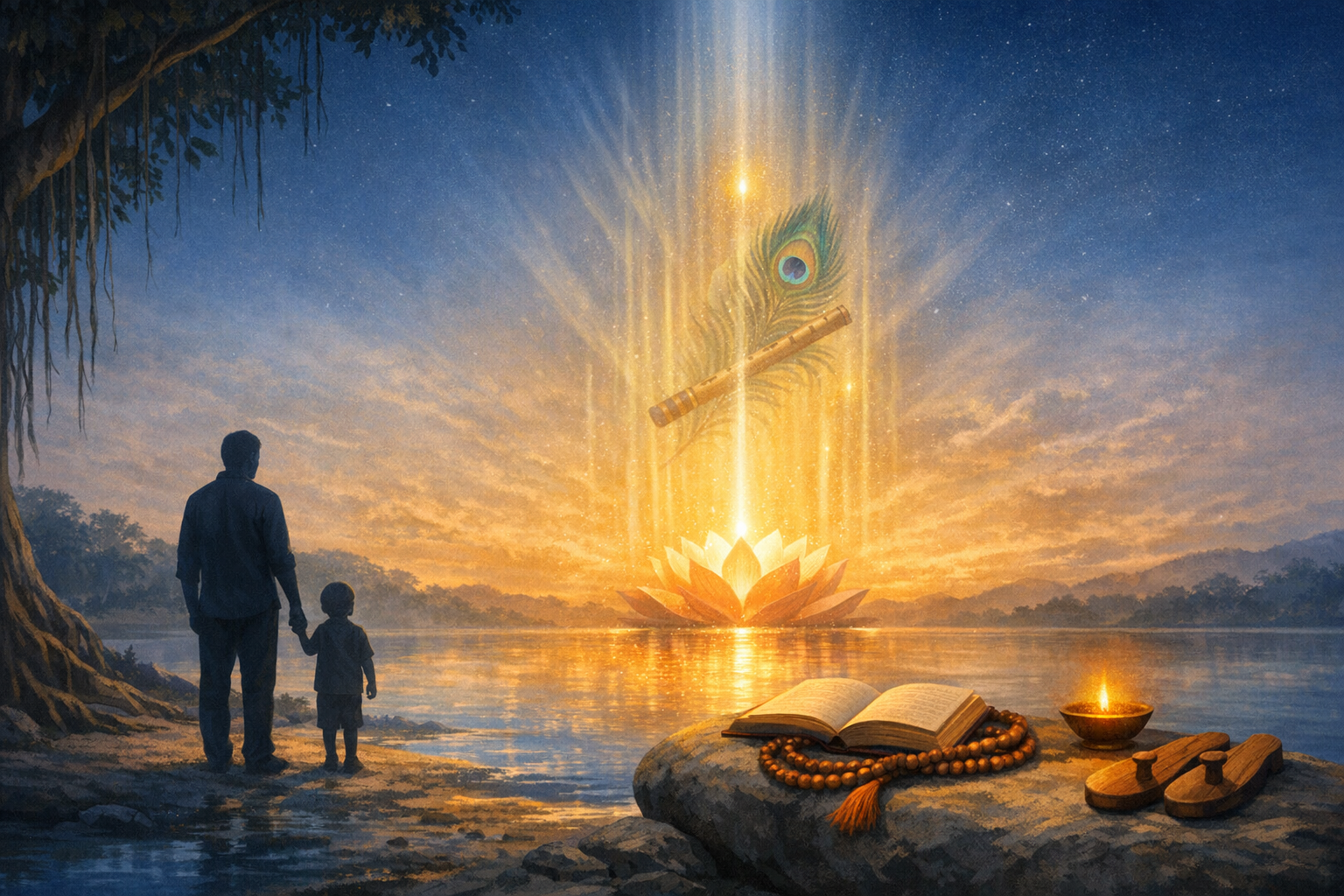
The question of who the “real father” is becomes visceral when confronting death. In the presence of a departed parent, people commonly say, “My father is no more; he has gone away,” even while the physical body remains. This everyday intuition underpins a classical Hare Krishna (ISKCON) analysis: what distinguishes the living from the dead is the conscious self (ātmā), and the “person” we love is not reducible to the body. This insight leads to a broader theological inquiry into the origin and kinship of the self.
In the Hare Krishna Movement’s philosophical framework, the real father is ultimately the Supreme Source from whom all living beings arise. Biological parents generate and care for the body, yet the self that animates, wills, understands, and lovesthe ātmātraces its origin to the Divine. The Bhagavad Gita expresses this succinctly: “sarva-yoniṣu kaunteya mūrtayaḥ sambhavanti yāḥ | tāsāṁ brahma mahad yonir ahaṁ bīja-pradaḥ pitā ||” (Bhagavad Gita 14.4). Material nature functions as the universal womb (mahān brahman), and Kṛṣṇa is described as the seed-giving father (bīja-pradaḥ pitā). Thus, parenthood operates on two planes: proximate, bodily parenthood and ultimate, spiritual parenthood.
This metaphysical distinction is reinforced across the Gita’s ontology of the self. The text affirms that the conscious self continuously outlives bodily changes: “dehino ’smin yathā dehe kaumāraṁ yauvanaṁ jarā | tathā dehāntara-prāptir dhīras tatra na muhyati ||” (2.13). The self “na jāyate mriyate vā kadācin” (2.20)is never born nor dies as bodies do. The identity one mourns or loves is, therefore, not a configuration of matter but a conscious entity whose presence distinguishes a living body from a corpse.
The Gita further clarifies the relation between the Supreme and the individual self: “mamaivāmśo jīva-loke jīva-bhūtaḥ sanātanaḥ” (15.7)the living being is an eternal part of Kṛṣṇa. This amśa-relation explains why the father metaphor is not merely poetic but ontological: the jīva belongs to, and derives being from, the Supreme Father. What leaves at death, prompting the lament “he has gone,” is the ātmākin to the Divinedeparting a particular bodily configuration.
This vision helps explain why bereavement language intuitively treats the person as distinct from the body: the person has departed, even though the physical frame is present. For ISKCON, this is practical evidence of dehātma-buddhi’s errorthe mistaken identification of the self with the body. Recognizing the ātmā as the true subject of experience reframes death as a transition rather than annihilation.
Within the same tradition, the notion of fatherhood extends to spiritual guidance. Vedic culture speaks of two births: the biological birth from parents and the second, transformative birth through knowledge and practice, conferred by a bona fide spiritual mentor (guru). Śrīmad-Bhāgavatam advises: “tasmād guruṁ prapadyeta jijñāsuḥ śreya uttamam | śābde pare ca niṣṇātaṁ brahmaṇy upaśamāśrayam ||” (SB 11.3.21). In the Gaudiya Vaiṣṇava (Hare Krishna) lineage, the guru is often called a spiritual father because this relationship reawakens the lost filial bond with the Supreme Father, Kṛṣṇa. These two fatherhoodsbodily and spiritualdo not compete; they complete one another.
Importantly, affirming the Supreme as the real father deepens, rather than diminishes, duties toward one’s immediate parents. Gratitude, care, and respect (including the honoring of pitṛ-riṇa, the debt to parents) are intrinsic to a dharmic life. Recognizing the Divine source ennobles family relations by grounding them in reverence, responsibility, and compassionqualities central to the Hindu way of life.
Common objections are addressed within this philosophical matrix. If God is the father, why is there suffering? The Gita frames suffering in terms of karmic causality and the jīva’s exercised independence within material nature. A loving father sets laws for the good of the children; transgressions yield consequences aimed at correction, not cruelty. Far from promoting fatalism, this view urges moral agency, purification, and reorientation toward bhakti-yogaconscious service to the Divine that culminates in liberation from “janma-mṛtyu-jarā-vyādhi” (birth, death, old age, and disease; cf. Gita 13.9).
Practically, ISKCON emphasizes disciplines that restore awareness of the Supreme Father: attentive study of Bhagavad Gita (śravaṇa), remembrance and the chanting of the mahā-mantra (kīrtana), service (seva), and ethical living congruent with sattva (clarity and harmony). These practices gradually dissolve dehātma-buddhi and awaken one’s native relationship with Kṛṣṇa, the seed-giving father.
This inquiry also resonates across dharmic traditions that share a commitment to liberation and ethical discipline. Buddhism, while articulating anattā (non-self) rather than a permanent ātman, directs seekers to discern the impermanence of bodily and mental aggregates, reducing attachment and suffering in a way that constructively parallels the Gita’s call to transcend bodily identification. Jainism’s path to kevala-jñāna highlights ahiṁsā, self-restraint, and karmic purification, converging with the broader dharmic mandate to refine consciousness and end bondage. Sikhism venerates Ik Onkarthe singular, all-pervading Realityoften addressed in devotional language as both “Pita” (father) and “Mata” (mother), reinforcing a familial intimacy with the Divine that complements the Gita’s paternal metaphor.
These perspectives differ in metaphysical detail yet align in practical purpose: to transform conduct, expand compassion, and transcend the narrow identification with transient forms. Seen in this light, the Supreme Father theme becomes a bridge for unity among Hinduism, Buddhism, Jainism, and Sikhismdistinct paths serving a shared horizon of freedom from suffering, integrity in action, and reverence for all life (Vasudhaiva Kutumbakam).
In summary, the Hare Krishna account distinguishes bodily from spiritual parenthood to answer a profoundly human question: who is the real father? The biological father gifts a body and nurtures worldly life; the guru fathers spiritual awakening; the Supreme, Kṛṣṇa, eternally fathers the jīva and sustains existence. Grounded in Bhagavad Gita’s ontology”ahaṁ bīja-pradaḥ pitā”this view renders grief more intelligible, deepens familial gratitude, and orients practice toward liberation. Recognizing the Supreme Father does not negate earthly ties; it sanctifies them, while encouraging a dharmic, compassionate, and unifying vision across all spiritual traditions of the Indian civilization.
Inspired by this post on Hindu Pad.
