
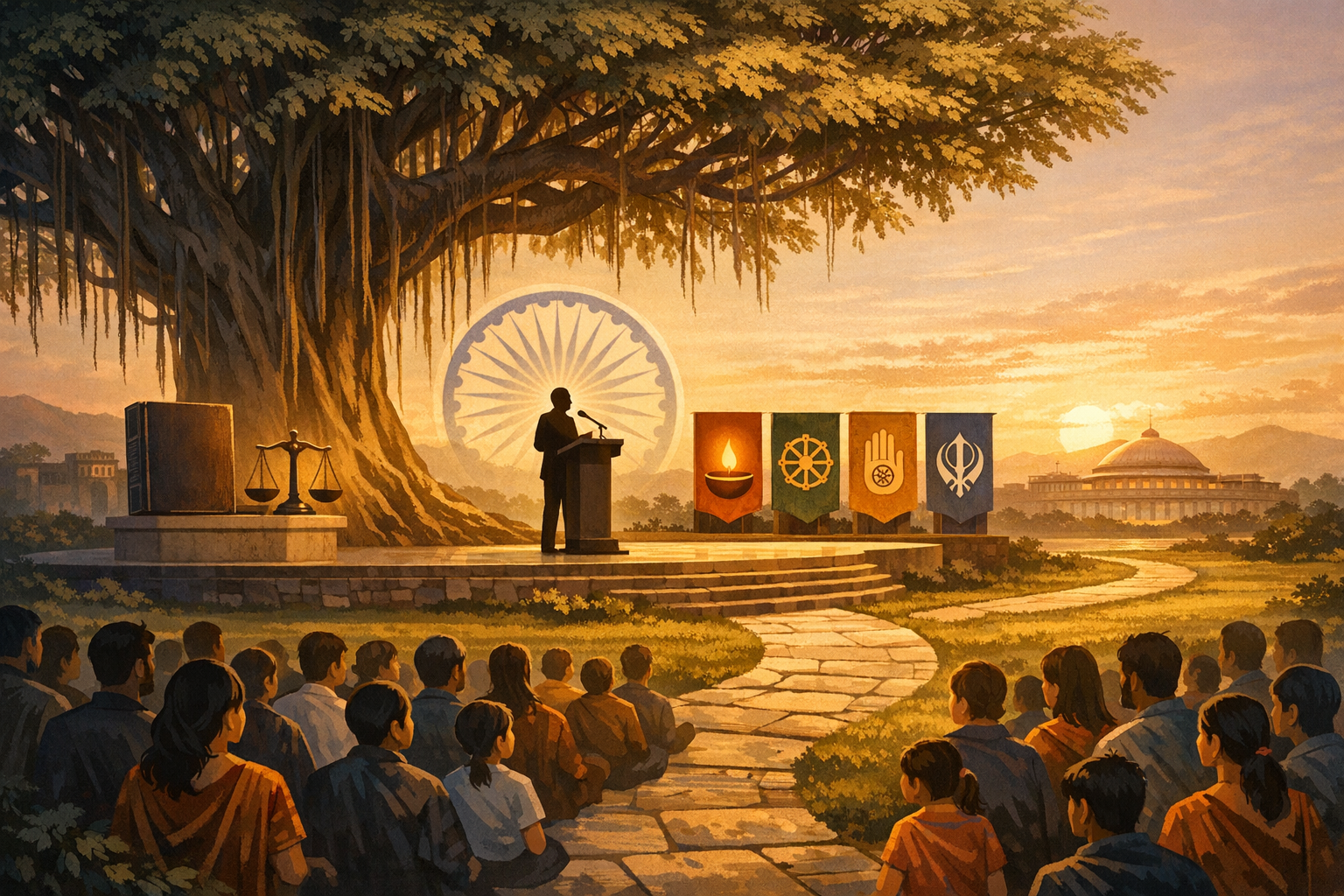
At a Virat Hindu Sammelan near Pune, civil society leader Sunil Ghanwat urged collective, democratic efforts to seek a constitutional declaration of Bharat as a Hindu Rashtra. The appeal, delivered in a public forum dedicated to dharmic discourse, has renewed debate about whether and how India’s civilizational ethos can be more explicitly reflected in its constitutional architecture while preserving fundamental rights and pluralist commitments.
The central proposition is often misunderstood. In public discourse, Hindu Rashtra is alternately interpreted as a theocratic state or as a cultural-civilizational framework grounded in dharmaan ethical order that historically accommodates multiple paths, including Hindu, Buddhist, Jain, and Sikh traditions. Understanding this semantic spectrum is essential to evaluate constitutional options with clarity and to uphold unity among dharmic traditions without compromising the equal citizenship of all communities.
As a civic platform, the Virat Hindu Sammelan near Pune functions as a space where concerns about cultural continuity, heritage protection, and social cohesion converge. For many attendees, the call resonated less as a demand for confessional rule and more as a plea to recover dharmic valuessewa, ahimsa, karuna, and satyain public life. These values, shared across Hindu, Buddhist, Jain, and Sikh lineages, can motivate policy that is ethically robust and socially unifying.
Any discussion of a constitutional Hindu Rashtra must begin with India’s constitutional bedrock. The Preamble describes India as a “sovereign, socialist, secular, democratic republic,” with the terms “secular” and “socialist” added by the 42nd Constitutional Amendment in 1976. Fundamental Rights (Part III), particularly Articles 14–15 (equality and non-discrimination), 19 (freedoms), and 25–28 (freedom of religion and denominational rights), form non-negotiable guardrails. The Supreme Court’s basic structure doctrine, articulated in Kesavananda Bharati (1973) and elaborated in subsequent rulings, affirms that certain core featuressecularism among themare beyond abrogation.
The formal pathway for any constitutional change is Article 368, which requires special majorities in both Houses of Parliament and, for specified subjects, ratification by at least half of state legislatures. Although the Preamble has been amended before, the basic structure doctrine operates as a constitutional ceiling: an amendment that effectively nullifies secularism, equality, or the rule of law would be impermissible. Consequently, proposals that imagine a denominational state model are legally untenable; proposals that articulate a civilizational ethic consistent with constitutional pluralism warrant closer analysis.
Within these constraints, several constitutionally plausible approaches merit scholarly attention. One is interpretive rather than textual: affirming through jurisprudence and policy that dharmaunderstood as ethical duties, compassion, and public virtuecan guide governance without conferring legal primacy on any single faith. Another is preambular or statutory recognition of India’s civilizational heritage that explicitly protects the rights of all religious communities, ensuring that cultural affirmation does not become religious establishment.
The Directive Principles of State Policy (Part IV) provide a substantive bridge between dharmic ethics and policy. Commitments to social justice, education, public health, environmental stewardship (Articles 39, 41–47, 48A), and compassionate treatment of living beings echo longstanding dharmic concerns about collective welfare and reverence for nature. Aligning governance with these principles strengthens a dharma-informed public philosophy without infringing Fundamental Rights.
Articles 25–28 deserve particular emphasis. They enshrine the freedom of conscience, free profession, practice, and propagation of religion; protect denominational rights to manage religious affairs; prohibit state-imposed religious instruction in state institutions; and affirm equality across faiths. Any model of Hindu Rashtra compatible with the Indian Constitution must leave these guarantees intact and, ideally, fortify themensuring that “unity in religious diversity” is not a slogan but a lived constitutional reality.
Comparative constitutional experience offers cautionary lessons. States that have privileged a single tradition often struggle to balance symbolic recognition with equitable rights and inclusive governance. India’s history and constitutional design suggest a distinct path: a civilizational state that upholds sarva dharma sambhavaequal regard for all pathsthrough strong, enforceable guarantees for minorities and robust judicial oversight.
Policy design can advance ethical statecraft without denominational preference. Priority areas include: transparent and equitable management of religious endowments across communities; conservation of sacred and historical sites with nondiscriminatory funding frameworks; curriculum reforms that teach India’s plural dharmic heritage alongside constitutional values; and community-led initiatives that reduce social friction through shared service (sewa), interfaith dialogue, and local problem-solving.
Institutional safeguards matter as much as aspirations. A rights-forward approachanchored in Articles 14–15 and 25–28should be paired with stronger remedies for discrimination, targeted violence, and hate speech, regardless of the group affected. Parliamentary committees and law reform bodies could evaluate whether existing statutes and administrative practices treat all traditions symmetrically, recommend corrections where asymmetries exist, and ensure that reforms enhance rather than erode constitutional equality.
For many families and youth listening near Pune, the call for Hindu Rashtra evoked a desire for ethical governance more than a confessional identity. The experiences of social fragmentation, cultural erosion, and the anxieties of rapid change often translate into a search for stable values. When framed as dharma-guided public reasonrather than a narrow majoritarian politicsthe idea becomes a vocabulary for civic virtue: truthfulness in public life, restraint in discourse, compassion for the vulnerable, and responsibility toward future generations.
Sunil Ghanwat’s emphasis on “collective efforts” spotlights democratic method. In India’s federal system, constitutional change requires not only legal feasibility but also social legitimacy, inter-state consensus, and careful calibration to the basic structure doctrine. Civic education, public consultations, and rigorous legal scholarship are prerequisites to any proposal that aspires to durability and justice.
Scholarly objections must be addressed head-on. Critics fear that “Hindu Rashtra” might marginalize minorities or chill dissent. The antidote is structural: explicit constitutional and statutory guarantees for non-discrimination; uniform and fair protection for cultural and religious rights; strong judicial remedies for violations; and independent oversight bodies with real powers. In other words, the wider the ambit of rights and the stronger their enforcement, the less space there is for exclusionary practice.
Moreover, unity among dharmic traditionsHinduism, Buddhism, Jainism, and Sikhismshould be explicit, not assumed. Public policy can honor shared ethical lineages while recognizing each tradition’s unique teachings, monastic practices, institutions, and community needs. When a dharma-informed statecraft is articulated as a compact for mutual flourishing, it reinforces national integration and civic trust.
Pragmatically, progress is likely to be incremental. Steps might include: a green paper mapping constitutional boundaries and options; state-level pilots for heritage conservation and ethical civics education; judicial and administrative reviews to ensure parity in endowment governance; and local charters for interfaith cooperation that measure concrete outcomesreduced communal tensions, better neighborhood mediation, and joint service projects.
Measurable success builds legitimacy. Metrics could track improvements in equal access to public services for all communities; the condition and accessibility of shared heritage sites; the incidence and resolution time of communal disputes; and the quality of civic education on constitutional duties and rights. Transparent reporting fosters accountability and public confidence.
In this light, the Virat Hindu Sammelan near Pune functions as both a mirror and a megaphonereflecting lived concerns about cultural continuity and amplifying calls for ethical governance. When channeled through constitutional pathways, such mobilization can contribute to a mature national conversation about how to better align statecraft with India’s civilizational strengths while protecting every citizen’s dignity.
The legal and moral horizon remains clear: any move toward articulating Bharat’s dharmic ethos in constitutional language must strengthen, not weaken, the guarantees that define the republic. A rights-anchored, dharma-informed public philosophyrooted in compassion, duty, and truthcan deepen national integration. If the call from Pune propels that conversation forward, it will have served a constructive purpose: advancing a vision of Hindu Rashtra that is inseparable from constitutionalism, pluralism, and the unity of India’s dharmic family.
Inspired by this post on Hindu Jagruti Samiti.
