
-
HG Kratu Prabhu’s Enduring Legacy: Devotional Leadership, Dharmic Unity, and Bhakti-Yoga

This tribute reflects on the life and legacy of His Grace Kratu Prabhu, a beloved Vaisnava, stalwart ISKCON leader, and dedicated disciple of Srila A. C. Bhaktivedanta Swami Prabhupada. It explains how his devotion to bhakti-yogarooted in śravaṇa, kīrtana, and sevaoffers a rigorous, compassionate pathway for modern practitioners. Readers will gain an academic yet accessible…
-
ISKCON Prison Ministry: Compassionate Bhakti-Yoga and Dharma-Based Healing Behind Bars

Prisons concentrate isolation, fear, and scarcity, yet they also present a profound opportunity for humane, evidence-aligned rehabilitation. The ISKCON Prison Ministry integrates Bhakti-Yoga practicesmantra meditation, kirtan, reflective study, and breathworkwith universal dharmic ethics to reduce stress, improve conduct, and foster dignity. Voluntary and non-coercive by design, the program welcomes participants of Hindu, Buddhist, Jain, and…
-
When Life Finds Balance: The Dharmic Science of Harmony in Hinduism, Buddhism, Jainism, Sikhism

This in-depth exploration shows how balancedefined as dynamic homeostasis guided by dharmaproduces well-being, clarity, and social harmony across Hinduism, Buddhism, Jainism, and Sikhism. Drawing on puruṣārtha, guna theory, Panchakosha, the Bhagavad Gita, Patanjali’s Yoga, and Ayurveda, it explains why moderation is a rigorous discipline, not a compromise. Parallels with the Buddhist Middle Path, Jain Anekantavada,…
-
Burning for Power or Truth? Asuric vs Human Tapas in Hindu Dharma, with Scriptural Insights

Tapas in Hindu Dharma is a double-edged heat: it can fuel domination or refine awareness. Drawing on the Bhagavad Gita, Yoga Sutra, Upanishads, and Purāṇic narratives, this analysis distinguishes asuric austerity (ambition, harm, display) from sattvic human tapas (truth, non-harm, integration). It maps these paths onto the guṇa framework, shows how intention and method determine…
-
Become the Witness: Rise Above Matter and Realize Consciousness with Timeless Dharmic Wisdom

This long-form, academically grounded essay explains why over-identification with matter creates volatility and how dharmic traditions teach a precise, trainable alternative: witness-consciousness (sakṣi-bhāva). Drawing from Sāṅkhya–Yoga, Advaita Vedānta, the Bhagavad Gītā, Buddhist mindfulness, Jain anekāntavāda, and Sikh practices such as Naam Simran, it shows the deep unity of Hinduism, Buddhism, Jainism, and Sikhism. Readers gain…
-
Nearly 300,000 Spiritual Literatures Shared: WSN March 2026 Sankirtan Highlights and Temple Rankings

The March 2026 World Sankirtan Newsletter records a near-300,000 distribution of spiritual literatures worldwide, highlighting the enduring outreach of ISKCON temples. Mumbai-Juhu, Vrindavan, and Silicon Valley (ISV) lead the large category, while London-Soho, Bengaluru-South, and San Diego top the medium segment. Small centers such as Atlanta Krishna Life, Surat, and Swansea, and maha-small leaders Baltimore,…
-
Why Detachment Unlocks Maximum Happiness: A Dharmic, Evidence-Based Guide from Gita to Yoga

Detachment in Hinduism is a trainable skill that unlocks maximum happiness by freeing the mind from compulsion. Grounded in the Isha Upanishad and Bhagavad Gita, it reframes enjoyment as arising from renunciation and the release of outcome-clinging. Yoga Sutra’s abhyasa-vairagya method makes this pragmatic, while allied teachings in Buddhism, Jainism, and Sikhism affirm the shared…
-
Timeless Dharmic Science of Joy: A Sacred Blueprint for Lasting Happiness Within

Hindu philosophy holds that lasting happiness is not acquired but uncovered by cultivating a living relationship with the Divine within. Drawing on the Upanishads, Bhagavad Gita, and Yoga philosophy, this exploration distinguishes fleeting pleasure from the abiding fullness called ānanda. The analysis integrates Advaita, Viśiṣṭādvaita, and Dvaita perspectives, while honoring dharmic unity with Buddhism, Jainism,…
-
Overcoming Egoism and Lethargy in Kali-Yuga: Bhagavad Gita Guidance for Humility and Seva

Egoism and lethargy are two subtle forces that derail spiritual progress in Kali-Yuga. Drawing on Bhagavad Gita teachings and parallel insights from Buddhism, Jainism, and Sikhism, this article explains how false ego (ahankara) reframes practice around I and mine, while tamasic inertia fosters delay and neglect. It then offers an integrated, practical program that combines…
-
Unshakable Safety in Saranagati: Why Krishna’s Protection Surpasses All Obstacles

This essay examines the Vaishnava doctrine of saranagatisurrender to Krishnaas an intellectually rigorous and ethically disciplined path to unshakable protection. Anchored in Bhagavad Gita assurances (4.11, 9.22, 18.66) and illuminated by case studies such as Gajendra, Draupadi, Prahlada, and Govardhana, it shows how divine shelter operates within, not outside, responsible agency. The six limbs of…
-
Mastering Bhakti Yoga: How Loving Krishna Transforms Stress into Unshakable Peace

Bhakti yoga reframes modern stress by transforming daily work into purposeful seva anchored in Bhagavad Gita teachings. Regulated living in eating, sleep, speech, and activity cultivates sattva and aligns with contemporary research on circadian health. Japa and kirtan enhance attentional control and calm the nervous system, supporting wiser choices in work and relationships. A practical…
-
Jnana–Karma Samuccaya Vada in Vedanta: Unifying Knowledge and Action on the Path to Moksha

Jnana Karma Samuccaya Vada explains how knowledge (jnana) and action (karma) can operate together on the path to moksha without diluting the distinctive role of each. Drawing on the Bhagavad Gita, Brahma Sutra, and classical Vedanta, it clarifies why Advaita treats karma as preparatory, how Bhedabheda argues for a robust synthesis, and how Vishishtadvaita and…
-
From Reactivity to Freedom: Dharmic Wisdom on Maya, Attention, and Inner Mastery

Modern life conditions people to react incessantly; dharmic traditions explain this reflex as a misperception of appearancesMaya in Hinduism, avidyā and dependent origination in Buddhism, mithyātva and kashāyas in Jainism, and the pull of Maya away from Naam in Sikhism. Rather than denying experience, these lineages teach methods to recalibrate perception and lengthen the gap…
-
Is Any Indian Scripture Equal to the Quran or Bible? A Definitive Guide to Dharmic Canons

Is any Indian scripture equal to the Quran or Bible? In the dharmic world, authority is polycentric rather than centralized in one book. Hinduism distinguishes Sruti (the Vedas, as apex authority) from Smriti (Itihāsa, Purāṇa, Dharmashastras, and Agamas), with the Bhagavad Gita serving as the most accessible synthesis for general readers. Sikhism centers on a…
-
Is the Universe an Illusion? A Rigorous Vedic Guide to Maya, Vedanta, and Liberation

Vedic scriptures call the world an “illusion” not to deny its existence, but to redefine reality with precision. Advaita Vedanta distinguishes absolute reality (Brahman) from empirical, dependent reality (the cosmos as mithyā) and explains how māyā and avidyā generate the appearance of multiplicity. Upanishadic teachings, supported by the Bhagavad Gita, show why the world is…
-
Work Without Motive: Sri Sri Ravi Shankar on Intuition, Nishkama Karma, and Flow States

This article unpacks the axiom “the best work comes out when you work without any motive” through Sri Sri Ravi Shankar’s description of intuition as a “sudden sprout of thought,” the Bhagavad Gita’s Nishkama Karma, and insights from modern psychology. It distinguishes non-attachment from aimlessness, showing how purpose can remain strong while egoic craving for…
-
How One Gita Bridged Burma and New York: A Transformative Journey of Language, Bhakti, and Unity

A real-world case links New York City’s street book distribution to community transformation in Burma (Myanmar) through a single Bhagavad Gita. Burmese doctors, initially drawn by the Dasavatar image that includes Lord Buddha, passed the text to a Hindu colleague aligned with Sankharacharya, and it eventually reached a college student seeking to learn English. Through…
-
Azhwars and Ramanujacharya: Timeless Bhakti, Living Vedanta, and the Path of Grace
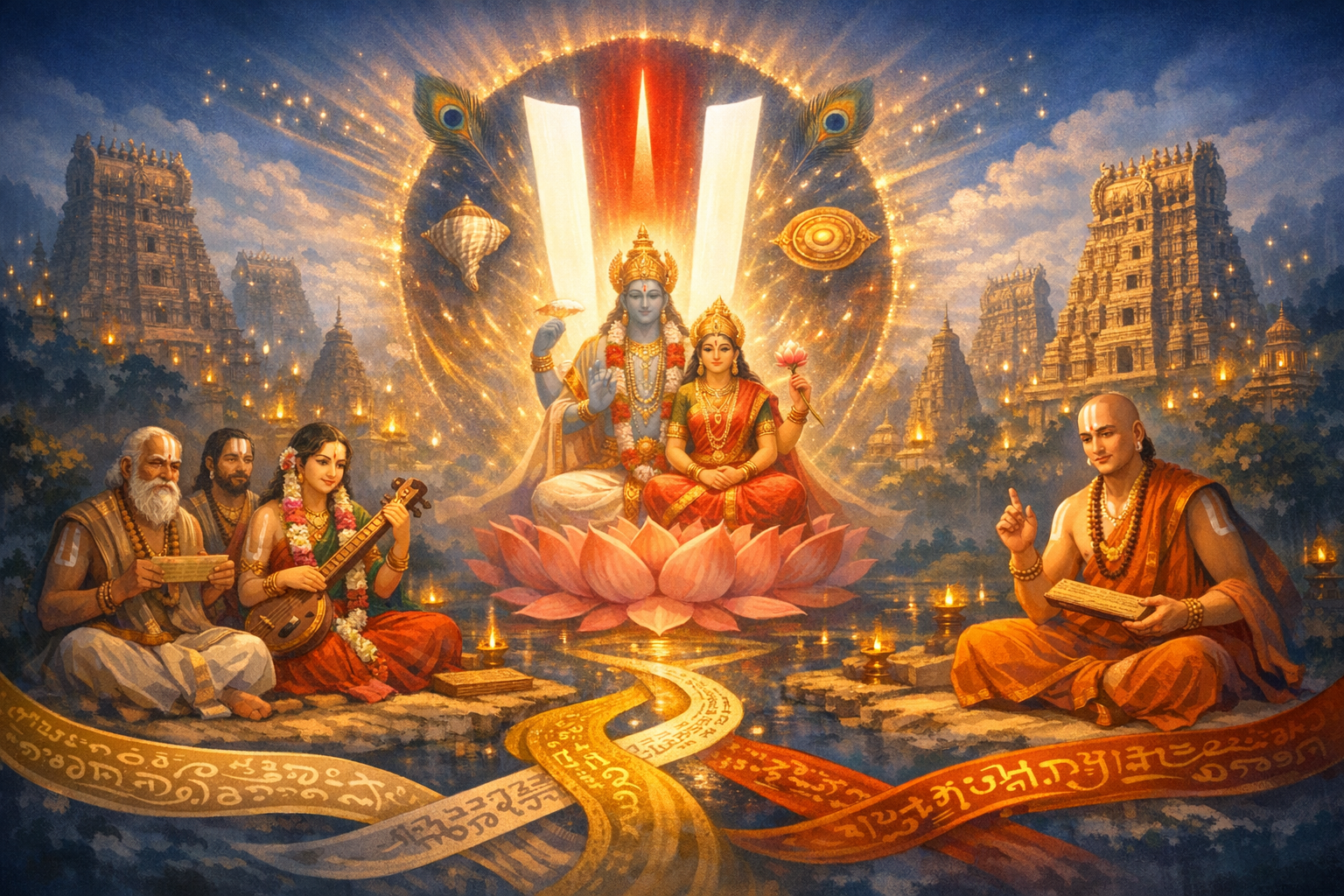
This comparative study explores how the Azhwars and Ramanujacharya jointly shape the Sri Vaishnava tradition by uniting ecstatic devotion with systematic Vedanta. It situates the Azhwars’ Divya Prabandham and Ramanuja’s Viśiṣṭādvaita within one inclusive, Ubhaya Vedanta canon that values both Tamil and Sanskrit revelation. Readers gain a clear map of similaritiesVishnu’s supremacy, Sri’s compassion, bhakti…
-
Escaping Samsara: Why Dharmic Traditions Urge Freedom from Rebirth and End Suffering

Life’s recurrent conflicts and losses point to a systemic feature of samsara rather than isolated misfortune. Dharmic traditionsHinduism, Buddhism, Jainism, and Sikhismconverge on a technical diagnosis: ignorance and craving generate karma that sustains rebirth, while disciplined ethics, meditation, wisdom, and service interrupt the cycle. This essay synthesizes Upanishadic, Yogic, Vedantic, Buddhist (paṭicca-samuppāda), Jain (samvara–nirjara and…
-
Prakamya Siddhi Explained: How Focused Intention Turns Inner Vision into Tangible Reality

Prakamya Siddhi in Hinduism is the disciplined capacity by which a clear, dharma-aligned inner intention becomes an outward result. Distinguished from mere desire or casual “manifestation,” it integrates ethical foundations, focused attention (samyama), embodied action, and surrender. Classical yoga, Vedanta, tantra, and bhakti converge to present prakamya as a lawful and ethical maturation of will,…