-
Jnana Yoga and Karma Yoga: A Definitive, Heart-Centered Guide to Wisdom, Duty, and Moksha

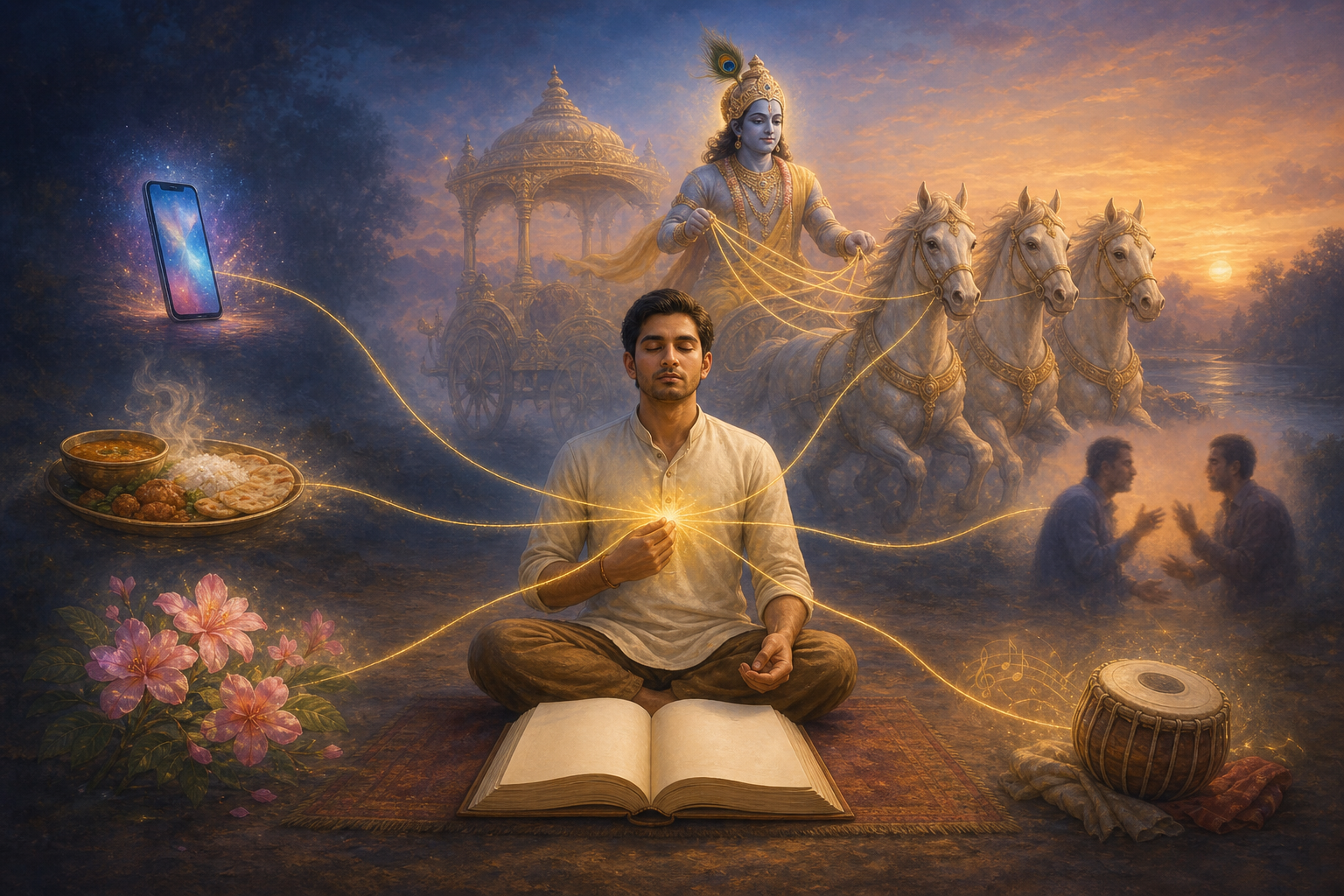
Jnana Yoga and Karma Yoga are complementary yogic disciplines in Hinduism that unite liberating insight with selfless duty. Grounded in the Upanishads and the Bhagavad Gita, Jnana clarifies reality through viveka and nididhyasana, while Karma refines character via nishkama karma, isvararpana buddhi, and prasada buddhi. The two paths interpenetrate: ethical action purifies the mind for…
-
Why Hegemony Persists: A Dharmic Guide to Ethical Power, Rajadharma, and Pluralism

Hegemony persists because human societies require coordination, security, and shared meaning; the Dharmic lens accepts this reality and seeks to civilize it. Drawing on Rajadharma, the Bhagavad Gita, and Kautilya’s Arthasastra, the article reframes power as service bounded by Dharma and directed toward Lokasangraha (social cohesion). It integrates Buddhist Dhamma-raja ideals, Jain Anekantavada and Ahimsa,…
-
Beyond Blood and Bond: Krishna’s Universal Love as Cosmic Law, Bhakti, and Living Dharma

This long-form exploration argues that in Krishna’s life and theology, love functions as a cosmic law that reorganizes reality beyond birth, contract, or duty. Drawing on the Bhagavad Gita, the Bhagavata Purana, the Narada Bhakti Sutra, and bhakti-rasa theory, it explains how diverse devotional relationshipsvatsalya, sakhya, dasya, and madhuryareveal universal paths to the Divine. The…
-
Before the Beginning: The Profound Self-Awakening of Consciousness in Sanatana Dharma

Sanatana Dharma advances a radical thesis: creation is Consciousness awakening to itself, not an external fabrication. Drawing on the Upanishads, Bhagavad Gita, Advaita Vedanta, Kashmir Shaivism, and Samkhya–Yoga, this essay explains how the Absolute (Brahman) both pervades and transcends the cosmos. It maps macrocosm to experience via the Mandukya’s four states and clarifies cyclical timesṛṣṭi,…
-
Atma vs Anatma Explained: A Scholar’s Guide to Inner Freedom, Clarity, and Lasting Peace

This in-depth guide clarifies the difference between Atma (the changeless witness) and Anatma (all that arises and passes), showing why this insight is the key to inner freedom and lasting peace. Drawing on the Upanishads, the Bhagavad Gita, Vedanta, Sāṅkhya-Yoga, and Nyāya-Vaiśeṣika, it presents multiple, mutually reinforcing methods: Pancha Kosha Viveka, Drg-Drsya Viveka, Avasthātraya analysis,…
-
Srila Prabhupada Lilamrita Unveiled by HG Daivi Shakti Mataji: Bhakti, History, and Shared Dharma

Delivered at ISKCON Vrindavan on 07.06.2026, this analytical exploration of Srila Prabhupada Lilamrita by HG Daivi Shakti Mataji shows how devotional biography can serve as rigorous history, spiritual pedagogy, and leadership guide. Readers learn to distinguish inspiration from idealization and to apply guru–sadhu–shastra principles in daily practice. The piece demonstrates how bhakti-yoga integrates chanting, study,…
-
Prahlada’s Hearth: SB 5.18.9 on Narasimha, Fearless Compassion, and Dharmic Dialogue

This analysis distills insights shared by Rukmini D.D acbsp at the ISKCON Communications Retreat into a clear, actionable reading of Srimad-Bhagavatam (SB) 5.18.9. It situates the verse within the Bhagavata Purana, explains its philological and theological contours, and clarifies how Narasimha’s omnipresent shelter grounds real-world fearlessness. The discussion translates the verse into a communications ethic…
-
Krishna’s Science of Non-Attachment: A Dharmic Path to Fearlessness, Peace, and Joy

This essay presents a clear, research-aligned account of non-attachment as taught by Bhagavan Sri Krishna in the Bhagavad Gita and shows why it reliably produces fearlessness, peace, and happiness. It defines attachment and non-attachment with precision and details Krishna’s core methodsniṣkāma karma, equanimity, and the cultivation of sthita-prajña. It demonstrates convergence across Dharmic traditions, connecting…
-
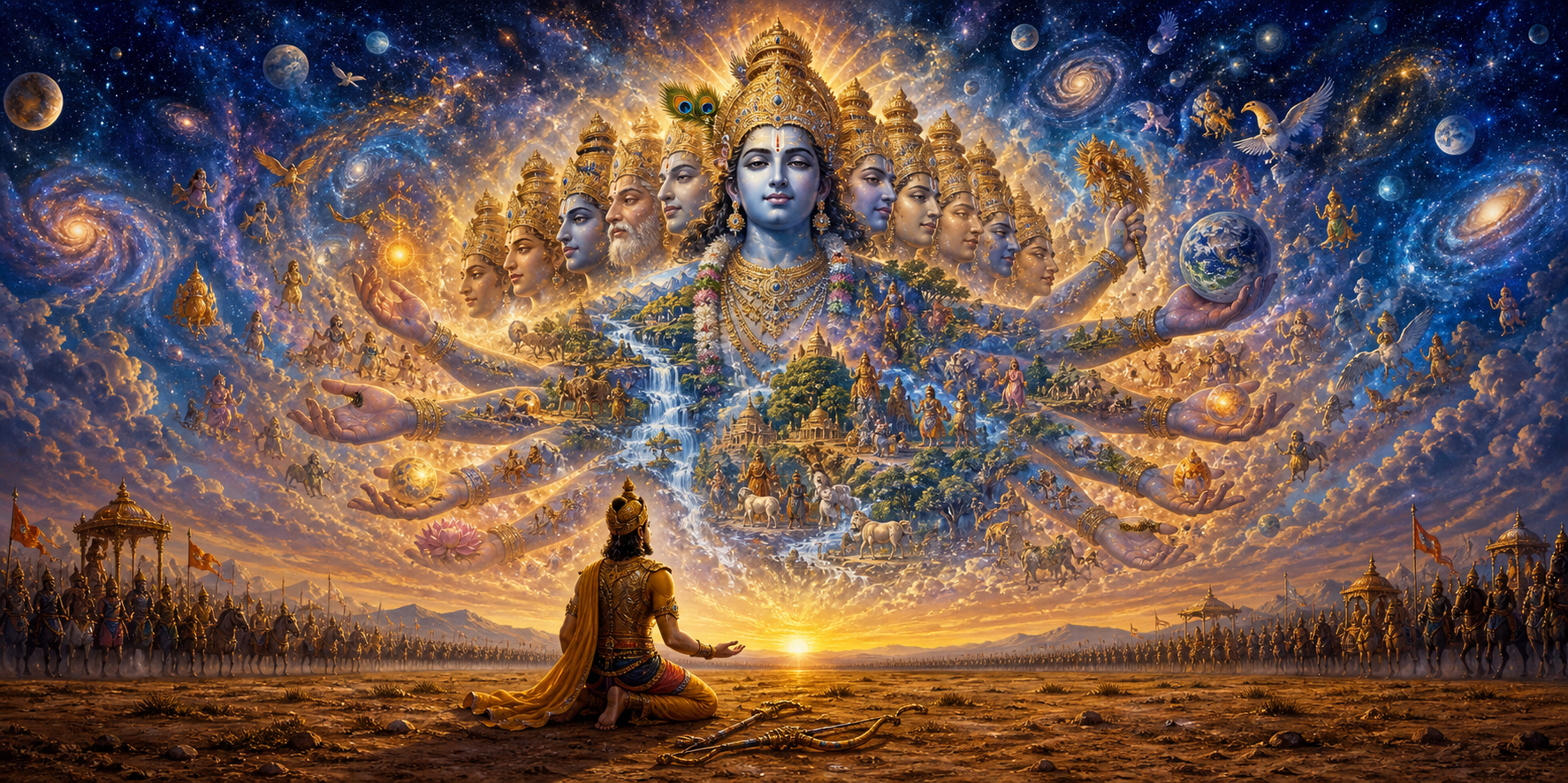
Three Who Saw Krishna’s Infinite VishvarupaArjuna, Sanjaya, Akrura: Evidence and Insights

This long-form study examines the three principal witnesses to Krishna’s viśvarūpaArjuna, Sanjaya, and Akrurausing the Bhagavad Gita, Mahabharata, and Bhagavata Purana as primary touchpoints. It clarifies how divya cakṣuḥ (divine sight) conditions the experience, why Arjuna’s battlefield vision is pedagogically unique, and how Sanjaya’s Vyasa-given perception mediates revelation to a wider audience. Akrura’s Yamuna theophany…
-
HH Niranjan Swami in Boston: The Transformative Power of Kirtan, Sound, and Gaudiya Bhakti

On 6 June 2026, ISKCON Boston hosted a kirtan led by HH Niranjan Swami Maharaj, highlighting how Gaudiya Vaishnava congregational chanting fuses scripture, music, and community. The practice centered on the maha-mantra and the disciplined use of raga and tala, demonstrating how structure supports devotion. Participants experienced the psychosocial benefits of group singingentrainment, focus, and…
-
Resolute Mind, Unstoppable Path: Dharmic Science of Determination from Gita to Guru Granth

This essay examines the dharmic science of determination across Hinduism, Buddhism, Jainism, and Sikhism, showing how unwavering resolve yields reliable results when aligned with ethics and sustained practice. It grounds the teaching in the Bhagavad Gita’s vyavasāyātmikā buddhi, the Yoga Sutras’ abhyāsa–vairāgya, Buddhism’s adhiṭṭhāna pāramī, Jainism’s vīrya and Anekantavada, and Sikhism’s Chardi Kala and sevā.…
-
Mastering Lifelong Learning: Dharmic Methods that Transform Observation into Wisdom

Rote learning produces fragile knowledge; dharmic education converts observation into durable wisdom. Drawing on Hinduism, Buddhism, Jainism, and Sikhism, this piece outlines a replicable pathway: inquiry, reasoning, contemplative assimilation, and ethical action. It maps classical pramanas to modern evidence-based methods such as retrieval practice, spaced repetition, and mindfulness. Nyaya’s tarka, Mimamsa’s hermeneutics, Vedanta’s sravana–manana–nididhyasana, Buddhist…
-
Ashadha Purnima (Guru Purnima) 2026: Date, Rituals, Vyasa Puja Guide & Dharmic Unity

Ashadha Purnimaalso known as Guru Purnima or Veda Vyasa Purnimafalls on 29 July 2026 and honors the Guru-Shishya Tradition across the dharmic family. The festival venerates Bhagavan Veda Vyasa and the transpersonal Guru principle that links knowledge with ethical living. This long-form guide explains the lunar calendar basis of the observance, regional variations, and the…
-
ISKCON at 60 in The Hague: Nauka-vihara Boat Festival and Gita Expo Inspire Unity

Śrī Krishna Dhaam The Hague marked ISKCON 60 with a compelling union of the Nauka-vihara Festival and a Bhagavad-gita Exhibition, held during Purusottama Masa. The program balanced devotion and scholarship, using the ceremonial boat pastime to communicate universal dharmic themes of crossing samsara through remembrance, ethics, and contemplative practice. A curated Gita Expo mapped core…
-
A Temple Room Stilled: Srila Prabhupada’s Ecstatic SymptomsScripture, Science, and Practice

An eyewitness account describes a packed temple room falling into profound silence as Srila Prabhupada paused, eyes closed, before gently remarking, “I do not do that very often.” The analysis situates this rare episode within Gaudiya Vaishnavism’s technical framework of ecstatic symptoms (sattvika-bhavas) and rasa theory as outlined in Bhakti-rasamrta-sindhu and the Caitanya-caritamrta. It explains…
-
Manava Janma Uddeshya: A Transformative Dharmic Guide to the Purpose of Human Life

This long-form exploration presents Manava Janma Uddeshyathe purpose of human birthas a rigorous, unified framework across Hinduism, Buddhism, Jainism, and Sikhism. It clarifies the Purusharthas within Sanatana Dharma, aligns worldy aims with Dharma, and situates Moksha as the culminating horizon. Readers gain an actionable, research-informed roadmap that integrates meditation, ethical discipline, devotion, study, and seva.…
-
Devotion Through Buddhi and Grace: Mastering Hindu Bhakti via Consciousness and Surrender

This essay examines two complementary currents of Hindu devotionbuddhi-yoga (devotion through consciousness and intelligence) and prapatti/śaraṇāgati (devotion through surrender)grounded in the Bhagavad Gita, the Bhāgavata Purāṇa, Vedānta, and Yoga. It explains how disciplined study, reflection, and mindful ritual refine devotion, while wholehearted entrustment to the divine expands receptivity to grace. The discussion translates classical terms…
-
11 Root Causes of Dejection (Part 2): A Dharmic Framework for Resilience and Joy

This Part 2 deep-dive completes a unified, dharmic map of dejection by examining six Yoga Sutra obstaclesillness, stagnation, doubt, heedlessness, laziness, and over-attachmentthrough the shared wisdom of Hinduism, Buddhism, Jainism, and Sikhism. Readers learn how these factors interlock, why they amplify heaviness of heart, and how to respond with integrative practices grounded in the Bhagavad…
-
Stop Chasing Birthplaces: Honor Guru-Bhakti by Living the Teaching, Not Worshiping Soil

This essay clarifies a core paradox in dharmic spirituality: gurus teach transcendence of body and place, yet communities often fixate on birthplaces and relics. It reframes sacred geography as a valid but secondary aid to sadhana, drawing on the Bhagavad Gita, the Upanishads, and the Guru-Shishya Tradition. Case studies from Hinduism, Buddhism, Jainism, and Sikhism…
-
HG Kratu Prabhu’s Enduring Legacy: Devotional Leadership, Dharmic Unity, and Bhakti-Yoga

This tribute reflects on the life and legacy of His Grace Kratu Prabhu, a beloved Vaisnava, stalwart ISKCON leader, and dedicated disciple of Srila A. C. Bhaktivedanta Swami Prabhupada. It explains how his devotion to bhakti-yogarooted in śravaṇa, kīrtana, and sevaoffers a rigorous, compassionate pathway for modern practitioners. Readers will gain an academic yet accessible…