Tag: Bhagavad Gita

  • Beyond Starships: Vedic and Dharmic Pathways for Safe, Effortless Journeys to Other Worlds

    Beyond Starships: Vedic and Dharmic Pathways for Safe, Effortless Journeys to Other Worlds

    Modern fascination with interplanetary travel reflects a timeless philosophical impulse to understand creation and its inhabitants. Vedic literature, supported by Srimad-Bhagavatam, Sri Isopanisad, and the Bhagavad-gita, offers a complementary research program to empirical science via testimony and disciplined practice. Rather than relying on fragile material instruments, the Vedic model proposes bhakti-yoga as a safe, replicable…

  • Modern Love, Ancient Bhakti: How Krishna’s Wisdom Transforms Youthful Desire into Dharma

    Modern Love, Ancient Bhakti: How Krishna’s Wisdom Transforms Youthful Desire into Dharma

    This article reframes the turbulence of modern romance through Krishna-centered bhakti, showing how desire (kāma) matures into expansive love (prema) when guided by dharma. Drawing on the Bhagavad Gita and Srimad Bhagavata Purana, it explains the cognitive arc of attachment and offers a practical sequence—śravaṇa, kīrtana, smaraṇa, and sevā—to steady attention, study, and relationships. Yoga’s…

  • Transfer the Burden: Gita–Bhagavatam Principles for Dharma-Led, Resilient Infrastructure

    Transfer the Burden: Gita–Bhagavatam Principles for Dharma-Led, Resilient Infrastructure

    India’s rapid infrastructure expansion brings both promise and pressure, especially across urban corridors in the National Capital Region. Drawing on the Bhagavad Gita and Srimad-Bhagavatam, this analysis frames “transfer the burden” as a dual principle: allocate project risks to the parties best equipped to manage them, and relieve paralyzing outcome-anxiety through disciplined action and spiritual…

  • Ananya Sharan Bhaava: Mastering Unshakeable Devotion and Inner Surrender in Dharmic Life

    Ananya Sharan Bhaava: Mastering Unshakeable Devotion and Inner Surrender in Dharmic Life

    Ananya Sharan Bhaava, or single-minded devotion, is best understood as something uncovered rather than acquired. Dharmic traditions—Hinduism, Buddhism, Jainism, and Sikhism—converge on a shared architecture: ethical grounding, attentional training, and devotion that matures into surrender. Practical methods include clarifying a chosen refuge (Ishta or central ideal), adopting regular sadhana (japa, Naam Simran, dhyana), and aligning…

  • Krishna as the Highest Pleasure: Evidence-Based Insights and Dharmic Practices for Joy

    Krishna as the Highest Pleasure: Evidence-Based Insights and Dharmic Practices for Joy

    The name Krishna is traditionally associated with paramānanda—the highest pleasure—linking sacred sound to a complete philosophy of enduring happiness. Drawing on the Upaniṣads, the Bhagavad Gita, and the Bhagavata Purana, this analysis explains how fleeting, sense-based sukha differs from stable spiritual joy, and why cultivating a “higher taste” transforms desire rather than suppresses it. Navadha-bhakti,…

  • Eighteen Parvas of the Mahabharata: Sacred Architecture, Dharma, and Timeless Symbolism

    Eighteen Parvas of the Mahabharata: Sacred Architecture, Dharma, and Timeless Symbolism

    The Mahabharata’s division into eighteen Parvas is a sacred architecture that encodes as much meaning as the verses themselves. Eighteen recurs across the tradition—Parvas, war days, akshauhinis, and the Gita’s chapters—signaling a deliberate design that integrates nature and human faculties under dharma. Organized in arcs from origins and diplomacy (Udyoga Parva) to war (Bhishma to…

  • From Vidya Kashi to a Graveyard of Knowledge: Politics and Ideology at Mysore University

    From Vidya Kashi to a Graveyard of Knowledge: Politics and Ideology at Mysore University

    This essay examines the University of Mysore’s founding ideal—Na hi jñānena sadṛśam—and contrasts it with the institutional decay chronicled in B.G.L. Swamy’s Mysore Diary (1979–80). Drawing on primary testimony and corroboration from S.L. Bhyrappa’s autobiography, it maps how caste-based mobilizations, ideological capture (including Communist-aligned activism), and party patronage (notably tied to the Congress party’s local…

  • Why Hinduism Has No Commandments: Dharma’s Liberating, Context-Sensitive Ethics

    Why Hinduism Has No Commandments: Dharma’s Liberating, Context-Sensitive Ethics

    Hinduism’s ethical core is not a fixed list of commandments but the dynamic, context‑sensitive framework of dharma. Drawing on the Vedas, Upanishads, the Bhagavad Gita, and the Dharmashastra tradition, it integrates personal virtue, social responsibility, and a vision of the highest good. This article explains sadharana and vishesha dharma, Mimamsa hermeneutics, and yogic disciplines such…

  • The Power of One Book: How a Bhagavad-gita Sparked Lifelong Devotion and Dharmic Unity

    The Power of One Book: How a Bhagavad-gita Sparked Lifelong Devotion and Dharmic Unity

    A single sacred text can catalyze lifelong practice and broad social uplift. Kadamba Kanana Swami’s testimony — that a Bhagavad-gita passed from a friend reshaped his life and then vanished from view — illustrates how books “find people,” a process he linked to grace: “Krsna is also part of it.” Social-science models of diffusion explain…

  • Prasadam’s Transformative Grace: Gaudiya Insights on CC Madhya 14.36 for Daily Life and Unity

    Prasadam’s Transformative Grace: Gaudiya Insights on CC Madhya 14.36 for Daily Life and Unity

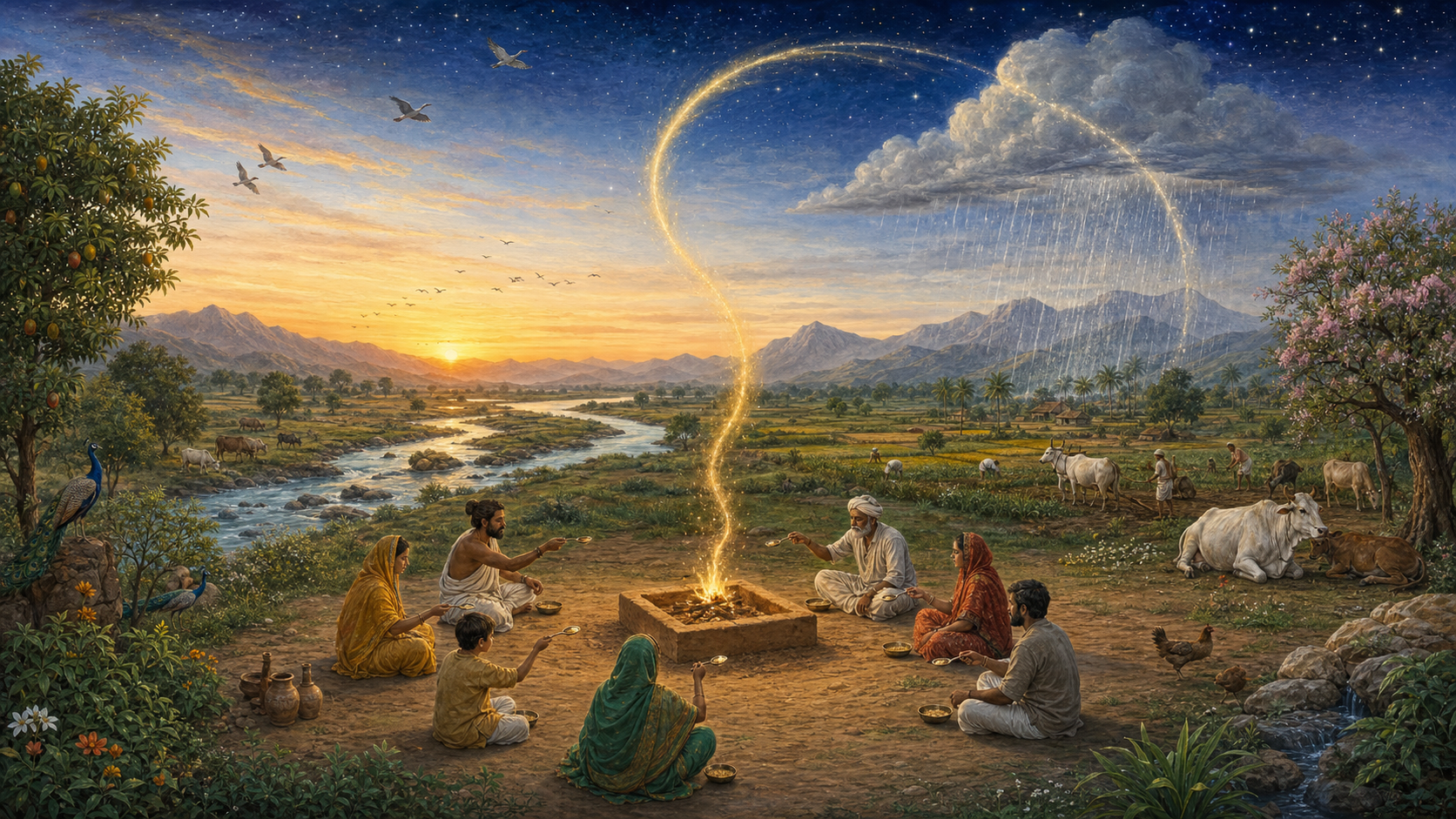
    This in-depth exploration of prasadam situates sanctified food within Gaudiya Vaishnava theology, anchored in CC Madhya 14.36 and the example of King Prataparudra. Readers gain a clear understanding of how offering transforms nourishment into a daily practice of grace, supported by Bhagavad Gita principles and Gaudiya ritual steps. The piece outlines a practical five-step home…

  • Mastering Discipline: Dharmic Practices for Spiritual Bliss and Devotional Growth

    Mastering Discipline: Dharmic Practices for Spiritual Bliss and Devotional Growth

    Discipline in the dharmic traditions is not mere suppression but the intelligent redirection of desire toward higher aims. Drawing on Hindu, Buddhist, Jain, and Sikh sources, this article explains how ethical restraint, attentional training, and ritual regularity form a unified system that sustains devotional service and spiritual bliss. It translates Patanjali’s abhyasa–vairagya, the Bhagavad Gita’s…

  • Unattached Like the Sun: Dharmic Wisdom on the Divine Light That Impartially Illumines All

    Unattached Like the Sun: Dharmic Wisdom on the Divine Light That Impartially Illumines All

    This article examines the Hindu aphorism that the Divine is like the sun—illuminating all without attachment—and shows how this insight unifies the Dharmic traditions of Hinduism, Buddhism, Jainism, and Sikhism. Drawing on scriptural anchors such as the Bhagavad Gita (13.33; 5.10; 9.9; 15.6; 15.12) and the Upanishads, it explains why Brahman/Īśvara is described as nirlepa…

  • Are the Puranas Just Fiction? A Rigorous, Heart-Centered Guide to Finding God and Trusting Truth

    Are the Puranas Just Fiction? A Rigorous, Heart-Centered Guide to Finding God and Trusting Truth

    Are the Puranas fiction or a reservoir of living wisdom? This analysis explains how Puranic narratives operate beyond a literal-versus-fable dichotomy by integrating mythic memory, ethics, ritual rationale, and contemplative instruction. Drawing on Indian epistemology (pramāṇa), it clarifies how śabda (trustworthy testimony), anumāna (inference), and yogic pratyakṣa (direct insight) jointly ground a rational, testable faith.…

  • Stop Buying What the Mind Sells: A Dharmic Art of Witnessing for Lasting Inner Freedom

    Stop Buying What the Mind Sells: A Dharmic Art of Witnessing for Lasting Inner Freedom

    A tireless inner salesman—fear, regret, desire, anxiety—constantly pitches stories and urges. This long-form analysis presents the dharmic antidote: the art of witnessing across Hinduism, Buddhism, Jainism, and Sikhism. Drawing on Patanjali’s Yoga Sutra, Sankhya, the Bhagavad Gita, Vedantic discernment, Buddhist mindfulness, Jain samayik, and Sikh simran, it explains why the mind’s pitch works and how…

  • Indratva vs Nidratva: Kumbhakarna’s Boon, Ambition, and the Lost Science of Balance

    Indratva vs Nidratva: Kumbhakarna’s Boon, Ambition, and the Lost Science of Balance

    Kumbhakarna’s story in the Ramayana, often reduced to a trope of excess, encodes a precise philosophy of balance through the dialectic of Indratva (unbounded agency) and Nidratva (overpowering inertia). Read across Valmiki and later retellings, the episode becomes a systems lesson in regulating rajas and tamas under sattva’s guidance. The analysis connects dharmic psychology with…

  • Insults Reveal Insecurity: Dharmic Wisdom on Speech, Self‑Mastery, and Real Strength

    Insults are often misread as strength, yet dharmic traditions consistently treat them as signs of insecurity and weak self-mastery. Drawing on the Bhagavad Gita, Dharmaśāstra, Buddhist Right Speech, Jain vows, and Sikh teachings, this analysis outlines a rigorous fourfold test for ethical speech: non-agitating, true, beneficial, and skillfully delivered. Contemporary psychology and neuroscience corroborate these…

  • Spiritual Thirst: Building Unshakable, Heartfelt Devotion across Dharmic Traditions

    Spiritual Thirst: Building Unshakable, Heartfelt Devotion across Dharmic Traditions

    Spiritual thirst is the disciplined, whole‑hearted longing for the Divine or ultimate truth, expressed across Hinduism, Buddhism, Jainism, and Sikhism through listening, singing, remembrance, contemplation, and seva. Drawing on Yoga Sutra principles such as tivra samvega and nairantarya abhyase, it emphasizes intensity and unbroken practice over half‑hearted effort. The Varkari saints exemplify steadiness through kirtan,…

  • Who Is the Real Father? Dharmic Wisdom on Body, Soul, Karma, and the Supreme Source

    Who Is the Real Father? Dharmic Wisdom on Body, Soul, Karma, and the Supreme Source

    What distinguishes a living person from a lifeless body points directly to the dharmic insight at the heart of the Hare Krishna Movement: the living self (atman) is distinct from matter, and its ultimate source is the Supreme. This article presents a rigorous, compassionate exploration of “Who is the real father?” across ISKCON’s Gaudiya Vaishnava…

  • Idle Mind, Restless Life: Dharmic, Yogic, and Mindfulness Practices to Build Purposeful Focus

    Idle Mind, Restless Life: Dharmic, Yogic, and Mindfulness Practices to Build Purposeful Focus

    The age-old saying that an idle mind becomes a workshop for unwholesome impulses is reframed here through the shared wisdom of Hinduism, Buddhism, Jainism, and Sikhism. Instead of moralizing idleness, the analysis distinguishes healing rest from tamasic drift and presents a technical, evidence-aligned path to train attention and action. Readers gain a clear map of…

  • Beyond Luck and Fate: Timeless Dharmic Wisdom on Karma, Free Will, and Untouched Truth

    Beyond Luck and Fate: Timeless Dharmic Wisdom on Karma, Free Will, and Untouched Truth

    This article reframes “luck” and “fate” through a dharmic lens as shorthand for complex causality rather than forces that control life. It integrates Hindu, Buddhist, Jain, and Sikh perspectives to show how karma, dependent origination, niyama, and hukam together replace fatalism with responsibility and wisdom. Hindu teachings on sañcita–prārabdha–kriyāmāṇa karma and puruṣārtha emphasize effort within…