
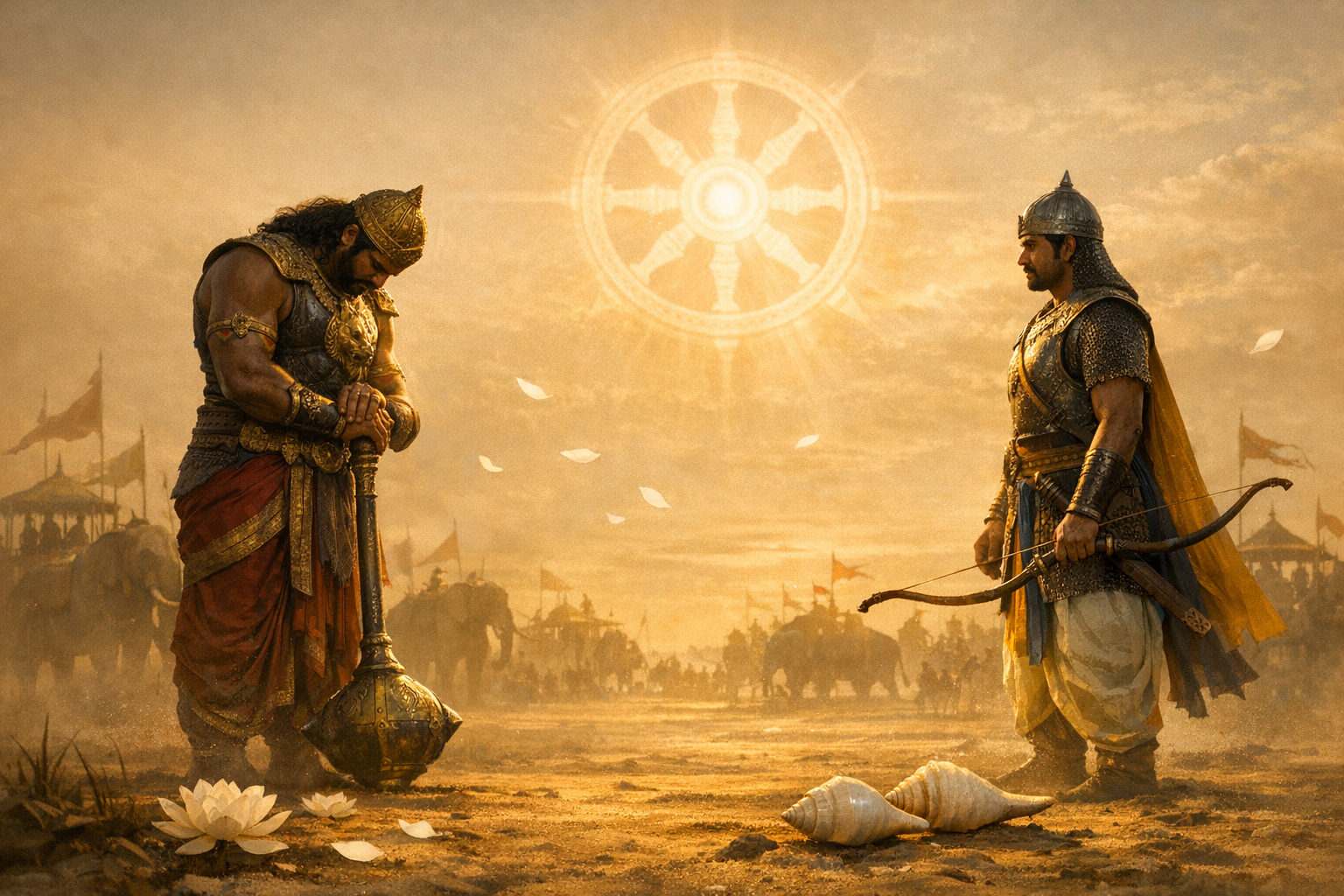
The Mahabharata repeatedly resists simple binaries of virtue and vice, and few episodes illustrate this more poignantly than the death of Vikarna at the hands of Bhima. A Kaurava prince who had once challenged the unrighteousness of Draupadi’s humiliation, Vikarna enters the Kurukshetra War as an emblem of moral courage caught within the coils of loyalty and lineage. His falland Bhima’s rare public respect for a foeframes a profound meditation on dharma, duty, dissent, and the ethics of war in an epic that is as much scripture as it is history.
Vikarna’s moral profile is forged in the Sabha Parva during the dice-game crisis. When Draupadi is dragged into the assembly and subjected to vastra-harana, he alone among the Kauravas voices a principled objection, insisting that her questions regarding Yudhiṣṭhira’s right to stake her are grounded in dharma. In doing so, Vikarna aligns with what the tradition later calls sādhāraṇa-dharma (universal duty)truth, non-cruelty, and justiceover partisan victory. His lonely protest becomes a canonical moment of internal critique, revealing that the Kaurava camp is not ethically monolithic and that dharma’s call can pierce even the strongest bonds of clan and command.
That Vikarna nevertheless marches under Duryodhana’s banner at Kurukshetra is not a contradiction so much as an illustration of a classic Mahabharata tension: svadharma (role-specific duty) versus sādhāraṇa-dharma. As a kshatriya bound by kṣātra-dharmaloyalty to sovereign, protection of formation, and steadfastness in battlehe accepts the perils of fighting for a cause he once questioned. The epic uses this dissonance not to indict Vikarna but to expose the complexity of ethical life: dharma is frequently contextual, layered, and tragic, pressing individuals to choose among competing goods under the shadow of consequence.
The field of Kurukshetra, governed by the ideals of Dharma-Yuddha, still houses innumerable dharma-saṅkaṭascrises where every path wounds. Within this framework, Vikarna’s duel with Bhima emerges as an inflection point. Traditional reckonings place their encounter in the Drona Parva amid the sustained fury of the fourteenth day, when formations shatter and codes strain under vows and counter-vows. Bhima recognizes Vikarna not merely as an enemy but as the lone Kaurava who publicly upheld dharma in the assembly. He is reluctant, even sorrowful, at the prospect of killing one who had defended Draupadi’s dignity when it mattered most.
The exchange between the two, preserved across retellings, captures the paradox at the heart of the epic. Bhima acknowledges Vikarna’s righteousness and urges withdrawal; Vikarna refuses, affirming the demands of svadharmafidelity to his king and brothersand the honor of the warrior’s path. The duel that follows is brief and decisive. Bhima prevails, and in the aftermath, he offers an uncharacteristic elegy for a Kaurava foe, praising Vikarna’s truthfulness and courage. It is a rare moment when the heroic code pauses to salute an adversary’s conscience, and it signals that in the Mahabharata, moral worth can shine even on the “wrong” side.
From a technical standpoint, Vikarna’s arc can be read as a case study in competing layers of duty: kula-dharma (duty to family), rāja-dharma (duty to sovereign), kṣātra-dharma (the martial code), and sādhāraṇa-dharma (universal ethics). His protest in the court reflects satya (truth) and dayā (compassion), while his stance in war reflects martial obligation and vows of loyalty. The Mahabharata’s jurisprudence of ethicsfurther elaborated in the Śānti Parvadoes not collapse these layers into a single rule; rather, it recognizes practical wisdom (nīti) and right intention as essential mediators among them.
Bhima’s posture in this episode is equally significant. Often remembered for vows of vengeanceespecially against Duḥśāsana and DuryodhanaBhima here exemplifies a balanced reading of Bhagavad Gita-inflected action: to fight without hatred, to discharge duty without surrendering discernment. His respect for Vikarna fits the epic’s deeper argument that the worth of an action is measured not only by outcome but also by the moral quality of the agent’s intention and the ability to recognize dharma even in one’s foe. This is the very texture of niyata-karma (disciplined action) that Krishna urges upon Arjuna.
The episode also clarifies how dissent is treated within dharmic frameworks. Vikarna’s earlier objection to Draupadi’s humiliation shows that ethical critique from within a community is both possible and commendable. Rather than painting all Kauravas as uniformly adharma-aligned, the narrative preserves shades of gray, allowing readers to see how institutions can still nurture conscience. In contemporary leadership terms, this suggests that cultures of principled dissentwhere truth is spoken without rancor and heard without humiliationare not signs of weakness but of ethical vitality.
Comparative dharmic perspectives reinforce this insight. Across Hinduism, Buddhism, Jainism, and Sikhism, virtues such as satya (truthfulness), ahiṃsā (non-harm rightly understood and contextually applied), karuṇā/dayā (compassion), and seva (selfless service) converge as shared ethical anchors. Buddhism’s sīla and kṣānti foreground restraint and forbearance; Jainism’s anuvratas cultivate disciplined non-violence and truth in speech; Sikhism’s commitment to seva and righteous defense of the oppressed articulates a principled dharm yudh when compelled by justice. Vikarna’s truth-centered protest and Bhima’s respect for an opponent’s integrity resonate with these pan-dharmic ideals, offering a unifying lens rather than a sectarian one.
Gender ethics in the epic likewise gain nuance through Vikarna’s stand. By validating Draupadi’s arguments in the assembly, he affirms that dharma scrutinizes power even when exercised by men of stature and pedigree. The protest does not overturn the immediate outcome, but it inscribes a counter-narrative within the court itselfa reminder that just voices can emerge from unexpected quarters, and that the moral ledger records more than victories and defeats.
Readers often find this episode emotionally compelling because it mirrors real-world dilemmas: loyalty to one’s group versus allegiance to universal norms; the wish to avoid harming a good person versus the necessity to stop a harmful cause; the pain of recognizing virtue in those one must nevertheless oppose. The Mahabharata does not anesthetize these conflicts; it teaches how to carry them with sobriety. Bhima’s lament over Vikarna is not a lapse in resolve but an assertion that righteous action need not extinguish empathy.
Set beside other figuresKarna, who also wrestles with loyalty and gratitude; Yuyutsu, who defects to the PandavasVikarna represents a distinct moral type. He neither abandons his side nor abandons his conscience. That synthesis is fragile and, in war, fatal; yet the epic treats it with respect. The Mahabharata’s pedagogy is thus twofold: it honors principled dissent within a community and honors principled opponents across the battle-line. This dual honor is what lends the text its extraordinary ethical density and enduring relevance.
In sum, the death of Vikarna and Bhima’s uncommon reverence encapsulate the epic’s central thesis: dharma is contextual, tragic, and demanding, yet always reachable through courage, reflection, and compassion. The Kurukshetra War is not merely a ledger of who killed whom; it is a laboratory of moral testing where universal ethics, role duties, and personal vows collide. For contemporary readers seeking guidance across the dharmic familyHinduism, Buddhism, Jainism, and Sikhismthe episode invites a shared ethic: uphold truth, respect the opponent’s humanity, and let duty be illumined, not darkened, by conscience.
Key takeaway for those studying the Mahabharata’s ethics and statecraft is clear. Dharma-Yuddha is not a blank check for victory at any cost; it is a disciplined struggle where ends and means are jointly scrutinized. Vikarna’s solitary protest and Bhima’s respectful grief together establish an enduring benchmark: justice without cruelty, courage without contempt. That lesson, as relevant to boardrooms and classrooms as to battlefields, is why Vikarna’s memory continues to evoke both sorrow and admiration.
As a historical-literary source, the Mahabharata situates this episode amid Udyoga Parva diplomacy, Bhishma Parva strategy, and the rule-ethics of the Śānti Parva, offering a consistent thread: ethical clarity must accompany political resolve. The narrative’s refusal to erase moral complexityespecially in the figure of Vikarnaunderscores a civilizational insight shared across Dharmic traditions: unity is sustained not by uniformity, but by a common commitment to truth, compassion, and responsibility.
Thus, Vikarna’s fall at Kurukshetra is not only a battlefield datum; it is a mirror held up to perennial human conflict. Bhima’s salute to his adversary’s dharma reaffirms that even in the fiercest struggle, character remains the ultimate victory. In remembering Vikarna, the Mahabharata remembers the conscience within the campand invites every camp to listen.
Inspired by this post on Hindu Blog.
