
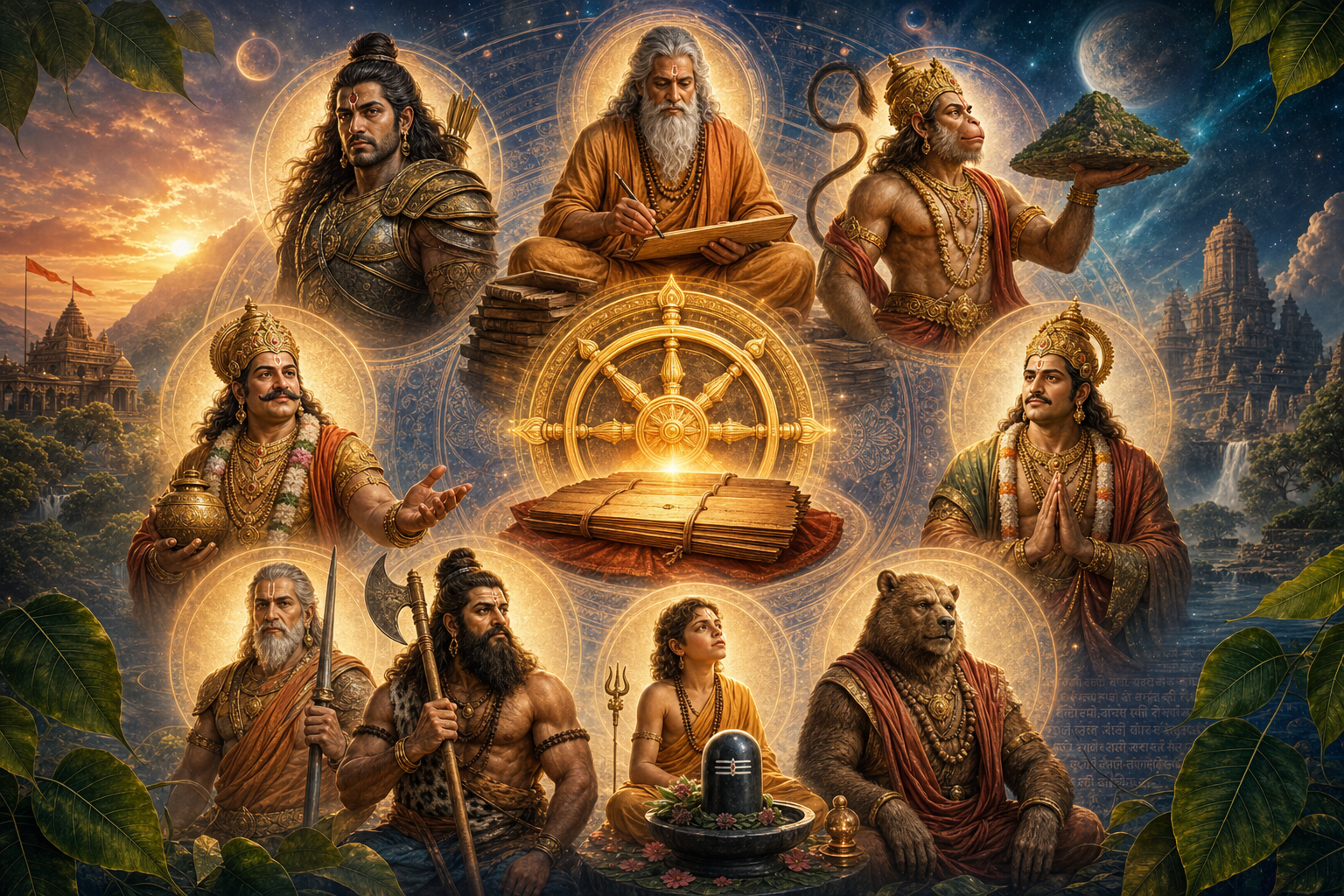
The Nava Chiranjeevis, also called the Nava Sanjivis in some devotional traditions, occupy a remarkable place in Hindu thought because they stand at the meeting point of mythology, ethics, cosmology, and living memory. They are not merely immortal figures in a simple biological sense. They are enduring witnesses who carry forward lessons from the Itihasas and Puranas across ages, reminding society that time in Hinduism is not linear, brief, or closed, but cyclical, expansive, and morally meaningful.
The word Chiranjivi is generally understood as one who lives for a very long time, often through a yuga or even through vast cosmic transitions. This idea differs from ordinary immortality. A Chiranjivi is not always free from sorrow, consequence, duty, or limitation. In many accounts, long life is a blessing; in others, it is a burden. This distinction is essential because Hindu scriptures rarely treat longevity as an automatic reward. Life becomes meaningful only when it is aligned with dharma, knowledge, devotion, humility, and service.
The better-known Sanskrit memory verse on the Ashta Chiranjeevis lists eight: Ashwatthama, Mahabali, Veda Vyasa, Hanuman, Vibhishana, Kripacharya, Parashurama, and Markandeya. In several later, regional, and devotional retellings, Jambavan is added, producing the Nava Chiranjeevis. This variation does not weaken the tradition. It shows how Hindu sacred memory has always preserved a core teaching while allowing communities to emphasize figures who best express continuity, devotion, wisdom, and moral endurance.
The Nava Chiranjeevis are therefore best studied not as a rigid list of supernatural beings, but as a symbolic map of dharmic survival. Each figure preserves a different mode of continuity. Some carry knowledge, some carry devotion, some carry the memory of war, some carry repentance, and some carry the promise that righteousness can reappear even after civilizational decline. Their stories remain emotionally powerful because they do not present perfection as the only spiritual path. They also present remorse, correction, loyalty, surrender, discipline, and renewal.
Ashwatthama: immortality as consequence. Ashwatthama, the son of Dronacharya, is one of the most tragic figures of the Mahabharata. Born with extraordinary martial inheritance and associated with great power, he becomes a warning about what happens when anger, humiliation, and revenge overtake judgment. After the Kurukshetra war, his attack on the sleeping sons of the Pandavas and his misuse of the Brahmastra place him under a terrible curse. His long life is not a glorious exemption from death, but a prolonged moral reckoning.
Ashwatthama’s place among the Chiranjeevis is deeply philosophical. He represents the memory of violence that cannot be erased simply because a war has ended. The Mahabharata repeatedly teaches that victory without self-mastery remains incomplete. In this sense, Ashwatthama becomes an undying witness to adharma born from wounded pride. His story asks an uncomfortable but necessary question: if human beings survive without inner purification, is survival itself a blessing or a sentence?
Mahabali: immortality through surrender and generosity. King Mahabali, also known as Bali, is remembered as a righteous and generous ruler from the Daitya lineage. His story is most famously connected with Vamana, the dwarf avatara of Vishnu. When Vamana asks for three steps of land, Mahabali grants the request despite warnings. The cosmic form of Vishnu then covers the worlds, and Mahabali offers his own head for the final step. This moment transforms apparent defeat into spiritual greatness.
Mahabali’s immortality is not rooted in conquest, but in surrender. He is sent to Sutala, where he continues to rule with divine protection. In Kerala, his memory is lovingly celebrated through Onam, where he is remembered as a beloved king whose reign symbolizes prosperity, equality, and social harmony. His story is especially valuable for a dharmic reading because it refuses simplistic categories. A being born outside the Deva lineage can still embody devotion, charity, and truthfulness. Dharma is measured by conduct, not by tribal identity alone.
Veda Vyasa: immortality through knowledge preservation. Veda Vyasa, also called Krishna Dvaipayana Vyasa, stands at the center of Hindu literary and spiritual civilization. He is traditionally credited with organizing the Vedas, composing or compiling the Mahabharata, and shaping the Puranic tradition. In the Mahabharata itself, he is not only a sage but also a participant in the continuity of the Kuru lineage. His life bridges revelation, history, memory, and instruction.
Vyasa’s Chiranjivi status reflects the immortality of knowledge. In Hinduism, sacred learning is not static information; it is transmitted through guru-shishya parampara, disciplined listening, contemplation, and ethical living. Vyasa represents the principle that civilization survives when knowledge is preserved, organized, interpreted, and passed forward responsibly. For students of Hindu scriptures, his presence is a reminder that memory itself is sacred when it serves wisdom rather than pride.
Hanuman: immortality through bhakti, strength, and seva. Hanuman is among the most beloved figures in the Ramayana and in Hindu devotional life. His strength is immense, but his greatness lies in humility. He does not seek power for its own sake. He uses it in service of Sri Rama, Sita, and dharma. His leap to Lanka, his discovery of Sita, his burning of Lanka, and his role in bringing the Sanjivani-bearing mountain are not merely heroic episodes. They express disciplined energy guided by devotion.
Hanuman’s immortality is often understood through the belief that he remains wherever Rama’s name and Rama Katha are recited. This makes him a living symbol of spiritual presence. He is worshipped by ascetics, householders, warriors, students, and seekers because he unites courage with restraint, scholarship with service, and devotion with practical action. In a modern context, Hanuman’s life speaks to anyone seeking strength without arrogance and faith without passivity.
Vibhishana: immortality through ethical courage. Vibhishana, the brother of Ravana, is one of the most important moral figures in the Ramayana. He lives within Lanka, understands Ravana’s power, and yet chooses to speak against adharma. His decision to leave Ravana and seek refuge with Sri Rama is sometimes misunderstood as betrayal, but the deeper dharmic reading is clear. Loyalty to family or state cannot override loyalty to truth.
Vibhishana’s Chiranjivi status represents ethical dissent. He teaches that dharma may require standing apart from one’s own side when that side becomes unjust. This lesson remains relevant in family life, public life, scholarship, and governance. A society committed to dharma must honor those who speak truth with humility, even when doing so is painful. Vibhishana’s later rule of Lanka also shows that correction is not merely destructive; it can restore order after moral collapse.
Kripacharya: immortality through disciplined instruction. Kripacharya, the royal teacher of the Kuru house, survives the great destruction of the Mahabharata war. He is a warrior, a scholar, and a guardian of continuity after catastrophe. His survival is significant because the Mahabharata is not only a story of battle; it is also a story of what must be preserved after battle. When kingdoms fall and heroes die, instruction must continue.
Kripacharya embodies the endurance of education. His role points to the importance of teachers who carry skills, memory, discipline, and ethical frameworks across generations. In some traditions, he is associated with future cycles of sacred instruction, which deepens his symbolic role as a custodian of learning. His presence among the Chiranjeevis reminds readers that civilization is rebuilt not only by kings and warriors, but also by teachers who refuse to let knowledge perish.
Parashurama: immortality through tapas and correction of power. Parashurama, the axe-bearing avatara of Vishnu, is a complex figure who combines Brahminical austerity with martial force. His story is associated with the correction of oppressive Kshatriya power, the defense of dharma, and the severe consequences of arrogance among rulers. He is also remembered as a teacher of formidable warriors such as Bhishma, Drona, and Karna.
Parashurama’s long life represents the continuing need to discipline power. His presence across yugas suggests that whenever authority becomes abusive, dharma must reassert moral limits. Yet his story must be read carefully. It is not a celebration of violence for its own sake. It is a warning that social order collapses when power loses accountability. In broader dharmic reflection, his life invites sober thinking about justice, restraint, repentance, and the difficult responsibilities attached to strength.
Markandeya: immortality through devotion and cosmic vision. Markandeya is remembered as the young sage whose devotion to Shiva overcame the appointed time of death. When Yama came to claim him, Markandeya embraced the Shiva Linga, and Shiva protected him, granting him long life. He is also associated with vast Puranic visions, including the experience of cosmic dissolution and the vision of the divine child on the banyan leaf, a profound image of existence continuing beyond pralaya.
Markandeya’s immortality differs from Ashwatthama’s. It is not the burden of guilt, but the fruit of devotion and divine grace. His story explores time at its most majestic scale. Human life appears fragile, yet devotion opens awareness to realities beyond ordinary fear. Markandeya therefore becomes a model for spiritual steadiness. He teaches that death is not conquered by denial, but by anchoring consciousness in the eternal.
Jambavan: immortality through memory across avataras. Jambavan, the wise elder of the Ramayana, is often included as the ninth Chiranjivi in Nava Chiranjeevi traditions. He is a leader among the rikshas and plays a crucial role in reminding Hanuman of his forgotten strength before the leap to Lanka. This act is spiritually profound. Jambavan does not give Hanuman a new power; he awakens the power already present within him.
Jambavan also appears in the Krishna tradition through the Syamantaka gem episode, where he encounters Sri Krishna after having served in the age of Sri Rama. His life thus links the Ramayana and Krishna narratives, showing continuity across avataras and yugas. Symbolically, Jambavan represents ancient memory, elder wisdom, and the sacred responsibility of reminding others of their hidden capacities. In a culture that values both youth and age, his presence affirms that elders are not relics of the past but carriers of insight.
The Nava Chiranjeevis together form a complete ethical spectrum. Ashwatthama warns against revenge. Mahabali honors surrender and generosity. Veda Vyasa preserves knowledge. Hanuman embodies devotion and service. Vibhishana protects truth over blind loyalty. Kripacharya carries disciplined teaching. Parashurama corrects corrupted power. Markandeya reveals the power of devotion before death. Jambavan preserves memory and awakens latent strength. Their immortality is meaningful because each one carries a lesson that must not die.
This is why the doctrine of the Chiranjeevis has remained compelling in Hindu spirituality. It offers a theology of continuity. The world may pass through decline, war, confusion, and forgetfulness, but dharma is never left without witnesses. Knowledge survives in Vyasa. Devotion survives in Hanuman. Repentance survives through the memory of Ashwatthama. Ethical courage survives in Vibhishana. The long-lived beings function as civilizational reminders that every age receives guidance, even if it must learn to recognize it.
The theme also connects naturally with the wider family of Dharmic traditions. Hinduism, Buddhism, Jainism, and Sikhism differ in theology, metaphysics, and practice, yet they share a profound concern for ethical living, self-discipline, compassion, truthfulness, humility, and liberation from ego. Read in this spirit, the Nava Chiranjeevis are not merely sectarian figures. They become part of a broader dharmic conversation on how human beings should live when faced with power, suffering, memory, mortality, and moral choice.
Modern readers often approach immortality through science fiction, medicine, or fear of death. The Puranic imagination offers a more demanding view. It asks not only whether one can live longer, but whether one can live rightly. The Chiranjeevis show that extended life magnifies the condition of the soul. If there is wisdom, long life becomes service. If there is devotion, it becomes presence. If there is guilt, it becomes purification. If there is knowledge, it becomes transmission. If there is humility, it becomes grace.
The Nava Chiranjeevis therefore continue to matter because they transform mythology into moral inquiry. They invite reflection on what should endure in a person, a family, a society, and a civilization. Wealth may fade, kingdoms may fall, and even great wars may become distant memory, but dharma must be carried by living witnesses. In the Puranic tradition, these witnesses remain undying so that humanity does not forget the cost of adharma, the beauty of bhakti, the dignity of knowledge, and the responsibility of power.
Inspired by this post on Hindu Blog.
