
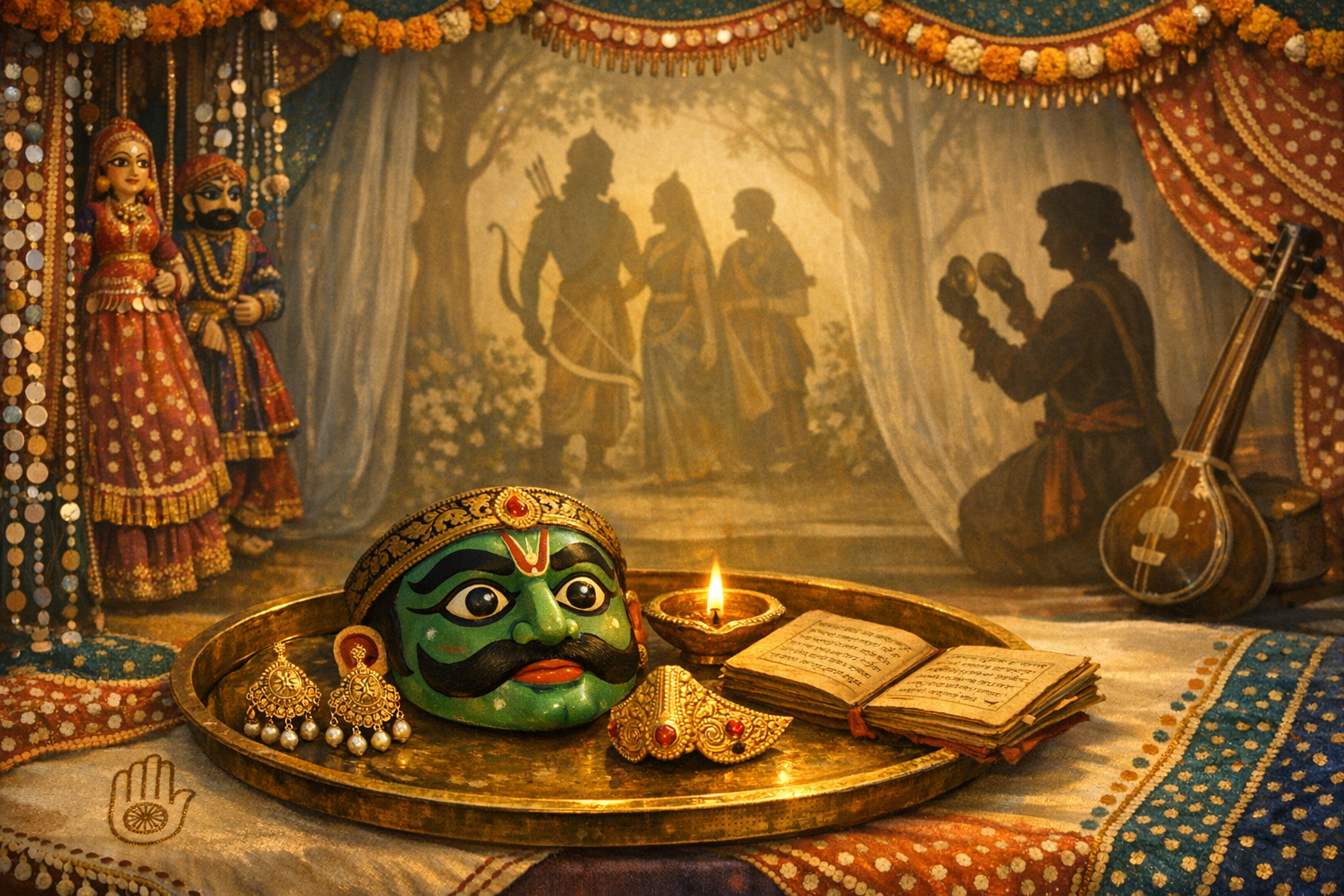
The Ramayana thrives as a living, performative, and interpretive tradition across the Indian subcontinent. In western IndiaGujarat, Rajasthan, and Maharashtrathe episode of Surpanakha’s mutilation has been reshaped through oral performance, vernacular poetry, and devotional discourse into narratives that foreground dharma, social ethics, and emotional nuance. These regional folktales and performance genres reinterpret a stark moment of violence into layered reflections on maryada (ethical boundaries), ahimsa (restraint from harm), and the responsibilities demanded by community life.
Valmiki’s Aranya Kanda presents the canonical point of departure: Surpanakha approaches Rama with desire, is courteously refused, and then confronts Sita. When Surpanakha threatens Sita, Lakshmana intervenes and disfigures hertraditionally described as the cutting of the nose and earssetting into motion a chain of retaliations that culminates in Ravana’s abduction of Sita and, ultimately, in the great war. Western Indian folktales do not overturn this narrative core; rather, they reframe tone, motive, symbolic meaning, and ethical emphasis.
Transmission channels in western India are crucial to understanding the variation. In Gujarat, Bhavai troupes, katha-vachaks, and dayro singers carry Ramayana episodes into public squares and temple courtyards. In Rajasthan, Charan-Bhat bards and kathputli (puppetry) ensembles embed the tale within honor codes and courtly aesthetics. In Maharashtra, Harikatha, kirtan, ovi-based pravachans, and the bhakti-inflected reading of Eknath’s Bhavarth Ramayan furnish a devotional hermeneutic that privileges compassion without diluting maryada.
Gujarat’s Bhavai often frames Surpanakha with hasya (comic) and nīti (didactic) rasas that temper the scene’s severity. The figure of Surpanakha can appear as a cautionary foilexaggerated not to mock womanhood but to satirize uncontrolled impulse and social impropriety. Violence is stylized, and the act of nasika-chedana (nose-cutting) becomes a signifier, not a spectacle: a theatrical gesture stands in for gore, and music or repartee restores ethical balance and audience composure.
Dayro and Vaishnava katha in Saurashtra and Kutch frequently move the episode into moral discourse. Speakers underscore maryada as the boundary that guards love, household order, and public trust. The Gujarati idiom that equates “naak katvi” (loss of nose) with loss of honor primes local audiences to hear the episode less as punitive cruelty and more as symbolic censure of dangerous transgression, especially when it threatens a guest-host covenant in the forest hermitage.
Rajasthan’s Charan and Dingal traditions map the scene onto rajamaryada and lajja (honor and modesty). There, Surpanakha’s transgression is narrated against a cultural backdrop where “naak” stands for communal reputation. The disfigurement becomes a juridical metaphor: it announces that threats to protected guestsor the moral order constituting a righteous householdinvite decisive, but strictly delimited, response. The act is contained within a rhetoric of necessary restraint rather than celebratory aggression.
Rajasthani puppetry pushes stylization further. Masks, veils, and deft stagecraft signal disfigurement without reproducing bodily harm. Dialogues lean on poetic repartee, keeping the performance family-oriented while still marking the ethical stakes. Viewers are invited to contemplate cause and consequence rather than dwell on pain.
In Maharashtra, the interpretive frame tends to be bhakti-inflected and philosophical. Eknath’s Bhavarth Ramayanrevered across the Marathi-speaking worldforegrounds a subtle moral psychology in which Rama personifies samashti-dharma (the universal order) and Lakshmana embodies vyashti-dharma (individual duty). Kirtankars often emphasize that Rama restrains violence to what dharma permits and that Lakshmana’s intervention is protective, not vindictive. The surrounding pravachan tradition reinforces that force, when it appears, must be the minimum necessary to defend maryada.
Marathi Harikatha and kirtan recitations are especially attentive to rasa-balance. Raudra (fury) must be harmonized with karuna (compassion) and shanta (tranquility). Audiences routinely hear the episode as a parable of self-mastery: unchecked kama and krodha endanger both the self and the social field. The didactic message is that guardianship of the vulnerableand refusal to escalate harmmarks true kshatra-dharma.
Maharashtra’s popular theatreTamasha, Lavani, and Gondhalsometimes gives Surpanakha a more audible voice. Song and repartee allow her longing to be acknowledged without endorsing her threat to Sita. This representational space enables empathy for desire as a human force while reaffirming that desire cannot override dharma or violate the sanctity of a protected household.
Jain communities of Gujarat and Rajasthan offer a further, dharmic lens. The Jain Ramayana tradition (notably the Paumacariya) recasts key events to extol ahimsa and rigorous self-restraint. While plot architecture differs from Valmiki’s, the regional ethos infuses folk retellings with a bias toward minimizing injury and extracting ethical insight. In such settings, the episode is repeatedly taught as a lesson in indriya-nigraha (sense-discipline) rather than as a celebration of punitive harm.
Symbolically, western Indian performances read the nose and ears in culturally resonant ways. The nose, linked to prana and social honor, signifies the threshold of impulse and breath-regulation; the ears, associated with shruti (active, moral listening), evoke discernment. Nasika- and karna-chedana, construed metaphorically, mark a curtailment of heedless speech, predatory desire, and unwillingness to listenall of which threaten maryada. What appears as bodily violence in literalist readings becomes, in folk hermeneutics, a drama of re-establishing ethical boundaries.
Poetics and performance theoryrasa, dhvani (suggestion), and aucitya (propriety)anchor these interpretations. Western Indian folktales rarely dwell on gore; they privilege suggestiveness and ethical inference. Hasya diffuses shock, karuna invites reflection, and shanta restores equilibriumproducing a dramaturgy that educates as it entertains.
Gendered dimensions are negotiated with care. Many performances refuse to vilify female desire as such; instead, they isolate the threat to Sita and the violation of hospitality as the core offenses. Surpanakha’s agency is acknowledged even when her act is condemned. This pivot steers audiences away from misogyny and toward a principled critique of conduct that breaches dharma.
Listeners in Kutch dayro gatherings or Pune kirtan sabhas often describe a shared hush at the instant of Lakshmana’s intervention, followed by relief when satire and song reframe the scene. Children are drawn in by puppets or clever dialogues; elders nod to proverbs about maryada; devotees respond to the bhakti ethos of compassion with responsibility. The affective arc is engineered to teach without traumatizing.
Many western retellings highlight the episode’s catalytic role in the epic’s causal chain. A moment of offenseand an equally forceful rebuttalinitiates a spiral involving Khara, Dushana, and ultimately Ravana. As a result, storytellers in Gujarat, Rajasthan, and Maharashtra often stress forbearance, self-regulation, and wise counsel as virtues that can defuse cycles of retaliationan emphasis consonant with Jain and Buddhist moral imagination and deeply compatible with the Hindu commitment to dharma.
Intertexts also circulate widely. Tulsidas’s Ramcharitmanas, Adhyatma Ramayana, and Eknath’s Bhavarth Ramayan all shape western idioms, even when performances are not strictly textual recitations. Across these sources, Rama’s composure and Lakshmana’s protective decisiveness are admired in tandem; the integrity of Sita’s space is non-negotiable; and compassion is never divorced from justice.
Stagecraft in the region uses visual codes to minimize visceral shock. A symbolic blade, a discarded cloth nose, or a mask suffices to indicate the act. Accompanying music immediately modulates the rasa, returning the audience from raudra to shanta. This aesthetic pattern acknowledges the gravity of the transgression and simultaneously re-centers the community in reflection and calm.
In comparative perspective, western Indian folktales exhibit several recurring shifts: the agent of the act (usually Lakshmana) is consistently framed as protective rather than punitive; the tone leans didactic and satirical instead of graphic; symbolic honor and boundary-keeping eclipse retribution; and Surpanakha’s voice, though constrained by the moral logic of the tale, is audibly present in song and repartee. These shifts produce a pedagogy of dharma suitable for mixed-age, community-centered audiences.
This interpretive ecology fosters unity across dharmic traditions. Hindu narratives emphasize maryada and the sanctity of household; Jain sensibilities elevate ahimsa and restraint; Buddhist resonances underscore causality and the perils of retaliation; Sikh articulations of maryada harmonize with the same vocabulary of disciplined conduct. Together, these strands affirm that the episode, far from endorsing cruelty, teaches communities to integrate strength with compassion and justice with self-mastery.
Contemporary performers and writers in Gujarati and Marathi have also experimented with Surpanakha’s perspective, offering interior monologues and reflective songs that dignify longing while clarifying its ethical bounds. Digital recordings of Bhavai, Harikatha, and kirtan further disseminate these nuanced readings, ensuring that younger audiences meet the Ramayana as a source of both cultural memory and ethical imagination.
In sum, western Indian folktales transform the mutilation of Surpanakha from a scene of shock into a crucible of meaning. By reading bodily signs as ethical metaphors, blending hasya with karuna, and situating the act within a disciplined understanding of dharma, these traditions protect the vulnerable, teach restraint, and invite inclusive reflection. The result is a regionally distinct yet deeply dharmic pedagogyone that strengthens shared values across Hindu, Jain, Buddhist, and Sikh communities while honoring the timeless power of the Ramayana.
Inspired by this post on Hindu Blog.
