
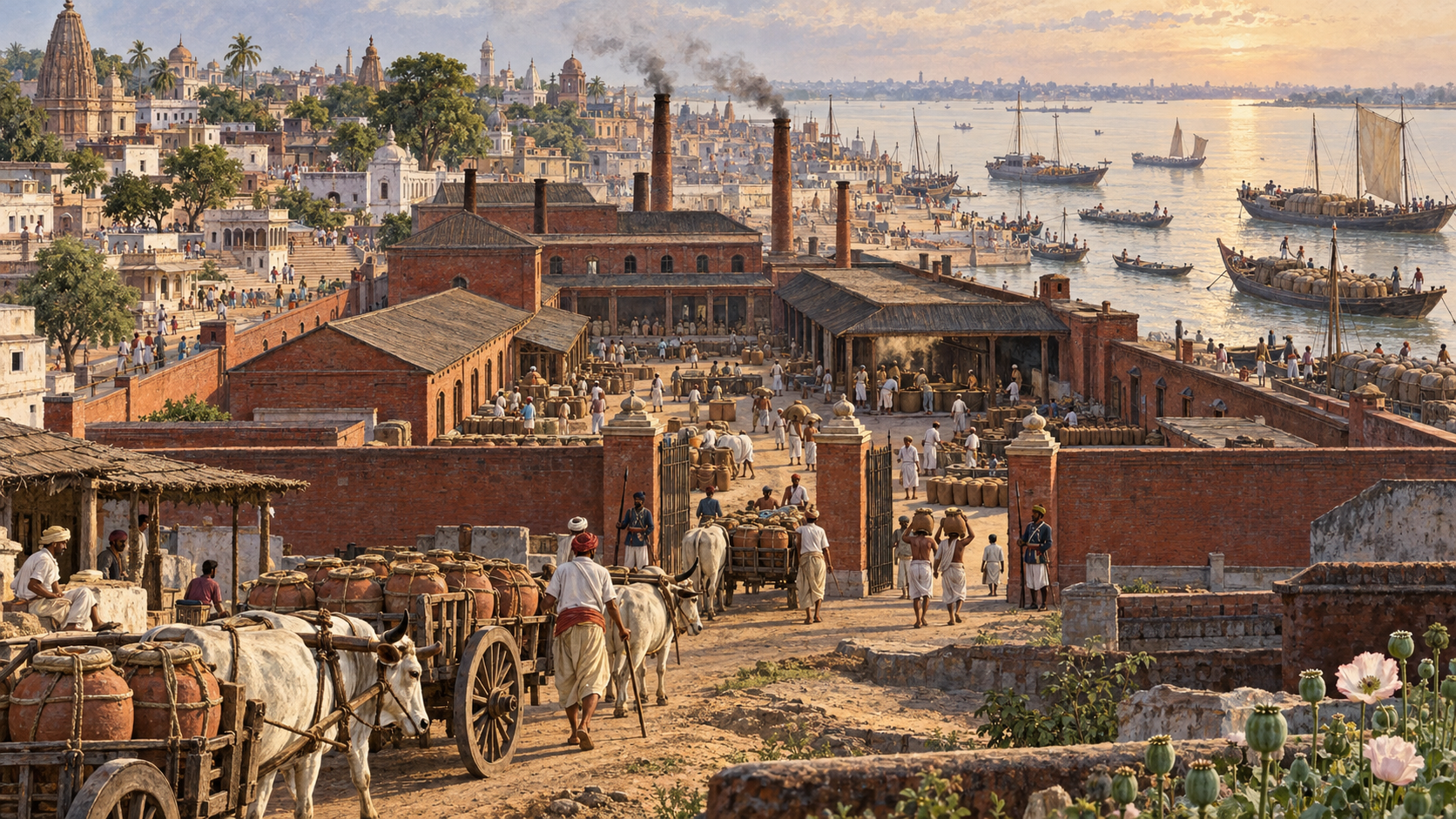
If you are trying to understand how Patna could be remembered both as the heir to a great Dharmic capital and as a centre of the colonial opium economy, do not look for the answer in the character of the city. Look at who acquired the power to reorganise its land, labour and trade.
The East India Company did more than buy a profitable commodity. It combined commercial ambition with governing authority. That combination helps explain how a city associated with the Mauryan world could be remade around opium. The decisive change was not simply the arrival of a new crop. It was the construction of a system in which colonial power influenced what was produced, who could buy it and where the proceeds went.
The short answer: sovereignty became a business instrument
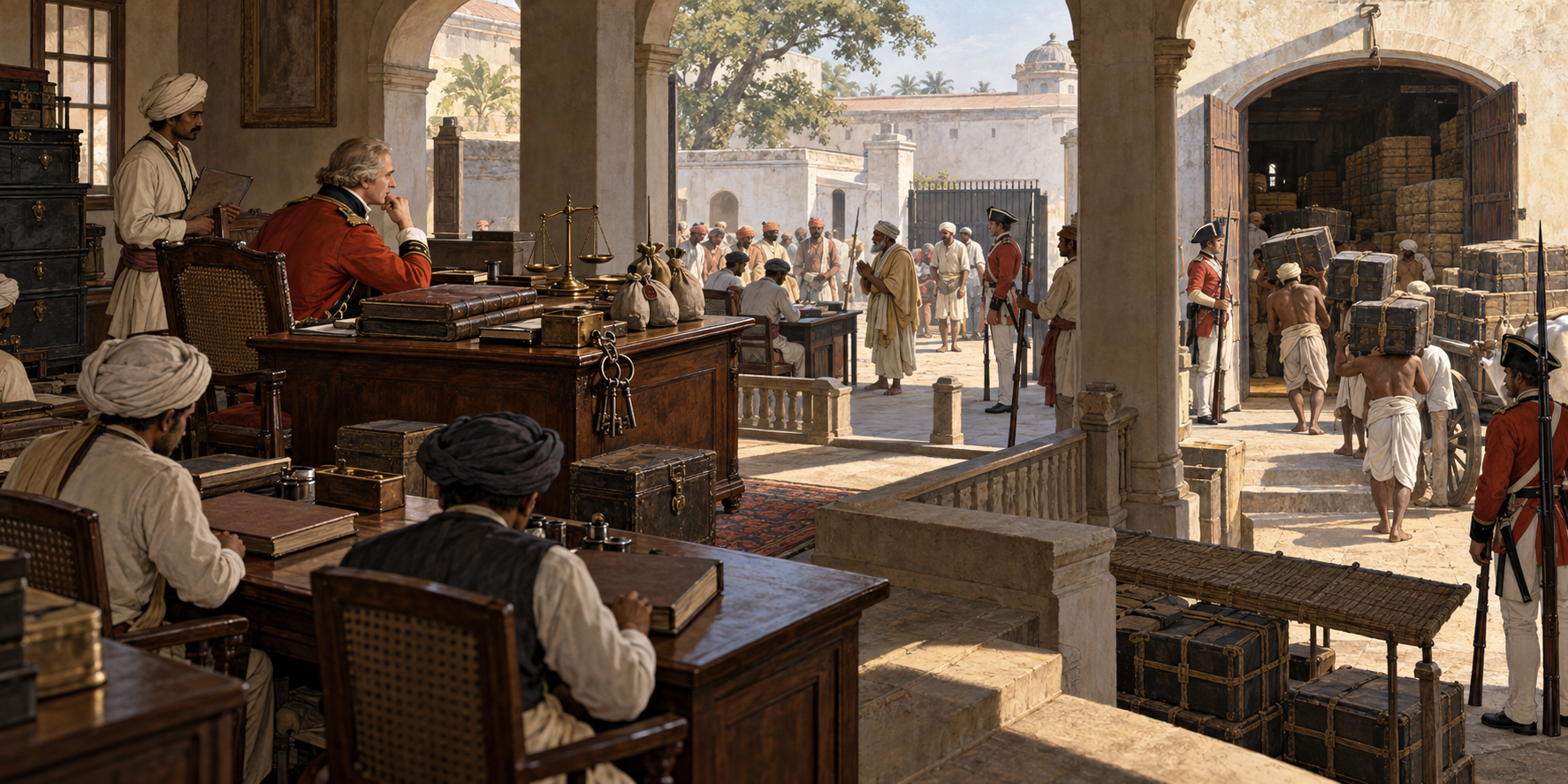
A normal merchant must negotiate within rules established by someone else. A sovereign authority can shape those rules. The East India Company occupied both positions: it was a corporation seeking profit and a political power capable of organising revenue, contracts and commerce.
That distinction matters because the phrase “opium trade” can sound like an ordinary market in which cultivators grew a crop, merchants purchased it and customers chose to consume it. Under Company rule, the market cannot be separated so neatly from political authority. Control over territory allowed commercial policy to reach backwards from the point of sale into cultivation and procurement.
Patna therefore should not be described merely as a place where opium happened to be available. It became an important node in a colonial system built around the commodity. The relevant question is not only how much opium passed through the city. It is who possessed the power to define the terms of the entire chain.
This gives you a useful test whenever colonial commerce is presented as evidence of prosperity: ask whether local people controlled the crop, the price, the routes and the surplus. A busy commercial centre can still be an extraction centre when decisions are made elsewhere and the strongest participant can also write or enforce the rules.
Follow the commodity chain, not just the city label
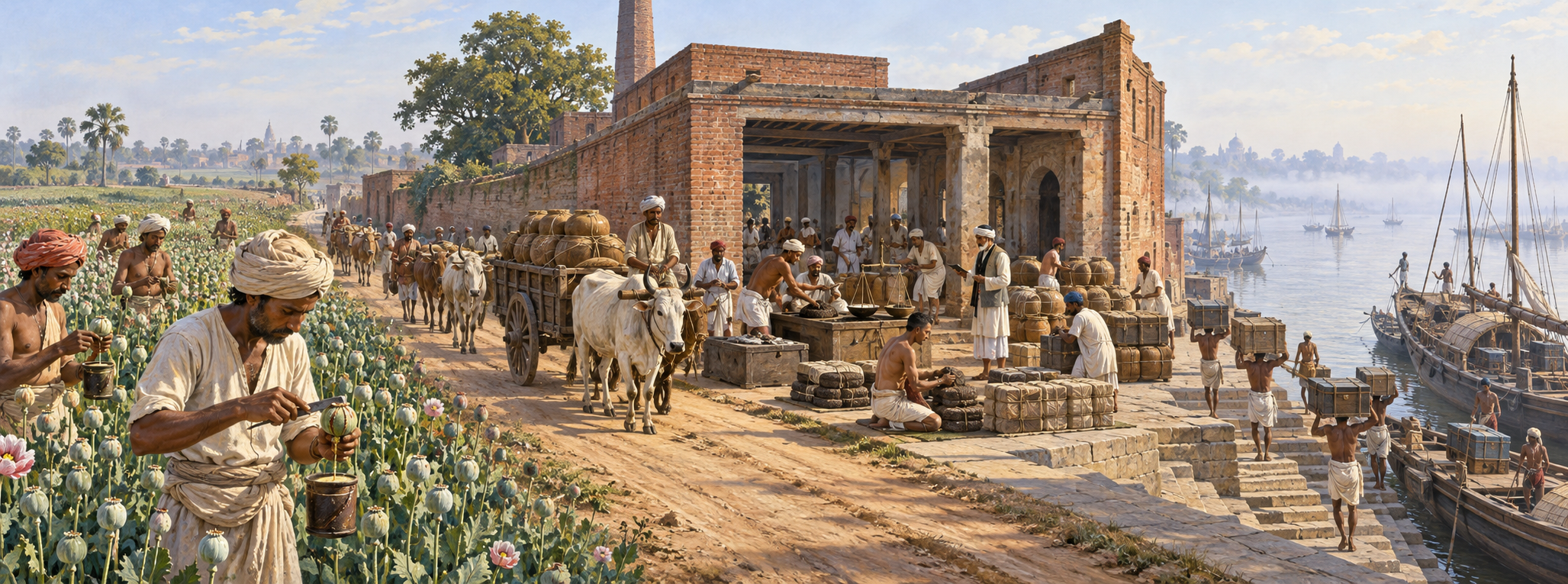
Calling Patna an “opium centre” compresses several different activities into one phrase. To understand what that label means, separate the chain into four stages: cultivation, procurement, concentration and long-distance trade.
- Cultivation: Poppy began as an agricultural decision made on land that also sustained households and local food systems. The first question is whether cultivators chose the crop freely and on workable terms, or whether political and financial pressure narrowed their choices.
- Procurement: The buyer’s power matters as much as the crop. When a dominant authority controls access to the recognised market, a cultivator may formally make a sale without possessing meaningful bargaining power.
- Concentration: Collection, inspection, processing and storage turn scattered agricultural production into a governable commodity. A city becomes strategically important when these functions are assembled there.
- Long-distance trade: The largest gains often arise after the product leaves the cultivator. Following the onward trade reveals whether local production created durable local wealth or mainly fed a distant fiscal and commercial machine.
This chain prevents a common historical mistake. A map showing production tells you where the burden fell, but not necessarily where control or profit accumulated. A record of high trade value tells you that the commodity was lucrative, but not that the cultivator received a proportionate benefit. Volume, control and welfare are three different questions.
When you encounter a claim that colonial rule “developed” Patna’s trade, examine each link separately. Who determined access to seed or advances? Who was permitted to purchase the output? Who judged its quality? Who carried the commercial risk? Who captured the final margin? Without those answers, the word development may conceal more than it explains.
Do not confuse the cultivator with the opium regime

A serious account must distinguish the people who grew poppy from the authority that organised the system. Blaming cultivators for participating ignores the imbalance between a rural household needing income and a territorial corporation able to influence markets and revenue demands.
It is equally misleading to treat every local intermediary as powerless. Agents, contractors, merchants and officials could occupy different positions within the same structure. Some transmitted pressure downwards, some profited from privileged access and some operated within choices constrained by stronger actors. Colonial extraction often worked through such layers rather than through a simple confrontation between one foreign official and one farmer.
The distinction between participation and control is therefore essential. A person can participate in a trade without determining its governing terms. Conversely, an institution need not cultivate a single field to exercise decisive control if it can regulate purchase, processing and sale.
This is also why opium should not be analysed as an isolated moral vice. The intoxicating commodity mattered, but the larger historical issue was the conversion of political supremacy into a revenue-producing commercial arrangement. The East India Company’s unusual power lay in its capacity to join administration, coercion and trade within the same institutional order.
What the Mauryan contrast reveals – and what it can hide
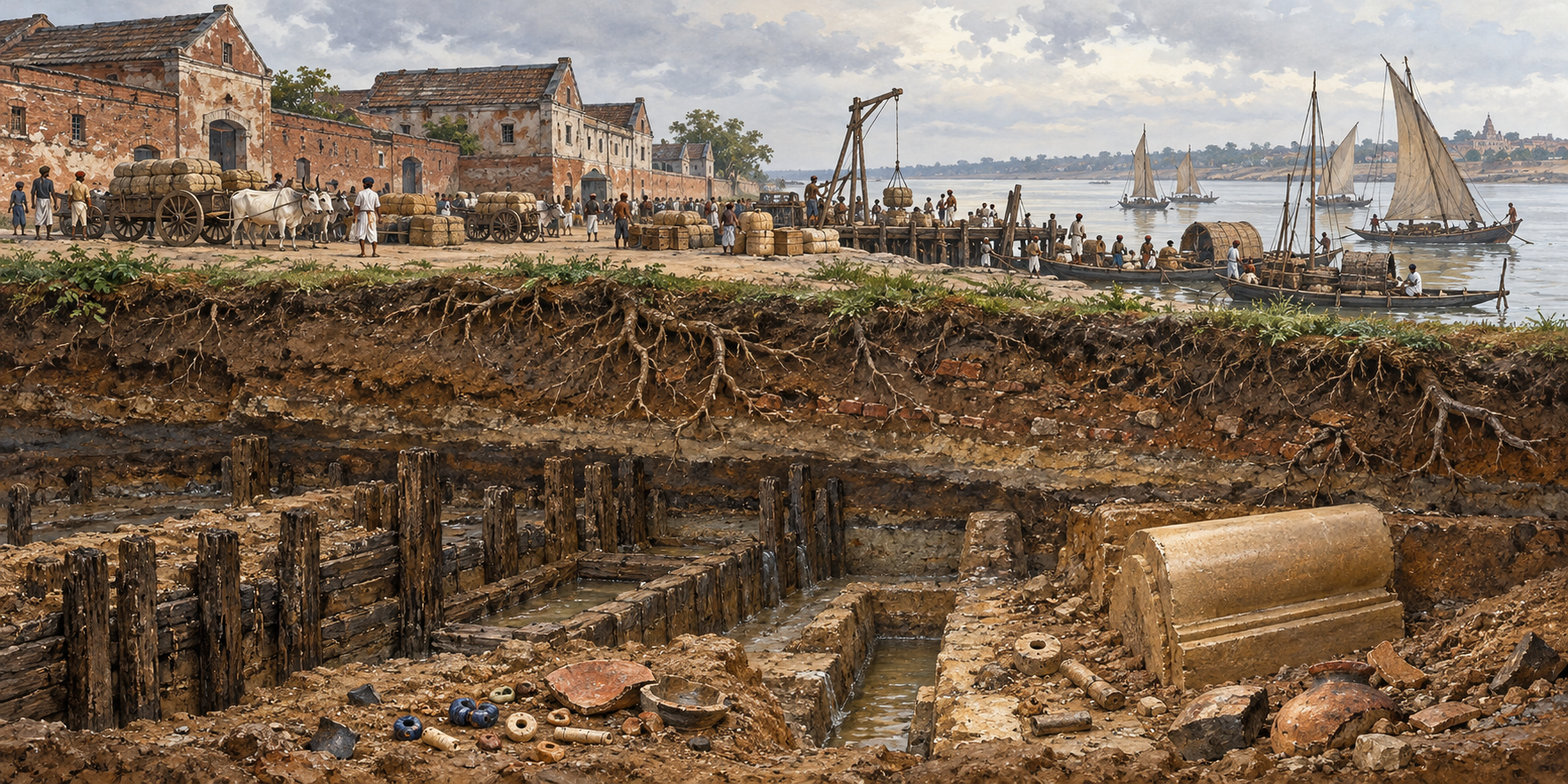
Patna carries a civilisational memory older than colonial rule. Its association with Pataliputra and the Mauryan imperial world makes its later place in the opium economy especially arresting. The contrast invites a legitimate question: how did a capital remembered through Bharat’s political and Dharmic history become an emblem of colonial commodity extraction?
The contrast is useful when it restores historical scale. The Company did not enter an empty landscape and create value from nothing. It encountered an old region with its own settlements, agricultural life, commercial connections and cultural memory, then redirected parts of that world towards imperial priorities.
But the contrast can mislead if it turns history into a simple story of a glorious ancient city followed by uninterrupted decline. Patna was not one fixed thing in either period. Cities survive by changing, and their residents retain agency even under unequal rule. Colonial reorganisation was profound, but it did not erase every older identity or make every inhabitant an identical victim.
A Dharmic reading should therefore avoid both romanticism and fatalism. Memory of the Mauryan capital supplies a standard of civilisational self-possession: political power rooted in Bharat rather than exercised by a corporation headquartered abroad. It should not become an excuse to skip the material questions of land, contracts, labour and revenue. Dharma without institutional analysis becomes sentiment; institutional analysis without civilisational memory reduces Bharat to a territory on somebody else’s balance sheet.
How to read Patna’s opium history with precision
You can test almost any claim about Patna and the Company by asking a short sequence of questions. These questions work whether you are reading a colonial record, visiting a historical site or assessing a modern account of the period.
- Who held governing power? Identify the authority able to make rules, collect revenue and enforce contracts. Do not treat that authority as just another trader.
- Who controlled the recognised buyer? A nominal sale does not prove a free market when one participant dominates legal procurement.
- Where did risk sit? Cultivators could bear agricultural and subsistence risks even when the larger commercial structure protected the dominant buyer’s position.
- Where did the surplus travel? Separate activity occurring in Patna from wealth remaining in Patna. They are not automatically the same.
- Whose language describes the system? Terms such as improvement, order and commerce can describe administrative efficiency while leaving coercion and unequal bargaining power out of view.
- What persisted beyond the commodity? Look for the city’s older cultural identity and the lives of its residents, not only the function assigned to it by colonial administration.
This method also guards against two opposite errors. One is to sanitise the opium economy as ordinary trade. The other is to replace analysis with moral outrage so broad that nobody can see how the system actually worked. Precision makes the indictment stronger because it locates responsibility where power was concentrated.
Key takeaways
- Patna’s role in the opium economy was not merely the result of soil, geography or private demand; it depended on a political-commercial order created under Company power.
- The East India Company must be analysed as both a trader and a governing authority. Ignoring either role produces a distorted picture.
- High commercial activity does not prove broad prosperity. Trace control, risk and surplus through the full commodity chain.
- Cultivators who participated in production should not be confused with the institution that set the system’s governing terms.
- Patna’s Mauryan inheritance matters because it shows that colonial rule redirected an existing civilisation rather than bringing history to an empty place.
The next time you see Patna reduced to a dot on a colonial trade map, read against the map. Follow the poppy from field to buyer, from buyer to storehouse and from storehouse into the larger trade. Then ask who could refuse, who could command and who ultimately benefited. That is where the history of power begins.
References

Leave a Reply
You must be logged in to post a comment.