
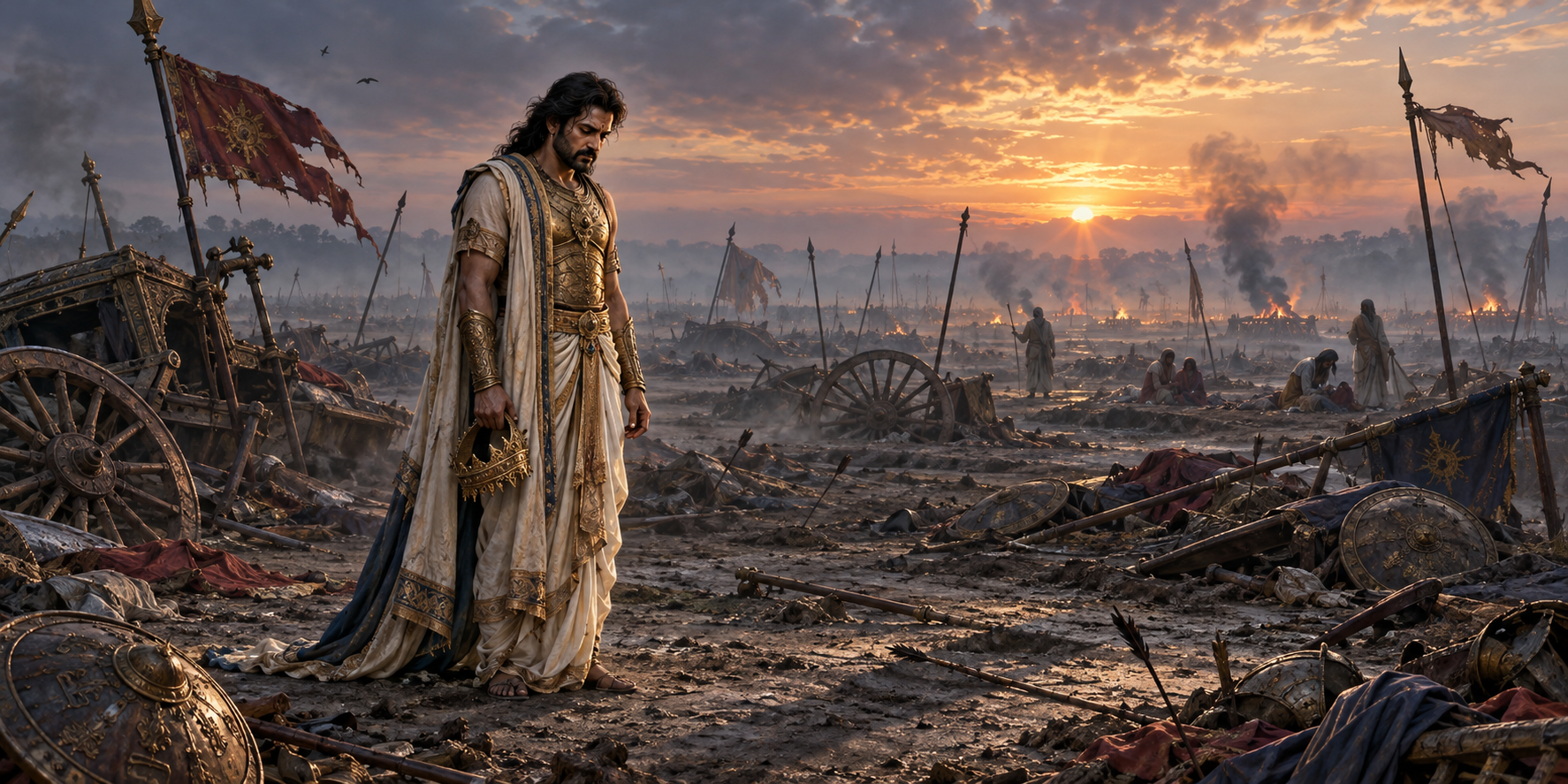
If you are asking whether the Mahabharata treats victory as proof of righteousness, Yudhishthira gives the hardest possible answer: it does not. A cause may deserve defence and a ruler may be obliged to act, yet winning cannot make the suffering disappear.
That distinction matters whenever you must judge a conflict in which inaction appears unjust but action will cause real harm. Yudhishthira shows you how to resist two temptations at once: calling every use of force adharma, and calling every victory righteous merely because your side prevailed.
The victory Yudhishthira cannot enjoy
Kings commonly fight for territory, authority and reputation, then celebrate when the contest ends in their favour. Yudhishthira is different. He fights, fulfils the obligations of kingship and accepts the throne, but he does not experience victory as happiness.
The distance between gaining the kingdom and rejoicing in the gain is morally decisive. Victory settles the question of who will rule. It does not, by itself, settle whether every choice was pure, whether every loss was justified, or whether the winner is now free of obligations to those who paid the price.
Yudhishthira neither throws away the throne nor turns it into a trophy. Accepting it means that responsibility continues after the fighting. Refusing to celebrate means that necessity has not been converted into appetite. He can carry out a king’s duty without pretending that destruction has become desirable.
This gives you a useful distinction when judging any serious conflict. Ask three separate questions: Was the cause defensible? Were the actions taken in its name restrained? What moral responsibility remains after success? A favourable answer to the first question cannot automatically answer the other two.
Dharma does not cancel consequence
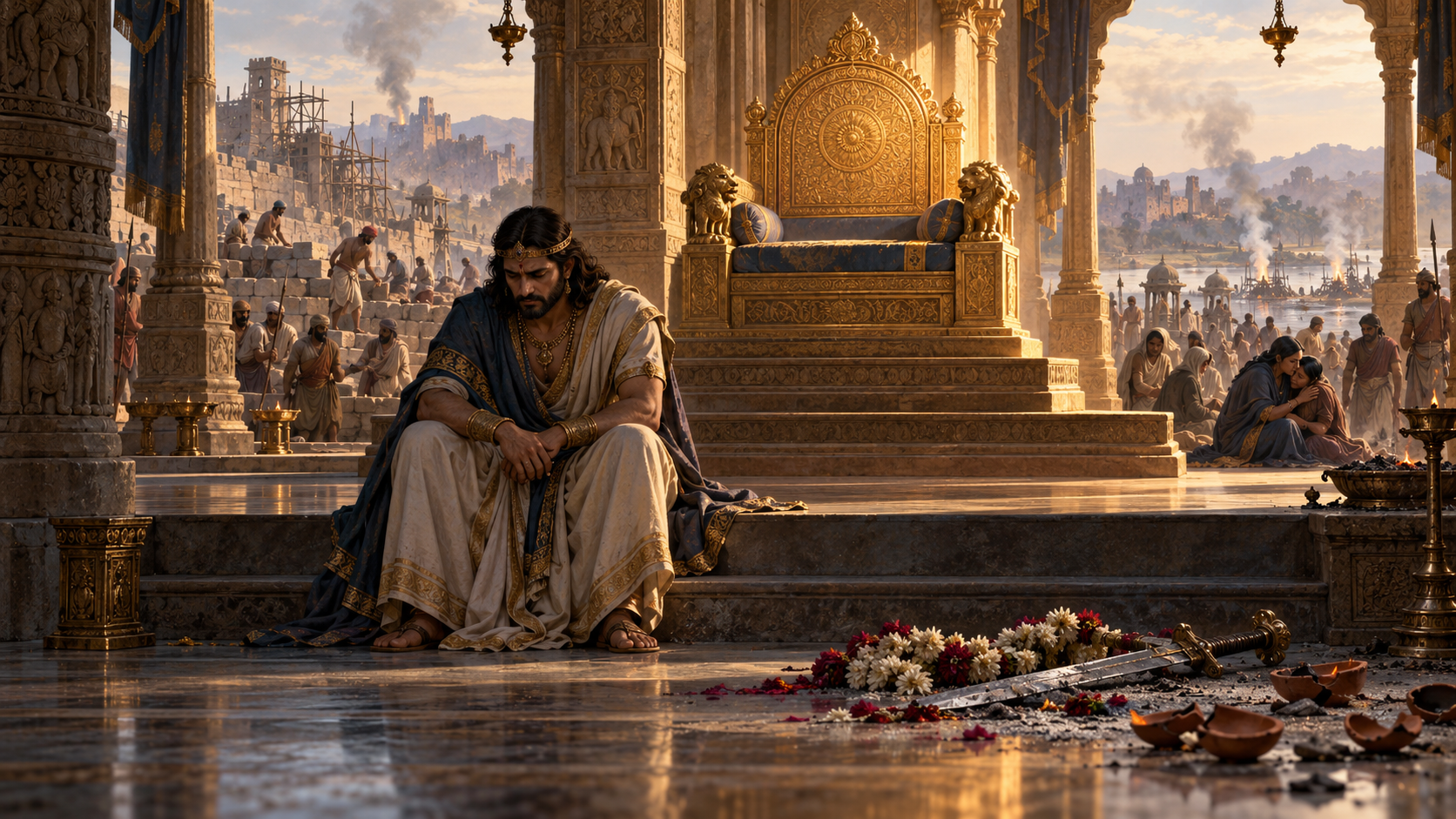
Dharma is sometimes reduced to a simple ledger: identify the righteous side, defeat the unrighteous side, and declare the account closed. Yudhishthira’s response prevents that reading. Right action can still leave a painful remainder because dharma governs relationships, duties and consequences, not merely labels attached to opposing camps.
One error says that an action cannot be right if it causes suffering. That makes decisive resistance to adharma almost impossible. The opposite error says that a righteous purpose purifies whatever its defenders do. That gives anger, ambition and cruelty permission to disguise themselves as duty.
Yudhishthira stands between those errors. His kingship indicates that action and political responsibility remain necessary. His lack of joy indicates that a justifying purpose does not make human cost unreal. Dharma may tell you that you must act; it does not require you to become insensible to what the action destroys.
This is the moral remainder of conflict: something can be necessary without becoming good in every respect. If you recognise that remainder, your next question changes. Instead of asking only whether you were allowed to act, you ask what the consequences now require from you. The answer may include restraint, remembrance, repair and a more sober use of the authority you gained.
Grief can be a form of accountability
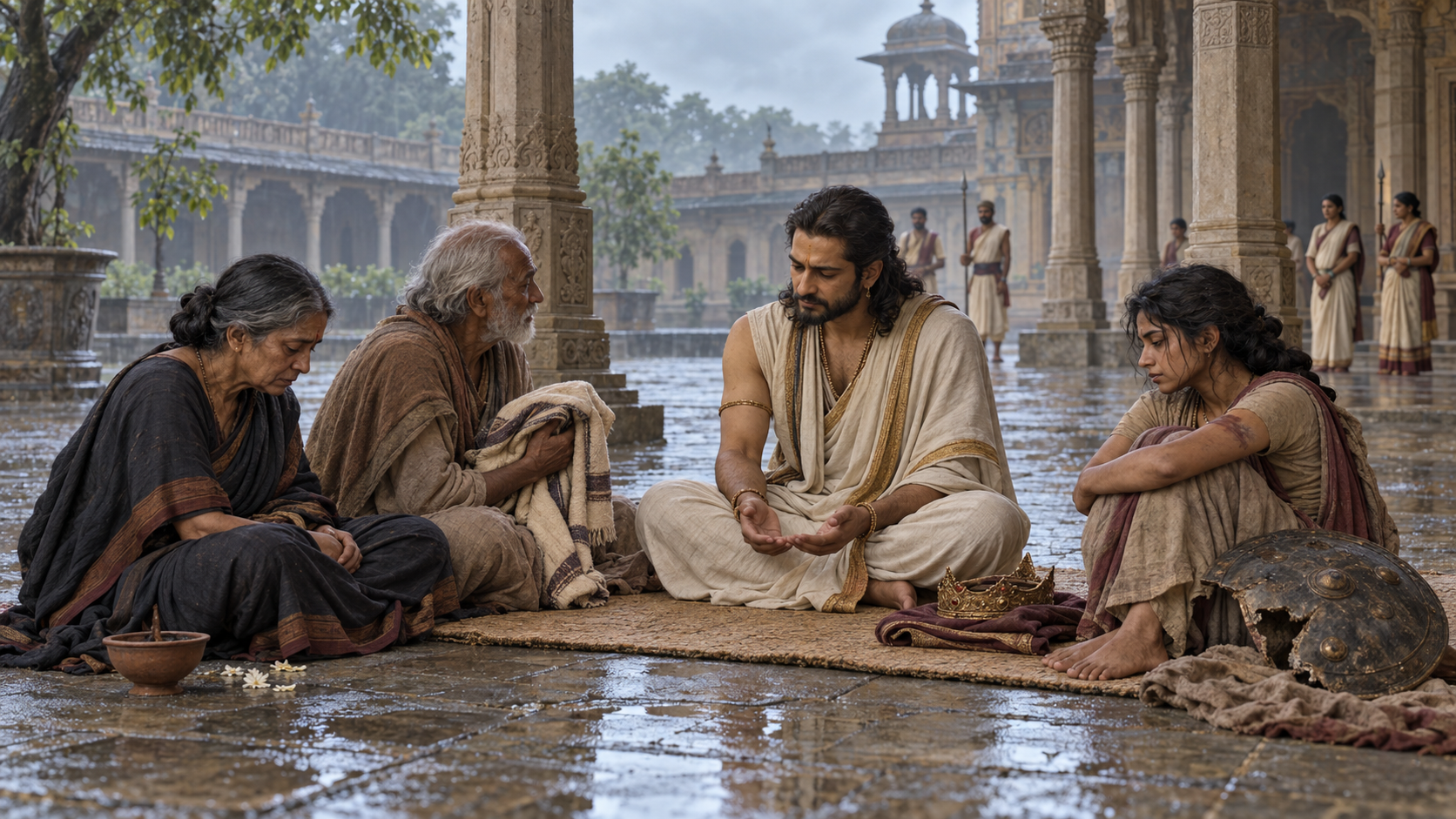
Yudhishthira’s sorrow should not be mistaken for cowardice merely because it follows victory. Cowardice avoids responsibility. His response does the opposite: he accepts the burden of ruling while refusing the emotional convenience of imagining that the crown erased its cost.
Nor is sorrow automatically virtuous. Remorse becomes self-indulgent when the winner makes everyone else comfort him, or when regret becomes an excuse to abandon the work that remains. Responsible grief has a different shape. It names the damage honestly, accepts the duty created by success and restrains the victor’s instinct to glorify himself.
You can recognise that accountability through three signs. First, the victor speaks of the price without euphemism. Second, he does not flee the responsibilities attached to the outcome. Third, he allows the memory of loss to limit how he uses power afterward. In this sense, grief is not an alternative to duty. It can protect duty from becoming vanity.
This does not mean treating every disagreement as another Kurukshetra. Ordinary political, professional and family conflicts differ enormously in scale. The transferable lesson is narrower: if your success required another person to bear a serious cost, do not use the fact that you won as evidence that you owe nothing further.
A four-part test for morally costly action
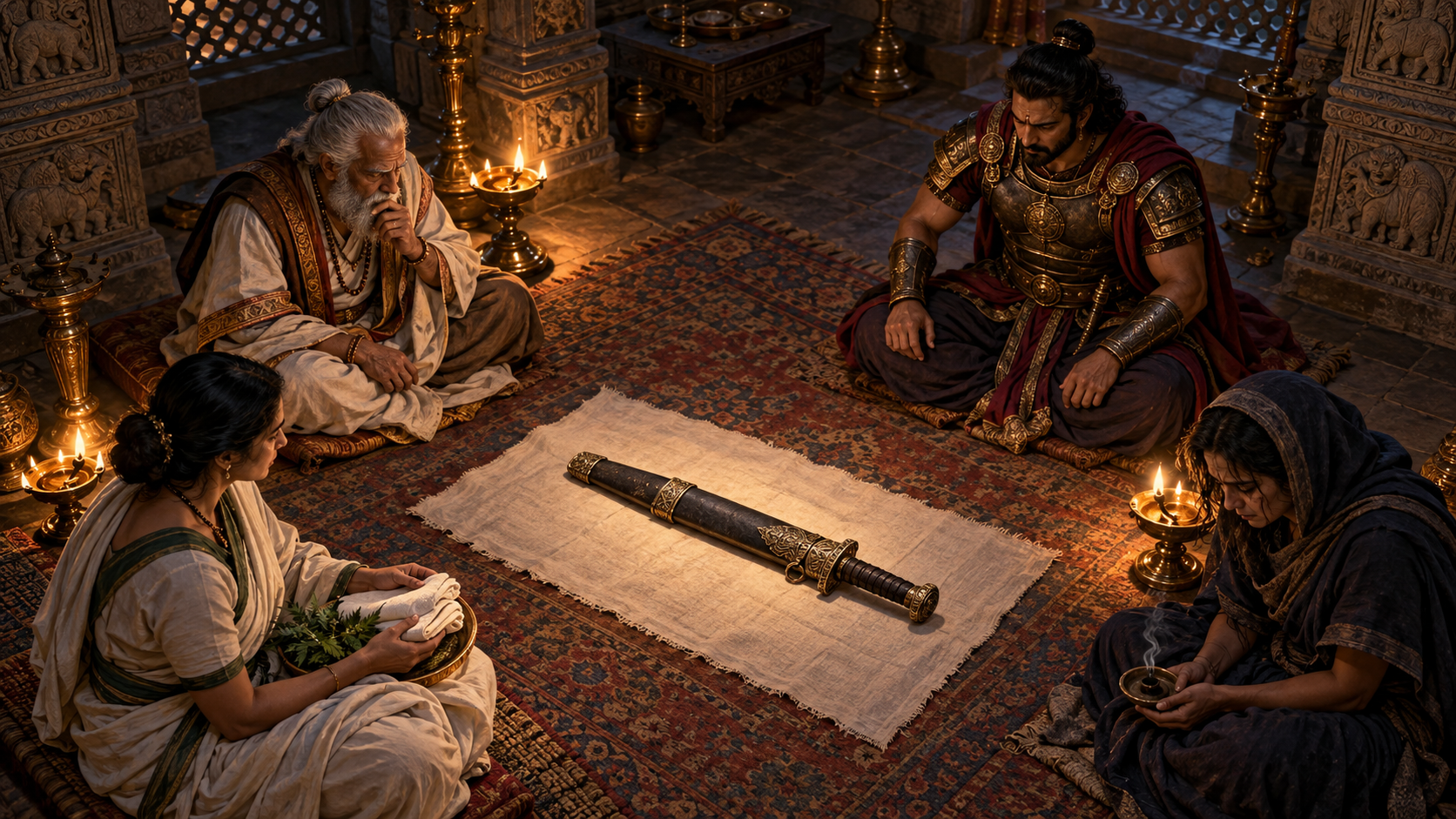
Yudhishthira’s example is most useful before celebration begins. When you must evaluate a leader’s victory, a public struggle or one of your own difficult decisions, examine it in four stages.
1. Identify the duty, not merely the desire
Ask what wrong the action was meant to stop and what obligation made inaction unacceptable. A desire to possess, dominate or avenge is not transformed into dharma by using sacred language. If the purpose cannot be stated without boasting about status or humiliating an opponent, appetite may be doing the work of duty.
2. Examine the means separately from the cause
A defensible goal does not give every method moral immunity. Ask whether the response remained directed toward correcting the wrong, or whether anger widened it into punishment for its own sake. This separate examination is essential because people are often least willing to question their conduct when they feel most certain about their cause.
3. Name who paid for the outcome
Do not let words such as success, restoration or triumph conceal the people who absorbed the cost. Naming a loss does not necessarily prove that the decision was wrong. It prevents you from claiming that the loss never mattered. If a victory can be described only by deleting its casualties and burdens, the description is morally incomplete.
4. Ask what obligation begins after victory
Winning may end a contest, but it begins the victor’s responsibility for what follows. Look for restoration rather than spectacle, disciplined authority rather than self-congratulation, and a willingness to carry burdens rather than transferring all of them to the defeated. The throne matters here not as a prize but as work that must now be done.
This test cannot turn a tragic decision into a clean one, and it cannot mechanically prove who was righteous. Its value is diagnostic. It exposes the point at which duty becomes ambition, restraint becomes revenge, or accountability gives way to triumphalism.
Key takeaways
- Victory determines an outcome; it does not certify every act committed on the winning side.
- A cause can be defensible while the suffering produced in its defence remains morally serious.
- Yudhishthira accepts political duty without treating the kingdom as a reason for personal exultation.
- Responsible grief names the cost, accepts the resulting obligations and restrains the later use of power.
- Judge a morally costly action by its purpose, its means, its human price and the duties that follow it.
The next time a public leader asks you to admire a victory, do not stop at whose banner stands at the end. Ask what made the struggle necessary, what limits were honoured, who bore the cost and what repair now follows. When you prevail in a difficult conflict of your own, take up the duty that success creates without turning another person’s loss into proof of your virtue. That sober willingness to govern after winning is the part of Yudhishthira’s example worth carrying forward.
References

Leave a Reply
You must be logged in to post a comment.