
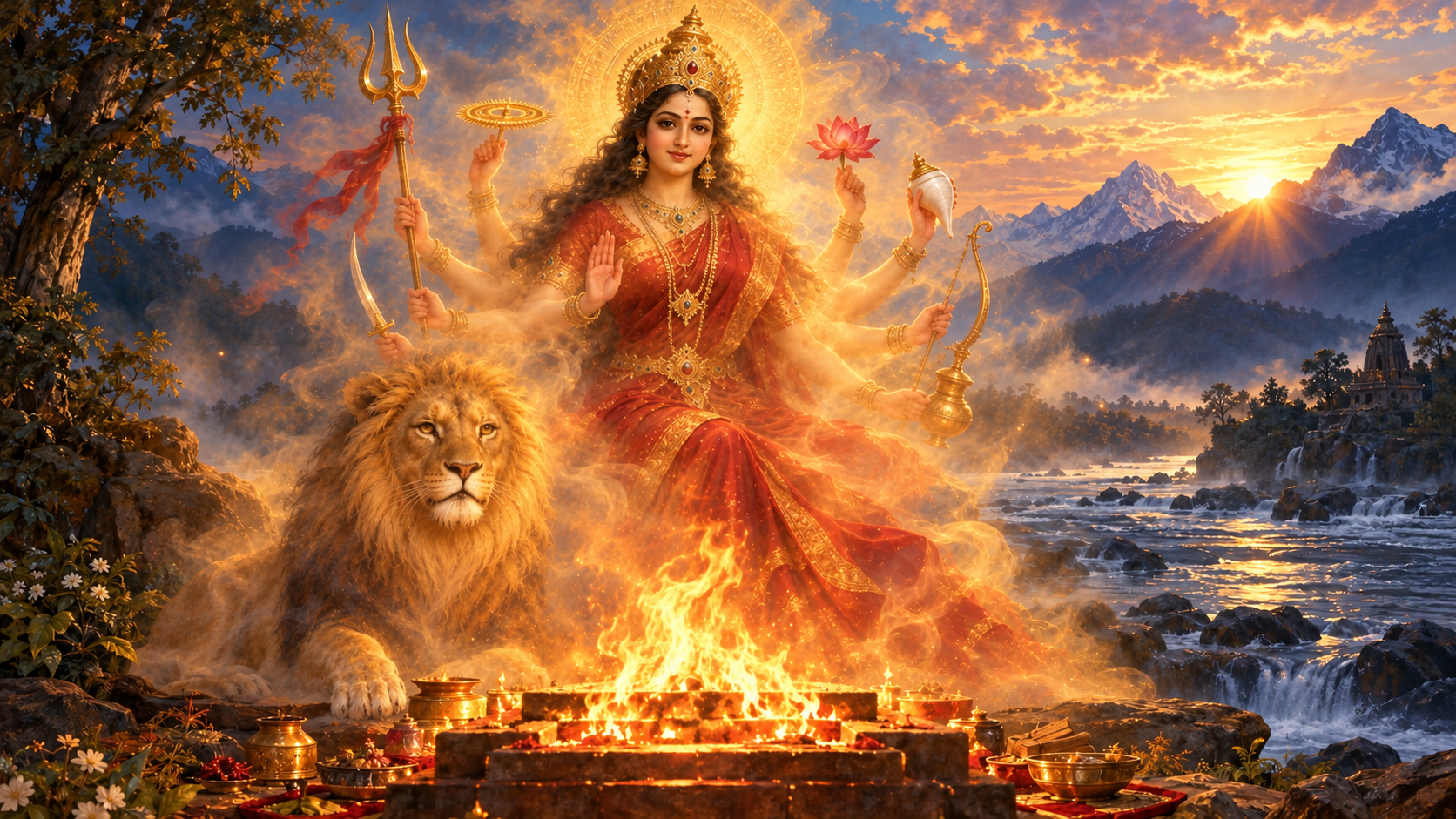
If you have been told that Durga is merely a later Puranic Goddess with no meaningful Vedic foundation, you do not have to choose between accepting that claim and forcing every feature of later Durga worship into the earliest hymns. Both approaches miss how a living sacred tradition develops.
The more defensible answer is also the more illuminating one: the Vedas contain a recognisable theology of divine feminine power, while the Durga Sukta brings protection, fiery radiance, disciplined action, refuge and spiritual crossing into one concentrated prayer. Later Shakta traditions give that ancient pattern a fuller personal and cosmic expression as Adyashakti Durga.
What it means to call Durga Vedic
A Vedic root is not the same thing as a complete later form. A seed and a flowering tree are continuous, but they are not visually identical. In the same way, you should not demand that the Vedas reproduce every Puranic narrative, image or theological formulation before accepting a Vedic foundation for Durga.
Begin with three different questions. Does Vedic worship recognise divine power in feminine form? Does that power protect, illuminate and guide the worshipper through danger? Do later traditions deepen these functions into a theology of the supreme Mother? The answer to each question is yes, although the language and degree of elaboration differ.
The Vedic field of the Divine Feminine includes the Devi Sukta, Ratri Sukta and Shri Sukta. More directly for this inquiry, the Durga Sukta appears in the Taittiriya Aranyaka of the Krishna Yajurveda. Its importance does not rest on finding a later biography hidden word for word in an earlier text. It rests on the spiritual identity of the power being approached: radiant, protective, transformative and able to carry the devotee through what is otherwise difficult to cross.
This distinction protects you from two opposite mistakes. One is anachronism: treating every Vedic deity as identical in every detail to a later Puranic form. The other is historical amnesia: assuming that a more developed later expression must have appeared without any earlier sacred foundation. Continuity allows real development without turning development into invention.
Key takeaways
- Durga’s Vedic roots do not depend on every element of later iconography appearing in an early hymn.
- The Durga Sukta joins protection from difficulty with fire, light, tapas, karmaphala, refuge and awakened intelligence.
- Jatavedas links visible sacrificial fire with a deeper symbolism of knowledge and consciousness.
- Later Shakta theology expands these Vedic patterns into the vision of the Goddess as cosmic power, Maya and a giver of liberation.
- The practical test of Durga worship is not spectacle alone, but whether it produces courage, clarity, discipline and right action.
The Durga Sukta gives you a three-part spiritual map

The Durga Sukta becomes much clearer when you stop looking for only one kind of statement. Its movement is practical as well as theological. It shows the predicament, reveals the power through which it can be crossed, and then asks for guidance of the intelligence.
First: recognise that life contains passages you cannot cross carelessly
The prayer to Jatavedas asks that we be taken through all durgani—the difficulties, dangers and obstructing conditions that stand in the way. Its memorable image is a boat carrying a person across uncertain waters. The line “Sa nah parshad ati durgani vishva” therefore asks for more than the disappearance of an inconvenience. It asks for safe passage through the whole field of difficulty.
This helps you understand the name Durga spiritually. Durga is not only the warrior who defeats a visible enemy. She is also the refuge through whom the difficult becomes crossable. The obstacle may be outside you, but fear, confusion, indiscipline and ignorance can make it more dangerous. Divine protection consequently includes the strength and discernment needed to pass through it.
When you use this prayer, name the passage honestly. “Remove every problem” is too vague to shape your conduct. Ask instead: What am I trying to cross? Which part lies beyond my control? Which weakness in me makes the crossing harder? That turns prayer from a wish for escape into a request for protection joined to self-knowledge.
Second: seek the fire that purifies and reveals
Another mantra presents the Goddess as fire-coloured, blazing through tapas and related to the fruits of action. The devotee then declares, “Durgam devim sharanam aham prapadye”—I take refuge in Goddess Durga. Radiance, tapas, karmaphala and refuge belong to the same vision.
Fire matters here because it does two things at once. It burns and it makes visible. Read inwardly, Durga’s fierceness is therefore not anger without purpose. It is the force that consumes what binds you and the light by which you finally see it. Tapas adds discipline to that force: transformation demands sustained inner heat, not a momentary surge of emotion.
The reference to karmaphala prevents refuge from becoming passivity. Durga gives strength to act, but action still bears fruit. You cannot ask the Mother to carry you across while deliberately steering in the opposite direction. If your prayer is for clarity, your next act should be more truthful. If it is for freedom from a destructive habit, your routine should stop feeding that habit. Grace and responsibility work together.
Third: ask for the right use of intelligence
The Durga Gayatri culminates in “Tanno Durgih prachodayat,” a prayer that Durga inspire or direct us. This matters because divine aid is not limited to protection from external harm. It includes the illumination of the mind that must choose a path.
Raw intelligence can find efficient ways to pursue a bad end. The prayer asks for something higher: intelligence moved toward what is true and beneficial. When you face a difficult decision, do not ask only, “How can I get the outcome I want?” Add two sharper questions: “What course is dharmic?” and “What kind of person will this choice make me?” That is the practical edge of asking Durga to guide the intellect.
Why Agni belongs in a hymn understood through Durga

A common confusion arises because the first mantra addresses Jatavedas, a name of Agni. If you expect sacred identities to behave like mutually exclusive modern labels, the connection to Durga can appear strained. Vedic symbolism is more layered than that.
Agni is certainly the visible sacred fire and the bearer of offerings. Yet fire also signifies light, knowledge and consciousness. The Nirukta explains the name through “Jatani veda iti Jatavedah”: Jatavedas is the one who knows what has come into being. The invocation can therefore be heard at physical, ritual and contemplative levels.
You do not need to erase Agni to honour Durga, nor collapse every distinction among Vedic deities. Follow the prayer’s own movement. The knowing fire receives the offering, destroys hostile or obstructing forces, gives light and carries the worshipper across difficulty. The Goddess is then approached explicitly as fiery, radiant through tapas and worthy of refuge. Agni supplies the sacred grammar through which Durga’s protecting and illuminating power becomes intelligible.
This is also a useful rule for reading Vedic imagery elsewhere: do not reduce a symbol to either matter or metaphor. Sacred fire can be the flame on the altar and the light of awareness without either level cancelling the other. The outer rite disciplines attention; the inner meaning disciplines life.
From Vedic Shakti to the supreme Mother

The later Shakta vision does not merely repeat the Vedic hymns. It makes their implications more explicit. In the Sri Sri Chandi, or Devi Mahatmyam, the Goddess is praised as Vaishnavi Shakti of immeasurable power, the seed of the universe and the supreme Maya. Her grace is also presented as a means to liberation.
That is a major theological flowering, but its central functions remain recognisable. The power who carries the devotee through danger becomes the Mother who protects the worlds. The fire that burns obstruction becomes the force that destroys demonic power. The light that reveals becomes divine knowledge. Refuge during a difficult crossing opens into liberation from bondage itself. Later Durga theology gathers protection, cosmic power, Maya and liberation into one vision of the Goddess.
This is where the term Adyashakti becomes meaningful. It identifies the Goddess not as one limited power among many, but as primordial divine potency—the power through which the universe is sustained, through which beings act, and through which ignorance can be overcome. The Vedic roots lie in the experience and invocation of that power; the later tradition states its supremacy with greater fullness.
Be precise when you explain this to someone else. Do not say, “The later Durga is described identically everywhere in the Vedas.” That is too strong. Say instead: “The Vedas already contain the feminine divine and a Durga prayer centred on fiery radiance, protection, refuge, right action and safe passage. Shakta scripture later develops those realities into an explicit theology of the supreme Mother.” That formulation neither diminishes tradition nor asks the text to say more than it does.
Let Vedic Durga change how you worship

The Vedic connection matters only partly as an answer to a historical objection. Its greater value is that it corrects a shallow understanding of worship. Durga is not invoked simply to crush an enemy on your behalf. She is approached for the power, light and disciplined intelligence by which you can cross difficulty without surrendering dharma.
You can bring that understanding into a daily prayer, a recitation of the Durga Sukta or the observance of Durga Puja through a simple sequence:
- Name one concrete durga, or difficult passage, instead of asking vaguely for every discomfort to vanish.
- Identify the inner condition that increases the danger—fear, anger, confusion, pride, inertia or lack of discipline.
- Invoke Durga as both protection and illumination. Ask not only to be spared, but to see clearly.
- Choose one dharmic action that matches the prayer. The reference to karmaphala makes conduct part of worship.
- Review the result without bargaining with the Goddess. Notice whether the practice produced greater courage, clarity, restraint and capacity to serve.
The same test applies to public celebration. Images, decoration and communal gathering belong to Durga Puja’s living cultural expression, but grandeur is not its spiritual measure. Devotion, discipline, purification and surrender remain the festival’s inner purpose. A celebration that attracts attention but leaves no room for these has preserved the outer vessel while neglecting what it is meant to carry.
Before your next recitation or Puja, write down three things: the difficulty you must cross, the weakness you must stop feeding, and the action you will take in alignment with dharma. Then approach Durga as the Mother who protects, the fire that reveals and the Shakti who moves right understanding into courageous action. That is where the Vedic root becomes a living practice rather than a debating point.
References

Leave a Reply
You must be logged in to post a comment.