Category: Spiritual Insight

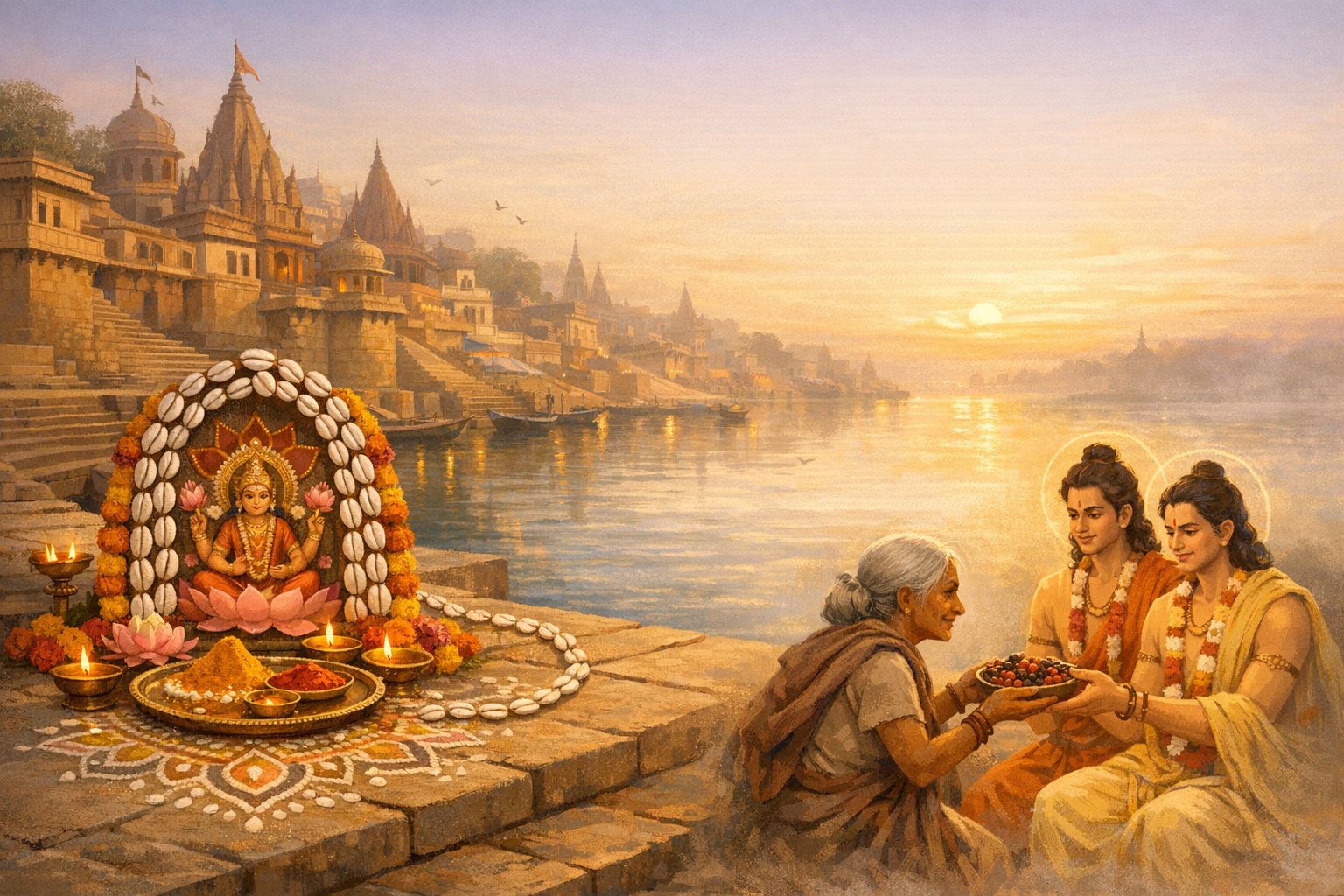
  • Divine Economics Unveiled: Why Lakshmi Chooses Vishnu—Eternal Wealth, Preservation, Dharma

    Divine Economics Unveiled: Why Lakshmi Chooses Vishnu—Eternal Wealth, Preservation, Dharma

    The union of Lakshmi and Vishnu is a precise ethical model in Hindu philosophy: prosperity endures only when guided by preservation. Scriptural narratives like Samudra Manthan show wealth choosing the preserver, while the Bhagavad Gita illuminates how stewardship sustains social balance. The insight translates into daily life—families, businesses, and communities flourish when accountability, restraint, and…

  • ‘Three Crore Gods’? A Scholarly, Respectful Reply Clarifying Hinduism’s Unity-in-Diversity

    ‘Three Crore Gods’? A Scholarly, Respectful Reply Clarifying Hinduism’s Unity-in-Diversity

    This article addresses the familiar question, “How many gods do Hindus believe in? Are there three crore?” with a calm, scholarly explanation. It clarifies that Hinduism centers on one ultimate reality (Brahman), while allowing many names and forms as legitimate approaches. The Ishta-devata principle explains personal choice in devotion, grounded in unity rather than fragmentation.…

  • SB 10.87.03 Unveiled by HH Bhakti Anugraha Janardan Swami: Paramparā and Inner Freedom

    SB 10.87.03 Unveiled by HH Bhakti Anugraha Janardan Swami: Paramparā and Inner Freedom

    This reflection on Srimad-Bhagavatam 10.87.03, presented at ISKCON Vrindavan on 03.12.2025 by HH Bhakti Anugraha Janardan Swami, explains why knowledge of the Absolute Truth is trustworthy when received through authentic paramparā. It encourages disciplined reverence over fruitive ritualism and unanchored speculation, guiding practitioners to relinquish upādhis—false designations—and cultivate inner freedom. The analysis situates the teaching…

  • Durvasa and Ambarisha: Perils of Offending Devotees and the Restorative Power of Bhakti

    Durvasa and Ambarisha: Perils of Offending Devotees and the Restorative Power of Bhakti

    Sri Sukadeva Goswami’s narration of Durvasa Muni and King Ambarisha (SB 9) demonstrates how offending devotees imperils spiritual progress, while humility and devotion offer a reliable remedy. The story’s turning point—Durvasa glorifying Ambarisha and seeking permission before traveling to Brahmaloka—exemplifies how bhakti resolves conflict and restores harmony. The text advances an ethic of respect for…

  • Beyond Religious Rigidity: Dharmic Paths Realize the Divine Through Personal Freedom

    Beyond Religious Rigidity: Dharmic Paths Realize the Divine Through Personal Freedom

    This article examines how Hinduism, Buddhism, Jainism, and Sikhism converge on a core principle: authentic divine realization emerges through personal freedom rather than religious rigidity. Drawing on the Upanishads, the Bhagavad Gita, Ishta philosophy, Anekantavada, and Sikh devotion to Naam, it shows how discipline functions as a tool for liberation, not coercion. The discussion clarifies…

  • Dashavatara Decoded: Ancient India’s Hidden Scientific Genius and Dharmic Unity

    Dashavatara Decoded: Ancient India’s Hidden Scientific Genius and Dharmic Unity

    The Dashavatara offers a sophisticated, non-sectarian framework for thinking about evolution, consciousness, and cosmic order in a way that resonates across Hinduism, Buddhism, Jainism, and Sikhism. Interpreted academically, the avatars serve as pedagogical metaphors for ecological insight, ethical formation, and inner refinement. This approach avoids anachronism while honoring ancient India’s scientific wisdom expressed through symbols.…

  • Unlocking Kundalini: The Mad Sadhu on Purusha–Prakriti, Nirvikalpa, and Praṇava

    Unlocking Kundalini: The Mad Sadhu on Purusha–Prakriti, Nirvikalpa, and Praṇava

    This rigorous retelling of Babaji’s discourse on Kundalini Yoga clarifies how the mind’s restraint (nirodha) opens into laya and nirvikalpa samādhi, where stillness reflects Purusha and activity reflects Prakriti. It explains how icchā-śakti awakens near nirvikalpa, refining desire into a unitive will aligned with pure consciousness. The analysis of bhāva-ākāśa shows how feeling unfolds as…

  • Ishtapurta Unveiled: Powerful Harmony of Vedic Offerings and Social Charity in Hinduism

    Ishtapurta Unveiled: Powerful Harmony of Vedic Offerings and Social Charity in Hinduism

    Ishtapurta (Ishta Purta) unites two essential dimensions of Hindu practice: Vedic offerings (Ishta) and charitable works for public welfare (Purta). This balanced ideal frames spiritual merit (punya) as the fruit of aligning ritual discipline with social responsibility. In lived tradition, devotees often integrate pūjā and mantra with seva, philanthropy, and ecological care, experiencing a felt…

  • When Honor Is Misplaced: Skanda Purana’s Warning—Fear, Famine, and Death Follow

    When Honor Is Misplaced: Skanda Purana’s Warning—Fear, Famine, and Death Follow

    Skanda Purana, Kedara Khanda (3.45), links misplaced honor to societal breakdown symbolized as fear, famine, and death. The teaching, conveyed through Lord Vishnu, gains clarity when read alongside the narrative of Daksha’s transgression and the disruption of ritual order. Interpreted as a diagnostic model of dharma and adharma, it explains how fear rises when moral…

  • Rashi Anusar Mantra: Powerful Zodiac Mantras to Remove Obstacles and Invite Prosperity

    Rashi Anusar Mantra: Powerful Zodiac Mantras to Remove Obstacles and Invite Prosperity

    This article introduces Rashi Anusar Mantra as a contemplative practice that aligns mantra-japa with the twelve Vedic zodiac signs to reduce obstacles and cultivate prosperity. It preserves the original Hindi context while clarifying how zodiac mantras integrate intention, attention, and ethical action. The discussion highlights shared insights from Hinduism, Buddhism, Jainism, and Sikhism, emphasizing unity…

  • Putra Prapti Pujan Explained: Dharma‑aligned rituals and gentle remedies for healthy progeny

    Putra Prapti Pujan Explained: Dharma‑aligned rituals and gentle remedies for healthy progeny

    This guide reframes पुत्र प्राप्ति के लिये ज्योतिष उपाय and Putra Prapti Pujan as compassionate, dharma-aligned practices aimed at overall family well-being. It explains commonly observed pujas—Santana Gopala worship, Putrada Ekadashi, and Shiva–Parvati puja—while emphasizing equality for पुत्र and पुत्री. Readers learn how Jyotisha can complement, not replace, medical guidance, and how ethical intent, seva,…

  • Tripada Trimurti Unveiled: The Profound Symbolism of Shiva’s Three-Footed Trinity

    Tripada Trimurti Unveiled: The Profound Symbolism of Shiva’s Three-Footed Trinity

    Tripada Trimurti presents the Trimurti—Brahma, Vishnu, and Shiva—through the striking motif of three feet, highlighting the unity of creation, preservation, and transformation. This interpretation clarifies how the visible legs of Vishnu and Shiva, with the third principle implied through Brahma or the composite form, teach oneness-in-diversity. Readers gain a clear understanding of the term’s meaning,…

  • The Transformative Power of Book Distribution: Sankirtana, Prasadam, and Dharmic Unity

    The Transformative Power of Book Distribution: Sankirtana, Prasadam, and Dharmic Unity

    Book distribution in the Krsna consciousness movement functions as sankirtana—the devotional glorification of the divine through words. It is simple and accessible, whether through the Hare Krsna mantra or reflective reading and discussion. Receiving a book invites personal dialogue with the philosophy and pastimes of Krsna, offering solace and ethical clarity. Temples complement these efforts…

  • Inspiration Through Love: Balancing Discipline and Compassion in Dharmic Education

    Inspiration Through Love: Balancing Discipline and Compassion in Dharmic Education

    This reflection presents a practical framework for Dharmic education: love as the source of inspiration and discipline as a compassionate structure. It explains how clear boundaries, when rooted in care, foster intrinsic motivation and dignity in the Guru–Shishya relationship. The discussion connects Hindu, Buddhist, Jain, and Sikh values—bhakti, karuṇā, ahiṃsā, and seva—to demonstrate unity in…

  • Compassion Without Boundaries: Bhakti, Ahimsa, and Seva for the Welfare of All

    Compassion Without Boundaries: Bhakti, Ahimsa, and Seva for the Welfare of All

    This reflection, inspired by His Divine Grace A.C.B. Swami Prabhupada, explores how bhakti-yoga calms the mind and orients the heart toward the welfare of all beings. It connects the Vaisnava ethos of universal compassion with shared dharmic principles—maitri, karuna, ahimsa, seva, and simran—found across Hinduism, Buddhism, Jainism, and Sikhism. The discussion highlights how remembrance of…

  • Beyond Name and Form: Advaita Vedanta’s Transformative Path to the Infinite and Unity

    Beyond Name and Form: Advaita Vedanta’s Transformative Path to the Infinite and Unity

    This essay explores a core insight of Hindu philosophy: that ignorance confines the infinite through name and form. Advaita Vedanta explains how naming obscures Brahman’s boundless nature, while still valuing forms as compassionate gateways. Relatable examples—like the sky in a pot and the ocean’s waves—illustrate why labels are helpful yet limited. The discussion connects this…

  • Avadhuta’s Radical Stillness: Transformative, Goal‑Free Awareness across Dharmic Traditions

    Avadhuta’s Radical Stillness: Transformative, Goal‑Free Awareness across Dharmic Traditions

    This reflection examines the Avadhuta ideal in Hinduism as a disciplined, goalless awareness that reveals freedom without withdrawal from life. It clarifies that “sitting and watching” is rigorous witness-consciousness (sakshi-bhava), not apathy or inertia. The discussion situates this insight within Advaita Vedanta and aligns it with parallel practices across Buddhism, Jainism, and Sikhism, highlighting unity…

  • Resilience in Hinduism: Timeless Dharmic Practices to Rise Strong from Adversity

    Resilience in Hinduism: Timeless Dharmic Practices to Rise Strong from Adversity

    This article examines resilience in Hinduism as a cultivated capacity grounded in abhyāsa (practice) and vairāgya (wise non-attachment). Drawing on the Bhagavad Gita, the Upanishads, and the Yoga Sutra, it outlines how equanimity, witnessing awareness, and disciplined routines foster emotional balance. Practical methods—dhyāna, prāṇāyāma, and mantra japa—are presented as accessible tools for stress management and…

  • Choose Trust Over Revenge: A Dharmic Roadmap to Inner Strength, Peace, and Unity

    Choose Trust Over Revenge: A Dharmic Roadmap to Inner Strength, Peace, and Unity

    In moments of hurt, choosing trust over revengeful action redirects energy from escalation to healing. Grounded in dharma, ahimsa, compassion, and kshama, this approach is shared across Hinduism, Buddhism, Jainism, and Sikhism. It combines inner clarity with practical accountability, replacing reactive punishment with boundaries, due process, and restorative steps. Mindfulness and brief meditation strengthen emotional…

  • December 9, 2025 Panchang Guide: Krishna Paksha Panchami → Sashti Timings, Meaning, and Planning Tips

    December 9, 2025 Panchang Guide: Krishna Paksha Panchami → Sashti Timings, Meaning, and Planning Tips

    On Tuesday, December 9, 2025, Krishna Paksha Panchami prevails until 8:01 PM and then transitions to Krishna Paksha Sashti. This Panchang update helps plan rituals, study, and daily routines with clarity and calm. Panchami favors introspection and steady sadhana, while Sashti encourages discipline and purification. Shubh Muhurat, Nakshatra, and Rashi vary by region, so local…