
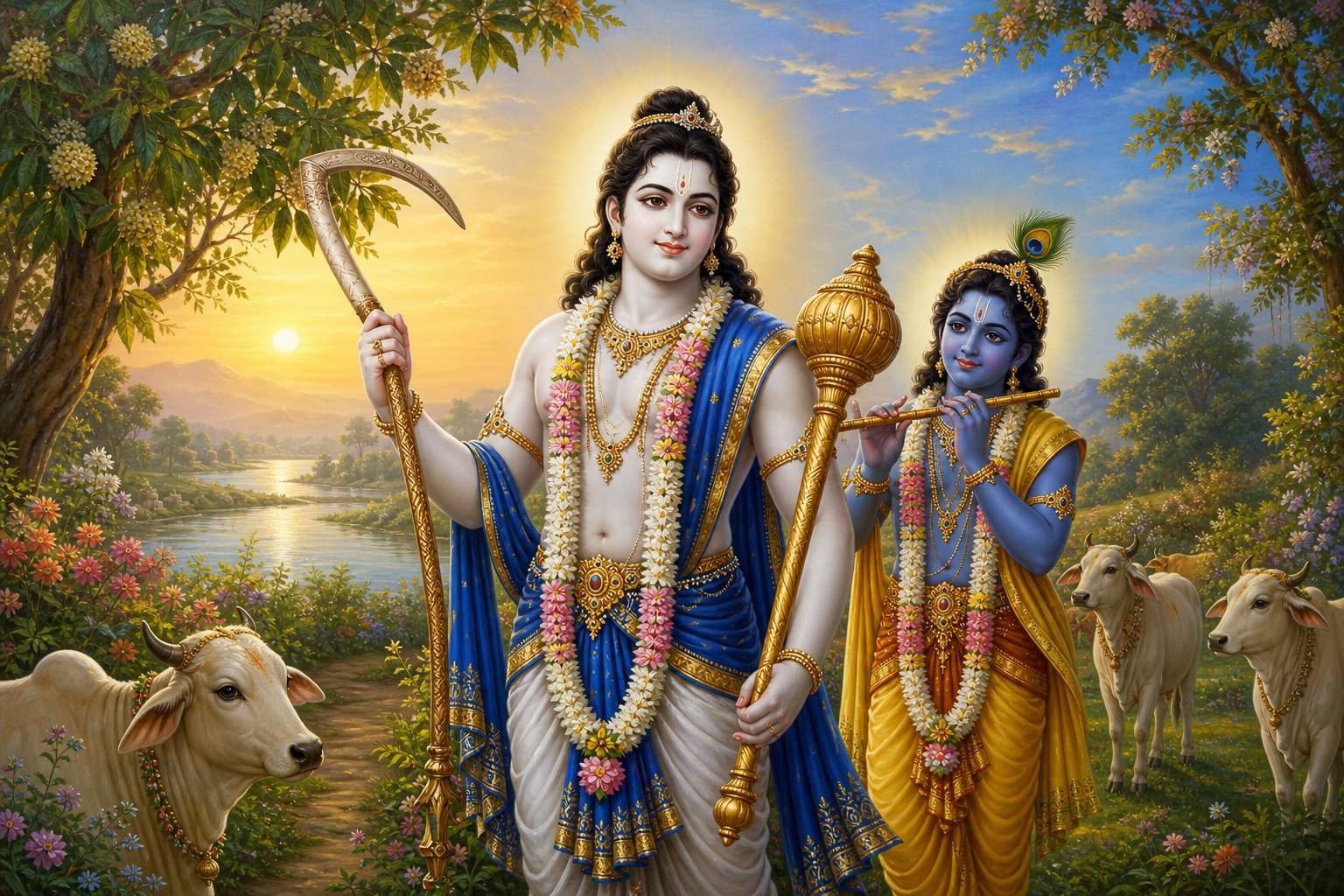
If you have seen a fair-complexioned figure in blue garments carrying a plough beside Lord Krishna, you are probably looking at Lord Balarama. The harder question is how to understand Him. Is He Krishna’s elder brother, Krishna’s first expansion, Sankarshana, or Ananta-Sesha? In the Gaudiya Vaishnava understanding, these are not competing answers. They describe one divine identity through different relationships and functions.
The word “appearance” creates a second ambiguity. It can mean what Lord Balarama looks like, or it can mean how He descended into the world. Keeping those two meanings separate gives you a coherent picture: who He is, why He has several names, how Devaki and Rohini are both connected to His appearance, and which features reliably identify Him in sacred art.
Key takeaways
- Within Gaudiya Vaishnava theology, Lord Balarama is Lord Krishna’s first full personal expansion and His eternal elder brother in Krishna-lila.
- He is non-different from Krishna in divine identity, yet distinct in appearance, relationship and function. A useful shorthand is: the same divinity, expressed through a different role.
- He first appeared in Devaki’s seventh pregnancy and was transferred by Yogamaya to Rohini. Calling Him Rohini-putra does not erase His connection with Devaki.
- His most recognizable visual features are a fair complexion, blue garments and a plough carried as a weapon. His presence beside Krishna strengthens the identification.
- Rama, Bala, Sankarshana, Dauji, Ananta and Sesha are not decorative synonyms. Each reveals something about His joy-giving nature, strength, family relationship, cosmic function or service.
Balarama is Krishna’s first expansion, not merely His sibling
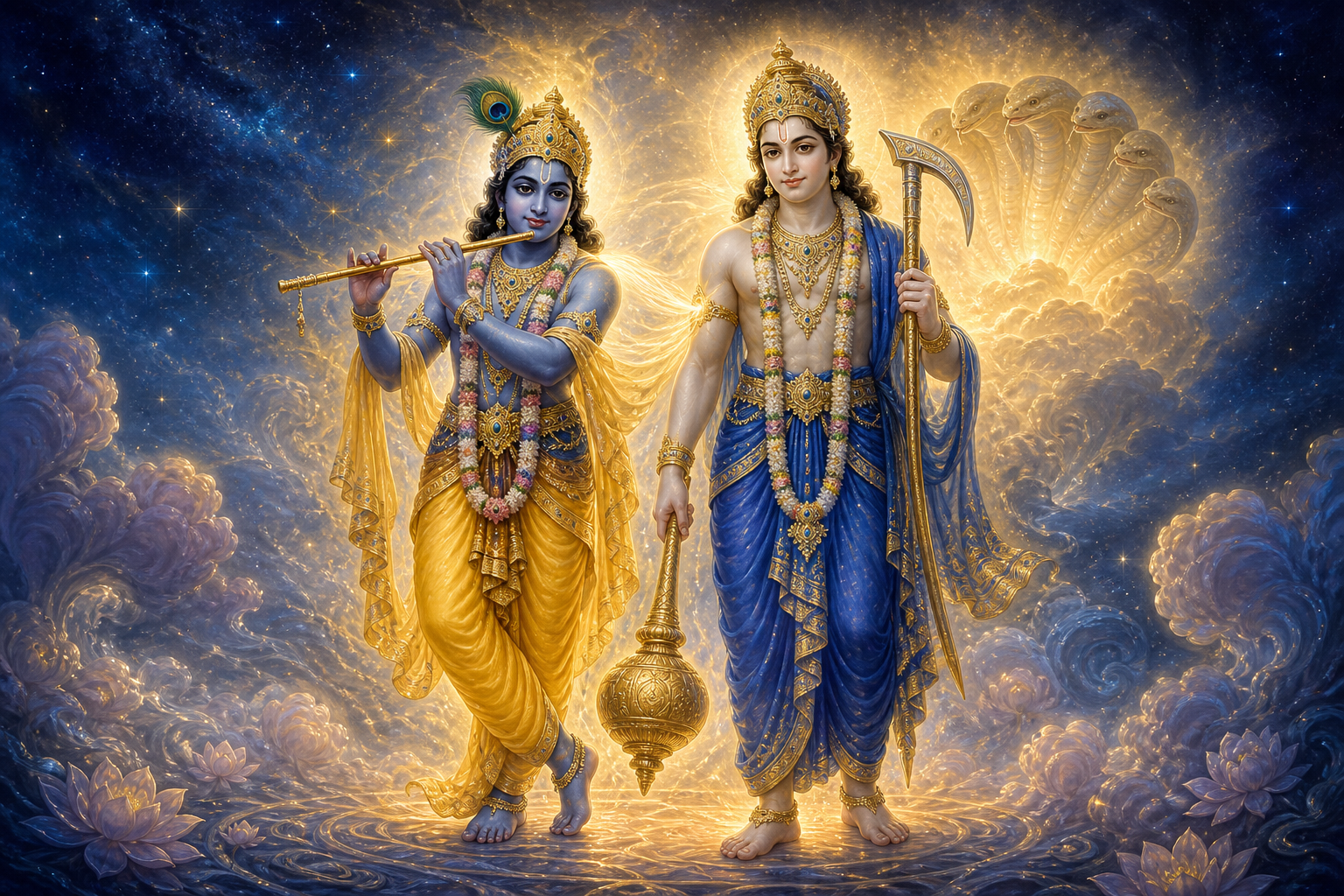
Begin with the scope of the explanation. Hindu sampradayas do not always arrange divine identities in precisely the same theological language. The map used here is the Gaudiya Vaishnava one: Krishna is the original Personality of Godhead, and Balarama is His first personal expansion, sometimes described as His second body. If you are explaining Balarama in an inter-sampradaya setting, naming that framework is more accurate than presenting one school’s formulation as the only possible Hindu account.
“Expansion” does not mean that Krishna was once alone, divided Himself, and produced Balarama at a later moment. Krishna and Balarama are understood as eternally existing together. The language of expansion helps a finite mind describe their relationship; it is not a chronological account of one divine person manufacturing another. Nor is Balarama placed in the same category as an individual jiva. Balarama possesses the fullness of Krishna’s divine identity, while the jiva remains an infinitesimal and dependent part of the Lord.
This gives you a precise way to hold unity and distinction together. Balarama is not a rival deity competing with Krishna, and He is not merely a powerful human brother standing near God. He is non-different from Krishna in divinity, while taking a distinct form and serving in a distinct relationship. As the elder brother, He accompanies Krishna, protects His companions and participates in His pastimes. His difference is meaningful without becoming separation.
His identity can be read at three connected levels:
- In intimate lila: He is Krishna’s elder brother and constant companion. His strength supports the delight, protection and movement of Krishna’s pastimes.
- At the cosmic level: His identity unfolds through Sankarshana and the forms associated with the support, ordering and manifestation of the spiritual and material worlds.
- As the principle of seva: He becomes Ananta-Sesha, the support and resting place of Vishnu, and is also described as serving through Krishna’s throne, bed, garments, umbrella, slippers and other personal paraphernalia.
This is why a bare statement such as “Balarama is Krishna’s brother” is true but incomplete. It identifies His family relationship without explaining His divine identity. The opposite error is to discuss cosmic expansions so abstractly that Dauji, the beloved elder brother who walks with Krishna, disappears. A sound explanation keeps both together: cosmic majesty expressed through intimate service.
The same service relationship is recognized in other divine descents. Balarama serves as the younger brother of Lord Ramachandra and later appears as Nityananda Prabhu alongside Sri Chaitanya Mahaprabhu. The outward family position changes, but the underlying movement does not: He places divine strength at the service of the Lord’s purpose.
The appearance narrative explains Devaki, Rohini and Sankarshana
You may encounter one account calling Balarama the son of Rohini and another connecting Him to Devaki’s womb. Within the traditional narrative, there is no contradiction. Each statement refers to a different part of His appearance.
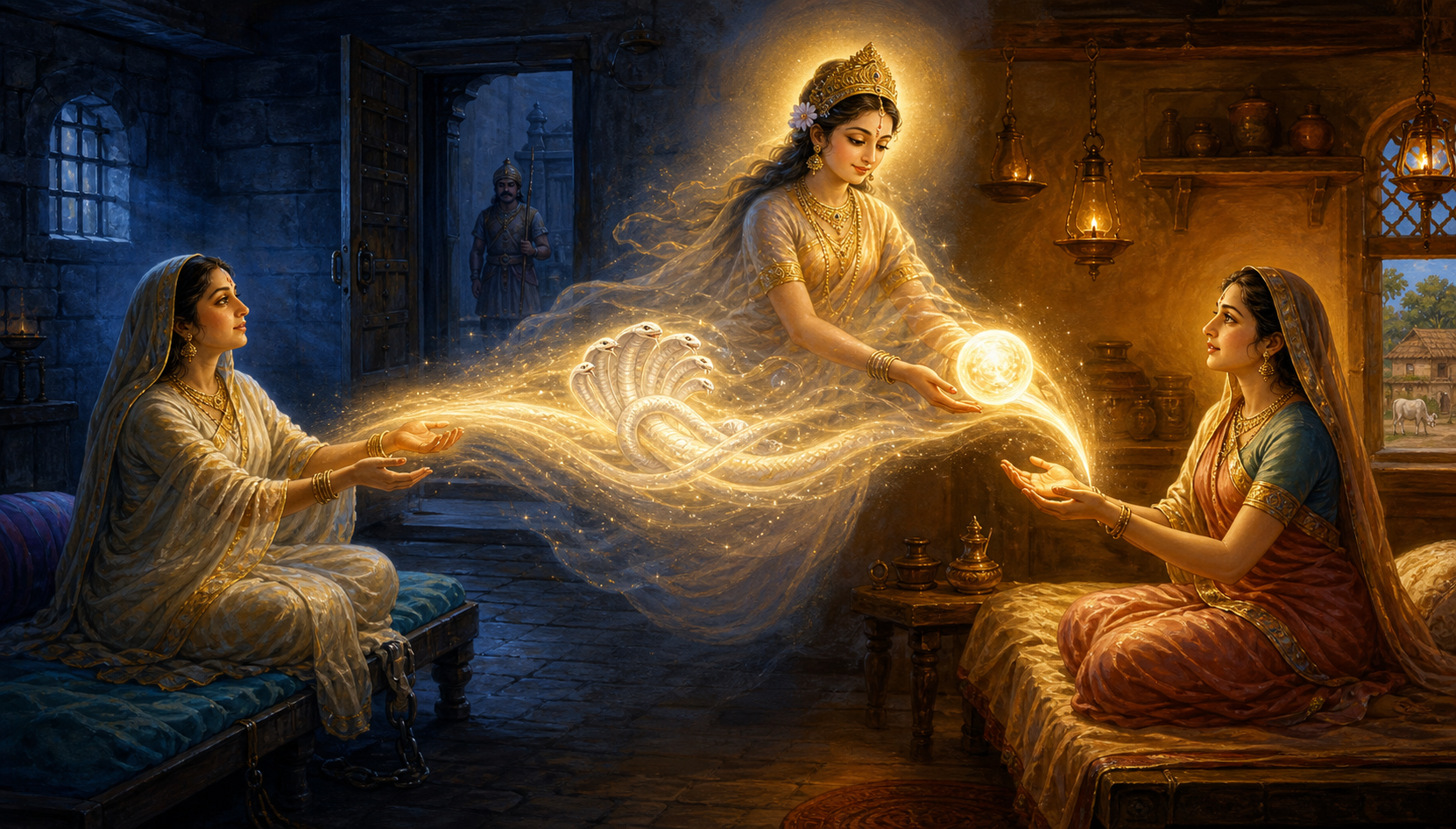
- King Kamsa heard the celestial warning that Devaki’s eighth child would bring about his death. He therefore killed the children born to Devaki.
- Lord Balarama appeared as the child of Devaki’s seventh pregnancy.
- At Krishna’s direction, Yogamaya transferred the child from Devaki’s womb to the womb of Rohini, another wife of Vasudeva who was then living under the protection of Nanda’s community in Gokula.
- Devaki appeared to have lost the pregnancy, while Rohini began to show the signs of carrying the child.
- Balarama was consequently born and raised as Rohini’s son, becoming Krishna’s elder brother in the earthly lila.
Calling Him Rohini-putra therefore identifies the mother who carried and gave birth to Him. Remembering His transfer from Devaki to Rohini preserves the whole account. If you teach this narrative, give the sequence before discussing the names; otherwise listeners can mistake two stages of one appearance for two incompatible birth stories.
Srimad Bhagavatam 10.8.12 connects three of His principal names with qualities and relationships revealed through this appearance. The names form a compact theological guide:
| Name or title | What it tells you | How to use it accurately |
|---|---|---|
| Rama | He gives happiness to relatives and friends through His transcendental qualities. | Hear the name here in connection with Balarama’s joy-giving presence, not as an automatic reference to Lord Ramachandra. |
| Bala | He manifests extraordinary bodily and divine strength. | Connect His strength with protection and service, rather than treating it as mere physical power. |
| Sankarshana | He draws together and unites, including the families of Vasudeva and Nanda through His transferred appearance. | Use the name for both this unifying relationship and, with proper context, His larger cosmic identity. |
| Dauji | He is the respected and affectionate elder brother of Krishna. | Use this title when emphasizing the intimate family mood of Krishna-lila. |
| Ananta or Sesha | His unlimited service supports the Lord and the cosmic manifestation. | Use these names when discussing His serpent form, His support of Vishnu, or His embodiment of ceaseless seva. |
Do not force every name into the same setting. Rama, Bala and Sankarshana are explained in the naming account; Dauji foregrounds His relationship with Krishna; Ananta and Sesha disclose His cosmic and serving functions. The person is one, but the names direct your attention to different dimensions of that person.
How to recognize Lord Balarama in sacred art
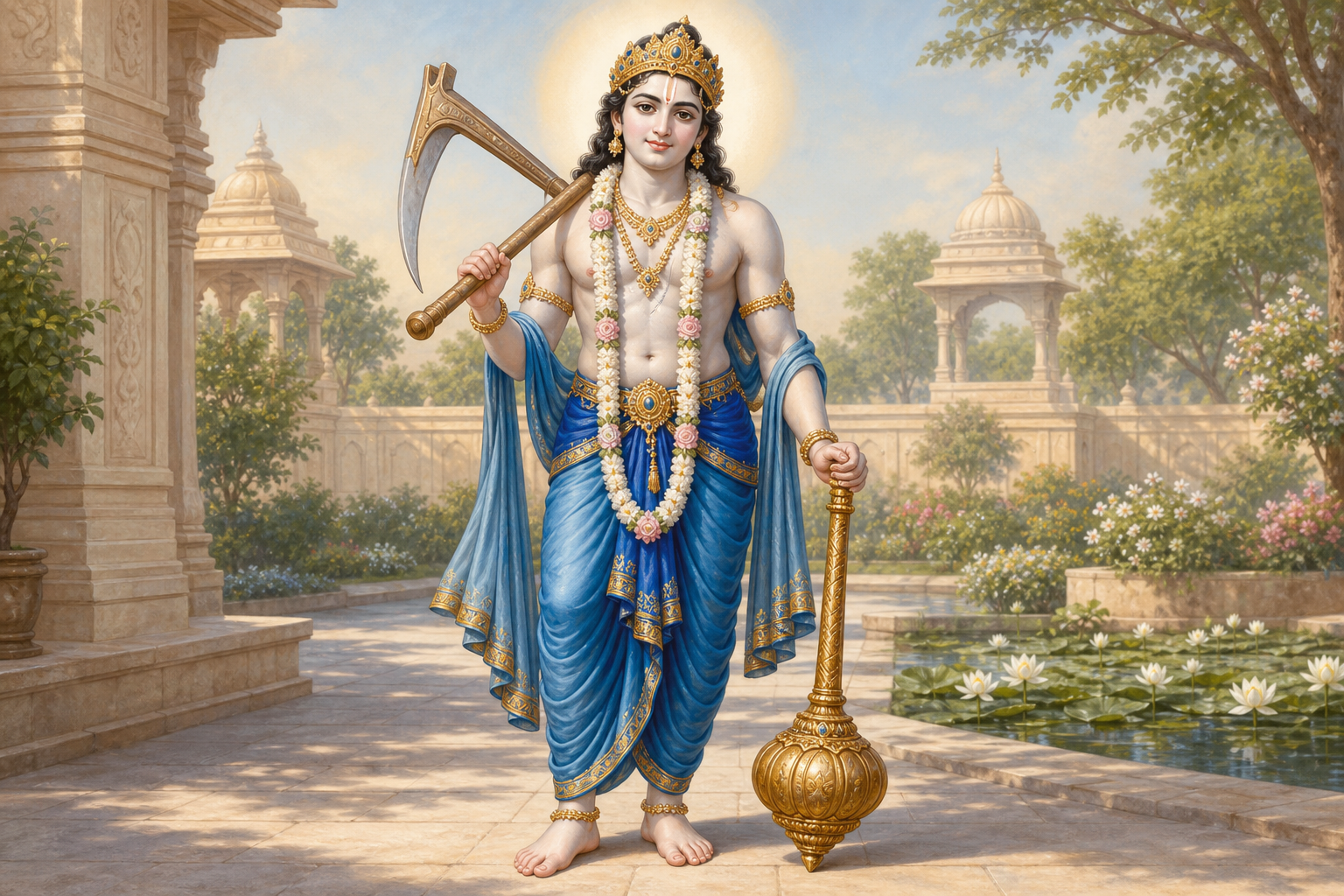
Lord Balarama’s Krishna-lila form is described as handsome, powerful and fair in complexion, or gaura. He favors blue garments, which visually echo His bond with dark-complexioned Krishna. He carries a plough in His hand as a weapon. These three elements – fair form, blue clothing and plough – provide the strongest visual starting point.
Look for a cluster of features rather than demanding that every image contain every detail:
- Fair complexion: His light or moonlike bodily color distinguishes Him from Krishna when the brothers appear together.
- Blue garments: The color reinforces His closeness to Krishna and creates a deliberate visual relationship between the brothers.
- The plough: This is not merely a farming prop placed in the background. It is carried as Balarama’s characteristic weapon and directly expresses His identity as the Lord of extraordinary strength.
- Krishna beside Him: The fraternal context can be as important as any single object. A fair figure accompanying Krishna, especially while holding a plough, is a strong identification.
- Royal and pastoral ornamentation: Descriptions include a jeweled necklace, flower garlands, long earrings, tilaka, hair tied upon the head, armlets, bracelets and anklets. A gunja ornament is also associated with His chest.
- Majestic bodily bearing: He has long arms, striking beauty and a grave voice compared with rumbling clouds. The voice cannot identify a painting, but it matters when you are reading or narrating Balarama-katha.
No single color reproduction should be treated as infallible. Paintings, festival decorations and regional murtis may simplify ornaments or render colors differently. If the plough is absent and the surrounding figures are unclear, consult the image caption or the temple’s own identification before assigning a name. Pale complexion alone is not enough.
It also helps to distinguish two forms that belong to the same theology. The fair, humanlike elder brother who walks beside Krishna is Balarama in Krishna-lila. The many-hooded serpent who supports Vishnu is Ananta-Sesha, Balarama’s unlimited form of support and personal service. Recognizing one form should not cause you to deny the other, but an image label should say which form is actually depicted.
If you are writing a caption or accessibility description, name only what can be seen. A useful pattern is: Lord Balarama, fair-complexioned and dressed in blue, holding His plough beside Lord Krishna. Remove any feature that is not visible in the particular image. This produces a more useful description than simply writing “a Hindu deity” or listing theological identities the viewer cannot see.
His appearance turns strength into a practice of service
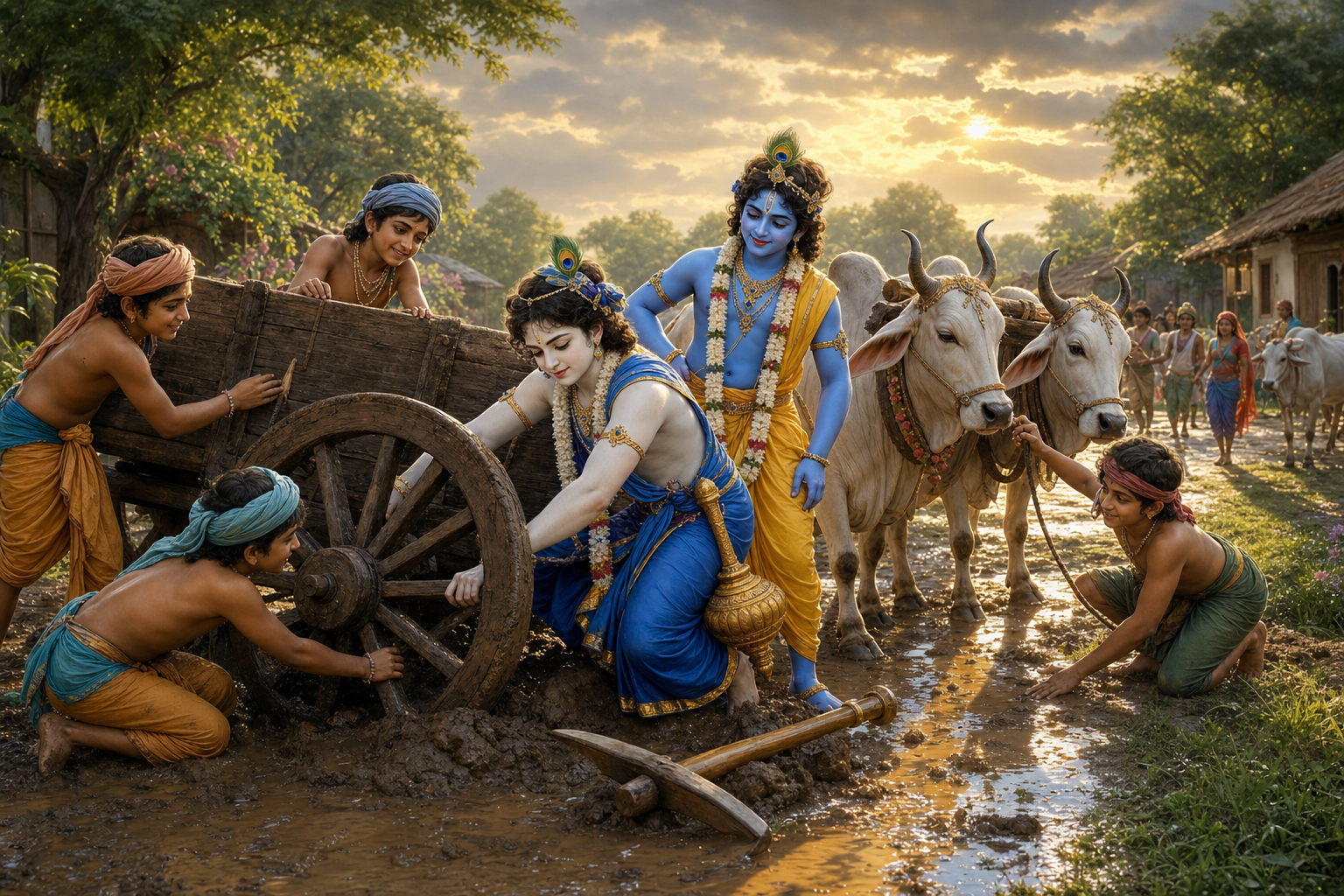
Balarama’s name and form repeatedly bring you back to bala, strength. Yet His strength is not presented as self-display. It assists Krishna, protects Krishna’s companions and makes divine service possible. Even at the cosmic scale, power becomes support: Ananta-Sesha bears, shelters and serves rather than competing for the center.
The Talavana lila makes the principle concrete. The ass-demon Dhenuka and his companions prevented the cowherd boys from enjoying the forest’s fruits. Balarama defeated Dhenuka and his associates, removing the threat faced by His companions. The episode helps you read the plough-bearing form correctly: His formidable power operates within relationship, protection and service.
This is also why devotees seeking Krishna are encouraged to seek Balarama’s mercy for proper bhakti. The point is not that Balarama stands between you and Krishna as a rival claimant. He is Krishna’s own first expansion and the original serving principle. Approaching Him means asking for the strength, stability and willingness through which service to Krishna becomes real.
You can carry that understanding into worship, teaching or an appearance-day observance in four specific ways:
- Tell the descent in its proper order. Begin with Devaki’s seventh pregnancy, then the transfer by Yogamaya, then Rohini’s motherhood. This prevents the most common confusion in the narrative.
- Explain identity before listing expansions. Say first that Balarama is Krishna’s first full personal expansion and elder brother. Introduce Sankarshana and Ananta-Sesha only after that foundation is clear.
- Use the visible form to teach the function. Connect the fair form, blue garments and plough with closeness to Krishna, extraordinary strength and protective service. Do not leave the iconography as a list of colors and objects.
- Turn bala toward seva. Ask where your own strength can carry a burden, protect another devotee, preserve a tradition or make worship possible. That question comes closer to Balarama’s example than admiration of power by itself.
The next time you stand before Lord Balarama’s murti, do more than identify the plough. Notice where He stands, whom He accompanies and what His strength makes possible. Then choose one burden you can carry in service. That is a practical way to let His appearance correct your understanding of spiritual power.
References
- Dandavats – Srimad Bhagavatam (Balarama Katha), Text 10.8.12
- Dandavats – Lord Balarama Appearance
- Dandavats – Lord Balarama: Who is He
- Dandavats – Lecture on Lord Balarama’s Appearance Day
