
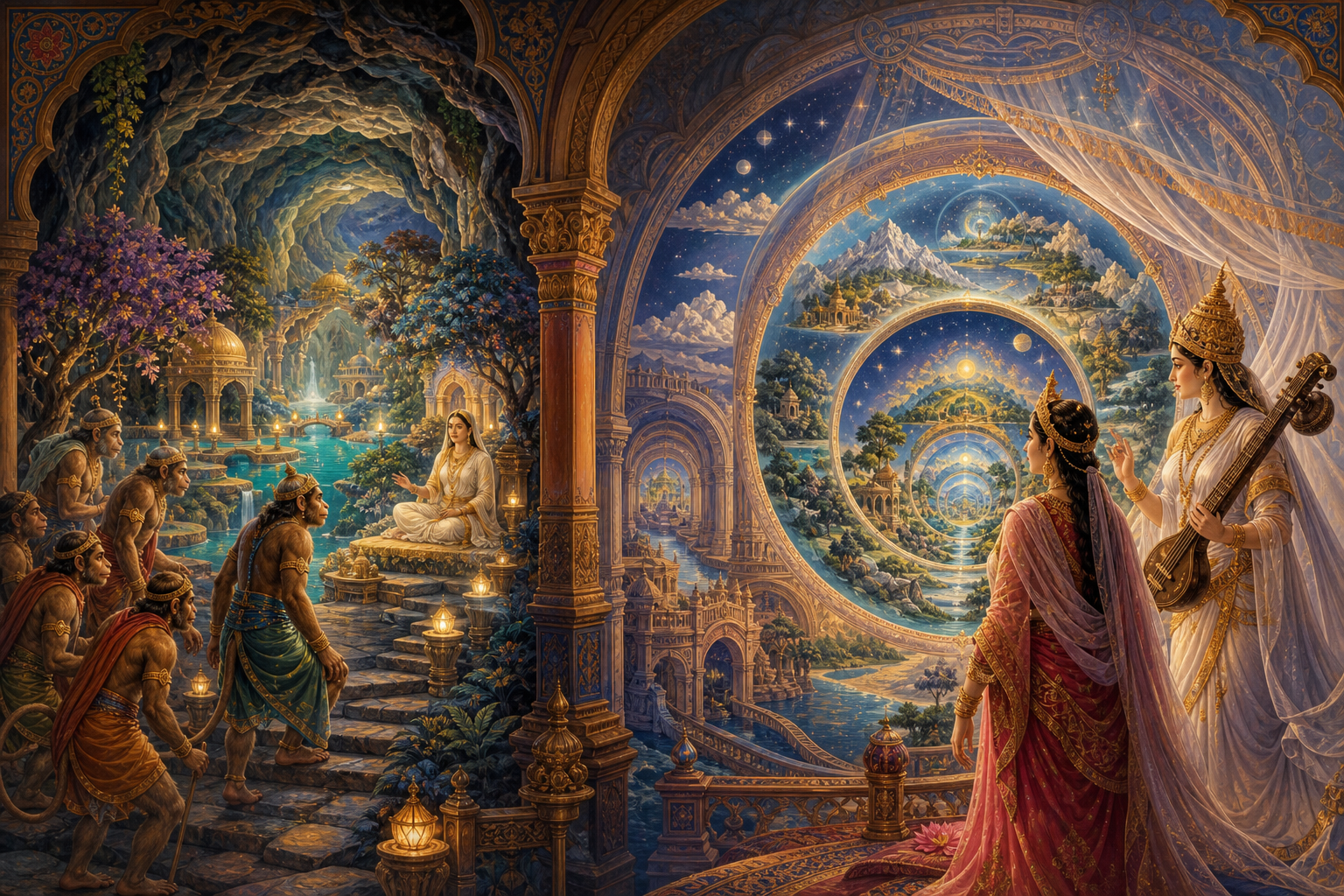
If you came to these passages wondering whether Hindu scripture anticipated the modern multiverse, the honest answer is more useful than a simple yes or no. Swayamprabha’s cave in the Ramayana and Leela’s canopy universe in the Yoga Vasistha both overturn ordinary ideas of size, location, and containment. Yet neither should be forced into the vocabulary of contemporary physics.
The sounder approach is to ask what the impossible space makes you notice. Read each episode in its own setting first. Then compare the change in standpoint that both demand. This preserves the distinctive purpose of each work while revealing why the image of a vast world folded into a small place carries such philosophical force.
The same spatial paradox serves two different purposes

The first discipline is genre. The Ramayana presents Bhagavan Rama’s life through itihasa, where teachings emerge through persons, choices, journeys, encounters, and their consequences. The Yoga Vasistha places its cosmological narratives inside a philosophical dialogue between Sage Vasistha and Prince Rama, directed toward awakening. That difference of purpose governs how Swayamprabha’s cave and the Leelopakhyana should be read.
| Reading question | Swayamprabha’s cave | Leela’s canopy universe |
|---|---|---|
| Immediate setting | An extraordinary place encountered within the action of an itihasa | A nested cosmological account within philosophical instruction |
| First question to ask | What does this encounter require the participants to perceive or do? | What assumption about an independently fixed world is being unsettled? |
| Primary effect | The marvellous enters lived and morally consequential action | The marvellous becomes an instrument of inquiry into experience and reality |
| Common misreading | Treating the cave as an isolated fantasy set-piece | Treating the nested cosmos as a literal travel chart and ignoring the dialogue |
This distinction prevents two opposite errors. If you read the cave only as an abstract metaphysical allegory, you drain it of its place in the Ramayana’s unfolding action. If you read Leela’s nested world only as unusual geography, you miss the contemplative pressure created by the Yoga Vasistha’s teacher-disciple setting.
The comparison becomes meaningful after that difference is secure. Both episodes use bounded space to interrupt habitual perception, but they do not have to deliver an identical doctrine. Resemblance is an interpretive bridge, not proof that the passages are interchangeable, that one borrowed from the other, or that they occupy the same textual layer.
The real clue is not size but standpoint

Ordinary spatial reasoning expects the container to exceed what it contains. A room must be larger than an object in the room; a cave must occupy a limited region; a canopy covers something smaller than itself. A world-within-world image disturbs that confidence. What seemed like a minor enclosure becomes the threshold to an order that cannot be judged from its exterior dimensions.
The useful question is therefore not, How could all of that physically fit inside? Begin instead with, From whose standpoint is this place small? The paradox appears because an observer treats one scale, location, or frame as final. When the frame changes, the earlier measurement may remain valid for practical purposes while losing its claim to describe the whole.
This does not mean that every boundary is false or that ordinary perception is worthless. You still need distinctions to act, speak, and uphold dharma. The episodes train a subtler capacity: use the world available to you without assuming that your present access to it is exhaustive. A map can guide a journey without becoming the territory; a visible boundary can organize experience without limiting all that is real.
You can test this reading with three notes in the margin. Identify the apparent container, the greater reality associated with it, and the observer whose expectation is overturned. If you cannot name all three, you are probably admiring the marvel without yet seeing its work.
The contrast between the two settings then becomes sharper. In the Ramayana, the altered standpoint remains joined to encounter and action. In the Yoga Vasistha, it directly presses the listener to examine whether the experienced world can be understood apart from the awareness in which it becomes known. One motif can therefore serve both narrative wonder and philosophical discrimination without reducing either to the other.
Modern analogies can clarify the image but cannot define it

Terms such as pocket universe, wormhole, simulation, hologram, and quantum multiverse may come to mind. They can provide a quick visual analogy, but they also import mechanisms that these episodes do not establish. A resemblance between images is not an identity between explanations.
A scientific theory specifies relationships that can be examined through mathematics, observation, or experiment. A sacred narrative can ask ontological, ethical, and contemplative questions without supplying that kind of model. Calling Swayamprabha’s cave a wormhole, for example, would require features belonging to the scientific concept rather than merely an unusual relation between an inside and an outside. Calling Leela’s universe a simulation would likewise import a simulator, a mechanism, and a technical architecture unless the passage itself warranted them.
Use a modern comparison only if you can complete this sentence honestly: The episode resembles this concept at the level of the image, but it is doing different intellectual work. That qualification keeps analogy in its proper place. It helps a contemporary reader picture the disruption of ordinary scale without quietly replacing a Dharmic teaching with a fashionable theory.
The opposite dismissal is just as shallow. A passage need not function as experimental science to disclose something important. Narrative can investigate the limits of perception, the instability of assumed frames, and the difference between what appears and what is ultimately known. A confident Dharmic reading does not need borrowed scientific prestige before it can take those questions seriously.
Avoid the slogan that the nested world proves everything is unreal. The spatial paradox alone proves no such doctrine. It loosens an assumption; the surrounding narrative or dialogue determines what follows. Keeping question and answer distinct is especially important with the Yoga Vasistha, where a memorable cosmological image can otherwise be detached from the instruction it was meant to serve.
A six-pass method for reading nested-world passages
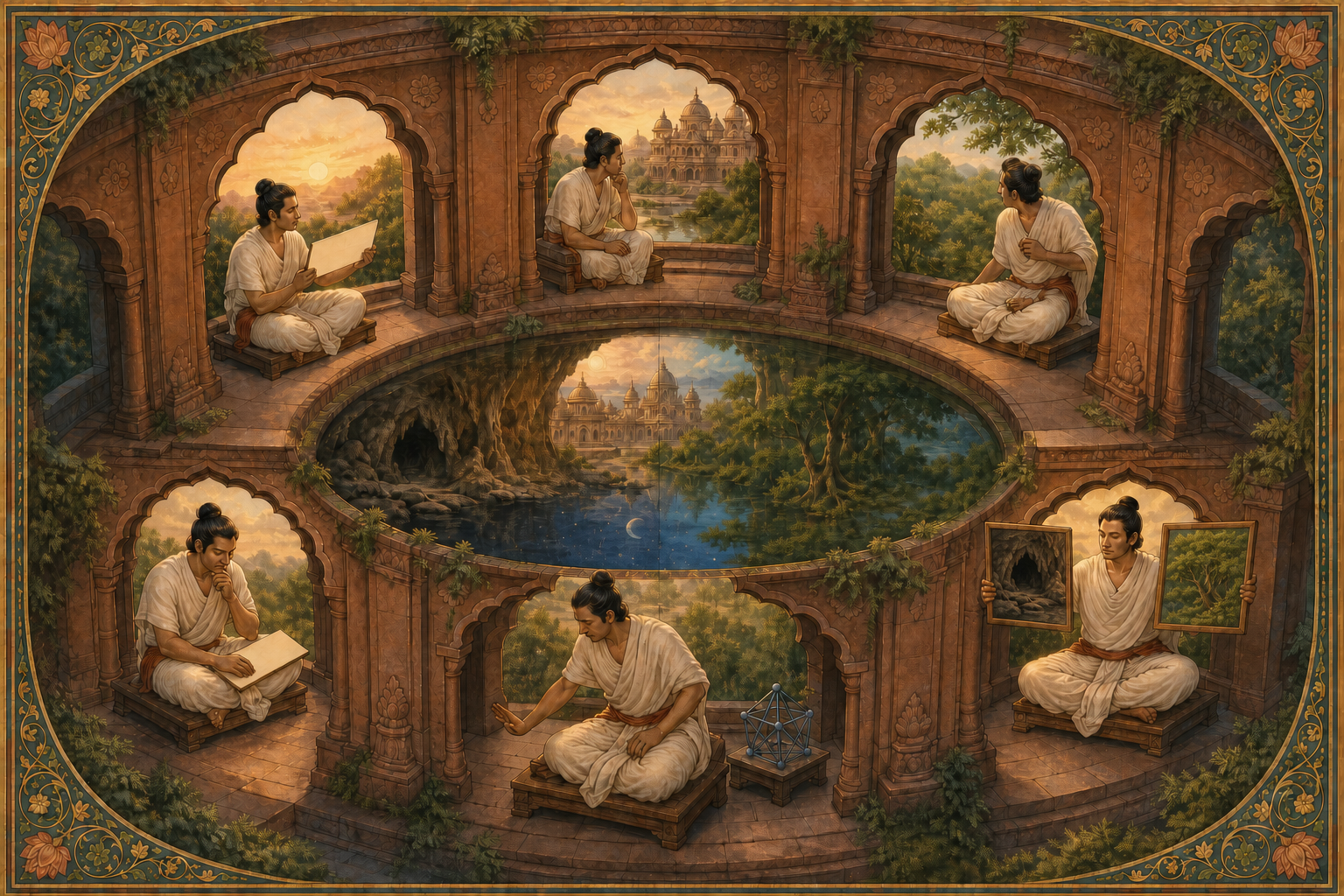
You do not need a technical commentary to begin responsibly. Use the following sequence with the translation available to you, and resist comparison until the fifth pass.
- Mark the frame. Write down who is acting, who is speaking, who is listening, and why the episode appears at this point. In the Ramayana, preserve the connection to unfolding action. In the Yoga Vasistha, preserve the connection to Vasistha’s instruction of Rama.
- Record only what the passage gives you. List the stated relations of place, scale, boundary, and perception. Do not add wormholes, dimensions, simulations, or other mechanisms merely because they make the scene easier to visualize.
- Track the knower. Ask what each participant initially believes, what becomes available to that participant, and whether the participant’s standpoint changes. A nested world matters because someone encounters, hears about, or understands it.
- Name the broken assumption. Is the passage disturbing a fixed idea of inside and outside, small and vast, local and universal, appearance and knowledge, or some combination of these? Choose the narrowest answer supported by the context.
- Find the consequence. In an itihasa, look for what the encounter changes in the movement of action or in the obligations of those involved. In a philosophical dialogue, look for the belief that the teaching asks the listener to relinquish or examine. If you omit the consequence, you retain the spectacle but lose the lesson.
- Compare functions, not decorations. Only now place the cave beside the canopy universe. Note the shared inversion of ordinary containment, then state separately what that inversion accomplishes in each work. Similar imagery should sharpen the difference of purpose rather than erase it.
A minimal comparison that remains honest
For Swayamprabha’s cave, begin with this provisional statement: a bounded place within the Ramayana’s action exceeds the expectation created by its apparent boundary. Then ask what the encounter contributes to the people and purpose already moving through the narrative.
For the Leelopakhyana, begin differently: a nested cosmos appears inside a dialogue intended to awaken Rama. Then ask which certainty about world, scale, or experience becomes harder to maintain after the account is heard.
The comparison can now be stated without exaggeration. Both images make ordinary spatial judgment insufficient. The Ramayana embeds that insufficiency in encountered reality; the Yoga Vasistha turns it into sustained philosophical instruction. This is a stronger conclusion than declaring that both describe the same multiverse, because it tells you what to notice in each text.
Key takeaways
- Read Swayamprabha’s cave first as an encounter within the Ramayana’s itihasa setting, not as a detached cosmological diagram.
- Read Leela’s canopy universe within Vasistha’s effort to awaken Rama, not merely as exotic geography.
- The shared motif challenges the assumption that an apparent boundary reveals the full extent of reality.
- Ask whose standpoint makes a place seem small, enclosed, external, or complete.
- Use modern scientific language as a limited analogy only; visual similarity does not establish identical mechanisms or claims.
- Compare the episodes after identifying their separate narrative and philosophical consequences.
On your next reading, give each episode its own page. Record the frame, the apparent boundary, the observer, the broken assumption, and the consequence. Only then place the pages side by side. You will see more than a curious world inside another world: you will see two disciplined ways of loosening the belief that reality must end where ordinary perception ends.
References
