
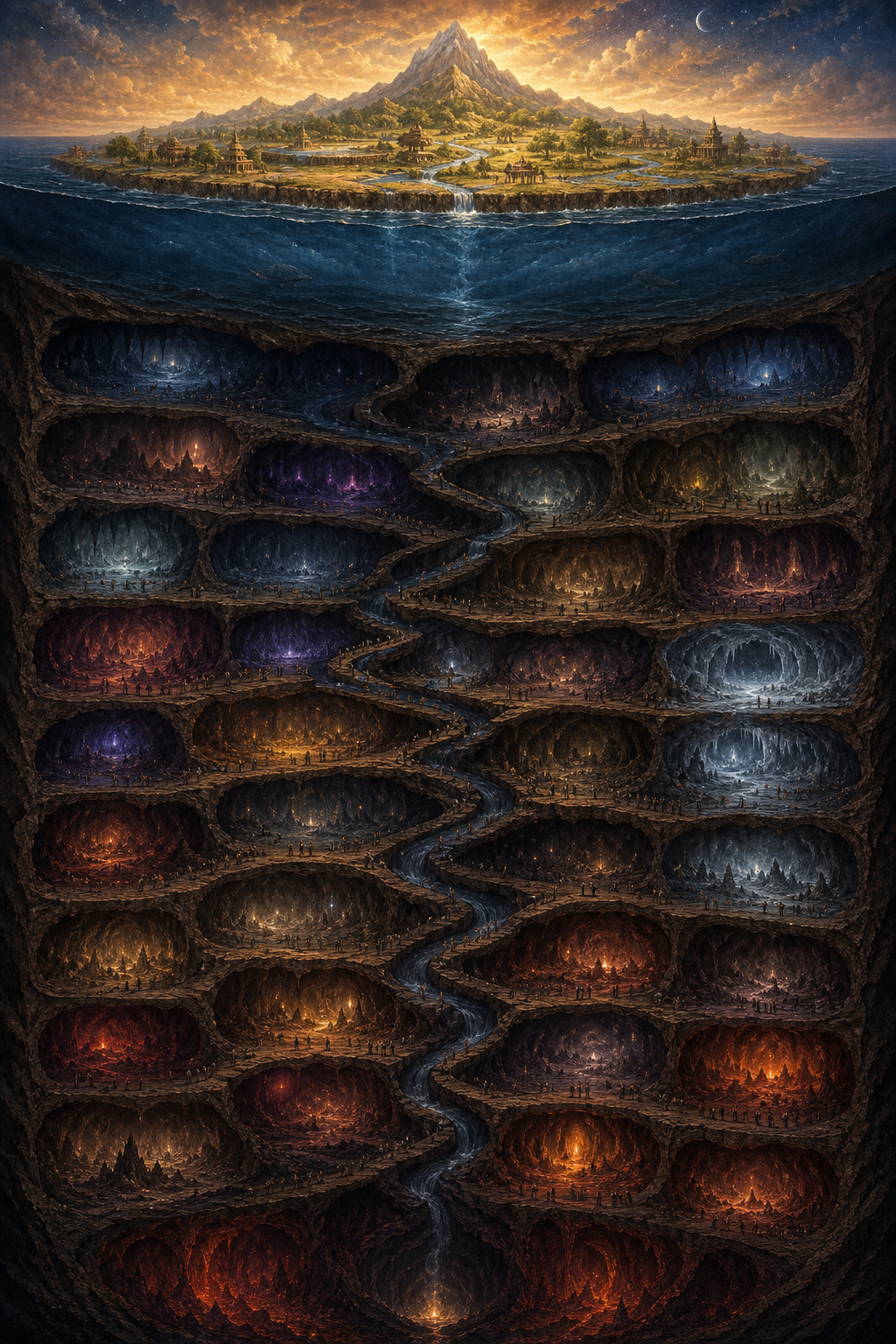
If you have encountered names such as Vaitarni, Kalsutra, or Avichi and want a clear account of Naraka in the Vishnu Purana, begin with a narrow, defensible answer. The text presents 28 principal Naraka realms beneath the earth and water, into which sinners are cast.
That gives you a moral cosmography and an ordered set of names. It does not, by itself, give you permission to invent a punishment for every name, declare the list exhaustive, or import every assumption carried by the English word “hell.” A careful reading starts by separating what is stated from what still requires a fuller textual basis.
Start with the claims you can safely make
Four points form the reliable foundation for reading or teaching this part of the Vishnu Purana:
- Naraka is plural here. The cosmology contains multiple punitive realms rather than one undifferentiated destination.
- The realms have a stated relative location. They are situated beneath the earth and water.
- They concern moral consequence. Sinners are described as being cast into them.
- The 28 are identified as the main realms. “Main” or “principal” is more accurate than claiming that no other Naraka designation can occur elsewhere in Hindu literature.
These distinctions matter. Saying “the Vishnu Purana names 28 principal Narakas” is supported. Saying “Hinduism has exactly 28 hells” is much broader and erases the variety of texts, recensions, translations, and teaching traditions within Sanatana Dharma.
The familiar translation “hell” should also be handled as a convenience, not as a complete interpretation. From this enumeration alone, you cannot settle the duration of a soul’s stay, the entire process by which it arrives there, what follows the punishment, or the exact deed associated with every realm. If those questions matter to your study, mark them as questions rather than filling the gaps from another religious framework or a popular retelling.
The 28 principal Naraka realms in their stated order
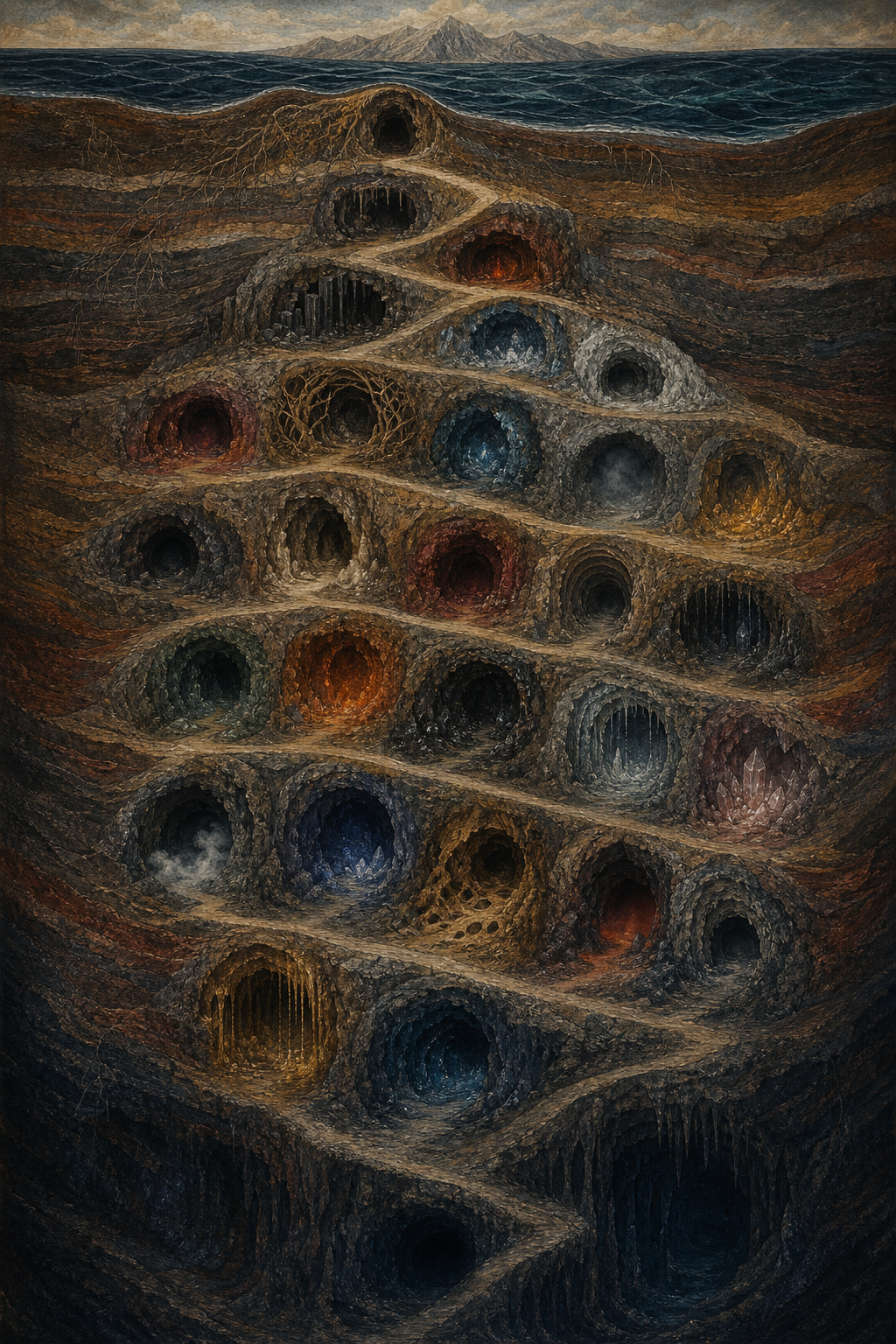
Preserving the order is useful because spelling can shift when Sanskrit names pass through different transliteration systems and regional conventions. Treat the following forms as lookup keys for this enumeration. When another edition spells a name differently, compare its position and underlying Sanskrit before deciding that it refers to a separate realm.
- Raurav
- Sukar
- Rodha
- Tal
- Vishsan
- Mahajwal
- Taptakumbh
- Lavan
- Vilohit
- Rudhiramabh
- Vaitarni
- Krimish
- Krimibhojan
- Asipatravana
- Krishna
- Lalabhaksha
- Darun
- Puyuvah
- Pap
- Vahnijwal
- Adhahshira
- Sandansh
- Kalsutra
- Tamas
- Avichi
- Swabhojan
- Apratishthit
- Aprachi
A list of names is an index, not a complete doctrine. Some names may appear suggestive to a reader who knows Sanskrit or has heard them explained in discourse, but resemblance is not enough to establish an exact punishment, offense, or theological meaning. For each realm, keep three things separate: the transmitted name, a defensible translation of that name, and the fuller description attached to it in the edition or commentary you are consulting.
This discipline is especially important with familiar names such as Vaitarni or Avichi. Familiarity can make a detail feel universal even when it comes from a different Purana, a regional narration, an artistic representation, or a later commentary. A valid teaching from another tradition may still be valuable, but it should not be silently presented as though every detail came from this Vishnu Purana enumeration.
Four common errors that distort the Naraka account
- Equating Naraka with every implication of the English word “hell.” A translation can help you enter the subject, but it can also import assumptions about finality, duration, judgment, and salvation. On first use, write “Naraka realm” and state only the features established by the passage you are discussing.
- Turning Puranic placement into modern map coordinates. “Beneath the earth and water” gives a relationship within a sacred cosmography. It does not supply measurable distances or a location that can be plotted using the methods of physical geography. Preserve the kind of claim being made rather than forcing it into a different category.
- Constructing punishments from names alone. A vivid or ominous name may invite speculation. Before repeating an explanation, check whether your full edition, translation, or commentary actually connects that realm with the asserted deed and consequence.
- Calling the 28 an exhaustive list for all Hindu traditions. These are presented as the main Narakas in this account. Keep the scope attached to the claim: name the Vishnu Purana and say “principal” rather than universalizing one enumeration into the whole of Hindu scripture.
These are not merely academic cautions. Once an embellished claim enters a sermon, classroom, social-media graphic, or family conversation, later readers often cannot tell which part came from scripture and which part came from the speaker. Clear attribution protects the authority of the text as well as the trust of your audience.
Key takeaways for study and spiritual reflection

- The Vishnu Purana account identifies 28 principal Naraka realms.
- They are situated beneath the earth and water and are destinations of punishment for sinners.
- The ordered names provide an index, not a complete explanation of every offense and punishment.
- “Naraka” and “hell” should not be treated as automatically identical theological concepts.
- A fuller edition or commentary is needed before attaching detailed narratives to individual names.
You can turn the enumeration into disciplined svadhyaya with a simple four-step method:
- Copy the names in order. Keep the spelling used by your chosen edition instead of silently combining spellings from several places.
- Record only explicit claims first. Note the stated location, the moral function, and the fact that these are principal Narakas.
- Create a separate question column. Put duration, governing process, associated offenses, punishments, and what follows there until you find textual support.
- Label every added explanation. If a detail comes from another Purana, a commentary, a guru’s teaching, or a regional tradition, identify that layer instead of folding it anonymously into the Vishnu Purana.
The spiritual use of Naraka imagery is not exhausted by curiosity about the afterlife. Its immediate force is ethical: actions have consequences, and adharma cannot be made harmless merely by rationalizing it. That turns your attention away from guessing another person’s fate and toward examining your own conduct.
Choose one present action involving truthfulness, restraint, fairness, or ahimsa. Ask what harm it may create, what excuse is allowing it to continue, and what correction can be made now. When Naraka directs you toward that honest correction, the cosmology is already doing practical work in your life.
References
