-
Beyond Boundaries: Proven Dharmic Insights to Master and Transform Human Limitations

Human life is shaped by real constraints, yet dharmic wisdom shows how to transform them into strengths. This reflection integrates Hindu, Buddhist, Jain, and Sikh insights to illuminate why transcending limitations matters and how to do it. Readers learn practical methods—Karma Yoga, mindfulness, simran–seva, ahimsa, svadhyaya, and dhyana—that stabilize attention and deepen resilience. The approach…
-
Mastering Desire for Inner Peace: The Proven Dharmic Breakthrough to End Discontent

This post examines a core dharmic insight: discontent grows as desires multiply. It synthesizes perspectives from the Bhagavad Gita, the Upanishads, Patanjali’s Raja Yoga, Buddhism’s analysis of tanha, Jainism’s Aparigraha, and Sikh santokh to show a shared pathway to contentment. Readers learn why hedonic adaptation fuels restlessness in modern life and how mindful discipline can…
-
Essential Dharma at Work: Discover the Proven Secret of Awareness for Lasting Happiness

This article explores a core dharmic teaching: performing actions with awareness leads to contentment and happiness. It reframes work through the lens of Karma Yoga and niṣkāma karma, emphasizing attention, integrity, and non-attachment. Drawing parallels across Hinduism, Buddhism, Jainism, and Sikhism, it highlights shared values such as mindfulness, aparigraha, seva, and Right Livelihood. The piece…
-
Natural Calamities and Karma: Essential Guide to Time, Place, and Compassionate Action

Do natural calamities happen because people share the same karma, or because of the qualities of a place and time? This analysis explains how dharmic traditions view causality through multiple lenses: individual, family, community, and the karma of deśa–kāla. It clarifies that these perspectives complement scientific explanations of geophysical and climatic processes rather than replace…
-
Master the Wandering Mind: A Complete Guide to Detachment from the Fickle Material World

The material world attracts yet never fully satisfies, a pattern that keeps the mind wandering from one stimulus to the next. This article presents a complete, unifying guide—rooted in Hindu Dharma, Buddhism, Jainism, and Sikhism—to understand impermanence and develop detachment without withdrawal. Readers discover practical methods such as breath awareness, pratyahara, dhyana, Aparigraha, Naam Simran,…
-
Essential Dharma Insight: Master the Bubble-and-Ocean Metaphor to Transform Character and Society

A vivid Hindu teaching contrasts unrighteousness with bubbles and righteousness with the ocean—brief display versus enduring depth. The metaphor aligns with the Bhagavad Gita’s portrait of a steady mind, emphasizing dharma as resilience, integrity, and service. Across Buddhism, Jainism, and Sikhism, similar values appear: impermanence, non-attachment, humility, and seva, reinforcing unity in spiritual diversity. Practical…
-
Discover Rebirth in the Bhagavad Gita: A Complete Guide to Epistemology, Ontology, and Ethics

This analysis presents a clear, three-part framework for understanding rebirth in the Bhagavad gītā: epistemology that privileges insight-oriented knowledge, ontology that secures the continuity of the ātman, and ethics that transform insight into equanimity and enlightened action. Readers gain conceptual clarity on how knowledge shapes worldview and why rebirth coherently follows from the soul’s imperishability.…
-
Fate, Effort, and Time: The Complete, Proven Dharmic Framework to Master Life’s Outcomes

This article presents a clear, dharmic framework for understanding the classic dilemma of fate versus free will. Drawing on Hindu scriptures and Lord Matsya’s teaching to Satyavrata Muni, it explains how fate (daiva), effort (puruṣārtha), and time (kāla) operate together to shape outcomes. Readers discover a practical metaphor—the farmer’s field—that makes complex philosophy immediately usable.…
-
Born Bad or Made Bad? Discover a Complete, Evidence‑Based Guide to Evil in Dharmic Thought

The everyday debate—born bad or made bad—finds a nuanced resolution in Dharmic thought. Hindu philosophy integrates guṇas, karma, and saṁskāras with the formative power of culture and community. Buddhism explains harmful actions through dependent origination, making transformation possible via ethics, meditation, and wisdom. Jain Anekantavada reframes blame by recognizing many-sided causes while prioritizing ahimsa and…
-
Essential Vedantic Insight: Discover the Shift from ‘I am’ to ‘God is’ for Inner Freedom

This reflection explores a core dharmic insight: the practical and philosophical shift from ‘I am’ to ‘God is’—or, more broadly, from ego-centered assertion to alignment with a higher truth. Drawing on Vedanta and SB 2.2.35, it highlights intelligence as a directing principle beyond ordinary control, sustained by a super self, a portion of God. The…
-
Discover the Proven Harmony of Science and Dharma: Newton’s Solar System Model Reimagined

A classic anecdote about Isaac Newton’s solar system model invites a disciplined way to relate science and philosophy. Instead of pitting mechanism against meaning, it encourages rigorous observation alongside intellectual humility. This balanced posture aligns with dharmic traditions—Hinduism, Buddhism, Jainism, and Sikhism—which explore causality, order, and ethics through logic and contemplative insight. Readers discover how…
-
Discover the Complete, Evidence‑Based Reassessment of Gandhi’s Ahimsa and India’s Transformation

This evidence-based reassessment places Gandhi’s Ahimsa and Satyagraha in a wider dharmic framework that values both moral courage and responsible protection. It highlights how Hinduism, Buddhism, Jainism, and Sikhism converge on non-violence while acknowledging duties to prevent harm. By contrasting successful non-violent mobilizations with moments of crisis during the late British Raj and the Partition…
-
The Complete Vrātya-stōma Guide: How Schopenhauer, Emerson, Elst, Frawley Embraced Sanatana Dharma

Vrātya-stōma, a Vedic rite of reintegration, serves as a compelling symbol of Sanatana Dharma’s inclusive ethos. This article traces how Western thinkers—Schopenhauer, Emerson, Elst, and Frawley—engaged the Upanishads, the Bhagavad Gita, and Vedanta to enrich global philosophical discourse. Readers will discover how dharmic principles such as ahimsa, yoga, and meditation support unity across Hinduism, Buddhism,…
-
Discover the Complete Convergence of Buddhism and Hinduism: A Proven Path of Rediscovery

Is Buddhism a social reformation of Hinduism, or a rediscovery of perennial truths? Drawing on Ananda K. Coomaraswamy, this analysis reframes the relationship as a deep continuity rather than a rupture. It explores shared methods—neti neti and analytical discernment—and common aims such as transcending the senses and realizing ultimate truth. It clarifies how modern mindfulness…
-
Discover the Proven Path from Attention to Focus to Affinity for Transformative Connection

Attention is easy to capture but rarely transformative. Focus, by contrast, is deliberate, effortful, and capable of reshaping understanding over time. Affinity goes further, making deep work feel energizing and relationships more authentic by aligning values, skills, and context. Drawing on shared dharmic principles—pratyahara, dhyana, and one-pointedness—this piece outlines a proven path from attention to…
-
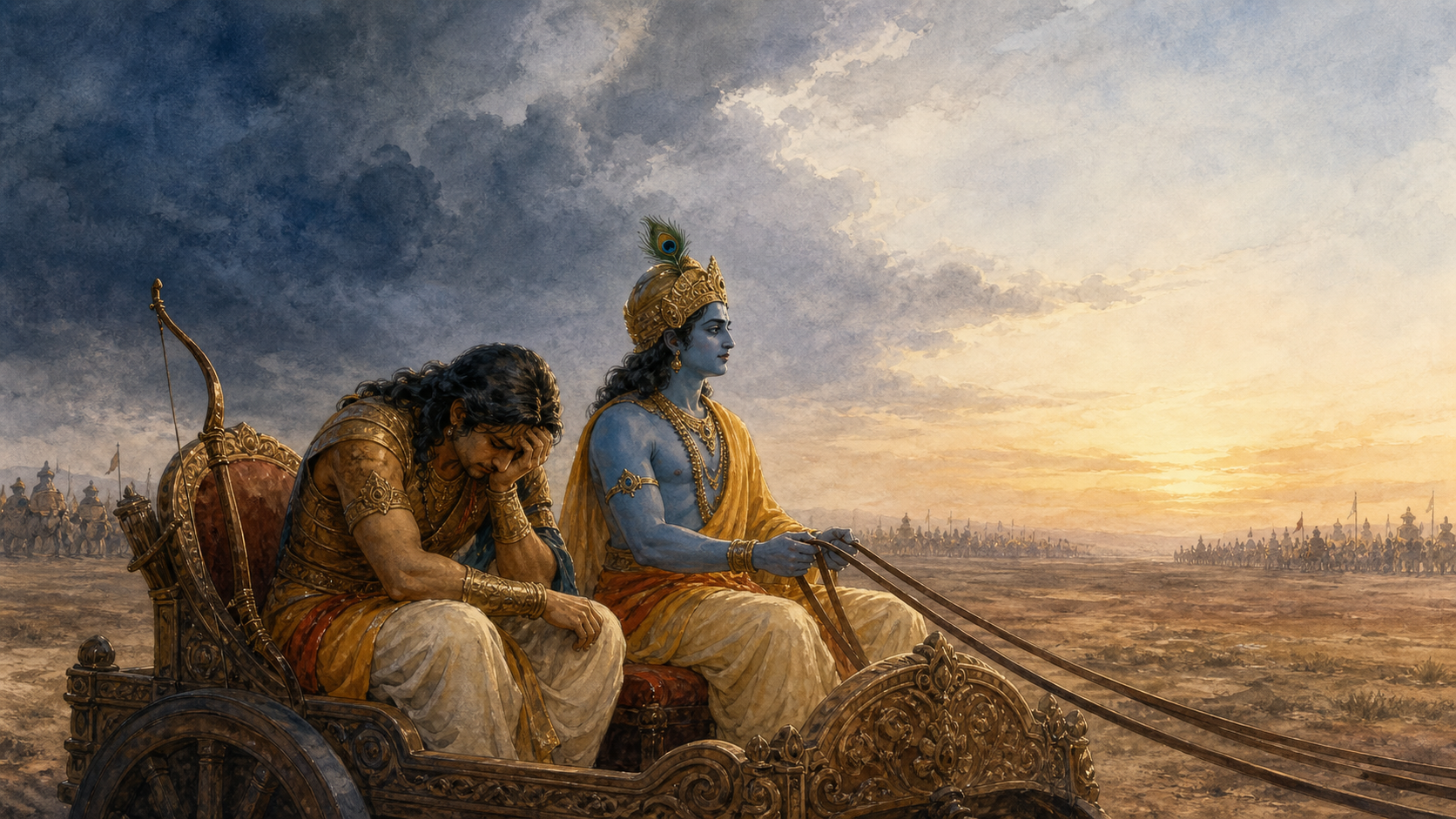
Master Anxiety with a Dharmic Breakthrough: Krishna’s Essential Lesson on Fear and Focus

This Mahabharata-inspired teaching presents Sri Krishna guiding Arjuna and Satyaki through an encounter that reveals how attention fuels anxiety and how disciplined focus dissolves it. The narrative shows a trivial stimulus expanding into a monstrous apparition when fed by fear, then vanishing when attention is steadied and withdrawn. Readers gain a clear, actionable understanding of…
-
Discover Dispersive History: A Proven Indic Framework to Transform How We Learn from the Past

This article reframes Indian historiography through the lens of Dispersive History—a proven Indic framework that preserves practical lessons while upholding civility. It contrasts linear, institution-centric Western historiography with cyclical, ethos-driven memory anchored in the Kaalachakra. Readers discover how हितोपदेश, पंचतन्त्र, and सुभाषित encode historical intelligence through allegory, enabling learning without public flagellation. The approach celebrates…
-
Discover the Proven Roots of Learning: Chandogya Upanishad’s Complete Education Blueprint

The Chandogya Upanishad illuminates an ancient yet enduring model of holistic education. It presents dialogic, inquiry-based learning that blends ethics, contemplation, and the arts with conceptual rigor. Through concrete demonstrations—clay, salt, and the banyan seed—it turns philosophical ideas into lived insight. The narrative of Satyakāma Jābāla highlights inclusivity grounded in truthfulness, echoing shared dharmic values…
-
Master Time’s Treasure: Essential Ancient Hindu Wisdom to Transform Life and Destiny

This reflection explores kala (काल) as a core principle in Hindu philosophy, presenting time as a sacred and transformative force. Readers will discover how the Bhagavad Gita’s “kālo’smi” clarifies the ethical urgency of each moment. The discussion weaves unity across dharmic traditions—Buddhism, Jainism, and Sikhism—showing shared respect for time through impermanence, disciplined conduct, and harmony…