-
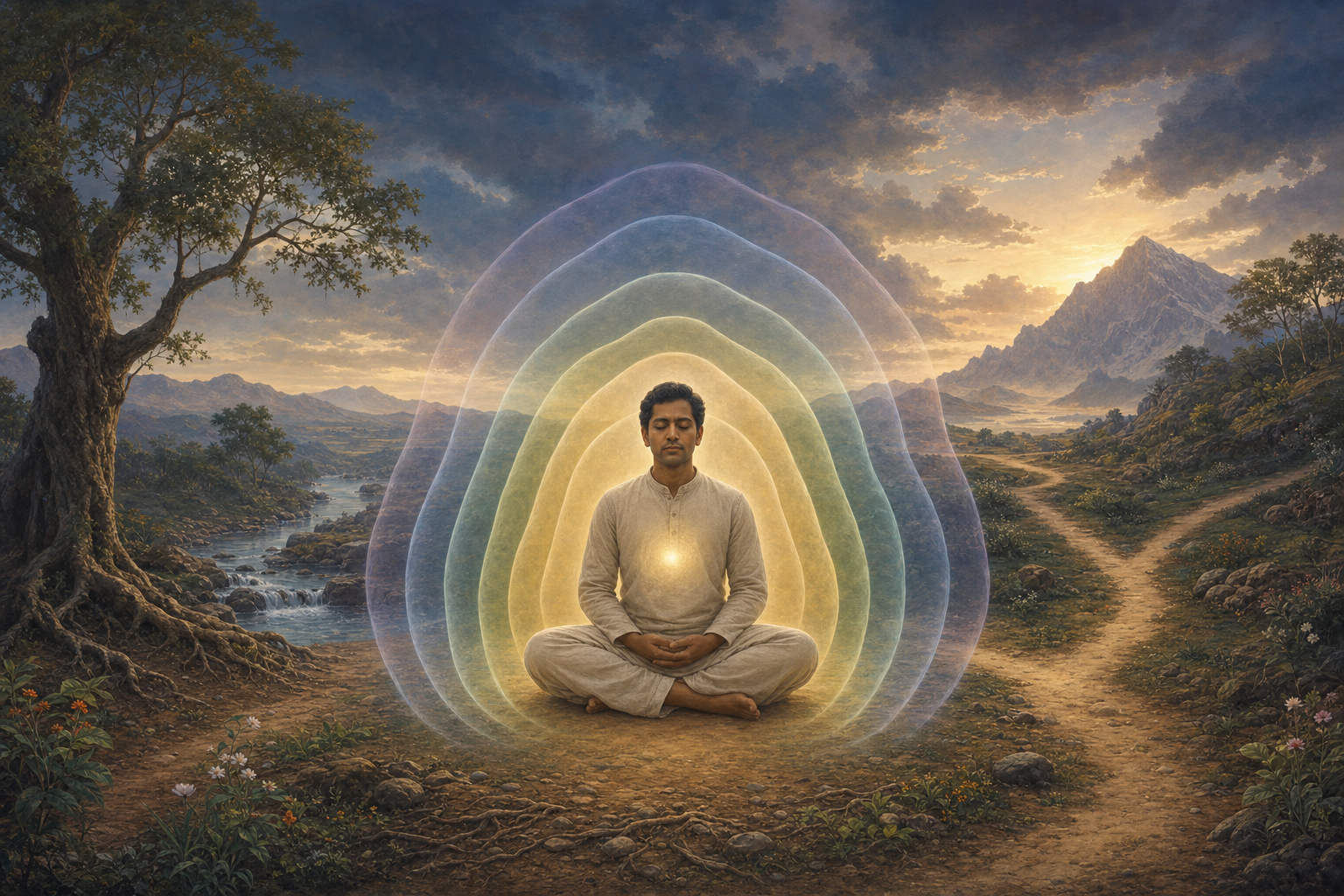
Essential Dharmic Breakthrough: Master Expectations and Rediscover Self through Hindu Wisdom

This article examines a core Hindu teaching: reliance on others’ approval fragments inner stability. It explains how non-attachment, Aparigraha, and svadharma reorient life from craving validation to purposeful action. It integrates convergent insights from Buddhism, Jainism, and Sikhism, highlighting a shared dharmic path of freedom from grasping. Readers learn practical steps—intention-setting, mindfulness, japa, breath awareness,…
-
Discover the Complete Purpose of Creation in Dharmic Thought: Master Karma, Dharma, Moksha

This article explains the purpose of creation in Hinduism through the interconnected ideas of karma, dharma, moksha, and samsara. It situates Hindu insights within the wider dharmic family—Buddhism, Jainism, and Sikhism—highlighting shared goals of liberation and ethical living. Readers discover why Prakriti is seen as a divine arena for growth and how jivas learn through…
-
Discover the Rig Veda’s Complete Creation Wisdom: Upanishadic Insights to Transform Understanding

Hinduism’s creation vision, grounded in the Rig Veda and clarified by the Upanishads, presents a cyclical, ever-unfolding cosmos sustained by Brahman. Rig Vedic humility, especially in the Nasadiya Sukta, invites inquiry rather than dogma. Upanishadic insights like “tat tvam asi” and “satyam jnanam anantam brahma” align the inner Self with the Absolute, framing multiplicity as…
-
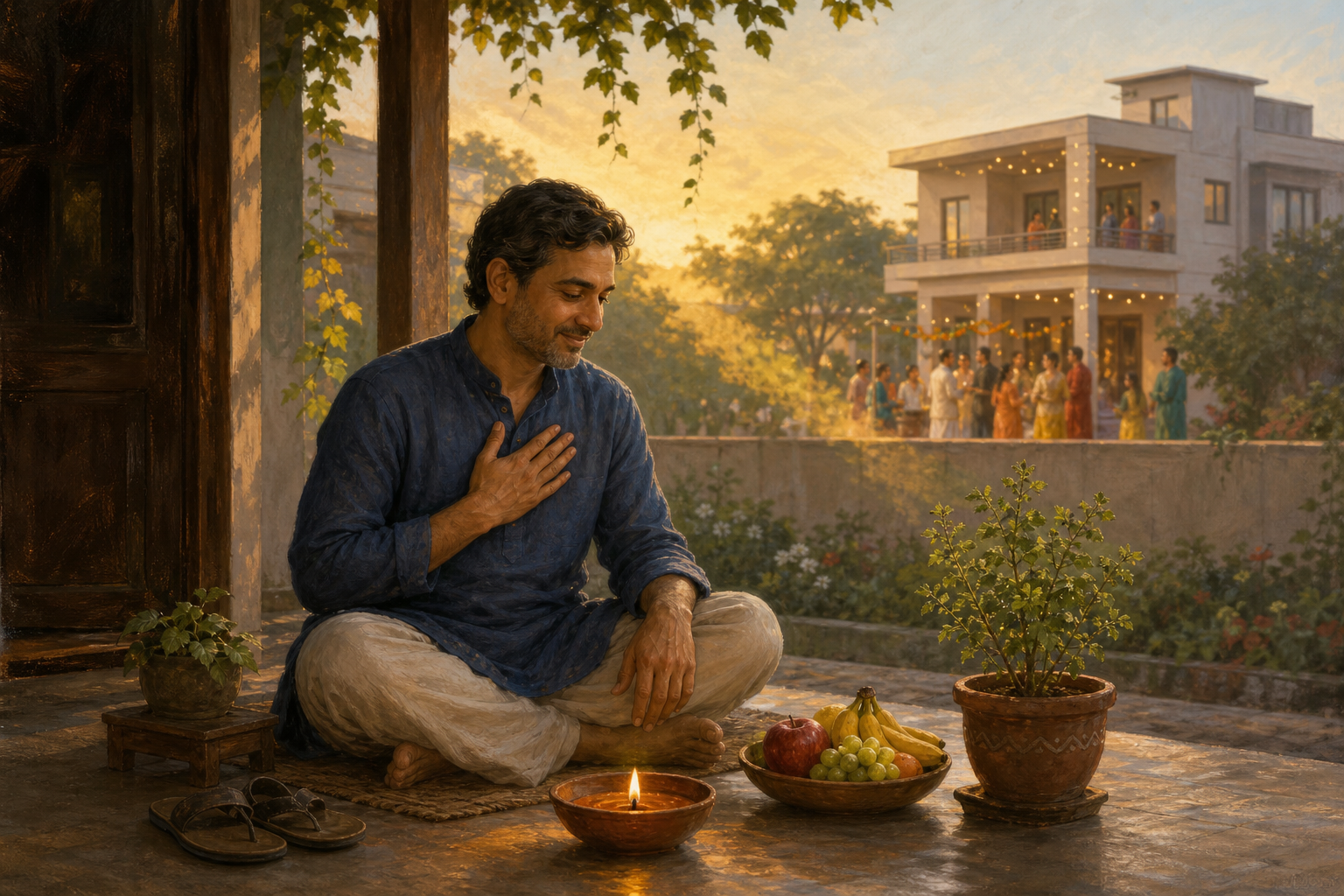
Master the Secret of Limitless Devotion: How Service Transforms Personal Limits

Diwali invites reflection on a dharmic insight: both humble and heroic efforts gain power through devotion and service. Across Hindu, Buddhist, Jain, and Sikh traditions, sincere intention and alignment with Dharma transcend visible limitations. Self-worth rests on intrinsic dignity, not comparison or scale. Objective constraints become a forge for character when action is guided by…
-
Essential Dharmic Wisdom: Master Mental Attitude to Transform Atmosphere and Well‑Being

This article explores the ancient Hindu insight that mental attitude shapes personal and social atmosphere, connecting classical teachings with practical modern relevance. It draws on the Bhagavad Gita, Patanjali’s Yoga philosophy, and parallel practices in Buddhism, Jainism, and Sikhism to show a unified Dharmic view. Readers gain clear, actionable methods—breath awareness, gratitude, seva, and mindful…
-
The Ultimate Dharmic Guide to Life’s Inevitables: Discover Calm, Clarity, and Freedom

A clear, dharmic approach can transform anxiety about life’s inevitables into calm, purpose, and inner freedom. Hinduism emphasizes Dharma, Karma, and Moksha through the Bhagavad Gita and Upanishads, guiding non-attachment and ethical action. Buddhism’s focus on Anicca and Anatta cultivates mindfulness and compassionate presence amid change. Jainism’s Anekantavada and Aparigraha reduce attachment and foster equanimity…
-
Essential Insight: Discover the Power of the Holy Name in Srila Prabhupada’s Global Breakthrough

This reflection examines whether the global spread of the Holy Name unfolded solely by prophetic empowerment or through the realized presence of Srila Prabhupada as a qualified instrument. It clarifies why, in the Bhakti Tradition and wider Hindu spirituality, empowerment is both a principle and a person-dependent transmission. It shows how sacred sound—whether in chanting,…
-
Essential Ancient Hindu Wisdom: Discover Proven Dharmic Ways to Purify Feelings and Build Trust
Ancient Hindu wisdom teaches that spiritual depth and the cleanliness of one’s feelings are essential for trustworthy character. Grounded in dharma and satya and expressed across the Vedas, Upanishads, and the Bhagavad Gita, these principles offer practical tools to purify intention and conduct. Disciplines such as Yoga, Meditation, and Mindfulness reinforce ethical clarity, while yamas…
-
The Complete Dharma Feminism Breakthrough: Discover Hinduism’s Proven Path to Intellectual Freedom

This article reframes feminism through a dharmic lens, showing how Hinduism has long cultivated intellectual freedom for women through inquiry, debate, and pluralism. It highlights exemplars such as Gargī, Maitreyī, Āṇḍāl, Akka Mahādevī, Mīrābāī, and Lal Ded, and explains how concepts like dharma, jñāna, and Ishta enable authentic autonomy. It connects this heritage to parallel…
-
Master Time’s Secret in Śrīmad-Bhāgavatam: HH Prahlādānanda Swami’s Complete Insight

This exploration of Śrīmad-Bhāgavatam 4.12.1–3, as presented by HH Prahlādānanda Swami at ISKCON NYC, clarifies kāla (time) as an impartial, divine agency guiding creation, order, and transformation. It rejects fatalism and strengthens responsibility, showing how time frames ethical action within dharma. The discussion connects Buddhist impermanence, Jain understandings of kāla, Sikh insights on Hukam, and…
-
Complete Guide to Vidyananda: Discover Panchadasi’s Fourteenth Chapter and Supreme Bliss

The Fourteenth Chapter of Panchadasi clarifies vidyānanda—the bliss born of Self-knowledge—within Advaita Vedanta’s Ananda-panchaka. It explains how disciplined study, reflection, and deep contemplation transform insight into stable joy. By distinguishing pure consciousness from mental states, the chapter prevents mistaking calm for realization. It maps the progression from sensory pleasure to the bliss of knowledge and…
-
Essential Dharmic Wisdom: Discover How to Protect Self‑Worth by Distancing from Belittlers

This article explores the dharmic principle “Distance yourself from those who belittle you” as a practical, ethical discipline for safeguarding dignity and Inner Divinity. It situates the teaching within Hinduism’s focus on atman, sva-dharma, and supportive satsang, and shows convergence with Buddhism, Jainism, and Sikhism. Readers discover how Ahimsa, Anekantavada, Right Speech, and the value…
-
Discover the Complete Sankhya–Yoga Creation Theory: A Transformative Guide to Hindu Cosmology

This article presents a clear, academic overview of the Sankhya–Yoga theory of creation within Hindu cosmology, explaining how Purusha and Prakriti account for the evolution of the universe. It outlines the ordered emergence of tattvas, clarifies the role of the gunas, and explains why misidentification leads to suffering. The Yoga perspective adds Ishvara and an…
-
Master Purva Mimamsa’s Complete Insight: Discover an Eternal, Uncreated Universe

This article presents Purva Mimamsa’s core insight: an eternal, uncreated universe governed by dharma, adrishta, and apurva rather than a one-time creation event. Readers gain a clear overview of how Vedic authority (apaurusheyatva) and precise ritual action explain moral causality without requiring a creator-deity. The piece shows how this perspective aligns with broader Dharmic traditions—Buddhism,…
-
Complete Guide to Advaitananda: Discover the Bliss of Non-Dual Realization in Panchadasi 13

Advaitananda Prakarana, the thirteenth chapter of Panchadasi by Vidyaranya, explains how the bliss of non-dual realization is not produced by the mind but recognized as the true nature of self. It distinguishes fleeting sense-pleasure from brahmananda, the unconditioned bliss revealed through knowledge. Rooted in the Upanishads, the chapter maps a practical progression—sravana, manana, and nididhyasana—toward…
-
Essential Insights on Power and Dharma: Discover the Proven Truth of Uncorrupted Divinity

Power often begins as a learned behavior—crying for attention, exerting strength, leveraging beauty, or wielding status—but dharmic wisdom clarifies that such tactics affect the ego, not the Divine. Hindu, Buddhist, Jain, and Sikh teachings converge on a central truth: the Divine remains uncorrupted, while human impulses require discipline. This essay offers practical tools—pranayama, mindfulness, japa,…
-
The Proven Power of Santosha: Discover How Inner Satisfaction Ignites Creativity

Santosha (contentment) in Hindu philosophy functions as a practical catalyst for creativity by quieting mental noise and freeing attention for insight. As a niyama of Yoga, it refines motivation from scarcity-driven striving to curiosity-driven exploration. Parallels in Buddhism (upekkhā), Jainism (aparigraha), and Sikhism (Santokh) reveal a shared Dharmic emphasis on inner satisfaction as a basis…
-
Essential Dharma Breakthrough: How Silent Goodness Enables Evil—and How to Transform It

Indraprastha’s Rajasuya yajna offers an enduring lesson: when courtesy lacks boundaries, adharma grows. The Mahabharata shows how excessive tolerance—at the Rajasuya and later in the dice hall—can legitimize injustice, as seen in the silence during Draupadi’s humiliation. Dharma demands proportionate, principled action after patient dialogue, a sequence Sri Krishna models in the Udyoga Parva. This…
-
Complete Guide to Manu in Hinduism: Discover the Timeless Law-Giver Beyond Gender and Time

This article examines Manu as both archetype and title within Hindu cosmology, clarifying how fourteen Manus guide each kalpa and why the role is best understood as beyond gender and bound to time cycles. It situates Manusmriti within the broader Dharmashastra tradition, highlighting contextual interpretation and ongoing ethical refinement. The narrative of Vaivasvata Manu and…
-
Discover Chitishakti’s Power: A Complete Guide to Purusha in Patanjali’s Yoga Philosophy

Patanjali’s Yoga presents Purusha as pure consciousness—the steady witness distinct from Prakriti’s changing field. Clarifying chiti and chitishakti reveals how conscious power illumines experience when mental fluctuations settle. Grounded in abhyasa and vairagya, and supported by pratyahara, dhyana, and samadhi, this approach offers a practical route to Self-Realization. Readers gain benefits such as emotional balance,…