
-
Beyond Liberation: Why Devotees Decline MokshaŚrīmad-Bhāgavatam 9.4.67, CC Ādi 4.208

Śrīmad-Bhāgavatam 9.4.67, cited in CC Ādi-līlā 4.208, presents a profound principle of the Bhakti Tradition: genuine devotees do not seek liberation or time-bound pleasures because loving service to the Divine is itself complete fulfillment. Set against the narrative of Durvāsā Muni and Mahārāja Ambarīṣa, the verse clarifies why bhakti transcends both material enjoyment and even…
-
Surname Privilege in India: How Dynastic Power Erodes Merit, Mobility, and Unity

India’s public life often privileges surnames as social capital, shaping access to power in politics, business, and culture. This analysis explains how political dynasty and nepotism in India undermine meritocracy, reduce social mobility, and erode institutional trust. Framed through a dharmic lens, it highlights shared values across Hinduism, Buddhism, Jainism, and Sikhism that favor competence,…
-
Coconut-Burning at Nayakanahatti Thipperudra Swamy Temple: Science, Symbolism, and Devotion

Nayakanahatti Thipperudra Swamy Temple near Chitradurga in Karnataka enshrines the samadhi of Shri Guru Thipperudra Swamy and the Shivling he installed. A distinctive coconut-burning ritual, rooted in local oral histories, invites devotees to symbolically surrender ego and obstacles to the purifying witness of Agni. The coconut’s layers and the fire’s transformation provide clear ethical symbolism…
-
Vayudeva Mahatmyam: Exploring the Wind God’s Power, Prana, and Dharma Across Traditions

Vayu Bhagavan, the wind god of Hindu tradition, is revered as the sustaining force behind prana, movement, and life. Classical narratives honor him as the divine father of Hanuman and Bhima, whose devotion to Lord Rama and loyalty to Lord Krishna exemplify courage and service. Philosophically, Vayu’s essence is experienced through pranayama and mindful breathing,…
-
Srimad-Bhagavatam: The Living Book-Form of Sri Krsna Revealing Ten Transcendent Themes

Srimad-Bhagavatam is honored in Vaisnava tradition as the “book form” of Lord Sri Krsna, unfolding twelve cantos that mirror His bodily limbs and present ten transcendental topics. Lord Sri Caitanya Mahaprabhu praised it as pramanam amalam“the spotless authority”while Srila Rupa Gosvami highlighted hearing the Bhagavatam as a most potent limb of bhakti-yoga. Its narrative and…
-
Desire, Discipline, and Redemption: Vishwamitra’s Fall and Rise to Enlightened Self-Mastery
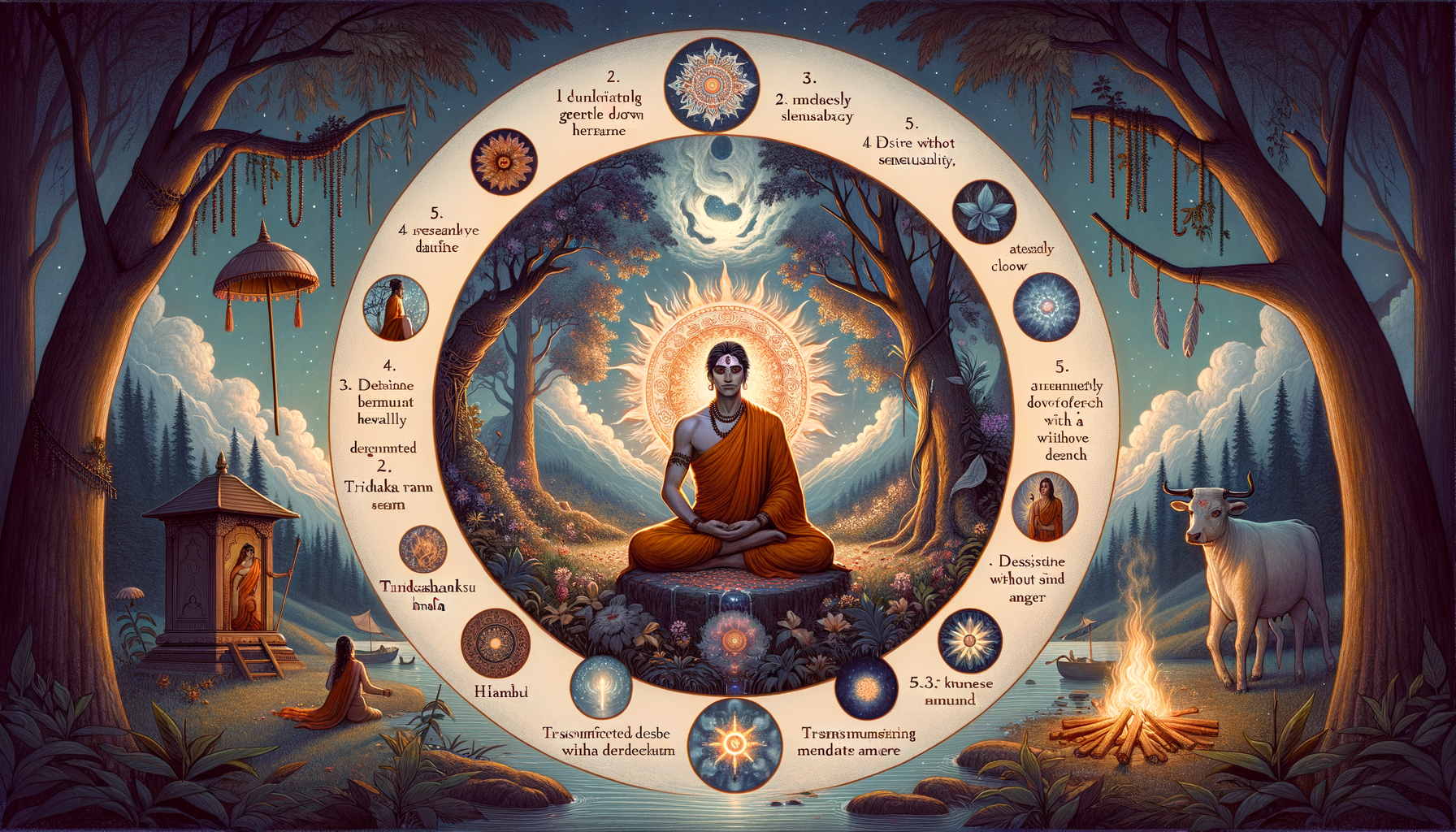
Sage Vishwamitra’s journey, preserved in the Ramayana and Puranas, reveals how desire, discipline, and humility shape authentic spiritual growth. The episodes of Menakā, Rambhā, and Trishanku illuminate why repression alone fails and how insight transforms both desire and anger. Read as a spiritual psychology, the narrative models tapas joined to compassion, equanimity, and surrender. The…
-
Rama–Sita and Shiva–Shakti: Sankhya’s Purusha–Prakriti and the Promise of Wholeness

Sankhya’s vision of Purusha (consciousness) and Prakriti (primordial nature) is illuminated by the sacred unions of Rama–Sita and Shiva–Shakti. These symbols present wholeness as a harmonious interplay rather than a clash of opposites. The essay connects Ardhanārīśvara, Maryāda-Puruṣottama, and Shakti’s resilience to psychological integration and ethical balance. Parallels from Buddhism (prajñā–upāya), Jainism (jīva–ajīva and the…
-
Four Faces of Varuna: Unveiling Vedic Symbolism for Cosmic Order and Inner Harmony

This article decodes the “Four Faces of Varuna” as a Vedic metaphor for omniscient care, moral order, and compassionate accountability. It clarifies how Rita (ṛta) structures both the cosmos and ethical life, linking Varuna’s symbolssuch as the pāśa and watersto practical integrity and social trust. Readers gain a clear framework that integrates the four Vedas,…
-
How the Sahibzaade’s Martyrdom Ignited Two Teens’ Inner Mission and Lifelong Courage

Two teenagers discovered a practical path to courage and clarity after studying the Sahibzaade’s martyrdom in a youth workshop. The narrative of Guru Gobind Singh’s sonsset around Anandpur Sahib, Chamkaur, and Sirhindbecame a framework for daily discipline. By linking seva, simran, and small vows (anuvrat) to study habits, the teens improved focus and reduced anxiety.…
-
Discover the Timeless Pillars of Hinduism: Temples, Saints, and Living Pluralism

Hinduism’s enduring features include a global network of Hindu temples, a lineage of rishis and saints, and historic royal patronage that nurtured sacred architecture and social welfare. Its core principlesdharma, karma, ahimsa, and mokshasupport multiple valid paths such as Bhakti, Jnana, Karma, and Yoga. This religious pluralism aligns naturally with the broader dharmic family of…
-
Vaikunta Ekadashi 2025 (Mukkoti Ekadashi): Sacred date, regional calendars, rituals, and meaning

Vaikunta Ekadashi (Mukkoti Ekadashi) falls on 30 December 2025, aligning with Margazhi Masam (Tamil), Dhanu Masam (Malayalam), and Paush Month (other regional Hindu calendars). The observance follows standard Ekadashi practicesfasting as health allows, Vishnu Sahasranama, japa, and reflective study. Many temples ceremonially open the Vaikunta Dwaram (Sorga Vasal), offering a powerful symbol of entry into…
-
Matangi Mahatmyam: Unlocking Matangi Mahavidya’s Blessings for Wisdom, Music, and Protection

Matangi Mahatmyam presents Matangi Mahavidya as a unifying synthesis of Parvati’s protective grace and Saraswati’s luminous wisdom. Venerated for education, music, knowledge, and courage, Matangi guides seekers toward clarity, refined speech, and ethical action. Devotees commonly report enhanced focus, creativity, and calm through steady remembrance, study, meditation, and music. The Devi’s blessings are associated with…
-
Honoring Srila Bhaktisiddhanta Sarasvati Thakur: Disappearance Day Reflections from Mayapur

This article reflects on the Disappearance Day of Srila Bhaktisiddhanta Sarasvati Thakur, presenting the day’s significance within the Gaudiya Vaishnava tradition and its wider relevance to contemporary spiritual life. It situates a lecture at ISKCON Mayapur by HH Bhakti Charu Swami as a thoughtful lens for understanding the Thakur’s disciplined sadhana, shastra-centered devotion, and compassionate…
-
Rethinking Advanced Civilization: A Vedic Lens on Technology, Wealth, and Inner Consciousness
Modern metrics often define advanced civilization by technology, comfort, and wealth, but Vedic philosophyespecially the Bhagavad-Gitabroadens the lens to include consciousness, ethics, and dharma. This perspective views the person as an eternal, conscious entity (jiva/atman) animating the body, much like a driver guides a car. By integrating material progress with inner development, societies gain resilience,…
-
Dhanu Lagna 2026–2027: Sagittarius Ascendant Forecast for Career, Love and Spiritual Growth

Dhanu Lagna (Sagittarius Ascendant) can expect 2026–2027 to emphasize partnerships, purposeful travel, and steady skill-building under supportive yet disciplined planetary trends. Career advances through ethical collaboration, transparent agreements, and elevated communication, while finances benefit from careful planning around taxes, insurance, and shared assets. Home and property require prudent decisions and better routines, building emotional stability…
-
Awaken Beyond Survival: Hindu Dharma on Human Nature, Karma, and Cosmic Responsibility
Human life clearly exceeds mere survival, and dharmic traditions explain why. Hinduism, Buddhism, Jainism, and Sikhism converge on a shared ethic of self-awareness, non-violence, service, and responsibility. Hindu teachings frame purpose through the puruṣārthas, guiding artha and kāma with dharma toward mokṣa. The Bhagavad-Gita and the Upanishads show how karma, guided by clarity and detachment,…
-
Tripada Trimurti Unveiled: The Profound Symbolism of Shiva’s Three-Footed Trinity

Tripada Trimurti presents the TrimurtiBrahma, Vishnu, and Shivathrough the striking motif of three feet, highlighting the unity of creation, preservation, and transformation. This interpretation clarifies how the visible legs of Vishnu and Shiva, with the third principle implied through Brahma or the composite form, teach oneness-in-diversity. Readers gain a clear understanding of the term’s meaning,…
-
Gita Jayanti Reflections: Timeless Guidance, Devotional Service, and Dharmic Unity
Gita Jayanti honors the revelation of the Bhagavad Gita and invites renewed attention to dharma, devotion, and ethical action. The featured assurancecherishing those who share wisdom with compassionunderscores teaching as a form of service, not coercion. Observances such as recitation, study, meditation, and dialogue help practitioners apply karma yoga, bhakti, and jnana to daily decisions.…
-
Kalluru Mahalakshmi Temple, Raichur: Sacred Splendor and Living Heritage in Karnataka

Kalluru Mahalakshmi Temple in Raichur, Karnataka, is a revered site often compared to the “Kolhapur Mahalakshmi Temple.” Housing the idols of Mahalakshmi and Lord Venkateshwara, it offers a rare devotional pairing that symbolizes prosperity and divine protection. Tradition associates its founding with the Madhwa scholar Sri Lakshmikanta Acharya, lending theological depth to the temple’s living…
-
Inside Karnataka’s Congress Power Struggle: How High-Command Drift Fueled a Governance Crisis

Karnataka’s present impasse within the Congress echoes a half-century pattern of centralized reshuffles, factional realignments, and revolving-door loyalties. This analysis traces the arc from H.C. Srikantaiah’s 1980 defection and Devaraj Urs’s fall to the high-command style under Indira and Rajiv Gandhi, then examines today’s Siddaramaiah–D.K. Shiva Kumar contest. It explains how a 50:50 power-sharing formula,…