
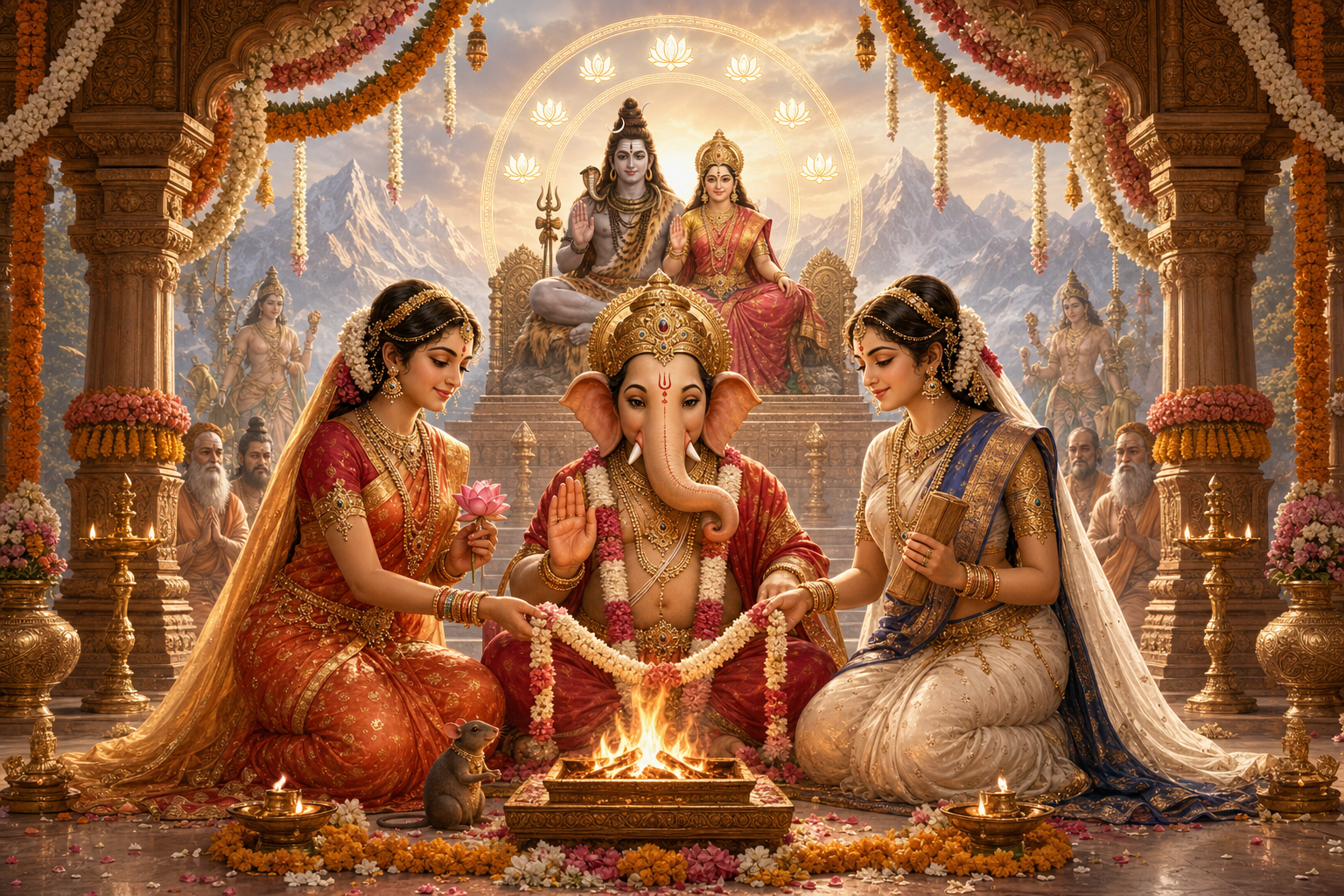
Lord Ganesha’s marriage to Siddhi and Buddhi is far more than a celestial wedding story. In its best-known Puranic form, the narrative explores intelligence, ethical reasoning, family duty, spiritual accomplishment and the ability to transform a limitation into a wiser course of action. It also addresses a question that often puzzles devotees: why is Ganesha married in some traditions but revered as a lifelong Brahmachari in others?
Reading a sacred story with precision
An academic reading does not force every regional account into a single biography. Puranic passages, temple traditions, devotional teachings, oral kathas and works of art preserve related but distinct understandings of Ganesha. Some present him as the husband of Siddhi and Buddhi; others pair him with Riddhi and Siddhi; still others emphasize his celibacy. These accounts become clearer when their sources and theological purposes remain distinct.
The central Ganesha marriage story appears in the Shiva Purana, within the Rudra-saṃhitā, Kumāra-khaṇḍa. Chapters 19 and 20 in the widely available J. L. Shastri translation narrate the competition between Ganesha and Karttikeya, Ganesha’s ritual circumambulation of his parents, and his marriage to the daughters of Prajāpati Viśvarūpa. Chapter numbering can differ among editions, so the section and narrative context are more reliable identifiers than the number alone.
A technical detail prevents a common misunderstanding. The passage is framed as a conversation in which Brahmā narrates events to Nārada. Repeated appearances of the formula “Brahmā said” identify the speaker; they do not make Brahmā the father of the brides. In this version, Siddhi and Buddhi are explicitly identified as the daughters of Prajāpati Viśvarūpa. Popular summaries that call them daughters or creations of Brahmā belong to other retellings and should not be silently merged with this passage.
The challenge that begins the marriage katha
The Shiva Purana first depicts Shiva and Parvati delighting in their sons, Ganesha and Karttikeya. When both sons reach marriageable age, the question arises as to whose wedding should be celebrated first. The brothers are equally eager, and their parents devise a demanding test: the son who travels around the earth and returns first will receive priority in marriage.
Karttikeya immediately begins the journey. His peacock is swift, his martial character suits the physical challenge, and the apparent rules favor rapid movement. Ganesha remains behind and reflects. His mouse vehicle cannot compete with the peacock’s speed across oceans, forests and continents, but the story does not portray reflection as surrender. It presents thought itself as a form of effective action.
Ganesha performs a ceremonial bath, prepares two seats and respectfully asks Shiva and Parvati to sit. He worships them and completes seven pradakṣiṇās, or clockwise ritual circumambulations, around them. This detail matters: he does not merely walk in a circle and declare victory. He creates a sacred setting, performs worship, bows repeatedly and then explains the scriptural logic behind his act.
His reasoning is that parents constitute the child’s immediate sacred world. Honoring and circumambulating them carries the merit of circumambulating the earth and visiting distant places of pilgrimage. Ganesha therefore fulfills the challenge through a theological interpretation of what “the world” means. The literal geography of the earth remains important, but it is placed within a larger moral geography centered on gratitude, origin and responsibility.
Shiva and Parvati examine his argument and accept it. They praise the intelligence that dispels adversity as sunlight dispels darkness. Ganesha’s success is therefore not based on deception or a convenient loophole. Within the logic of the text, his solution is validated because knowledge, ritual conduct and filial devotion are brought into agreement.
The arrival of Siddhi and Buddhi
Prajāpati Viśvarūpa learns that Ganesha is to be married. He has two daughters, Siddhi and Buddhi, whom the text describes as possessing divine and auspicious qualities. Shiva and Parvati joyfully arrange their marriage to Ganesha, while deities and sages attend the celebration. Viśvakarman, the divine architect and master artisan, oversees the wedding arrangements.
The wedding is described as a source of profound happiness. The narrative does not develop a modern romantic courtship; its focus is theological and familial. Ganesha’s demonstrated wisdom is joined to Buddhi, while his capacity to complete a worthy undertaking is joined to Siddhi. The divine marriage gives personal form to qualities already closely associated with Ganapati.
The next generation extends the symbolism. According to this Shiva Purana passage, Siddhi gives birth to Kṣema and Buddhi gives birth to Lābha. Kṣema denotes well-being, security, protection or the preservation of what is beneficial. Lābha denotes gain, acquisition or a beneficial result. Popular accounts sometimes alter or reverse these relationships, but the cited passage specifically associates Kṣema with Siddhi and Lābha with Buddhi.
Karttikeya eventually returns after completing the physical journey. When he learns that Ganesha’s marriage has already taken place, he withdraws to Mount Krauñca. In this particular Shaiva narrative, Karttikeya remains a bachelor thereafter. That conclusion should not be generalized to every Karttikeya or Murugan tradition, just as Ganesha’s wedding in this text should not erase traditions that worship Ganesha as a Brahmachari.
Marriage, fruit and necklace versions should not be confused
A frequently heard version describes Ganesha and Karttikeya competing for a fruit of knowledge, a precious necklace or another divine prize. Ganesha circles his parents because Shiva and Shakti contain the entire universe, and he receives the prize. That story shares the memorable structure of the Shiva Purana episode, but the object of the competition is different. In the marriage passage, the stated reward is priority in marriage, not a mango, necklace or abstract prize of wisdom.
This distinction does not make one telling spiritually valuable and another worthless. It shows how sacred narratives travel: a stable core can acquire new ritual objects, local emphases and moral applications. Accurate retelling requires identifying the version being presented instead of combining every familiar element into a supposedly original account.
What Siddhi and Buddhi mean
The Sanskrit name Siddhi conveys accomplishment, fulfillment, perfection or successful attainment. In yogic and Tantric vocabulary, it can also refer to an extraordinary spiritual capacity, although that specialized meaning should not replace its broader sense in every context. As Ganesha’s śakti or consort, Siddhi represents the power through which a sound intention reaches completion.
Buddhi means intelligence, understanding, discernment or the faculty that judges and decides. It is more precise than mere accumulation of information. Buddhi distinguishes an appropriate path from an inappropriate one and converts knowledge into wise judgment. Ganesha’s response to the circumambulation challenge is an ideal narrative demonstration of this faculty.
Together, Siddhi and Buddhi express a complete discipline of action. Intelligence without accomplishment can remain an unrealized idea, while accomplishment without discernment can become efficient movement in the wrong direction. Their union with Ganesha signifies the integration of insight, method and completion. This is one reason Ganesha is invoked before study, artistic work, business, travel, ceremonies and other consequential beginnings.
Kṣema and Lābha continue that conceptual sequence. An undertaking guided by discernment and carried to completion can generate both beneficial gain and the security required to preserve it. The names should not be reduced to a promise of effortless material wealth. Their deeper significance includes ethical welfare, stable progress and results that can be responsibly sustained.
Why Riddhi sometimes replaces Buddhi
Many households and works of popular art speak of Riddhi and Siddhi rather than Buddhi and Siddhi. Riddhi signifies growth, prosperity, flourishing or abundance. Riddhi and Buddhi are therefore not simply two spellings of the same name: one emphasizes prosperity, while the other emphasizes discerning intelligence. Different texts, regions and visual traditions select different pairings.
The distinction explains why an image may correctly be called Riddhi-Siddhi Ganapati even though the Shiva Purana passage names Siddhi and Buddhi. A responsible account identifies the pair represented in the relevant source. It does not correct a legitimate Riddhi-Siddhi tradition into Buddhi-Siddhi, nor does it rewrite the Puranic passage merely because Riddhi is more familiar in a particular household.
The popular story of the obstructed wedding roads
Another popular Ganesha marriage katha begins with his desire to find a bride possessing virtues comparable to those of Parvati. When no suitable match appears, some retellings say that his mouse attendants dig holes in roads and make wedding processions difficult. Complaints eventually reach Brahmā, after which suitable divine brides—usually named Riddhi and Siddhi in this cycle—are presented to Ganesha.
This road-obstruction account is not the sequence narrated in the Shiva Purana chapters about the race and Viśvarūpa’s daughters. It is better treated as a related popular tradition. Its imagery is nevertheless striking: the deity ordinarily invoked to remove obstacles temporarily permits obstacles to expose an unresolved need. Once intelligence, accomplishment and prosperity are properly integrated, movement becomes possible again.
That interpretation is symbolic rather than a claim stated word for word in the tale. It offers a practical insight into human behavior. Frustrated desire can turn into obstruction, while clearly understood needs can be addressed through discernment and constructive relationship. The mouse, capable of entering hidden spaces and gnawing through barriers, becomes an especially effective symbol for subtle causes that either create or dismantle difficulty.
Why other traditions call Ganesha a Brahmachari
A different devotional stream reveres Ganesha as unmarried. This understanding is especially prominent in numerous South Indian settings, although no simple north-south boundary can contain the full diversity of practice. In these traditions, his identity as Parvati’s devoted son, a disciplined student and a deity of pure intelligence receives greater emphasis than the householder symbolism of divine consorts.
A well-known didactic story explains this status through Ganesha’s encounter with a cat. As a child, he treats the animal roughly. Later, he sees injuries on Parvati and learns that the Divine Mother is present in every being; harm done to the cat has therefore reached her. Filled with remorse, he comes to regard all female beings through the sanctity of motherhood and resolves not to marry.
This account is strongly preserved in modern devotional teaching, including the tradition surrounding Sri Ramakrishna. It should be described as a transmitted ethical and theological narrative rather than automatically assigned to the same textual setting as the Shiva Purana marriage episode. Its lesson concerns repentance, non-harm and the recognition of Shiva and Shakti throughout life.
The word Brahmachari also deserves precision. It does not mean only “someone who is unmarried.” Brahmacarya denotes disciplined conduct directed toward sacred learning and spiritual life; celibacy or sexual restraint is a central expression of it in student and ascetic contexts. Calling Ganesha a Brahmachari therefore emphasizes concentration, purity and mastery of the senses as much as marital status.
Regional diversity without contradiction
The familiar statement that northern India worships a married Ganesha while southern India worships a bachelor Ganesha is useful only as a broad orientation. Regional traditions overlap, travel and change. A single region may preserve a celibate temple form, a Tantric form accompanied by śaktis, and household images of Riddhi-Siddhi Ganapati. Local sampradāya, ritual context and iconographic form can be more informative than geography alone.
The married and unmarried forms emphasize different theological relationships. Bachelor Ganesha embodies disciplined knowledge, filial devotion and concentrated spiritual force. Ganesha with Siddhi and Buddhi embodies the sovereign or householder ideal in which wisdom and attainment accompany responsible action. Neither form must be treated as an attack on the other.
Divine consorts may also be understood on more than one level. Devotional narratives honor Siddhi and Buddhi as goddesses and participants in a sacred marriage. Philosophical interpretations view them as Ganesha’s śaktis—the active powers inseparable from his being. Symbolic interpretation does not have to cancel devotional personhood; Hindu traditions frequently sustain personal, ritual and metaphysical readings together.
Material evidence in Indian art
The pairing of Ganesha with Siddhi and Buddhi is not merely a recent internet explanation. A sandstone sculpture from Madhya Pradesh dated to 1164 CE bears an inscription identifying the female figures seated on Ganesha’s knees as Siddhi, meaning success, and Buddhi, meaning intelligence. The Norton Simon Museum’s documented object record provides concrete evidence that this iconography was established in central India during the twelfth century.
A later example reveals the Riddhi-Siddhi pairing. A chromolithograph dated approximately 1900–1915 and associated with Karla-Lonavala, Maharashtra, depicts Ganesha enthroned with Riddhi and Siddhi. The Metropolitan Museum of Art identifies the work as Riddhi-Siddhi Ganapati. Read together, the two objects show continuity in the motif alongside variation in the names and qualities of the consorts.
Iconography functions as theology made visible. A central Ganesha flanked by two feminine figures communicates balance even before the viewer knows the accompanying katha. The arrangement can suggest that wise beginnings require both right understanding and the power to complete what has been begun. When the figures are identified as Riddhi and Siddhi, prosperity becomes part of that visual grammar.
The deeper philosophy of Ganesha’s victory
The race first appears to oppose speed and slowness, but its deeper contrast is between unexamined movement and correctly interpreted action. Karttikeya performs the literal task with courage and discipline; the text does not deny his achievement. Ganesha recognizes that a sacred instruction has more than a surface dimension. His victory arises from joining intelligence to ritual legitimacy.
The episode also offers a thoughtful account of embodied difference. Ganesha does not imitate the brother whose vehicle and abilities suit rapid travel. He studies his own circumstances and finds a course consistent with his strengths. The result is not a celebration of evasion but of adaptive intelligence—the capacity to reach a valid goal without treating difference as deficiency.
His circumambulation of Shiva and Parvati turns a domestic space into sacred geography. The episode teaches that pilgrimage and family duty need not occupy unrelated moral worlds. At the same time, the story should not be used to demand blind obedience or excuse harmful behavior within families. Its parents are honored as embodiments of care, origin and dharma, and they respond by listening seriously to their son’s reasoned case.
The marriage that follows gives the argument a second layer. Ganesha succeeds through Buddhi and then becomes united with Buddhi; he completes the challenge and is joined with Siddhi. Narrative action and divine personification mirror one another. The wedding expresses outwardly the powers already demonstrated inwardly.
This structure explains why the story remains relevant beyond a ritual setting. A student needs Buddhi to understand a problem and Siddhi to complete the work. A family needs discernment to make decisions and perseverance to carry them through. An institution needs sound analysis, competent execution, beneficial results and the stability represented by Kṣema. The sacred names organize a practical philosophy of responsible achievement.
An emotional and ethical reading
Many families recognize the emotional truth beneath the contest. Siblings can possess different gifts, and a comparison designed to settle one question can unexpectedly expose those differences. Karttikeya represents bold movement; Ganesha represents reflective interpretation. The narrative becomes most humane when both capacities are respected, even though the immediate outcome favors Ganesha.
The bachelor story contributes a different emotional movement: heedlessness, recognition, remorse and ethical transformation. Ganesha does not remain defined by the harm done to the cat. He learns to perceive the sacred presence within vulnerable life and changes his conduct. The account therefore supports compassion toward animals and the wider principle that injury to another being cannot be isolated from the moral condition of the one who causes it.
Placed side by side, the wedding and bachelor traditions share more than their different conclusions initially suggest. Both center on Ganesha’s relationship with Parvati, both interpret the universe through Shiva and Shakti, and both praise knowledge that transforms conduct. One leads toward a symbolic marriage with wisdom and attainment; the other leads toward disciplined celibacy grounded in universal reverence.
Relevance during Ganesh Chaturthi and daily worship
During Ganesh Chaturthi, family puja or the beginning of a new undertaking, this katha can deepen the meaning of invoking Ganesha. The prayer is not merely for every difficulty to disappear without effort. It is a request for the Buddhi to recognize the true obstacle, the Siddhi to complete the necessary work, the Lābha of a beneficial outcome and the Kṣema that preserves well-being.
The story also encourages careful speech about regional belief. A devotee encountering an unfamiliar form of Ganesha need not dismiss it as false. Respectful inquiry can ask which Purana, temple lineage, family tradition or philosophical interpretation gives the form its meaning. Such inquiry protects both accuracy and unity.
Frequently asked questions
Which scripture narrates Ganesha’s marriage to Siddhi and Buddhi? The clearest commonly cited account occurs in the Shiva Purana, Rudra-saṃhitā, Kumāra-khaṇḍa, particularly the chapters describing the circumambulation contest and wedding celebration. In that account, the brides are daughters of Prajāpati Viśvarūpa.
Who are Ganesha’s wives? The answer depends on the tradition being consulted. The cited Shiva Purana account names Siddhi and Buddhi. Many household and artistic traditions name Riddhi and Siddhi, while other traditions worship Ganesha without any consort.
Who are the sons of Siddhi and Buddhi? In the cited passage, Siddhi is the mother of Kṣema and Buddhi is the mother of Lābha. Their names signify well-being or security and beneficial gain. Other popular genealogies should be identified separately rather than substituted for this textual account.
Is Lord Ganesha married or unmarried? Both representations are authentic within their respective devotional settings. A textual or regional answer should identify its source. The apparent contradiction diminishes once Ganesha’s married form is understood as expressing divine powers and his bachelor form as expressing disciplined knowledge and filial devotion.
Are Buddhi and Riddhi the same goddess? Their names express different concepts and should not automatically be treated as synonyms. Buddhi is discerning intelligence; Riddhi is prosperity or flourishing. Either may appear beside Siddhi according to the relevant text, region or iconographic tradition.
A story of unity through meaningful diversity
Lord Ganesha’s marriage story ultimately reveals why he is invoked at beginnings. He does not remove obstacles by force alone. He examines the problem, honors its ethical setting, interprets it wisely and completes the task. Siddhi and Buddhi make those capacities visible, while Kṣema and Lābha portray their beneficial consequences.
The parallel tradition of the Brahmachari Ganesha adds compassion, restraint and reverence for the Divine Mother in all beings. Together, these traditions demonstrate unity without compulsory uniformity. Their differences invite careful study, and their shared values—wisdom, non-harm, devotion, disciplined action and auspicious completion—strengthen the wider fabric of dharmic culture.
Textual and material references: the requested Ganesha marriage source narrative; Shiva Purana, Ganesha’s marriage challenge; Shiva Purana, the wedding of Ganesha, Siddhi and Buddhi; the 1164 CE Siddhi-Buddhi sculpture; and the Riddhi-Siddhi Ganapati chromolithograph.
Inspired by this post on Hindu Pad.

Leave a Reply
You must be logged in to post a comment.