
Virata Kingdom in the Mahabharata: The Hidden Power of Matsya
The Virata Kingdom, widely identified with the Matsya Kingdom, holds a distinctive place in the Mahabharata because it is not merely a geographical setting but a decisive moral and political arena. In this kingdom, the Pandavas entered the thirteenth year of their exile, the period of ajnatavasa, when they had to live unrecognized after twelve years in the forest. The success of this concealment was essential: if discovered, they would have been compelled to repeat their exile. Thus, Virata became the place where royal identity, discipline, humility, courage, and dharma were tested under conditions of secrecy and pressure.
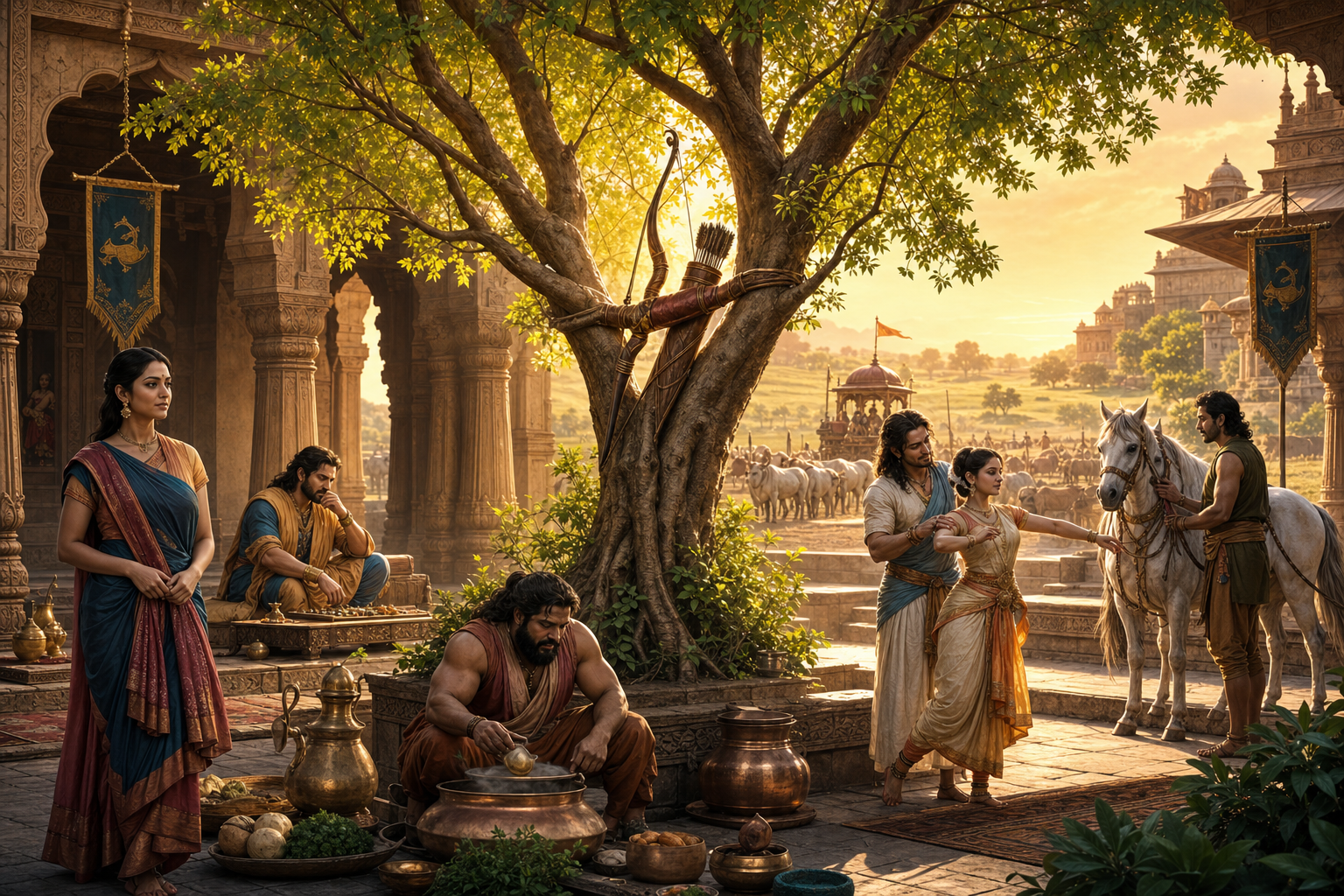
In the broader structure of the Mahabharata, the Matsya episode appears primarily in the Virata Parva, the fourth book of the epic. It marks the transition from wandering endurance to political re-emergence. The Pandavas did not simply hide in Virata’s court; they entered a social order in disguise and performed ordinary roles with extraordinary restraint. Yudhishthira became Kanka, a court companion skilled in dice and counsel. Bhima became Ballava, a cook of immense strength. Arjuna, under the name Brihannala, taught music and dance in the women’s quarters. Nakula cared for horses, Sahadeva tended cattle, and Draupadi became Sairandhri, a maidservant to Queen Sudeshna. These assumed identities reveal one of the epic’s most subtle teachings: true nobility is not dependent on titles, ornaments, or public recognition.
The kingdom itself is traditionally associated with the Matsyas, an ancient people mentioned in epic and early historical traditions. Many scholars connect the Matsya region with parts of present-day Rajasthan, especially areas around Jaipur, Alwar, and Bharatpur, though epic geography cannot always be reduced to modern political boundaries. The Mahabharata presents Matsya as a functioning kingdom with royal authority, military resources, cattle wealth, courtly life, and strategic importance. Its location made it relevant to the political field of northern Bharatavarsha, where kingdoms such as Kuru, Panchala, Chedi, and others formed a complex network of alliances, rivalries, marriages, and military obligations.
King Virata, the ruler of Matsya, is portrayed as a respectable but not invincible monarch. His court has dignity, yet it also contains vulnerabilities. The presence of Kichaka, Queen Sudeshna’s powerful brother and commander of the army, demonstrates the danger of concentrated power within a royal household. Kichaka’s misconduct toward Draupadi is one of the most emotionally charged episodes in the Virata Parva. It shows that adharma may arise not only from open enemies such as Duryodhana but also from arrogance, entitlement, and abuse within established institutions. Draupadi’s suffering in Virata’s palace gives the episode a human immediacy that still feels painfully recognizable.
Draupadi’s role in the Virata Kingdom deserves careful attention. She is not a passive figure hidden in the background of a martial narrative. As Sairandhri, she bears humiliation while preserving dignity, memory, and moral clarity. Her appeal to Bhima after Kichaka’s harassment reflects both anguish and strategic intelligence. The eventual destruction of Kichaka by Bhima is not presented as random revenge but as the restoration of moral balance after repeated violation. The episode reminds readers that dharma is not abstract philosophy alone; it must defend the vulnerable when power becomes predatory.
Bhima’s conduct in Virata is equally significant. He lives as a cook, a role far removed from the public image of a warrior prince, yet his strength remains available for righteous action. In the killing of Kichaka, Bhima becomes the concealed instrument of justice. The Mahabharata often shows that force, when governed by dharma, is not inherently immoral. The ethical problem lies in violence driven by ego, greed, or cruelty. In Virata, Bhima’s strength is restrained until it becomes necessary, and this restraint gives his action moral authority.
Arjuna’s life as Brihannala is among the most remarkable transformations in the epic. After receiving a curse from Urvashi that he would live for a time as a eunuch or one outside ordinary masculine status, Arjuna later turns that curse into a strategic advantage during the incognito year. As Brihannala, he teaches dance, music, rhythm, and refinement to Princess Uttara. This episode expands the epic understanding of heroism. Arjuna is not diminished by adopting an unconventional role; rather, his mastery becomes more complete. The warrior capable of wielding the Gandiva is also capable of transmitting art, discipline, and grace.
This layered portrayal is important for dharmic interpretation. The Mahabharata does not present a narrow model of strength. It allows courage to appear as silence, endurance, service, artistic instruction, strategic patience, and sudden battle-readiness. In this sense, the Virata episode offers a unifying lesson for Hindu, Buddhist, Jain, and Sikh ethical traditions: self-mastery is greater than outward display. Whether expressed through kshatra dharma, ahimsa disciplined by wisdom, seva, tapas, or inner restraint, the common principle is that conduct must be governed by truth, responsibility, and compassion.
Yudhishthira’s disguise as Kanka also carries deep philosophical weight. He enters Virata’s court as a dice-playing companion, a role that recalls the traumatic gambling match that led to the Pandavas’ exile. The irony is deliberate. The very instrument of his fall becomes a place of self-observation. In Virata’s court, Yudhishthira must remain calm, measured, and concealed even when provoked. His discipline shows that repentance in the Mahabharata is not sentimental; it is proven through transformed conduct under pressure.
Nakula and Sahadeva, often less emphasized in popular retellings, become essential to the kingdom’s stability. Nakula’s expertise with horses and Sahadeva’s knowledge of cattle demonstrate the practical sciences embedded in epic society. The Mahabharata repeatedly treats animal care, agriculture, food supply, military logistics, and household administration as serious forms of knowledge. Matsya’s cattle wealth is not incidental; it is central to the political economy of the kingdom. When the Kauravas later raid Virata’s cattle, the attack is both economic warfare and strategic provocation.
The cattle raid near the end of the Virata Parva is one of the most important military episodes before the Kurukshetra War. Duryodhana and his allies suspect that the Pandavas may be hiding in Matsya. By attacking Virata’s cattle, they seek both plunder and exposure. At the same time, the Trigartas attack from another direction, drawing King Virata and his forces away. This dual pressure reveals the tactical sophistication of ancient warfare as represented in the epic: diversion, intelligence gathering, economic targeting, and psychological pressure are all present.
Prince Uttara initially boasts that he can defeat the Kaurava army, but his confidence collapses when he sees the assembled warriors, including Bhishma, Drona, Karna, Kripa, and Duryodhana. At this moment, Brihannala becomes Arjuna again. The scene is dramatic not only because the hidden hero reveals himself but because courage is shown as something that can be transmitted. Arjuna does not merely mock Uttara’s fear; he guides him, steadies him, and turns him into a charioteer. The transformation of Uttara from boastful youth to participant in a great encounter is one of the quieter educational moments in the epic.
Arjuna’s recovery of his weapons from the shami tree is rich in symbolism. The Pandavas had hidden their weapons before entering Virata’s city, wrapping them and placing them in a tree near a cremation ground so that ordinary people would avoid the place. When Arjuna retrieves the Gandiva, the episode marks the return of rightful power after disciplined concealment. The shami tree later becomes associated in many traditions with victory, especially in the context of Dussehra and the remembrance of righteous action. The scene therefore links personal discipline, sacred memory, and political restoration.
The battle that follows confirms that the Pandavas’ period of concealment has succeeded. Arjuna defeats the Kaurava warriors without killing them, demonstrating technical superiority and ethical control. He uses celestial weapons and battlefield skill but does not convert the encounter into premature total war. This distinction matters. The Mahabharata carefully differentiates between necessary confrontation and uncontrolled destruction. Even on the edge of the Kurukshetra War, dharma still demands proportion, timing, and clarity of purpose.
After the Pandavas reveal themselves, King Virata’s court undergoes a reversal of perception. Those who had seemed to be servants, entertainers, and attendants are recognized as royal heroes. This is one of the great social lessons of the episode. Human worth is often hidden beneath circumstance. A person performing humble work may carry immense knowledge, sacrifice, or spiritual discipline. The Virata narrative therefore challenges superficial judgment and invites a more careful vision of dignity.
The marriage alliance that follows is politically and emotionally significant. King Virata initially wishes to offer his daughter Uttara to Arjuna, but Arjuna refuses because he has served as her teacher and regards her with the affection due to a daughter. Instead, Uttara is married to Abhimanyu, Arjuna’s son. This decision preserves the sanctity of the teacher-student relationship and strengthens the alliance between Matsya and the Pandavas. The marriage later becomes crucial because Uttara gives birth to Parikshit, the heir who continues the Kuru line after the devastation of Kurukshetra.
Through Uttara and Abhimanyu, the Virata Kingdom becomes tied to the survival of the epic’s future. Abhimanyu’s heroic death in the Chakravyuha is one of the most tragic moments of the Kurukshetra War, yet his unborn son Parikshit preserves dynastic continuity. In this way, Matsya is not a temporary shelter that disappears from the story. It becomes part of the Mahabharata’s long meditation on destruction, inheritance, and renewal. The kingdom shelters the Pandavas before war and, through Uttara, helps preserve the lineage after war.
The Virata episode also reveals how the Mahabharata understands statecraft. A kingdom depends not only on kings and armies but also on food systems, animal wealth, court discipline, gendered spaces, intelligence networks, commanders, alliances, and moral legitimacy. Kichaka’s dominance weakens Virata’s ethical order from within, while the Kaurava raid tests it from outside. The Pandavas’ presence exposes both threats and possibilities. They protect the kingdom, but they also reveal that power must be accountable to dharma.
From a literary perspective, the Virata Parva is built around concealment and recognition. Each major character lives under a hidden identity, and the reader knows what most characters within the story do not. This creates dramatic tension while also raising philosophical questions. What is identity when name, clothing, status, and occupation are changed? What remains constant when public recognition is removed? The epic’s answer is clear: svabhava, discipline, memory, and dharma remain. The Pandavas are still themselves because their inner commitments survive external disguise.
This has lasting relevance for modern readers. Many people experience periods when their abilities are unseen, their dignity is tested, or their rightful place is delayed. The Virata Kingdom speaks to such experiences with unusual tenderness. It suggests that hidden years are not wasted years when they are lived with discipline. The Pandavas do not control every circumstance, but they control their conduct. That distinction is central to the Mahabharata’s ethical intelligence.
The episode also invites reflection on humility. The greatest warriors of their generation spend a year in service roles without public admiration. This is not humiliation when willingly accepted for a righteous purpose; it becomes tapas, a disciplined acceptance of limitation for a higher end. In dharmic traditions, humility is not weakness. It is the purification of ego so that action becomes clearer. Virata’s court becomes a school of such humility.
At the same time, the Mahabharata does not romanticize suffering. Draupadi’s pain is real. Yudhishthira’s restraint is costly. Bhima’s anger is morally understandable. Arjuna’s concealment requires the suppression of public identity. The epic does not ask readers to admire injustice. Instead, it shows how dharmic action may require patience until the right moment for correction arrives. This balance between endurance and resistance is one reason the Virata narrative remains so powerful.
The Virata Kingdom is therefore important for understanding the movement from exile to war. Before the Pandavas can claim justice openly, they must prove that they can master themselves privately. Before Arjuna can return to the battlefield, he must live as Brihannala. Before Bhima can break Duryodhana’s thigh, he must cook in another king’s kitchen. Before Yudhishthira can become king, he must sit quietly in another court. The moral architecture is precise: legitimate power must pass through discipline.
The episode also strengthens the broader theme of unity within dharma. The Pandavas survive because each one accepts a different role without jealousy or fragmentation. Their unity is not sameness; it is coordinated difference. Yudhishthira’s patience, Bhima’s strength, Arjuna’s skill, Nakula’s refinement, Sahadeva’s knowledge, and Draupadi’s courage together preserve the group. This principle resonates beyond the Mahabharata. Dharmic civilization has long contained diverse paths, temperaments, practices, and philosophical schools, yet its deeper strength lies in harmony directed toward truth.
For students of Hindu scriptures and Indian epics, the Virata Kingdom provides a compact study of ethics, politics, gender, warfare, pedagogy, and spiritual psychology. It is a reminder that the Mahabharata is not only a story of kings and battles. It is a vast inquiry into human conduct. The palace of Virata, the kitchen, the cattle grounds, the dance chamber, the royal court, and the battlefield all become classrooms in which dharma is examined from different angles.
Ultimately, the hidden realm of Virata stands as the threshold between suffering and restoration. In Matsya, the Pandavas complete their exile, protect their honor, defend Draupadi, preserve their unity, gain an ally, and prepare for the unavoidable conflict ahead. The kingdom’s significance lies not in its size alone but in its function within the epic’s moral journey. It teaches that concealed virtue is still virtue, restrained power is still power, and justice, when rooted in dharma, may wait but does not disappear.
The Virata Kingdom in the Mahabharata therefore remains a profound symbol of disciplined endurance. It shows that the path from loss to renewal often passes through anonymity, service, and inner testing. For contemporary readers, its lesson is both historical and deeply personal: dignity must be preserved before victory is achieved, and true strength is proven not only in the moment of triumph but also in the long season when no one is watching.
Inspired by this post on Hindu Blog.
