
Sacred architecture is never merely a matter of walls, pillars, domes, courtyards, and measurements. In traditional cultures, built form becomes a disciplined way of organizing perception, memory, movement, attention, and meaning. A temple, samadhi, monastery, shrine, gurudwara, stupa, mandapa, or pilgrimage settlement is not only a physical structure; it is a field of experience in which the human being is invited to remember a larger order of reality. This is why architecture shaped by Vedic wisdom, Vastu Shastra, Bhakti Yoga, and other dharmic traditions cannot be understood only through engineering or aesthetics. It must also be studied as a symbolic, philosophical, and spiritual discipline.
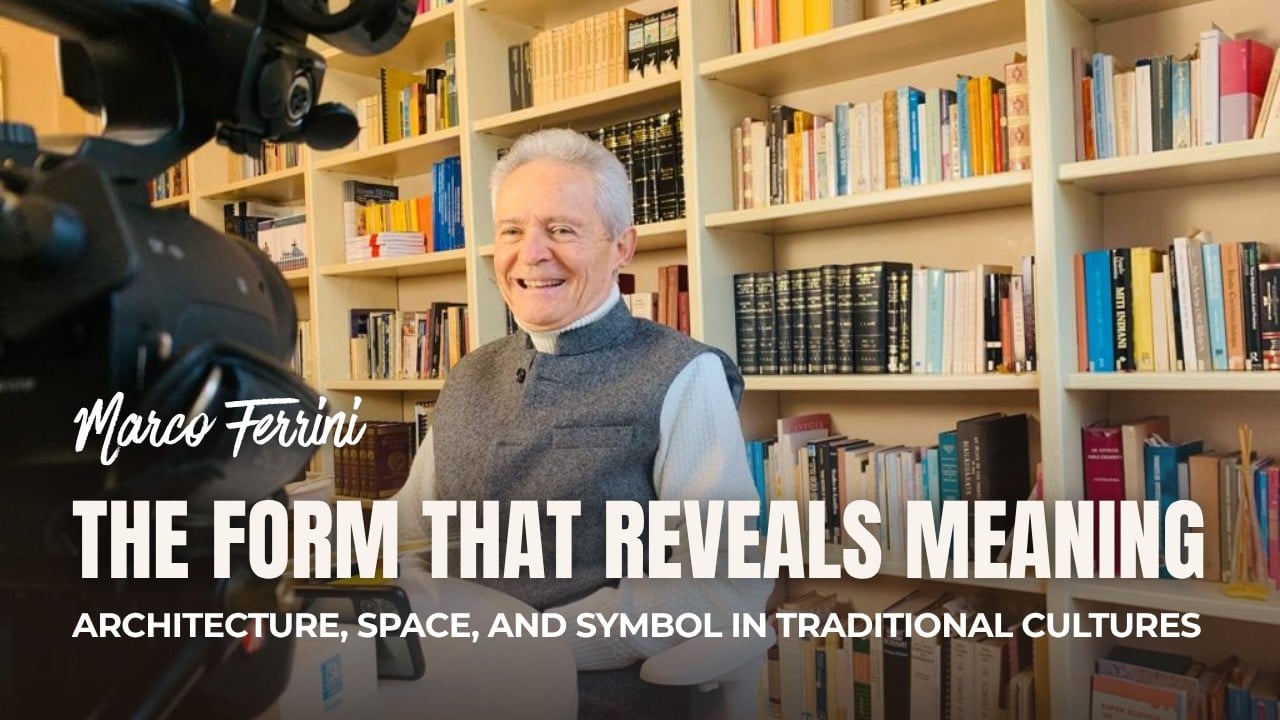
The lecture titled The Form That Reveals Meaning: Architecture, Space, and Symbol in Traditional Cultures presents architecture as a profound organization of consciousness rather than a neutral arrangement of materials. It brings together Vedic philosophy, sacred architecture, symbolic geometry, sustainable design, human values, and the built environment. Its central insight is that a building has meaning when it serves the complete person: body, mind, memory, emotion, community, and soul. Stability and technical correctness are essential, but they are not the whole purpose of architecture. The deeper question is whether a space helps human beings live with clarity, reverence, and spiritual orientation.
This approach becomes especially meaningful when viewed through the Bhagavad-gita’s thirteenth chapter, where the distinction between kshetra and kshetrajna becomes a key philosophical lens. Kshetra means the field, while kshetrajna means the knower of the field. The body, the senses, the mind, and the world of experience form a field in which consciousness acts, learns, suffers, desires, remembers, and awakens. Architecture, in this framework, creates an external field that interacts with the inward field of perception. The observer does not merely look at a building from outside; the observer is shaped by the rhythms, proportions, symbols, light, thresholds, and silences of the space.
Srila Prabhupada’s teaching that the body and the material world are fields of experience for the conscious soul gives this architectural idea a strong spiritual foundation. The built environment is not spiritually irrelevant. It can distract, agitate, fragment, and flatten the mind, or it can support remembrance, discipline, humility, and devotion. In Bhakti Yoga, the material world is not rejected as meaningless; it can be spiritualized when it is connected to service, remembrance, and sacred purpose. A building designed in that consciousness becomes more than shelter. It becomes an aid to sadhana, a disciplined environment for cultivating attention toward the Divine.
The importance of this idea is visible in the way traditional Hindu architecture treats space. Vastu Shastra does not treat a site as empty land waiting for arbitrary construction. It regards space as ordered, directional, relational, and alive with subtle correspondences. Orientation, proportion, axis, center, threshold, circulation, and enclosure are not decorative concerns. They shape how the inhabitant encounters light, sound, procession, stillness, and sacred presence. A temple plan, for example, often moves from the outer world of multiplicity toward the concentrated center of the garbhagriha. This movement is architectural, but it is also psychological and spiritual.
The same principle can be seen across dharmic traditions. In Hindu temples, the devotee often moves through layered spaces that gradually refine attention. In Buddhist stupas and monasteries, circumambulation, axiality, and contemplative order guide the mind toward mindfulness and awakening. In Jain temples, precision, purity, symmetry, and luminous ornamentation often express an ethic of restraint, non-violence, and spiritual ascent. In Sikh gurudwaras, openness, sangat, kirtan, and langar embody equality, devotion, and community service. These traditions differ in theology and ritual expression, yet they share a civilizational intuition: space can educate the inner life.
This shared dharmic vision helps prevent a narrow reading of sacred architecture. The point is not to reduce all traditions into one formula, nor to erase their distinctions. The point is to recognize that Hinduism, Buddhism, Jainism, and Sikhism have each preserved ways of shaping space so that human beings remember truth, discipline, compassion, humility, and transcendence. A civilization that forgets this function of architecture begins to treat buildings only as commodities, spectacles, or mechanical containers. A civilization that remembers it sees the built environment as a teacher.
The lecture’s emphasis on convergence is therefore crucial. Engineering gives a structure stability. Art gives it beauty. Philosophy gives it meaning. Spiritual intention gives it direction. None of these dimensions should be isolated from the others. A building that is beautiful but structurally careless fails its practical responsibility. A building that is strong but spiritually empty may still leave the human being restless and alienated. A building that claims sacred meaning but ignores proportion, function, and ecological responsibility risks sentimentality. True sacred architecture seeks the convergence of utility, beauty, stability, symbolism, and consciousness.
This convergence recalls classical architectural ideals found in many cultures, yet the dharmic contribution is distinctive because it connects form with inner transformation. In Vedic architecture and temple architecture, the visible is often meant to disclose the invisible. Geometry is not only mathematics; it is a language of order. Light is not only illumination; it can become a metaphor for knowledge. The center is not only a point in a plan; it can symbolize the still axis of being. Movement is not only circulation; it can become pilgrimage. Ornament is not only embellishment; it can encode mythology, cosmology, and ethical memory.
The reference to the Srila Prabhupada Samadhi Mandir in Mayapur makes these ideas concrete. A samadhi mandir is not merely a memorial building. It is a space where remembrance, gratitude, lineage, devotion, and sacred geography meet. Its purpose is not only to house memory but to activate it. The visitor is asked to enter a field where form and meaning converge: the life of a spiritual teacher, the continuity of Bhakti Tradition, the sanctity of Mayapur, and the inward movement of devotion. Such architecture becomes a visible expression of invisible dedication.
The notion of sacred geography is equally important. Places such as Vrindavan, Mathura, and Mayapur are not understood only as coordinates on a map. They are experienced as meanings carried within consciousness. In Bhakti traditions, dhama is not simply location; it is a sacred field of remembrance, relationship, and divine presence. The same principle can be extended carefully to many dharmic pilgrimage landscapes: Kashi, Bodh Gaya, Palitana, Amritsar, Puri, Rameswaram, Sarnath, Shravanabelagola, and countless local tirthas. Their power lies not only in physical terrain but in accumulated memory, practice, story, and faith.
Modern life often trains people to experience space in a reduced way. Buildings become real estate assets, offices become productivity containers, homes become storage units, and public spaces become traffic corridors. This reduction has emotional consequences. Many people recognize the feeling of entering a space that immediately produces anxiety, distraction, or fatigue. Others know the quiet relief of stepping into a temple courtyard, a meditation hall, a gurudwara during kirtan, or a simple room arranged with care and cleanliness. The body senses order before the intellect explains it. Architecture acts on the nervous system, the emotions, and the imagination.
That experiential dimension does not make sacred architecture irrational. On the contrary, it invites a wider rationality. Human beings are not machines who occupy measurable volume. They are embodied, relational, memory-bearing, symbol-making beings. A technical view of architecture can calculate load, airflow, acoustics, energy performance, and material efficiency. These are necessary. But traditional cultures ask additional questions: What does this space make people remember? Does it refine conduct? Does it support community? Does it honor nature? Does it encourage reverence? Does it bring the person closer to truth?
This is where the idea of sadhana becomes especially powerful. The lecture applies sadhana not only to the devotee but also to the creative process itself. Intention matters because it shapes the quality of the result. In Bhakti Yoga, sadhana is disciplined spiritual practice that purifies consciousness. In architecture, the sadhana of the architect means attention, responsibility, humility, and service. The designer is not merely solving a client brief. The designer is shaping conditions in which future lives will unfold. Such a responsibility demands more than technical competence; it requires moral and spiritual seriousness.
Seva, or service, deepens this point. A sacred building should not be created as an exercise in ego, spectacle, or domination. It should serve the community, the tradition, the environment, and the inner life of those who enter it. This service may appear in grand temple architecture, but it may also appear in modest forms: a clean prayer room, a well-designed community kitchen, a shaded pilgrimage path, a quiet library, a school shaped around dignity, or a home altar placed with care. The principle is not scale but consciousness.
The concept of Sat-Chit-Ananda, often translated as eternal being, consciousness, and bliss, gives sacred architecture an even deeper metaphysical horizon. If reality is not merely matter but being, consciousness, and bliss, then architecture should not be satisfied with utility alone. It should participate, however humbly, in stability, awareness, and joy. Stability appears through structural integrity, proportion, and durability. Consciousness appears through symbolism, orientation, and spaces that invite attention. Joy appears through beauty, harmony, ornament, light, rhythm, and the felt dignity of being human.
This does not mean that every building must imitate historical forms. Traditional wisdom is not the same as nostalgic reproduction. The deeper lesson of Vastu Shastra, sacred geometry, and dharmic spatial thinking is not that modern architects must mechanically copy old motifs. The lesson is that form must reveal meaning. Materials, technologies, and social needs change, but the human need for order, belonging, sacred memory, ecological balance, and transcendence remains. A contemporary building can be traditional in spirit when it honors these principles honestly.
Sustainable architecture also gains depth when viewed through this lens. Sustainability is not only energy efficiency, though that is important. It is also the cultivation of restraint, continuity, repair, reverence for land, and responsibility toward future generations. Traditional architecture often worked with climate, local materials, seasonal rhythms, courtyards, shaded thresholds, water systems, and community patterns. These were not romantic details; they were intelligent responses to place. A dharmic approach to the built environment should therefore unite ecological awareness with spiritual humility.
Symbolism plays a central role because symbols allow architecture to speak without argument. A doorway can mark transition. A circumambulatory path can teach repetition, patience, and orientation. A central shrine can gather attention. A dome can suggest the heavens. A pillar can signify support, axis, or aspiration. A lamp can embody knowledge. Water can purify and cool the senses. The visitor may not consciously analyze each element, yet the experience can still shape memory. This is why traditional cultures took symbols seriously. They understood that human beings live by meanings, not by measurements alone.
The danger in modern interpretation is to dismiss symbols as superstition or to consume them as decoration. Both approaches miss their function. A symbol is not powerful because it is exotic. It is powerful because it connects visible form with invisible truth. In Hindu architecture, Hindu symbols, temple rituals, and sacred geometry often work together to train perception. In Buddhist, Jain, and Sikh spaces, different symbolic languages perform comparable work: they refine the mind, orient the community, and embody values. The unity among dharmic traditions becomes clearer when symbolism is understood as a disciplined language of awakening rather than a collection of isolated motifs.
The built environment also shapes social life. A temple is not only a shrine; it can be a center of learning, music, food distribution, festivals, ethical instruction, and cultural continuity. A gurudwara is not only a devotional hall; it is a living institution of sangat and seva. A monastery can preserve study, meditation, manuscript traditions, and disciplined community. A Jain temple can sustain ritual purity, philosophical reflection, charity, and collective identity. Sacred architecture therefore links individual spiritual practice with community cohesion. It forms habits of gathering, serving, remembering, and transmitting knowledge.
This social dimension matters today because many communities experience fragmentation. Families are scattered, public culture is noisy, and digital life often weakens sustained attention. Sacred spaces offer a counter-discipline. They slow the body, regulate the senses, and place the individual within a lineage larger than personal preference. The experience can be emotionally grounding even for those who cannot fully explain it. A person may enter with fatigue and leave with a quieter mind because the space has done what sacred architecture is meant to do: it has reorganized attention around meaning.
The lecture’s core contribution is therefore philosophical as much as architectural. It shows that architecture is a meeting point between the outer field and the inner knower. The building is kshetra in a visible form, while the person who enters it is kshetrajna, the conscious witness and participant. When the field is disorderly, aggressive, or spiritually empty, the knower is affected. When the field is ordered toward truth, beauty, service, and remembrance, the knower is supported in self-understanding. This is not determinism; a building cannot force spiritual realization. But it can either obstruct or assist the journey.
Such an understanding also guards against shallow debates about tradition and modernity. The issue is not whether a building looks old or new. The issue is whether it understands the human being deeply. Traditional cultures often began with the assumption that human life has a sacred aim. Modern design often begins with function, cost, image, and efficiency. A mature synthesis would not reject modern knowledge; it would place it within a richer anthropology. Engineering, technology, and sustainability should be welcomed, but they should serve a vision of human flourishing that includes spiritual realization.
For dharmic civilization, this has practical implications. Temples, cultural centers, schools, homes, pilgrimage facilities, and community spaces should be designed with attention to more than crowd movement and visual impact. They should consider ritual flow, acoustics for chanting and kirtan, spaces for learning, accessibility for elders, areas for children, ecological responsibility, food service, contemplative quiet, and the dignity of artisanship. Sacred architecture must be beautiful, but it must also be usable, hospitable, and ethically grounded.
Artisanship deserves special attention. Traditional architecture depended on skill, patience, and transmission. The hand of the artisan was not incidental to meaning. Carving, proportioning, laying stone, preparing wood, painting, and consecrating space were all forms of disciplined participation. When workmanship declines, architecture loses not only technical quality but cultural memory. Restoring sacred architecture therefore requires restoring respect for craftsmen, sthapatis, sculptors, ritual specialists, scholars, engineers, and communities who together carry the knowledge tradition.
The phrase visible expression of the invisible captures the essence of the subject. Sacred form does not manufacture the sacred; it reveals, frames, and reminds. It gives the senses a disciplined path toward what cannot be reduced to the senses. This is why sacred architecture can remain powerful across centuries. A person may not know every textual reference or symbolic code, yet the space can still communicate gravity, beauty, and orientation. It offers an experience of meaning before it becomes an explanation of meaning.
In the end, architecture shaped by dharmic insight asks a demanding question: what kind of consciousness should this space cultivate? If the answer is consumption, speed, distraction, or prestige, the form will reveal that. If the answer is service, remembrance, wisdom, devotion, compassion, and harmony, the form can reveal that as well. The responsibility belongs not only to architects but to patrons, communities, religious leaders, educators, and householders. Every built environment teaches something. The task is to ensure that it teaches truth with humility and beauty.
The Form That Reveals Meaning ultimately points toward a civilizational recovery of architectural wisdom. It invites a return to spaces where utility, beauty, stability, and sacred symbolism are not enemies but partners. It affirms that Vedic architecture, temple architecture, sacred geography, Bhakti Yoga, and dharmic traditions continue to offer insights urgently relevant to modern life. When form is aligned with meaning, architecture becomes more than construction. It becomes a field of remembrance, a support for spiritual insight, and a quiet guide toward the inner knower.
Inspired by this post on Dandavats.
