
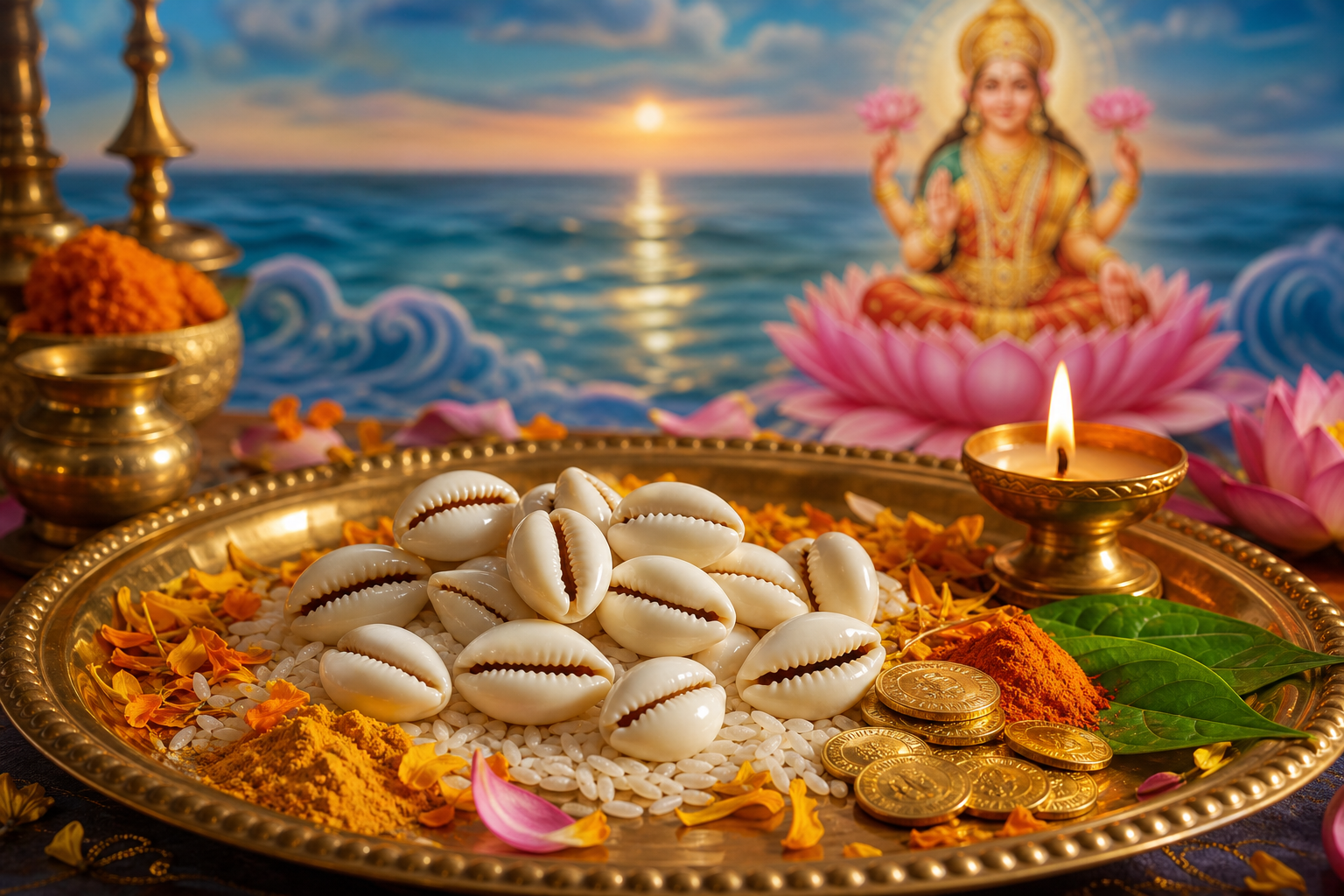
The cowrie shell, known in Hindi as kaudi, occupies a distinctive place in Hindu ritual culture because it brings together several streams of meaning: wealth, fertility, auspiciousness, oceanic abundance, domestic prosperity, and the blessings of Goddess Lakshmi. Its importance cannot be reduced to superstition or ornament. In traditional Hindu life, a small object often becomes sacred because it gathers memory, mythology, economics, aesthetics, and daily practice into a single symbol. The kaudi is one such object. Its polished surface, natural beauty, and historical use as a form of wealth made it a fitting emblem of Sri Lakshmi, the divine presence associated with prosperity, nourishment, fortune, beauty, generosity, and the sustaining order of household life.
The association between cowrie shells and Goddess Lakshmi becomes clearer when the symbol is studied in relation to the sea. In Hindu sacred imagination, Lakshmi is deeply linked with water, especially the cosmic ocean. The famous narrative of Samudra Manthan, the churning of the ocean, places Lakshmi’s manifestation within a vast drama of cosmic renewal. From the ocean emerge treasures, medicines, divine beings, and forms of power needed to restore balance. Lakshmi appears from this same oceanic source as the radiance of auspicious prosperity. Since cowrie shells are born from the sea, they naturally came to be seen as small signs of that oceanic abundance. A kaudi placed in a puja space is therefore not merely a shell; it is a reminder that prosperity flows from a deeper cosmic order.
In Hindu symbolism, water is not only physical water. It represents fertility, movement, rasa, life-force, emotional continuity, and the hidden potential from which visible abundance emerges. Lakshmi seated on a lotus, surrounded by water and elephants, expresses this same principle. Prosperity is not dry accumulation; it is living flow. Wealth that does not circulate becomes stagnant, while wealth that nourishes family, community, learning, charity, and dharma becomes auspicious. The cowrie shell’s oceanic origin quietly preserves this teaching. It points to wealth as something that must remain connected with purity, gratitude, and right use.
The kaudi also has an economic history that strengthens its connection with Lakshmi. Cowries were once used as currency or exchange objects in many regions of Asia, Africa, and the Indian Ocean world. Their durability, portability, recognizable shape, and relative scarcity gave them practical value. In parts of India, cowries were used in trade, small transactions, accounting, games, ornaments, and ritual gifts. This historical role matters because Lakshmi is not an abstract goddess of luxury alone. She is connected with grain, cattle, gold, coins, food, land, craftsmanship, household management, and the ethical circulation of resources. A shell that once functioned as a medium of exchange could easily become a ritual sign of wealth and fortune.
The physical form of the cowrie shell also contributed to its sacred meaning. Its glossy surface resembles polished ivory or a small jewel. Its natural opening has often been interpreted as a symbol of fertility, generative power, and the protective feminine principle. Such symbolism must be handled carefully and respectfully. In traditional cultures, fertility does not refer only to biological reproduction. It also means the capacity to generate food, ideas, lineage, artistic skill, social continuity, and spiritual merit. As a symbol of Goddess Lakshmi, the kaudi therefore suggests not only money but also the fuller power of life to renew itself.
This is why cowrie shells often appear in rituals connected with Lakshmi Puja, Deepavali, Dhanteras, Akshaya Tritiya, housewarming ceremonies, business openings, account-book worship, and domestic shrines. They may be kept near coins, rice, turmeric, kumkum, betel leaves, lamps, and images of Lakshmi or Vishnu. Their presence indicates a prayer for stable income, wise expenditure, protection from scarcity, and the cultivation of abundance in a dharmic manner. The shell becomes especially meaningful when placed with clean intention, disciplined conduct, and reverence. Ritual objects in Hindu tradition are not mechanical devices; they are supports for consciousness, memory, and ethical alignment.
Traditional households often preserve kaudi in small boxes, puja plates, or cloth pouches along with other auspicious items. This domestic use reveals the intimate character of Lakshmi worship. Prosperity is not limited to palaces, temples, or public ceremonies. It is equally present in the kitchen, the grain jar, the lamp lit at dusk, the careful keeping of accounts, the hospitality offered to guests, and the quiet effort to maintain family dignity. A small cowrie shell can carry emotional force because it belongs to this everyday sacred world. It reminds people that wealth is experienced most deeply as security, nourishment, beauty, and the ability to give.
The association of kaudi with Lakshmi also reflects the Hindu understanding of symbols as layered rather than literal. A symbol does not have only one meaning. The lotus can mean purity, beauty, detachment, divine birth, and spiritual awakening at the same time. Similarly, the cowrie can mean wealth, sea-born abundance, fertility, protection, exchange value, and auspicious feminine energy. This layered quality is one of the strengths of Hindu religious imagination. It allows a simple object to become a teaching tool that speaks differently to a child, a householder, a scholar, an artisan, and a devotee.
Kaudi is also associated with protective power. In folk practice, cowrie shells have been stitched into garments, tied to cradles, used in ornaments, or placed in ritual spaces to ward off negative influences. The gleaming white surface and eye-like form of the shell may have contributed to its apotropaic, or protective, symbolism. Within Lakshmi worship, protection is not separate from prosperity. Wealth needs safeguarding from waste, arrogance, envy, misfortune, and adharma. The shell therefore represents not only the arrival of fortune but also the wish that fortune remain stable, pure, and beneficial.
There is also a strong connection between kaudi and the language of auspicious sound and touch. Hindu ritual is sensory: lamps are seen, bells are heard, incense is smelled, prasada is tasted, and sacred substances are touched. Cowrie shells add texture and visual luminosity to this ritual environment. Their smallness is part of their power. They can be held in the palm, counted, arranged, offered, or preserved. In that tactile relationship, devotion becomes embodied. A symbol of Lakshmi is not distant; it can be touched with reverence and integrated into daily practice.
From a technical perspective, the cowrie belongs to a family of marine shells whose smooth exterior and durable structure made them widely valued across cultures. Their movement through trade networks helped connect coastal and inland societies. In the Indian context, this maritime dimension is significant. India’s cultural history has long been shaped by rivers, seas, ports, pilgrimage routes, and trade networks. Cowries carried the memory of the ocean into inland homes and temples. They became portable signs of a larger world where commerce, ritual, and sacred geography interacted. This broader historical frame helps explain why kaudi could become both an economic object and a religious symbol.
The kaudi’s link with Goddess Lakshmi also has a moral dimension. Hindu thought repeatedly distinguishes between wealth that supports dharma and wealth that fuels greed. Lakshmi is welcomed where there is cleanliness, generosity, order, respect, truthfulness, and reverence. She is not merely the accumulation of money; she is the grace that makes prosperity beautiful and sustaining. A cowrie shell kept in a shrine should therefore be understood as a reminder to cultivate worthy conditions for abundance. It silently asks whether wealth is being earned honestly, used wisely, shared appropriately, and aligned with the welfare of others.
This moral reading is especially important in modern life. Today, prosperity is often measured by salary, property, markets, and consumption. The symbol of kaudi broadens that definition. It suggests that true wealth includes health, food security, education, family harmony, ecological balance, spiritual discipline, and the capacity to remain content without becoming careless. In this sense, the cowrie shell offers a gentle critique of purely material wealth. It belongs to Lakshmi, but Lakshmi herself is inseparable from auspiciousness, responsibility, and grace.
In many Lakshmi rituals, kaudi is placed with rice or grains. This pairing is highly meaningful. Rice represents food, continuity, agricultural abundance, and the power of the earth. The cowrie represents oceanic abundance, exchange, and wealth. Together, they join land and sea, food and currency, nourishment and trade. This union reflects a sophisticated cultural understanding: prosperity requires both production and circulation. A household needs grain in storage, but it also needs resources that can move. Lakshmi’s blessings are therefore understood as both stability and flow.
The use of cowrie shells in counting and games also adds another layer to their symbolism. Traditional games involving cowries are not merely recreational; they often encode ideas of chance, skill, destiny, and decision. This symbolic world overlaps with Lakshmi because fortune is never entirely under human control. Effort is essential, but timing, grace, social conditions, and unseen causes also shape outcomes. A kaudi therefore points toward humility. It reminds the devotee that prosperity is cultivated through discipline but received with gratitude.
It is also important to distinguish living tradition from exaggerated claims. Not every ritual use of cowrie shells can be traced to a single scriptural command, and not every regional practice has the same meaning. Hindu traditions often develop through an interplay of scripture, temple practice, family custom, regional culture, oral memory, and symbolic interpretation. The association of kaudi with Lakshmi is best understood through this combined framework. Its authority lies not in one isolated citation but in a long continuity of ritual use, symbolic coherence, and devotional acceptance.
The regional diversity of kaudi practices also shows the inclusive character of Hindu culture. In some communities, cowries are tied to prosperity rituals; in others, they appear in folk deities’ ornaments, bridal customs, children’s protection practices, or festival decorations. Such variety does not weaken the symbol. It enriches it. Hinduism has historically allowed sacred meanings to grow through local experience while remaining connected to larger philosophical ideas. The kaudi can therefore belong both to Lakshmi Puja in a household shrine and to regional expressions of Shakti, fertility, protection, and ancestral continuity.
The symbol also fits naturally within the wider Dharmic appreciation of auspicious objects. Hindu, Buddhist, Jain, and Sikh communities have each preserved distinctive relationships with sacred signs, disciplined practice, ethical living, and reverence for inherited wisdom. While their philosophies and rituals differ, they share a broad respect for objects that focus attention, preserve memory, and support inner refinement. The kaudi, in a Hindu context, points specifically to Lakshmi; more broadly, it illustrates how Dharmic cultures often transform simple natural forms into reminders of gratitude, restraint, and higher purpose.
For devotees, the emotional appeal of the cowrie shell lies in its accessibility. Gold may be beyond reach, jewels may be rare, and elaborate rituals may not always be possible. A kaudi, however, is small and humble. It allows even a modest household to invoke the symbolism of Lakshmi with sincerity. This democratic quality is spiritually significant. It affirms that divine grace is not reserved for the wealthy. Prosperity begins with reverence, cleanliness, effort, gratitude, and the willingness to live according to dharma.
The cowrie shell also teaches that beauty in Hindu ritual is not accidental. Lakshmi is associated with saundarya, or beauty, because beauty indicates harmony. A clean home, a well-arranged altar, a lit lamp, fresh flowers, polished vessels, and carefully placed kaudi shells create an atmosphere where the mind becomes receptive. Ritual beauty disciplines attention. It removes dullness and invites refinement. The shell’s natural elegance therefore makes it an appropriate offering and symbol for a goddess whose presence is felt as order, grace, radiance, and fullness.
In philosophical terms, the kaudi may be read as a bridge between the material and the spiritual. On one level, it represents wealth and exchange. On another, it represents the oceanic source of life. On a deeper level, it reminds the devotee that all forms of abundance are entrusted, not possessed absolutely. Hindu thought does not reject wealth; it places wealth within the purusharthas, the aims of life, where artha must be guided by dharma. The cowrie shell becomes meaningful precisely because it holds artha within a sacred frame.
The enduring presence of kaudi in Lakshmi worship shows how Hindu symbols survive because they remain useful to the heart and mind. The shell is ancient, but its message is not outdated. In a world of financial anxiety, unstable economies, and constant comparison, it offers a quieter vision of abundance. Prosperity is not merely having more; it is living with enough order, generosity, nourishment, and spiritual balance that wealth becomes auspicious. This is the deeper reason cowrie shells are associated with Goddess Lakshmi. They embody the hope that life may become fertile, protected, beautiful, and aligned with divine grace.
Thus, the sacred kaudi represents much more than a ritual accessory. It is a sea-born symbol of Lakshmi’s blessings, a memory of ancient exchange, a sign of fertility and protection, and a reminder that prosperity must remain connected to dharma. When placed before Goddess Lakshmi, it expresses a refined prayer: may wealth arise from purity, may it circulate with responsibility, may it nourish the household and community, and may it never be separated from wisdom, gratitude, and compassion.
Inspired by this post on Hindu Blog.
