
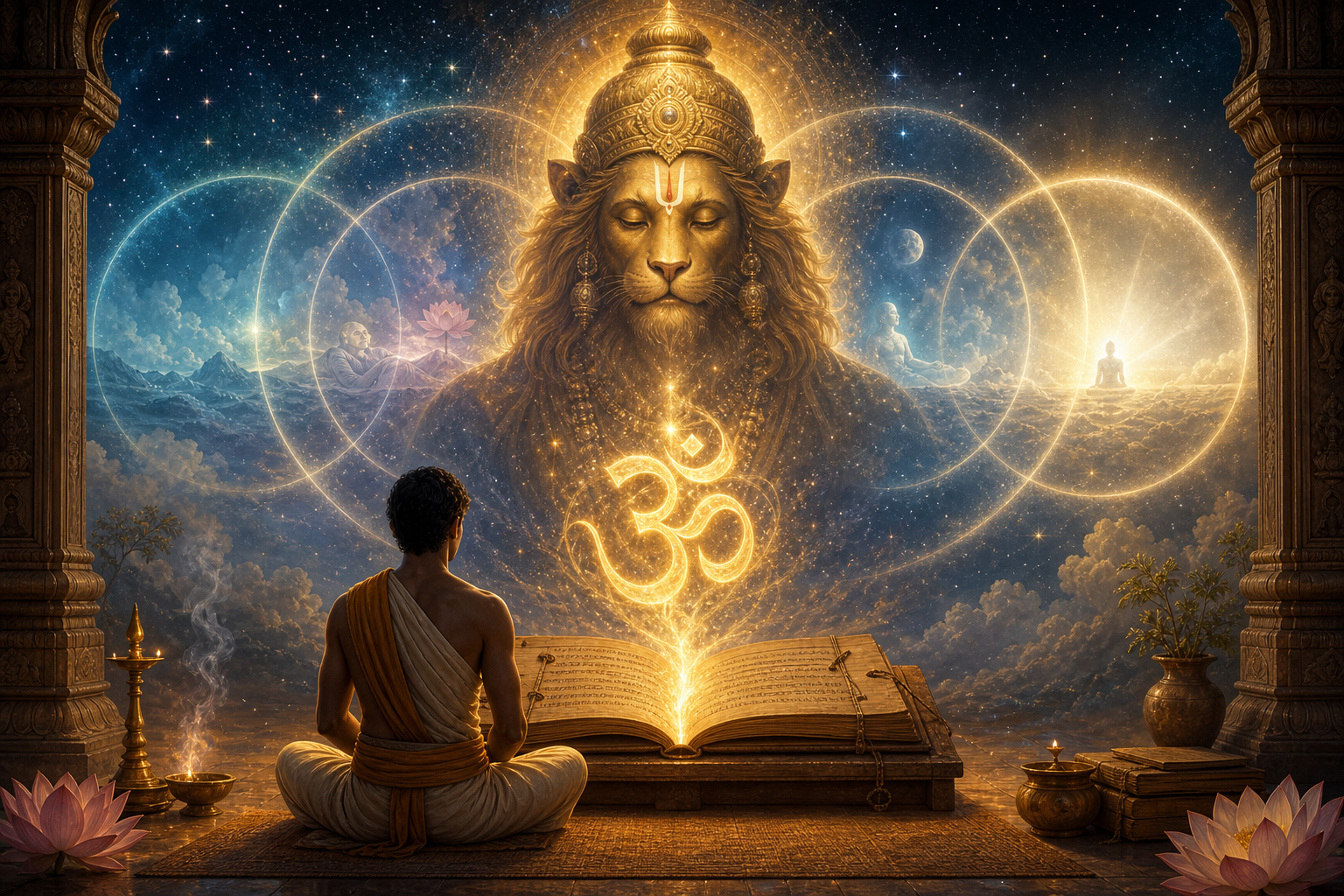
The Uttaratapini section of the Nrisimha Tapaniya Upanishad is one of the most concentrated meditations on nondual awareness within the Vaishnava Upanishadic tradition. It presents Lord Narasimha not merely as a mythic form of divine protection, but as a contemplative doorway into the identity of Atman, Om, Brahman, and pure consciousness. Its teaching moves with unusual philosophical intensity: the seeker begins with mantra, enters the analysis of AUM, contemplates the witnessing Self, and finally recognizes the divine as the innermost reality rather than an external object alone.
This section belongs to the larger Nrisimha Tapaniya Upanishad, a Sanskrit text associated with the Atharvaveda and traditionally classified among the Vaishnava Upanishads. The full work is divided into Purva Tapaniya and Uttara Tapaniya portions. The Purva section emphasizes the Nrisimha mantra, its sacred structure, and its protective and liberating power, while the Uttara section turns inward and unfolds the metaphysics behind that practice. In nine khandas and traditionally counted as 84 mantras, the Uttaratapini becomes a disciplined inquiry into how devotion, mantra, meditation, and Vedanta converge.
The text is written largely in prose, which gives it a direct and instructional character. Occasional Vedic references anchor the teaching in the wider authority of the Vedic tradition, but the dominant mode is contemplative explanation. This makes the Uttaratapini especially valuable for students of Hindu scriptures because it does not separate ritual sound from philosophical realization. A mantra is not treated as a decorative religious formula; it is treated as a precise means of entering the nature of reality.
At the center of the Upanishad stands the Pranava, AUM or Om. The text follows the wider Upanishadic pattern in which AUM is not only a sound but a map of consciousness. The letters A, U, and M correspond to layered states of experience, while the silence beyond them points toward Turiya, the fourth state. Turiya is not another ordinary mental state. It is pure awareness, the witnessing ground in which waking, dreaming, and deep sleep appear and disappear.
The first khanda begins with a request for knowledge. The devas approach Brahma and seek instruction on AUM and the Self. This dramatic frame is important because it places even celestial beings in the position of students. The Upanishadic path is therefore not built on status, power, or inherited identity; it is built on inquiry, humility, and disciplined listening. Knowledge of Atman is presented as higher than ordinary knowledge because it is the ground that makes all knowing possible.
The second khanda develops the fourfold symbolism of AUM. Brahman is approached through the articulated sound and through the silence that completes it. This teaching closely resonates with the Mandukya Upanishad, where the syllable Om becomes a complete philosophical diagram of the Self. In the Uttaratapini, however, this nondual analysis is joined to Narasimha devotion. The result is a distinctive synthesis: the fierce form of Vishnu is interpreted as the very reality that the contemplative discovers within consciousness.
The third khanda turns from doctrine to practice. Meditation on Om is not presented as casual repetition but as an intense internal discipline. The mind is invited to gather itself, withdraw from fragmentation, and allow all names and forms to be absorbed into pure awareness. This is where the technical language of Vedanta becomes psychologically powerful. The text recognizes that the ordinary mind is scattered across memory, fear, desire, and sensory pressure. Om becomes a method for re-centering consciousness in its own source.
The fourth khanda deepens this contemplation by identifying the Self with Omkara and Parabrahman. The seeker is not asked to imagine Brahman as a distant abstraction. Instead, the practice directs attention toward the immediate fact of awareness. The one who hears, thinks, doubts, remembers, and worships is invited to look back toward the witness of all these movements. In this sense, the Uttaratapini is both devotional and analytical. It speaks the language of Narasimha while guiding the mind into subtle self-inquiry.
The fifth khanda states the fruit of such meditation in bold Vedantic terms. One who meditates on Om comes to abide in Brahman and attains Brahman. Worship of the Self and recitation of the Pranava are brought into a single contemplative movement. Narasimha is then realized not only as an avatar who protects Prahlada in sacred narrative, but as Parabrahman Narasimha, the supreme reality recognized in the heart of awareness.
The sixth khanda is especially meaningful for practical spirituality because it links Narasimha worship with the overcoming of inner negativities. The traditional image of Narasimha is fierce, but this fierceness is not random aggression. It is the force that destroys adharma, fear, delusion, cruelty, and spiritual inertia. Read inwardly, the demon conquered by Narasimha is not only an external figure from mythology; it is also the hardened ego that refuses truth, humility, and compassion.
The seventh khanda continues the discipline of meditation. Its concern is not speculative novelty but steadiness. The Upanishadic student must learn to refine attention, sustain remembrance, and allow mantra to transform the quality of perception. In modern terms, this can be understood as a rigorous contemplative psychology. The text assumes that consciousness can be trained, purified, and made transparent to its own deepest nature.
The eighth khanda brings the identity of Atman and Narasimha into sharper focus. The Self is linked with Turiya, the pure consciousness that cannot be reduced to body, senses, emotion, or thought. This does not dismiss embodied life. Rather, it teaches that embodied life becomes rightly understood only when its foundation is known. The human being is not merely a bundle of impulses and anxieties; there is an unbroken awareness beneath the changing surface of experience.
The ninth khanda completes the teaching by explaining AUM through the language of the witness. Prajapati instructs the devas to recognize the Self as the inner reality. The lion form is treated as a sacred symbol that points beyond ordinary sensory grasp. The senses cannot capture the whole truth, and the mind cannot fully objectify that which is the basis of mind itself. The realization is therefore not possession of an idea but dissolution of ignorance.
This is the central philosophical achievement of the Uttaratapini section: it joins saguna and nirguna approaches without treating them as enemies. Narasimha is worshipped as a divine form, yet the same Narasimha is also understood as the formless Brahman realized through Om. Devotion does not block nondual knowledge; it matures into it. Knowledge does not erase devotion; it reveals the infinite depth of the deity being worshipped.
Such a synthesis has great importance for the unity of Dharmic traditions. Hinduism, Buddhism, Jainism, and Sikhism differ in metaphysical vocabulary and doctrinal emphasis, yet they share a serious concern for liberation from ignorance, ethical purification, disciplined awareness, and freedom from ego-centered life. The Uttaratapini should therefore be read in a spirit of depth rather than sectarian pride. Its Narasimha-centered Vedanta enriches the Hindu tradition while also contributing to the broader Dharmic conversation on consciousness, bondage, and liberation.
From a Vedantic standpoint, the text is also an important witness to the elasticity of Upanishadic language. Brahman, Atman, Om, Turiya, and Narasimha are not placed in isolated compartments. They are allowed to illuminate one another. The deity becomes a philosophical key, the mantra becomes a contemplative instrument, and the Self becomes the field in which the meaning of scripture is verified.
The emotional power of this teaching lies in its promise of inner fearlessness. Narasimha is traditionally invoked in moments of danger, oppression, and vulnerability. The Uttaratapini carries that protective symbolism into the interior life. Fear is not conquered only by external rescue; it is also dissolved when the seeker recognizes that the witnessing Self is not destroyed by the fluctuations of body and mind. The fierce compassion of Narasimha becomes the courage to face reality directly.
Technically, the Upanishad also demonstrates how mantra functions in Vedanta. A mantra has sound, meaning, deity, meditative form, and metaphysical depth. The Nrisimha mantra is not simply a plea for protection, and Om is not merely a sacred syllable. Both are treated as structured vehicles of realization. The practitioner begins with repetition, moves into contemplation, and ultimately recognizes the consciousness in which the mantra itself arises.
This makes the Uttaratapini useful for readers interested in yoga and meditation. It does not describe yoga primarily as posture or external technique. Its yoga is a movement from dispersion to unity, from sound to silence, from deity as object to deity as the ground of awareness. The practice demands attention, reverence, and philosophical clarity. Without attention, mantra becomes mechanical. Without reverence, philosophy becomes dry. Without clarity, devotion can remain limited to emotion alone.
The Upanishad also offers a subtle correction to purely intellectual spirituality. The devas themselves ask, listen, and practice. Knowledge is not presented as cleverness. It is a transformation of perception. A person may speak fluently about Brahman and still remain bound by anger, fear, vanity, and craving. The Uttaratapini insists that real knowledge must burn through these limitations, just as Narasimha burns through the arrogance of adharma.
For contemporary readers, the text can be read as a disciplined response to fragmentation. Modern life often divides the human person into competing identities: professional, social, religious, emotional, and intellectual. The Uttaratapini draws attention back to the unifying awareness beneath these roles. It does not deny the world, but it refuses to let the changing world define the final truth of the Self.
Its teaching on the witness is especially relevant. The witness is not cold detachment or indifference. It is the luminous awareness that allows experience to be known without being consumed by it. In ethical life, this awareness creates space before reaction. In devotional life, it deepens surrender. In philosophical life, it prevents confusion between the Self and the passing contents of the mind.
The figure of Narasimha adds a distinctive devotional texture to this nondual awareness. Unlike abstract metaphysical language, Narasimha carries narrative force: protection of Prahlada, destruction of tyranny, and restoration of dharma. The Uttaratapini does not abandon that sacred memory. It internalizes it. Prahlada’s faith becomes the seeker’s trust in truth, Hiranyakashipu’s arrogance becomes egoic resistance, and Narasimha’s emergence becomes the revelation of consciousness that cannot be confined by categories.
In this way, the Uttaratapini section shows why Hindu scriptures often operate on several levels at once. A story may be historical in sacred memory, symbolic in meditation, ethical in conduct, and metaphysical in Vedanta. The same Narasimha who appears in Purana and temple worship also becomes the supreme Self of the Upanishadic contemplative. This layered reading does not weaken devotion; it makes devotion more expansive.
The text also protects the dignity of practice. It does not imply that realization is gained through casual reading alone. The nine khandas unfold progressively because the mind must be prepared. Hearing, reflection, meditation, and realization form an organic sequence. The Pranava is heard, analyzed, contemplated, and finally recognized as pointing to the ground of the hearer itself.
The philosophical vocabulary of the Uttaratapini is best approached with care. Atman refers to the innermost Self, not the personality. Brahman refers to absolute reality, not a limited being among beings. Turiya refers to the fourth, not as a numerical addition to waking, dream, and deep sleep, but as the ever-present consciousness underlying all three. Om is the sound-symbol through which this structure is contemplated. Narasimha is the divine form through which this nondual truth becomes devotional, protective, and accessible.
When the Upanishad identifies these terms, it is not making a casual poetic comparison. It is advancing a technical metaphysical claim: the deepest Self, the sacred syllable, the supreme reality, and the divine Narasimha are to be realized as one truth from different angles of approach. This is why the text belongs naturally within Vedanta while retaining a distinctly Vaishnava devotional center.
The academic study of this Upanishad also requires historical caution. The exact date of the Nrisimha Tapaniya Upanishad is uncertain, though it is often treated as one of the earlier Vaishnava Upanishads and is commonly discussed in relation to pre-medieval Vedantic and devotional developments. Its importance lies not only in chronology but in influence: later Tapanīya-style Upanishads, including Rama and Gopala traditions, show how deity-centered devotion and Upanishadic nondualism could be woven together in Sanskrit religious literature.
For textual orientation, public reference summaries such as Nrisimha Tapaniya Upanishad and broader discussions of Vaishnava Upanishads identify the text as an Atharvaveda-associated Vaishnava Upanishad with Purva and Uttara divisions. Traditional and scholarly discussions also commonly connect it with the themes of Om, Atman, Brahman, Turiya, Narasimha worship, and liberation. These references are useful starting points, though serious study should also consult Sanskrit editions and established translations such as those associated with Paul Deussen’s work on the Upanishads.
The lasting value of the Uttaratapini section is that it refuses to separate courage from contemplation. Narasimha is fierce because truth is fierce toward illusion. Om is subtle because consciousness cannot be grasped by force. Atman is intimate because liberation is not found outside the Self. Brahman is infinite because no single form, word, or concept can exhaust reality. The seeker who holds these together enters the heart of the text.
Read with patience, the Uttaratapini section of the Nrisimha Tapaniya Upanishad becomes more than a theological document. It becomes a map of inner transformation. It begins with reverent questioning, passes through mantra and meditative analysis, confronts fear and ignorance, and culminates in the recognition of nondual awareness. In that recognition, Lord Narasimha is not distant from the seeker. The divine protection, the sacred sound, and the witnessing Self are understood as one luminous reality.
Inspired by this post on Hindu Blog.
