
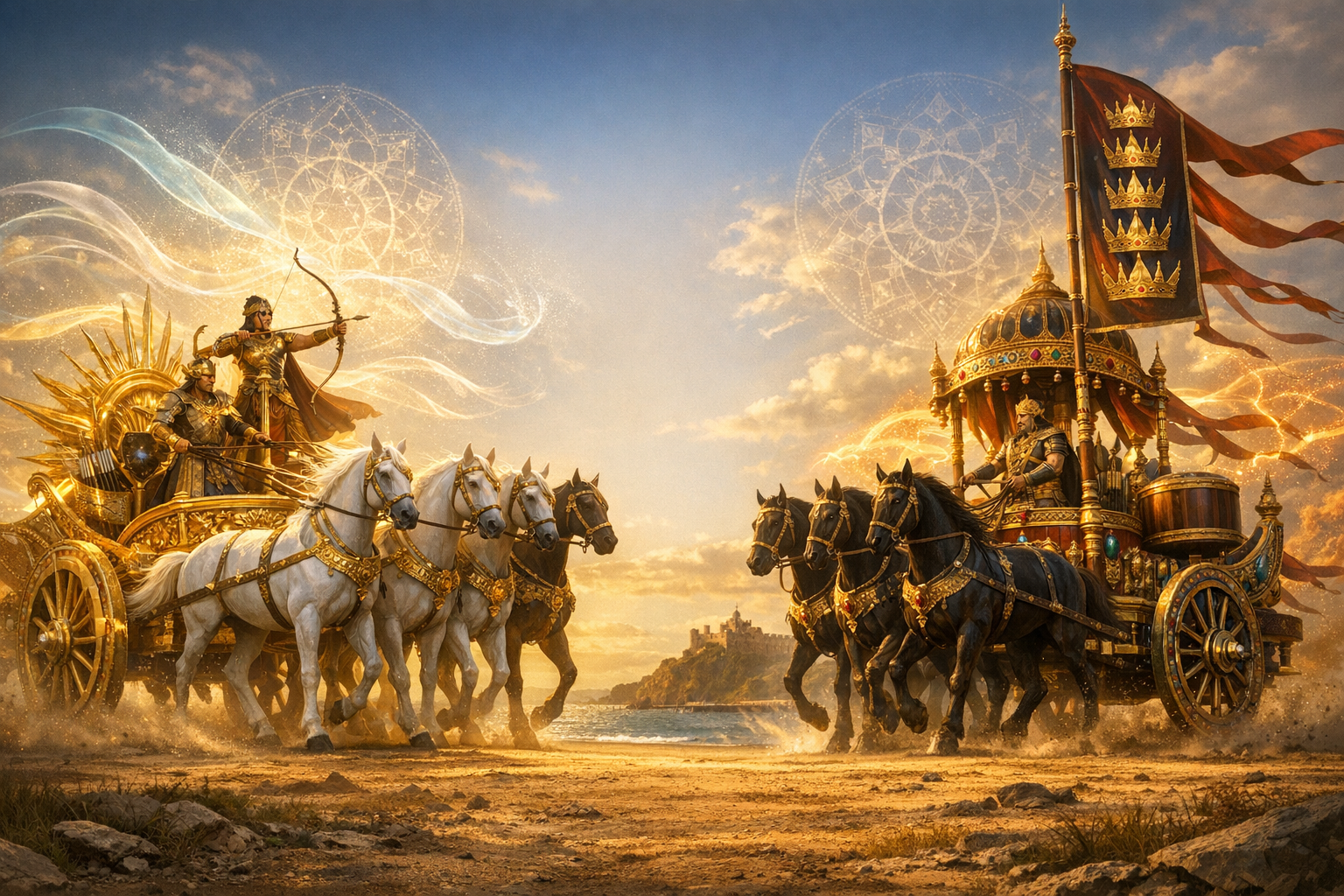
The war of Lanka in the Yuddha Kanda of the Valmiki Ramayana culminates in a climactic confrontation that is as ritual and metaphysical as it is martial. Following the abduction of Devi Sita and the audacious construction of Nala Setu, the theatre of battle foregrounds a pair of war machines whose presence is both sacred and terrible: Ravana’s resplendent chariot and the divinely sanctioned chariot driven by Matali, sent by Indra to support Sri Rama. To understand the ethics, technology, and symbolism that govern this final duel is to understand how the Ramayana fuses dharma, craftsmanship, and the science of weapons into a singular narrative of civilization.
Ravana’s chariot is not merely a vehicle; it is a consecrated instrument of sovereignty and a platform for the deployment of astras. In epic warfare, the ratha is the mobile altar of the kshatriya, bearing standards, mantras, and vows as tangibly as it bears bows and quivers. Its grandeurgem-studded harness, roaring wheels, and a banner proclaiming royal identitysignals a theology of kingship in motion. Its terror lies in what it can unleash: volleys of arrows, spear-like śaktis, and a spectrum of divine missiles evoking wind, fire, water, and the sun.
The textual staging in the Yuddha Kanda is precise. Indra commissions Matali to bring his celestial chariot to Rama, establishing parity of platforms and the ethical contours of a duel worthy of kings. Ravana ascends his own chariot, armed with an immense bow and an arsenal of astras. The narrative shifts into a tightly choreographed science of battle: maneuver, disablement, counter-weaponry, and the upholding of Dharma-Yuddha even at the height of fury.
Technically, the epic ratha integrates materials knowledge, animal husbandry, and battlefield ergonomics. Core components include the yoke (yuga), axle (aksha), wheel (rathāṅga) with hub (nābhi), platform (kūbara or dais), protective railings, and scabbards and quiver-holders built into the side walls. Elite chariots favor shock-absorbing axles, high-visibility standards (ketu), and tightly braided reins enabling the sārathi to coordinate rapid obliques, retreats, and pivots while the dhanurdhara (archer) fires in constant motion.
Descriptions of Ravana’s chariot highlight luminosity, speed, and psychological overawe. Yoked to swift steeds, it gleams with gold fittings and radiates the theater of power; the flag and drumbeats serve as acoustic and visual signals meant to dominate space. The chariot’s architecture protects the torso while giving the archer a 360-degree field of fire from a raised platform, allowing split-second transitions between bow, sword, and spear-like missiles.
As a ritual object, the ratha often undergoes consecrationharness-blessings, auspicious mantras for horses, and invocations to deities presiding over weapons and directions. Such rites embed the chariot within a dharmic ecology: motion is yoked to vow, velocity to vigilance, and victory to responsibility. Ravana’s ratha thus carries both the aura of sovereignty and the weight of transgressions fueling the war itself.
Weapon deployment in the duel demonstrates a sophisticated command of astravidyā. Agneyastra ignites, Varunastra quenches, Vayavyastra disperses, and Indrastra batters with force; Brahmastra stands as the supreme adjudicator when dharma requires irrevocable closure. Ravana’s barrages create stormlike densities of arrows that darken the sky; Rama counters with timed sequences, cutting shafts in mid-air and nullifying elemental effects with their complementary counterparts.
The charioteer emerges as a tactical mind. Matali urges timely aggression, cueing strikes at structural vulnerabilities: steeds, axle, standard, and bowstring. Disablement doctrine in epic warfare aims to control escalation while honoring Dharma-Yuddha; it tests skill and resolve rather than relying on blind carnage. Ravana responds with lethal recoveries, remounts, and renewed onslaughts, affirming his stature as a formidable, if adharma-aligned, warrior.
Ethical boundaries remain legible even at the battle’s apex. The narrative emphasizes not striking the unarmed, allowing rearmament after dislodgment, and keeping the contest centered on valor rather than treachery. These constraints do not trivialize conflict; they sacralize it, guarding the combatants against the slide into annihilatory nihilism.
Earlier in the war, a devastating śakti had grievously felled Lakshmana, an event that intensifies the moral gravity of the final encounter. Within the duel itself, Ravana wields bow and spear-like weapons from the chariot with unrelenting ferocity, pressing advantages gained from experience and boons. Yet, his strength is increasingly framed as alienated from dharma, and therefore ultimately unsustainable before a rightly invoked, vow-aligned astric power.
The conclusion is decisive and textual: Rama, standing upon Indra’s chariot driven by Matali, readies a brahma-weapon whose sanctity, instruction, and intent align perfectly with the justice of the cause. Released with mindfulness and restraint, the arrow penetrates defenses that lesser weapons could not breach, ending Ravana’s reign while preserving the ethical frame of Dharma-Yuddha.
Popular imagination often associates Ravana with the Pushpaka Vimana, the aerial car taken from Kubera. The Yuddha Kanda, however, differentiates the motifs: the final duel unfolds with conventional war chariots, not the Pushpaka. This distinction is significant; the chariot emphasizes rule-bound contest and ritualized ground-combat technology, whereas the vimana symbolizes sovereignty and long-range traversal. Both are sacred vehicles in the epic cosmos, but they serve different narrative and ethical functions.
Beyond the battlefield, the ratha functions as a civilizational emblem. In Vedic and classical literature, artisanship (śilpa), materials lore, and animal training interlock to produce a reliquary of kinetic dharma. The ratha is at once a mobile sanctuary for vows and a machine for measured force; to mount it is to assume not only power but also accountability to cosmic order.
Symbolically, the chariot welds metaphysics to ethics. The Katha Upanishad’s ratha-kalpanā renders the body as chariot, intellect as charioteer, mind as reins, and senses as horses; mastery requires wise guidance and disciplined control. In the Ramayana’s war, this same logic scales outward: the righteous charioteer steers not only steeds but also passion and purpose, ensuring that power remains bridled by insight.
Chariot symbolism also resonates across dharmic traditions, affirming a shared civilizational grammar. In Buddhist literature, the Ratha-vinita Sutta deploys the metaphor of relay chariots to explain progressive realization; means are purposeful yet relinquished once their role is fulfilled. Jain traditions employ chariot motifs in festivals and narrative art to extol self-mastery and the disciplined pursuit of the Three Jewels. Sikh scriptural language, too, adapts vehicle metaphors to convey how dharma, remembrance, and truth direct the mind’s momentum. Across Hinduism, Buddhism, Jainism, and Sikhism, the chariot coheres as a symbol of guided motion toward liberation-oriented order.
Festival culture keeps this memory alive. The ratha-yatra, most famously in the Jagannath tradition, dramatizes the public bearing of the sacred through the city’s arteries, transforming streets into avenues of shared devotion. As a counterpoint to the Ramayana’s battlefield, these processions present the ratha as a vessel of compassion and unity, a reminder that the same technology of movement can serve healing ends.
From the vantage of military studies, the ratha reveals system-level thinking in ancient South Asia: shock mobility for archers, stable launch-platforms for persistent fire, and sārathi–archer communication loops for high-tempo decision-making under uncertainty. Disablement tacticssevering reins, breaking the bow, toppling the standardare forms of control warfare meant to degrade enemy agency with minimal collateral violation of dharma.
Archaeological and textual horizons, while distinct, are mutually suggestive. References to chariotry thread through the Vedas, epics, and kāvya; material finds across the subcontinent point to complex vehicular traditions and elite transport in early historic milieus. Whatever specific correspondences are debated, the cultural memory embedded in the Ramayana’s chariots coheres with a long-standing South Asian imagination of engineered motion serving righteous order.
Weapon-science in the duel invites a technical reading of astras as codified effects bundled with ritual prerequisites. Agneyastra’s heat, Varunastra’s deluge, and Vayavyastra’s dispersal manifest an elemental taxonomy, while Indrastra and Brahmastra escalate force under strict ethical gating. The final choice of Brahmastra underscores proportionality: devastating when necessary, restrained by oath, and used in full awareness of consequence.
Ethics remains the throughline. Dharma-Yuddha insists that means matter as much as ends; it forbids cruelty even when cruelty tempts as a shortcut to victory. In this light, Ravana’s chariot, though magnificent, becomes a cautionary emblem: sacred technology untethered from dharma devolves into spectacle and, finally, self-undoing.
For many readers, the roar of wheels and the whistle of arrows also recall the hum of festival drums and the pulling of rathas by communities in solidarity. That resonance is not accidental. The epic teaches that human motionon roads, in rituals, or across the field of dutyought to be steered by clarity, compassion, and courage.
The final battle of Lanka thus yields a layered conclusion. Strategically, it is a masterclass in platform parity, disablement doctrine, and the escalatory logic of astras. Culturally, it enshrines the ratha as a civilizational artifact where śastra is governed by śāstra. Spiritually, it invites a pan-dharmic recognition that power, like a team of horses, fulfills its purpose only when guided by wisdom toward the good.
Viewed through this integrated lens, Ravana’s war chariot embodies both the sacred and the terrible: sacred in its consecration and craft, terrible in its capacity to magnify misaligned will. The Ramayana answers that paradox not with technophobia but with ethical mastery. When Dharma-Yuddha holds the reins, even the swiftest chariot carries civilization forward.
Inspired by this post on Hindu Blog.
