-
Maori Haka at Medaram Jathara, Telangana: A Powerful Salute to Indigenous Unity

A historic cultural exchange unfolded at Medaram Jathara (Sammakka Saralamma Jathara) in Telangana as New Zealand’s Maori community joined India’s largest Hindu tribal gathering. The Maori Haka honored local traditions and embodied mutual respect, indigenous solidarity, and interfaith harmony. The encounter showcased how Hindu festivals serve as inclusive platforms for dialogue across dharmic traditions and…
-
Surya in Bengal: The Sacred Dharma Deva (Ral Deva) Uniting Light, Righteousness, and Prosperity

In Bengal and eastern India, Surya—revered as Dharma Deva or Ral Deva—embodies light, righteousness, fertility, and prosperity. The tradition integrates ethics with ecology, aligning daily life to the solar cycle through dawn arghya and seasonal vows, especially in Poush and Magh. Folk practices transmit values across generations, while classical Vedic symbolism links Bengal’s Dharma Deva…
-
When ‘Failure’ Becomes Success: Transforming Painful Chanting Doubts into Growth

Acknowledging chanting as central to spiritual practice can feel painful because it exposes gaps between ideals and daily effort. This reflection reframes that discomfort as diagnostic feedback, turning apparent failure into a catalyst for growth. Instead of avoiding conversations about quality chanting, compassionate accountability and mindful attention help align intention, technique, and devotion. The same…
-
Awe and Revelation: Early Miracles of Caitanya Mahaprabhu and the Transforming Power of Nama

Early narratives of Caitanya Mahaprabhu recount how, after Sarvabhauma Bhattacarya sought refuge, the Lord revealed a four-armed Visnu form and then the original two-armed Krsna form. This sequence communicates both transcendence and intimacy, guiding readers toward humility and sustained remembrance through chanting. The episode clarifies a core bhakti principle: mercy opens understanding, and understanding ripens…
-
From Seer to Seen: Liberating the jiva through Krishna-centered Vision and Joyful Service

This exploration of Srila Bhakti Siddhanta Saraswati’s teaching on the seer and the seen clarifies how misidentifying the senses as the true knower distorts perception. It shows why the jiva’s ego-centered stance—seeing the world as material for private enjoyment—leads to anxiety and dissatisfaction. By reframing life as Krishna’s world and the self as the object…
-
‘Ghooskhor Pandat’ Sparks Nationwide Protests; VHP Moves Legally, Calls for Cultural Sensitivity
Netflix’s title ‘Ghooskhor Pandat’ has sparked nationwide protests and a legal push by the Vishwa Hindu Parishad (VHP), spotlighting the balance between creative freedom and cultural sensitivity. This analysis outlines the concerns raised by Brahmin community organizations, the legal avenues being explored, and the broader implications for cinematic representation. Readers gain a clear view of…
-
Beliefs as Mirrors of Consciousness: Timeless Dharmic Wisdom from Yoga Vasishta to Today

This reflection explores how Hindu philosophy understands beliefs as mirrors of consciousness, drawing on the Yoga Vasishta, the Upanishads, and Advaita Vedanta. It highlights convergences with Buddhism, Jainism, and Sikhism, showing how Dharmic traditions foster clarity, compassion, and ethical living. Readers gain a precise framework—samskara, vasana, manas, buddhi, and ahamkara—to understand how beliefs form and…
-
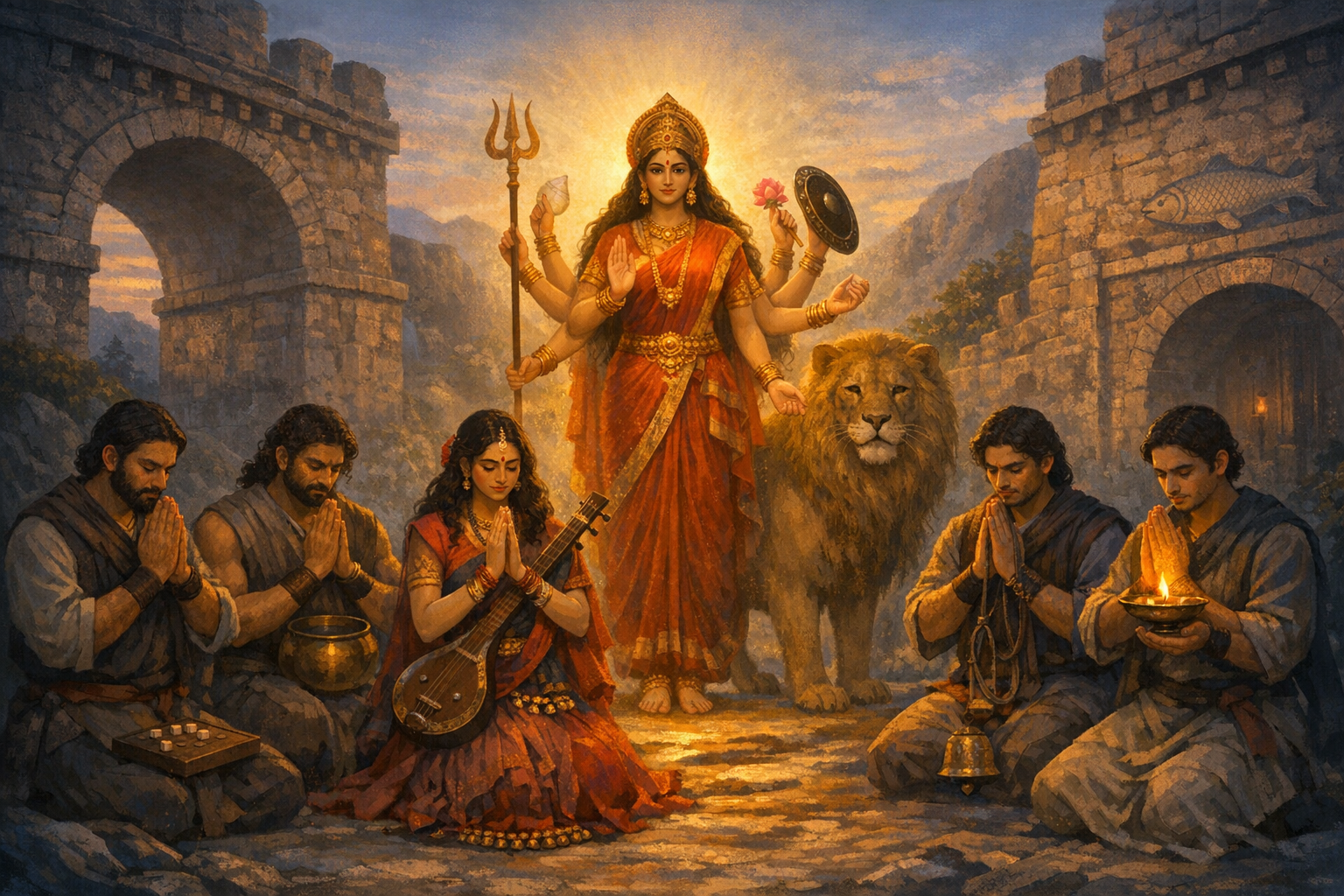
Durga’s Sacred Mace (Gada): A Powerful Emblem of Strength, Justice, and Living Dharma

The gada (mace) in Goddess Durga’s hands signifies ethical strength guided by justice and compassion. Rooted in the Devi Mahatmya, it recalls how Yama endowed Durga with the power to restore order against adharma. The mace symbolizes grounded resolve, impartial accountability, and the stabilizing force of dharma in public and personal life. Beyond martial imagery,…
-
Mahabahu in Hinduism: Unveiling the Mighty-Armed Ideal of Strength, Dharma, and Service

Mahabahu, from the Sanskrit roots “maha” (great) and “bahu” (arms), is a profound ideal in Hindu scriptures that unites power with ethical responsibility. Found in the Ramayana, Mahabharata, and Bhagavad Gita, it signifies strength guided by self-mastery and compassion. The term illuminates how epic narrative encodes philosophical principles: arms symbolize disciplined action in the service…
-
Sthalasayana Perumal, Mahabalipuram: A Soul-Stirring Divyadesam and Chola-Era Masterpiece

Sri Sthalasayana Perumal Temple in Mahabalipuram is a revered Divyadesam of Lord Vishnu, celebrated in the Divya Prabandha of the Azhwar saints. Its Dravidian architecture and contemplative sanctum create a living bridge between bhakti and heritage. Visitors frequently report a sense of quiet awe shaped by liturgy, sculpture, and the rhythm of traditional worship. The…
-
Tripuranthakeswara Temple at Tripurantakam: Timeless Gateway to Srisailam and Divine Grace

Tripuranthakeswara Temple at Tripurantakam, an ancient Shiva kshetra in the Prakasam district of Andhra Pradesh, is venerated as the eastern gateway to Srisailam. The twin shrines—Tripurantakeswara swamy and Tripura sundari Devi—embody Śiva–Śakti harmony at the heart of dharmic philosophy. Visitors frequently note a contemplative ambience shaped by stone steps, temple bells, and gentle lamp light,…
-
Mahashivaratri 2026 in Tirupati: TTD’s City-Wide Spiritual Fest Unites Devotees Till Midnight

On 15 February 2026, TTD will host Mahashivaratri Adhyatmika Vaibhavam across Tirupati from 6 pm to midnight. The city-wide format spans Mahathi Kalakshetram, Kapila Theertham, Annamacharya Kalamandiram, and Ramachandra Pushkarini, enabling personalized participation across venues. Attendees can immerse in Shiva Stotra recitations alongside cultural and devotional segments that support quiet reflection and collective bhakti. The…
-
February 15, 2026 Panchang: Exact Tithi Shift—Krishna Paksha Trayodashi to Chaturdashi at 4:23 PM

On Sunday, February 15, 2026, the Hindu calendar notes Krishna Paksha Trayodashi until 4:23 PM, followed by Krishna Paksha Chaturdashi from 4:23 PM onward. This exact tithi transition supports accurate planning for daily worship, vratas, and community observances. Because Pradosha customs depend on Trayodashi’s presence during evening twilight, observers should verify local timings. Nakshatra and…
-
GBC AGM 2026 Day 4: Organizational Reforms, ISKCON Constitution Milestones, and TOVP Honors

Day Four of the GBC AGM 2026 showcased concrete progress in governance, education, and service. The Organization Development Committee presented reforms to strengthen roles, training, and accountability across regions. Updates on the ISKCON Constitution clarified implementation paths and affirmed a new Constitution Dissemination Committee focused on multilingual, inclusive education. Attendees emphasized that transparency and gratitude…
-
Vishnupathi Punyakalam on 13 February 2026: Auspicious Timings, Meaning, and Devotional Guidance

Vishnupathi Punyakalam occurs on 13 February 2026, with the auspicious muhurta from 01:30 to 10:30 IST. Rooted in the Sun’s transit and aligned with Kumbha Sankranti, this sacred window is ideal for Lord Vishnu worship, mantra-japa, and charitable acts. Families can observe at home or in temples through simple practices like Vishnu Sahasranama recitation, tulasi…
-
Bhagavatha Anugraha Moorthy: Vishnu’s Boundless Grace, Hope, and Protection for Devotees

Bhagavatha Anugraha Moorthy presents Lord Vishnu as the embodiment of unconditional grace responsive to sincere devotion. Classical Puranic narratives of Dhruva, Prahalada, and Narada illustrate how steadfast bhakti invites protection, guidance, and spiritual elevation. The concept emphasizes that divine compassion is inclusive and accessible, not transactional or exclusive. In daily life, practices such as japa,…
-
Discover Tripurantakam’s Sri Bala Tripurasundari Temple: Timeless Serenity near Srisailam

Located in Tripurantakam, Prakasam district, the SRI BALA TRIPURA SUNDARI AMMAVARI SAMEDHA SRI BALA SIVAN TEMPLE lies about 100 kilometres from the sacred Srisailam Temple. The shrine is revered for a devotional atmosphere often compared to Srisailam’s sanctity. Visitors find unhurried reflection through mantra, darshan, and simple yet purposeful temple design. Ritual life centers on…
-
Bhikshatanamurti: Shiva as the Supreme Mendicant—Symbolism, Stories, and Dharmic Unity

Bhikshatanamurti, the Supreme Mendicant form of Lord Shiva, embodies humility, compassion, and aparigraha while elevating giving into a sacred exchange. This academic overview clarifies the meaning of “mendicant” beyond mere begging and explores how Shaivism frames detachment as inner freedom. It surveys key narratives and iconography—such as the kapala bowl and staff—so readers can interpret…
-
Mannarasala Nagaraja: Parashurama’s Penance and the Serpent King Who Made Kerala Bloom

Mannarasala Nagaraja Temple in Kerala is revered as the sacred grove where Parashurama’s penance and the serpent king’s grace transformed reclaimed coast into fertile land. Rooted in Treta Yuga tradition, the shrine venerates Sree Nagaraja and Sarpayakshi amid thousands of serpent stones. The Ayilyam festival in Kanni draws devotees seeking blessings for fertility, health, and…