
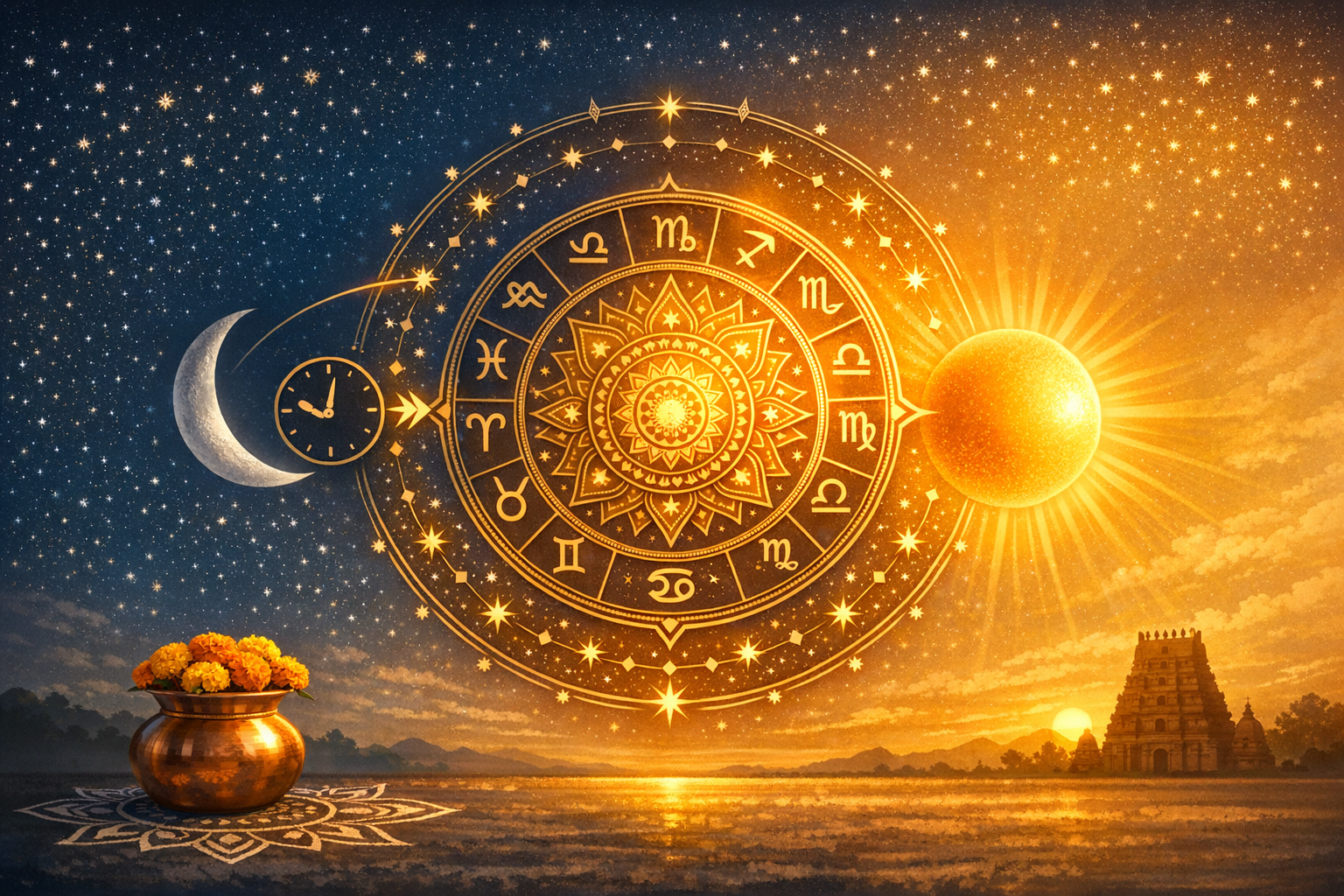
On Monday, February 23, 2026, the Hindu calendar (Panchang) in most regions indicates Shukla Paksha Sashti tithi until 09:26 AM (IST). From 09:26 AM onward, the day observes Shukla Paksha Saptami tithi. This mid-morning transition shapes how household rituals, temple observances, and personal disciplines are scheduled through the day.
For readers looking for Tithi today on February 23, 2026: it is Shukla Paksha Sashti tithi until 09:26 AM IST, followed by Shukla Paksha Saptami tithi thereafter. As with all Panchang data, slight variations may occur by location and local almanac tradition; practitioners generally follow a trusted, region-specific Panchang for precision.
Tithi is a technical lunar measure defined by the angular separation between the Moon and the Sun. One tithi corresponds to a 12° increment in their geocentric longitudinal difference. Consequently, Shukla Paksha Sashti corresponds to the interval when that difference lies between 60° and 72°, and Shukla Paksha Saptami corresponds to 72° to 84°. Because the Moon’s apparent motion varies across the month, individual tithis can last roughly 19–26 hours and seldom align neatly with the civil day from sunrise to sunrise; this explains why the tithi often changes at a specific clock time, as it does here at 09:26 AM.
In practical terms, when a day straddles two tithis, rituals specifically linked to the earlier tithi are completed before the change, and observances tied to the later tithi commence after the transition. On February 23, 2026, activities associated with Shukla Paksha Sashti are best concluded before 09:26 AM, while those best aligned with Shukla Paksha Saptami are ideally scheduled after that time and within daylight hours.
Across traditions, Shukla Paksha Sashti is often observed by devotees with reverence to Subrahmanya (Skanda/Murugan), who may keep a simple vrata or offer prayers for courage and clarity. Shukla Paksha Saptami, by contrast, is classically associated with solar adoration (Surya upasana), including practices such as Surya namaskara and offering arghya. When Saptami begins after sunrise, as on this date, many households align solar observances to the active Saptami window later in the morning to preserve ritual concordance between intention and calendrical time.
Selecting a good time (shubha muhurta) considers Panchanga shuddhiVaar (weekday), Tithi, Nakshatra, Yoga, and Karana. A widely used neutralizing interval is Abhijit Muhurta, centered around local midday, which many traditions treat as generally supportive for initiatives that cannot wait for a bespoke muhurta. Conversely, practitioners typically avoid Rahu Kalam for new undertakings. On Mondays, Rahu Kalam falls in the second equal division of daylight after sunrise; Yamaganda and Gulika Kalam fall in later segments. A practical rule is to divide the daylight span (sunrise to sunset) into eight equal parts and identify these segments for the weekdaythis ensures location-specific accuracy without assuming fixed clock values.
Nakshatra and Rashi provide an additional layer of granularity. The Moon’s position against the 27 Nakshatraeach spanning 13°20′is used to tune personal practice (for example, choosing a Nakshatra-friendly window for certain vratas or study routines). The Moon’s Rashi (Chandra Rashi) reflects which of the twelve 30° zodiacal segments the Moon occupies and is often referenced for transit assessments (gochara) and for gauging the psychological tone of the day. As Nakshatra and Rashi depend on the Moon’s instantaneous position, consulting a reliable, location-aware Panchang or ephemeris is essential for the exact values on February 23, 2026.
Karana, the half-tithi subdivision, is similarly valuable when refining auspicious timing for practical activities such as travel, transactions, and engagements. While many everyday tasks proceed without this fine-tuning, communities that strive for precision consider Karana alignment alongside Tithi and Nakshatra to build a consistent, harmonious daily rhythm.
For day planning on February 23, 2026, those observing Shukla Paksha Sashti may offer early-morning prayers or a light vrata before 09:26 AM. After 09:26 AM, Shukla Paksha Saptami observancessuch as Surya-focused practicescan be meaningfully undertaken. Because this date falls on Somavar (Monday), many also integrate Shiva devotion within the same day, reflecting the Panchang’s integrative, non-competing ethos: the weekday (Vaar) enriches rather than replaces the tithi’s spiritual emphasis.
The Panchang’s lunar-solar cadence resonates across the dharmic familyHinduism, Buddhism, Jainism, and Sikh heritageby reinforcing seasonality, mindfulness, and communal harmony. While observance styles and calendar conventions vary by sampradaya and region, the shared attention to cyclical time fosters unity of purpose: compassion in conduct, restraint in speech, and reverence toward nature and one another. Many families report that aligning their routines to these rhythms supports emotional balance and a sense of belonging.
For precise nakshatra, rashi, yoga, and karana valuesand for local sunrise, sunset, and muhurta segmentsconsult a trusted regional Panchang (print or digital) configured to the specific location. Priests, household elders, and established almanac traditions remain reliable guides, especially when scheduling samskaras or ceremonies that require exactitude.
In summary: February 23, 2026 observes Shukla Paksha Sashti tithi until 09:26 AM IST and Shukla Paksha Saptami thereafter. Plan Sashti-related worship before the transition and Saptami-focused observances in the later morning and afternoon. For new beginnings, confirm an auspicious muhurta by checking Panchanga shuddhi, preferring windows such as Abhijit Muhurta when appropriate, and avoiding Monday’s Rahu Kalam segment. Using Nakshatra and Rashi for fine-tuning can deepen both precision and personal resonance while honoring the unity and diversity of the dharmic traditions.
Inspired by this post on Hindu Blog.
