
-
Sanyasa Yoga: A Powerful Path of Inner Renunciation toward Self‑Realization in Hinduism
Samnyasayoga in Hinduism emphasizes inner renunciation over external withdrawal, directing attention to self-realization and Brahman. Grounded in the Kaivalya Upanishad and Vedanta, it unites śraddhā, bhakti, and dhyāna to reveal Ātman as Brahman and guide seekers toward moksha. In contemporary life, Sanyasa Yoga appears as simplicity, mindful limits, and aparigraha rather than asceticism for its…
-
Sacred Ecology in Hinduism: How Nature Worship Shapes Dharma, Ethics, and Daily Life

Nature worship in Hinduism is a core expression of sacred ecology that unites philosophy, ritual, and ethics. Rooted in the Vedas, Upanishads, and Puranas, it affirms cosmic unity and the sanctity of the five elements. Rituals like offerings to Surya and the care of Tulsi translate reverence into daily practice. Ethical pillars—Ahimsa, Aparigraha, and devotion…
-
Reclaim Consciousness with Timeless Hindu Wisdom: Upanishadic Insights for a Unified Dharma

Hindu philosophy presents consciousness as the essence of existence, summarized by the Mandukya Upanishad’s “Ayam atma brahma.” This post clarifies how witnessing awareness (sakshi) and the four states culminating in turiya offer a practical framework for modern life. It outlines accessible methods—pranayama, mantra japa, and meditation—to improve focus, emotional balance, and resilience. Ethical foundations (yama…
-
Beyond Male and Female: The Profound Non-Dual Insight Needed to Realize Brahman

The teaching that “Knowledge of Brahman is impossible with the idea of male and female” emphasizes that ultimate reality in the Upanishads and Advaita Vedanta lies beyond all dualities. Read in harmony with Buddhism’s śūnyatā, Jainism’s Anekāntavāda, and Sikhism’s Ek Onkar, it supports unity across dharmic traditions while honoring diversity of paths. Recognizing gender as…
-
Awaken Beyond Survival: Hindu Dharma on Human Nature, Karma, and Cosmic Responsibility
Human life clearly exceeds mere survival, and dharmic traditions explain why. Hinduism, Buddhism, Jainism, and Sikhism converge on a shared ethic of self-awareness, non-violence, service, and responsibility. Hindu teachings frame purpose through the puruṣārthas, guiding artha and kāma with dharma toward mokṣa. The Bhagavad-Gita and the Upanishads show how karma, guided by clarity and detachment,…
-
Discover Bliss in the Eternal Now: Dharmic Wisdom on Presence Beyond Happiness
Modern life scatters attention, yet dharmic traditions affirm that abiding in the present moment reveals a stable bliss—ananda—beyond fleeting happiness. Hinduism links Presence to equanimity and Karma Yoga, turning daily duties into contemplative practice. Practical methods such as breath awareness, Pranayama, dhyana, and japa make the Eternal Now accessible in ordinary routines. Buddhism’s mindfulness, Jainism’s…
-
Decoding Śūnya, Bhakti, and Avatāra: Profound Insights from Kashi’s ‘Mad Monk’
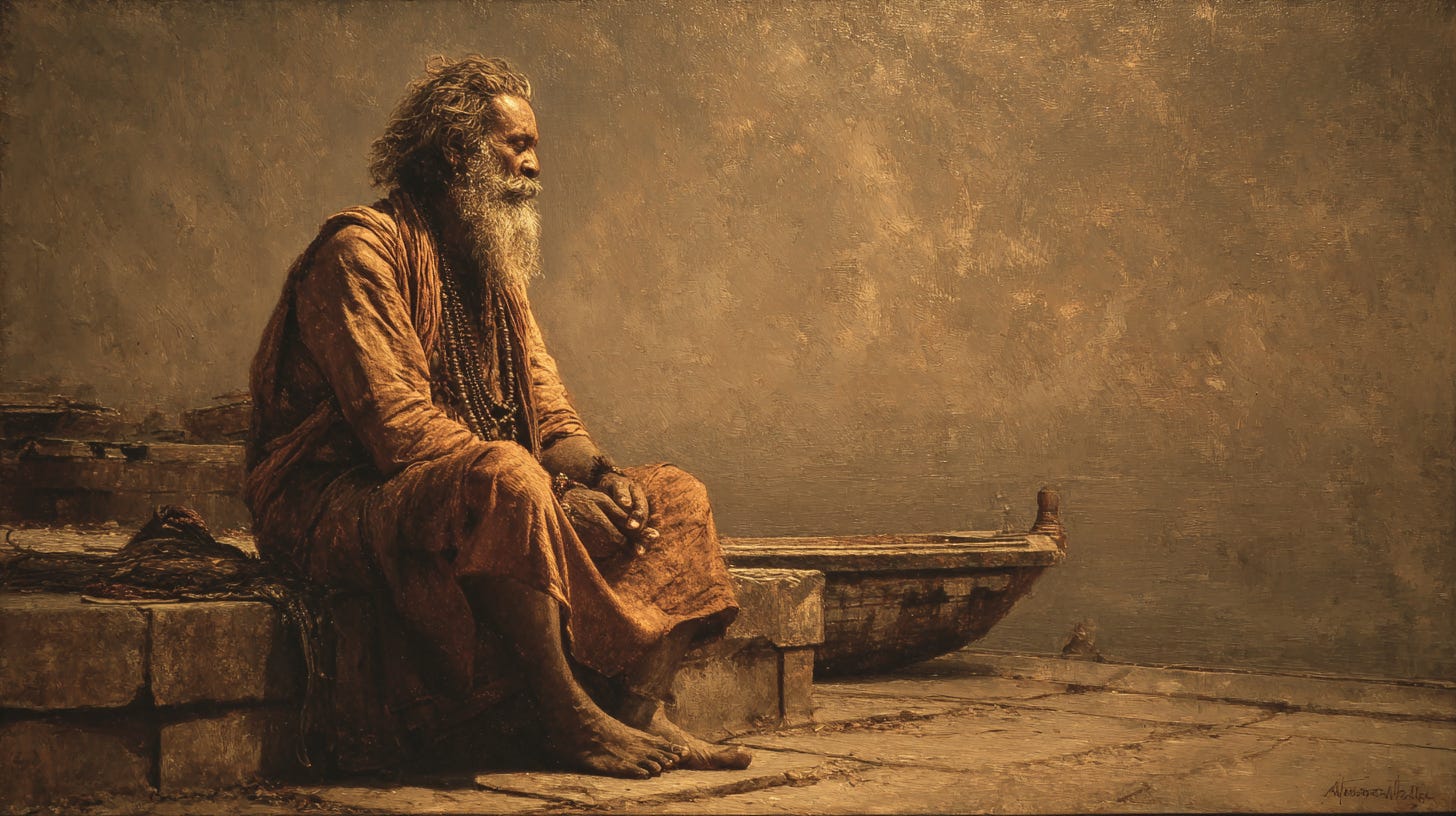
A rare Kashi dialogue with the so-called “Mad Monk” maps creation from Bhāvākāśa to bindu, rekhā, and vṛtta, framing śūnya as a luminous interval rather than mere emptiness. The Sadhu links kāma and prema to two textures of creation, explains how inner blossoming at sahasrāra, anāhata, maṇipūra, or mūlādhāra colours experience, and outlines a tenfold…
-
Mastering Purushaartha: A Transformative Guide to Dharma, Artha, Kaama & Moksha

Purushaartha offers a complete framework—Dharma, Artha, Kaama, and Moksha—for a life that is ethical, prosperous, joyful, and inwardly free. Rather than rejecting wealth or desire, it refines them through Dharma so they support higher clarity. Practical steps include right livelihood, generosity, mindful restraint, and steady yoga-meditation practice. The Bhagavad Gita and the Upanishads inform a…
-
Ishtasiddhi by Vimuktatman: A Timeless Advaita Masterwork Illuminating Non-Dual Wisdom

Ishtasiddhi by Vimuktatman (9th–10th century CE) is a landmark Sanskrit treatise in Advaita Vedanta that unites rigorous reasoning with Upanishadic insight. It clarifies core non-dual themes—Brahman, Atman, māyā, and the role of knowledge in liberation—through a fair-minded purvapaksha–siddhanta method. Readers gain a dependable map of Advaita epistemology while experiencing a gradual movement from conceptual complexity…
-
You Are Already That: Effortless Realization of Infinite Pure Consciousness—A Dharmic Perspective

This article clarifies a core Vedantic insight: infinite pure consciousness is not something to attain but to recognize. It explains how Hindu philosophy, especially Advaita Vedanta and the Upanishads, frames self-realization as effortless recognition rather than forced achievement. It highlights convergences with Buddhism, Jainism, and Sikhism, reinforcing unity in spiritual diversity. Practical guidance shows how…
-
Anatmabuddhi Explained: Unmasking the Not-Self Illusion and Awakening to Self-Realization

Anatmabuddhi names the intellect’s tendency to mistake the not-self for the Self, a root cause of anxiety, craving, and conflict. This article explains the concept in clear, accessible terms and connects it to allied insights in Buddhism’s anatta, Jainism’s anekantavada, and Sikh perspectives on ego. Readers gain practical tools—viveka, dhyana, ethical living, and a short…
-
Sankhya Philosophy Explained: A Timeless, Rational Roadmap to Absolute Reality

Sankhya offers a clear, rational pathway for understanding absolute reality within Hindu philosophy. By distinguishing Purusha (consciousness) from Prakriti (nature), it explains both experience and liberation. Its ordered model of tattvas and emphasis on valid knowledge make it a rigorous system rather than speculation. The philosophy directly supports Yoga’s practical methods for inner transformation and…
-
The Transformative Power of Divine Names: Vedas, Upanishads, and Epics for Inner Renewal

This reflection examines the power of divine names as preserved in the Vedas, Upanishads, Ramayana, and Mahabharata, highlighting how sacred sound directs the mind toward dharma. It presents chanting, mantra, and japa as disciplined practices that transform remorse into responsible action. The analysis emphasizes unity across Hinduism, Buddhism, Jainism, and Sikhism, where sacred names—such as…
-
Essential Dharmic Insights to Transform Fear of Death: A Complete Hindu Guide

This article explains how Hinduism, in harmony with Buddhist, Jain, and Sikh insights, transforms fear of death into understanding through a clear, compassionate philosophy. It presents death as a transition within samsara, guided by karma and oriented toward moksha, drawing on the Bhagavad Gita and upanishad. Readers gain practical tools—meditation, japa, pranayama, and seva—to cultivate…
-
The Essential Dharmic Secret to Clarity: Discover Travel as a Proven Path to Inner Renewal

This article explores a time-tested Dharmic insight: intentional travel as a disciplined practice for clarity. Drawing on Hinduism’s tirtha-yatra and the parivrajaka ethos, it shows how movement functions as sādhanā that resets cognition, widens perspective, and supports mindful self-discovery. Scriptural themes—such as Charaiveti charaiveti and the Gita’s emphasis on equanimity—are connected to modern psychology’s findings…
-
Discover the Ultimate Secret of the Gunas: How the Divine Transcends and Guides Them

This article explains the classic Hinduism teaching that the Divine pervades the three guṇas—sattva, rajas, tamas—yet remains beyond them. Drawing on the Bhagavad Gita and Vedānta, it clarifies how Brahman is nirguṇa while Īśvara guides Prakṛti’s modes without being constrained. Readers gain a practical framework for recognizing and transcending the guṇas through bhakti, viveka, and…
-
Mastering Desire for Inner Peace: The Proven Dharmic Breakthrough to End Discontent

This post examines a core dharmic insight: discontent grows as desires multiply. It synthesizes perspectives from the Bhagavad Gita, the Upanishads, Patanjali’s Raja Yoga, Buddhism’s analysis of tanha, Jainism’s Aparigraha, and Sikh santokh to show a shared pathway to contentment. Readers learn why hedonic adaptation fuels restlessness in modern life and how mindful discipline can…
-
Discover the Complete Convergence of Buddhism and Hinduism: A Proven Path of Rediscovery
Is Buddhism a social reformation of Hinduism, or a rediscovery of perennial truths? Drawing on Ananda K. Coomaraswamy, this analysis reframes the relationship as a deep continuity rather than a rupture. It explores shared methods—neti neti and analytical discernment—and common aims such as transcending the senses and realizing ultimate truth. It clarifies how modern mindfulness…
-
Discover Chit Shakti: The Essential, Complete Guide to Sentient Power in Dharmic Wisdom
Chit Shakti (Chicchakti) is the sentient, conscious power at the heart of Vedanta’s vision of reality. It highlights Brahman’s luminous knowing and explains how multiplicity appears within non-duality. The concept resonates across dharmic traditions—Buddhism, Jainism, and Sikhism—encouraging unity in spiritual diversity. Readers gain a clear definition, careful metaphysical context, and practical pathways for meditation, mantra,…
-
Discover Tatpurusha: The Complete Guide to Shiva’s Eastern Face on the Shivalinga

This exploration of Tatpurusha—the eastern face of Shiva on the Panchamukha Linga—clarifies its sacred symbolism, directional meaning, and contemplative value. It explains why east-facing worship aligns with dawn’s illumining power and how the Rudra Gayatri supports breath-centered focus. The discussion situates Tatpurusha within the five cosmic functions of Shaiva theology and shows how disciplined practice…