
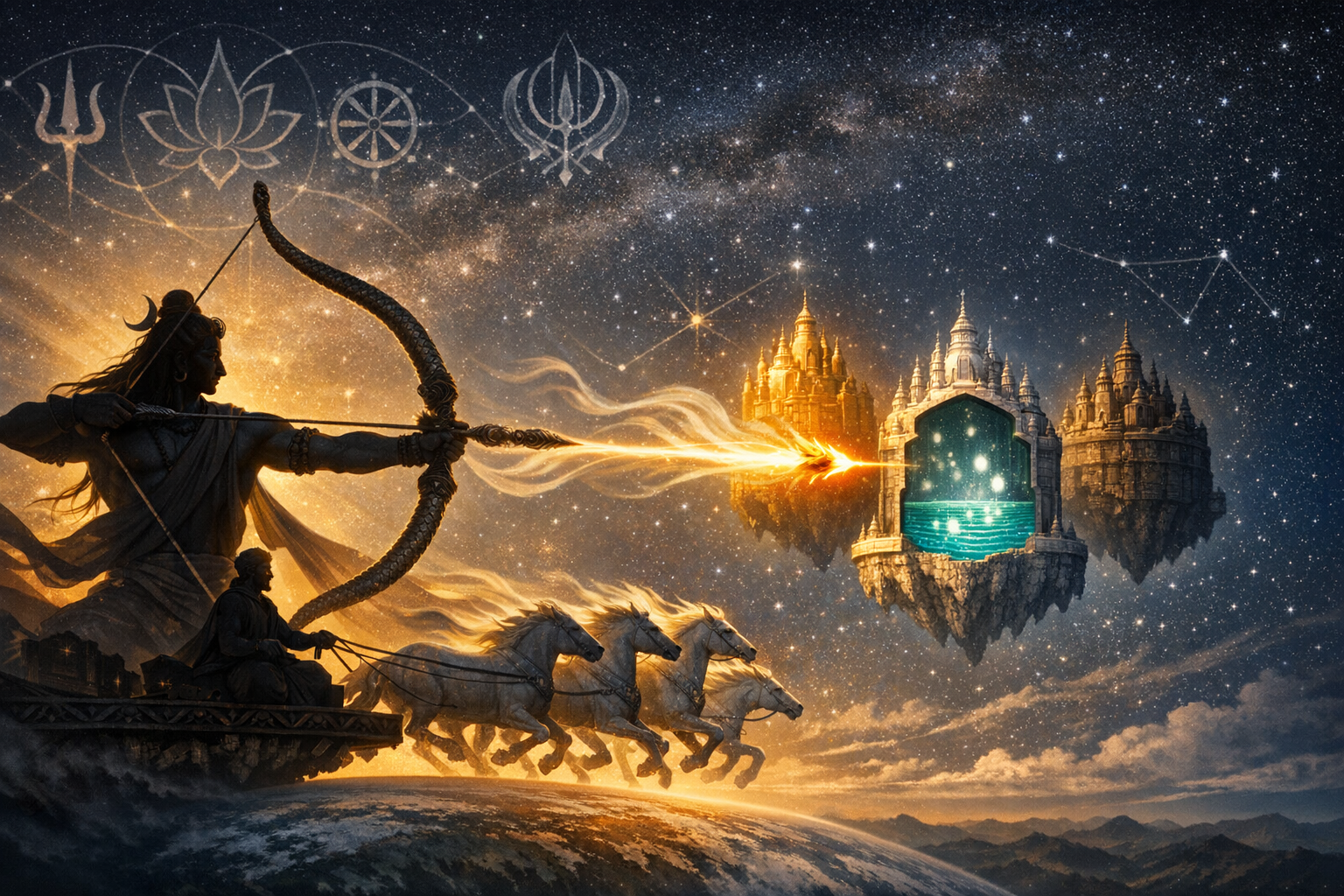
Tripurathree mobile citadels of gold, silver, and ironstands as one of the most striking episodes in the Purāṇic imagination. The cities, granted by Brahma to the asura brothers Tarakaksha, Vidyunmali, and Kamalaksha after severe tapas, are frequently translated as a “city of demons,” yet the narrative is richer and more nuanced than that label suggests. It interweaves devotion, power, cosmic order, and a profound critique of invincibility untempered by dharma. Central to several tellings is a sacred reservoir within Tripura described as containing a death-reviving nectaran idea that explains why the asuras appeared undefeatable until Shiva’s singular, cosmos-spanning arrow resolved the impasse.
Purāṇic sources such as the Shiva Purana, Linga Purana, and Skanda Purana broadly agree on the contours of the narrative while differing in detail. Having been gratified by the brothers’ austerities, Brahma sanctioned three virtually impregnable, movable fortressesgold in heaven, silver in the mid-region, and iron on earthcrafted by the celebrated architect Maya Dānava. The cities moved independently and could not be subdued by conventional force. A precise condition attached to the boon made their destruction possible only when all three aligned, and only by a single arrow released by Shiva. This rare celestial configuration, occurring after long cycles of time, rendered the fortresses a persistent challenge to cosmic equilibrium.
Later recensions and regional retellings introduce a technical and theological amplification: a sarovara or kunda within Tripura that contained amrita, or a mr̥ta-sañjīvanī potency. Immersed in this sacred tank, the fallen were revived, rendering ordinary warfare futile. Other strands preserve the role of Śukrācārya’s revivifying knowledge (mr̥ta-sañjīvanī vidyā) as the operative principle. Read together, these strands clarify why the devas appealed to Shiva; every tactical victory against Tripura was nullified by a systemritual, pharmacological, or sacralthat erased the finality of death.
The narrative’s hinge is the alignment stipulation in Brahma’s boon. The three cities, revolving across cosmic pathways, would transiently form a single line. Only in that moment could a lone shaft, loosed by Shiva, end Tripura’s dominion. This condition signals an interpretive key: power is not merely physical but also cosmological and ethical, requiring right timing, collective cooperation, and rightful intent (dharma) rather than raw force.
Accounts converge on a remarkable image of Shiva’s “cosmic military engineering,” assembling an integrated chariot whose components are metaphysical correspondences rather than mere materials. In prominent tellings, the Earth becomes the chariot, Mount Meru the bow, the serpent Vāsuki the bowstring, Brahma the charioteer, and Vishnu the arrow itself. The Vedas serve as steeds, Agni as the arrowhead, and Vāyu lends momentum. This is not only poetic grandeur; it encodes a philosophical template in which the cosmos cooperates to restore balance when dharma is imperiled.
When the long-awaited alignment finally occurs, Shivanow Tripurantaka, the conqueror of Tripurareleases a single shaft. In many retellings, the arrow incinerates the three cities at once, simultaneously neutralizing the regenerative mechanismwhether interpreted as the sacred tank or revivifying vidyā. Some Purāṇas stress that even in destruction there is compassion: the beings bound to adharma are released from its grip, and cosmic order is renewed without the triumphalism of hatred. The episode is commemorated on Kārttika Pūrṇimāoften called Tripurārī Pūrṇimāobserved across India and linked in places like Kashi with Dev Deepawali, when countless lamps affirm the restoration of harmony.
Symbolically, Tripura has invited sustained exegesis. In Śaiva and later Tantric readings, the three cities can represent the tri-guṇa (sattva, rajas, tamas) or the triple impurities (āṇava, karma, māyā) that bind awareness. Philosophers also correlate Tripura with the three states of consciousness (jāgrat, svapna, suṣupti). In these interpretive frames, Shiva’s single arrow signifies ekāgrataone-pointed, integrated knowledgethat pierces fragmentation. The sacred tank of “death-reviving nectar” then becomes a metaphor for cycles of error that continually reassert themselves until insight addresses the structural cause rather than the symptom.
A dharmic-unity lens strengthens this symbolic reading. Buddhism’s diagnostics of the three poisons (rāga, dveṣa, moha) parallel the “three cities” that sustain cyclical harm, with prajñā functioning as the unifying arrow of insight. Jainism’s Anekantavada encourages many-sided understanding of such narratives, reminding readers that the Purāṇic episode can be held historically, ethically, and allegorically at once without contradiction. Sikh thought harmonizes shakti (necessary force) with bhakti (devotion), resonating with the episode’s insistence that power be yoked to humility and moral purpose. Across Hinduism, Buddhism, Jainism, and Sikhism, the story thus illustrates unity in spiritual diversity: multiple methods, one shared aspiration toward truth and compassionate order.
Ritually and culturally, the episode retains wide reach. Tripurārī Pūrṇimā on Kārttika Pūrṇimā is marked by deepa-dāna and scriptural recitations in many regions. Temples dedicated to Tripurantaka and forms such as Shiva Nataraja encode theological memory in sculpture and liturgy. The narrative is retold in kathā, dance traditions, and local lore, often foregrounding the sacred reservoir of nectar as the dramatic device that makes the final, ethical solution both necessary and meaningful.
Read as ethical guidance for contemporary life, the Tripura cycle cautions against technologies or institutions that perpetuate harm under the guise of invincibility. The devas’ reliance on alignment, cooperation, and rightful intent highlights that enduring solutions rarely emerge from brute confrontation; they are achieved when knowledge, timing, and collective will are harmonized. Many readers who first encountered this tale in childhood recall a sense of wonder at the “one arrow” that solves the unsolvable; revisiting it now, that image matures into a disciplined idealintegrated insight aimed at the heart of systemic imbalance.
In sum, the “sacred tank filled with death‑reviving nectar” and Shiva’s cosmic arrow are more than mythic spectacle. They are precise narrative instruments that explain why conventional victories repeatedly failed and why an integrated, dharmic response succeeded. The episode yields a comprehensive, non-sectarian teaching: power must be constrained by ethics; many valid perspectives can coexist; and unity across dharmic traditions strengthens the shared quest for truth. That is why the Tripura narrative enduresas literature, as theology, and as a living reminder that wisdom, rightly aimed, can transform even a city fortified by death-defying nectar.
Inspired by this post on Hindu Blog.
