
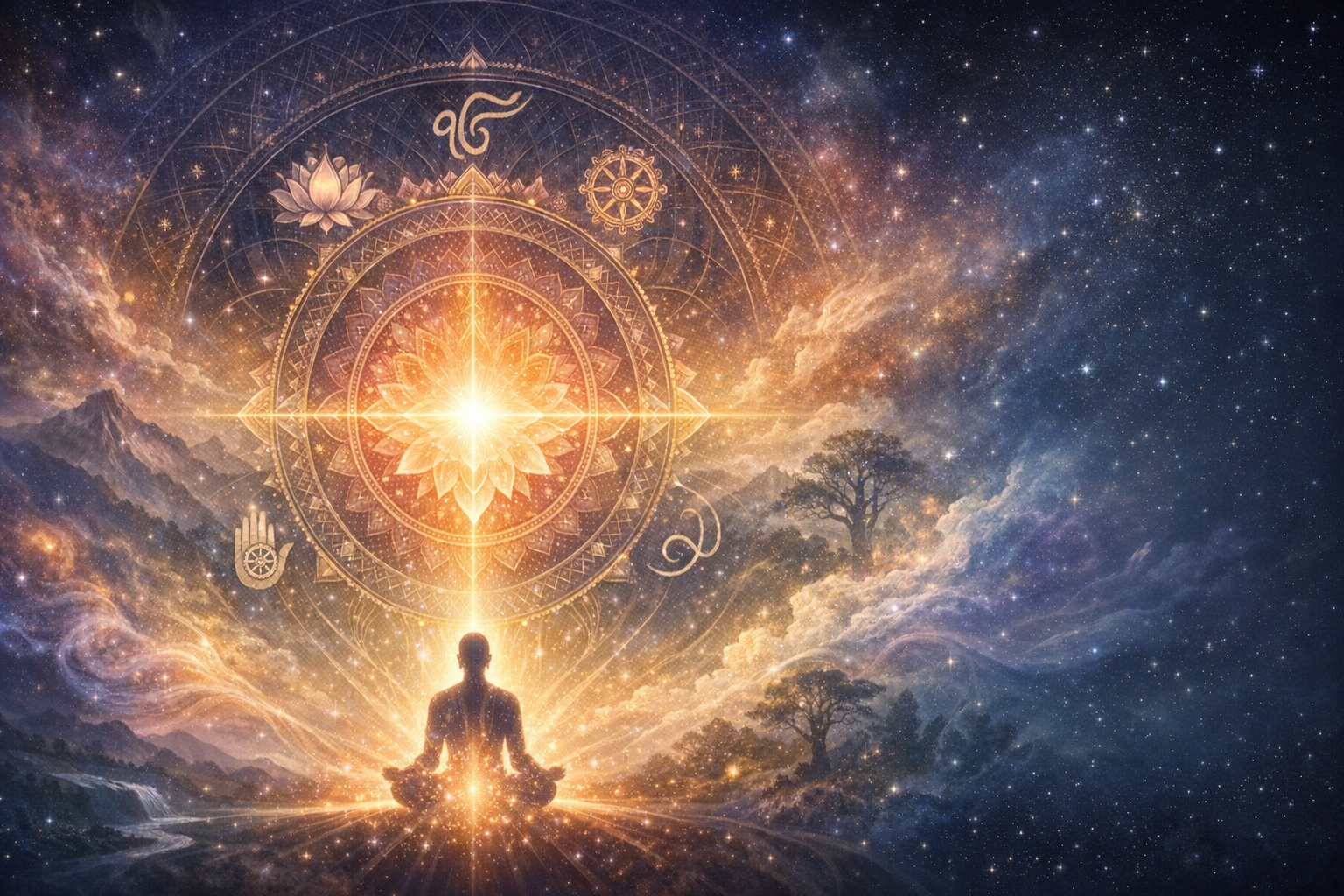
Before the beginning, before time or space could be named, Indic wisdom traditions asked one audacious question: what if creation is not an act performed on something else, but Consciousness recognizing itself? In contrast to artisan metaphors common in many theistic accountswhere a transcendent maker fashions a world as a potter shapes claySanatana Dharma advances a more radical intuition: the universe is the Self-manifestation of the Absolute, a process of self-awakening rather than external fabrication.
This thesis appears across Hindu philosophy, especially in the Upanishads and Vedanta, where the Absolute (Brahman) is described as Sat–Cit–AnandaBeing, Consciousness, and Bliss. The universe, on this understanding, is neither wholly other to Brahman nor a second, independent reality. Rather, it is the appearance, expression, or play (līlā) of that same Consciousness as it becomes aware of itself in and as multiplicity. The familiar duality of creator and creation softens into a non-dual vision in which all beings are held within a single, living continuum.
Classical sources articulate this vision with striking clarity. Brihadaranyaka Upanishad 1.4.1 affirms, “In the beginning this (universe) was the Self alone,” while Chāndogya Upanishad 6.2.1 declares, “sad eva saumya idam agra āsīt”Being alone existed in the beginning. The Rig Veda’s Nāsadīya Sūkta (10.129) goes further into metaphysical depth: “There was neither non-existence nor existence then,” inviting reflection beyond ordinary binaries toward a ground that is both the source and witness of emergence.
Bhagavad Gita 9.4 encapsulates the immanence of the Absolute: “Mayā tatam idaṁ sarvaṁ jagad avyakta-mūrtināby Me this entire universe is pervaded in an unmanifest form.” Yet Gita 9.5 preserves transcendence: “na ca mat-sthāni bhūtānibeings are not in Me” in the ultimate sense. The simultaneous pervasion and transcendence of the One underwrite a non-reductive non-dualism: the cosmos is not separate from Brahman, while Brahman is not exhausted by the cosmos.
Different darśanas within Hinduism fine-tune how this Self-becoming is understood. Advaita Vedanta often speaks of vivartaappearance without real transformation of Brahmansupported by the rope-snake and pot-space analogies. Viśiṣṭādvaita emphasizes a qualified non-dualism: the universe and souls are real modes (prakāra) of Brahman, organically one with the Supreme. Śaiva and Śākta traditions highlight self-articulation through power (Śakti), reading creation as Consciousness pulsing (spanda) into form while never ceasing to be Itself.
Kashmir Shaivism presents the process with unusual granularity. Reality begins as undivided Śiva (pure I-consciousness), whose freedom (svātantrya) vibrates as Śakti. Through the levels of Sadāśiva (I am This), Īśvara (This am I), and Śuddhavidyā (balanced I–This), Consciousness dons the veils (kañcukas) of limitationspace, time, knowledge, agency, and capacityculminating in the emergence of the individual subject and the network of 36 tattvas. Creation, here, is pratyabhijñā in reverse: the One forgets Itself as One to rediscover Itself as the many.
Samkhya–Yoga offers a complementary map. Without positing a creator-deity, it describes an eternal Purusha (pure witness) and Prakriti (primordial nature). When the equilibrium of Prakriti perturbs in the presence of Purusha, the evolutes unfoldbuddhi (intelligence), ahaṁkāra (I-notion), manas (mind), the tanmātras (subtle elements), and the mahābhūtas (gross elements). Though framed as dualism, lived practice in Yoga Sutra aligns the inner ascentthrough pratyāhāra, dhāraṇā, dhyāna, and samādhiwith the same culmination: the recognition of one’s essential luminosity.
Time, too, is envisioned cyclically. Cosmology speaks of sṛṣṭi (emanation), sthiti (maintenance), and saṁhāra (reabsorption), extended by tirodhāna (veiling) and anugraha (grace) in Śaiva theology. Yugas, manvantaras, and kalpas measure unimaginably long arcs of manifestation and rest (pralaya). This cyclicality shifts focus from beginnings to rhythms, from a one-time event to a perennial pulsation of Consciousness.
The Mandukya Upanishad maps the macrocosm onto experience. Waking (jāgrat), dream (svapna), and deep sleep (suṣupti) culminate in turīya, the “fourth” that is not a state within time but the timeless background of all states. The dictum “ayam ātmā brahma” (this Self is Brahman) compresses the thesis of Sanatana Dharma into a single experiential invitation: by recognizing the substratum of awareness in oneself, one intuits the ground of world and God alike.
Seekers often describe this recognition in accessible metaphors. Just as a dream scene rises within a dreamer’s mind, the felt world rises in awareness. When attention rests in the witnessthrough japa, breath awareness, or contemplative self-inquiryidentity loosens from the flux of thought and sensation. What remains is a clear, stable, compassionate presence. From that vantage, the many cease to threaten the One; multiplicity becomes the living vocabulary of unity.
This non-dual arc resonates across the wider dharmic family. In Buddhism, the doctrine of pratītya-samutpāda (dependent origination) and the insight into śūnyatā (emptiness) dissolve independent selfhood and substance. Rather than posit a metaphysical Self, Buddhist analysis reveals the groundless ground where all dharmas arise interdependently. Mahayana teachings on prabhāsvara-citta (luminous mind) and tathāgatagarbha (buddha-nature) describe, in experiential terms, the same unbounded clarity Advaita calls Brahman.
Jain philosophy contributes the ethic and logic of plurality. Anekāntavāda (many-sidedness) and syādvāda (qualified predication) affirm that reality exceeds any single proposition. The cosmos is beginningless, and jīva’s bondage and liberation are governed by law-like causality. This many-angled realism complements the non-dual gaze by reminding philosophical discourse to remain humble, non-violent (ahiṁsā) in thought and word, and careful with claims about absolutes.
Sikh teachings likewise center unity: Ik OnkarOne Realityexpresses itself through hukam (divine order). The One is kartā purakh (creative being), ajūnī saibhaṅ (unborn, self-existent), immanent in nām (the Name) and accessible through śabad (sacred Word) and seva (service). The Sikh vision, like the Upanishadic, holds transcendence and immanence together, seeing the world as suffused with the One Light (jot sarūp) while calling for ethical engagement and fearless compassion.
These perspectives converge on a shared intuition: whether expressed as Brahman, buddha-nature, kevala-jñāna’s clarity, or Ik Onkar, the ultimate is not elsewhere. It is the very immediacy of awareness and the moral imperative to live non-violently, truthfully, and inclusively. Unity in spiritual diversity emerges not as a slogan but as a carefully reasoned stance grounded in text, practice, and lived realization across Hinduism, Buddhism, Jainism, and Sikhism.
Two misconceptions are worth addressing. First, this vision is not naive pantheism; it is closer to panentheism or non-dual realism. The Absolute pervades all phenomena while exceeding them. Second, devotion (bhakti) and non-duality (jñāna) are not rivals. Gita harmonizes both: surrender to the personal Lord (Īśvara) becomes the doorway to knowing the impersonal ground (Brahman), and knowledge matures into love for all beings as one’s own Self.
The ethical implications are profound. If beings are modes of one Consciousness, harming another is self-injury. Ahiṁsā, karuṇā, maitri, and seva follow as natural consequences. Ecological stewardship gains metaphysical weight: rivers, mountains, and forests are not inert resources but expressions of the One life, deserving reverence and responsible care.
Practically, contemplative traditions offer convergent methods for testing these insights. Advaita recommends ātma-vicāra (Self-inquiry) and śravaṇa–manana–nididhyāsana (listening, reflection, deep contemplation). Yoga emphasizes aṣṭāṅga practice; Buddhism refines attention through śamatha and vipaśyanā; Jain disciplines cultivate ethical purification and meditative steadiness; Sikh practice centers nām-simran and seva. Each path, faithful to its idiom, guides practitioners from fragmentation toward abiding clarity and compassion.
Seen through this lens, “creation” is best imagined not as a distant event but as the ceaseless present tense of Consciousness: becoming, beholding, and blessing its own display. The Absolute awakens to itself as person and planet, particle and galaxy, silence and song. Honoring this vision across dharmic traditions invites rigorous study, contemplative depth, and a renewed social ethican integral spirituality in which unity is realized through, not against, diversity.
Inspired by this post on Hindu Blog.
