
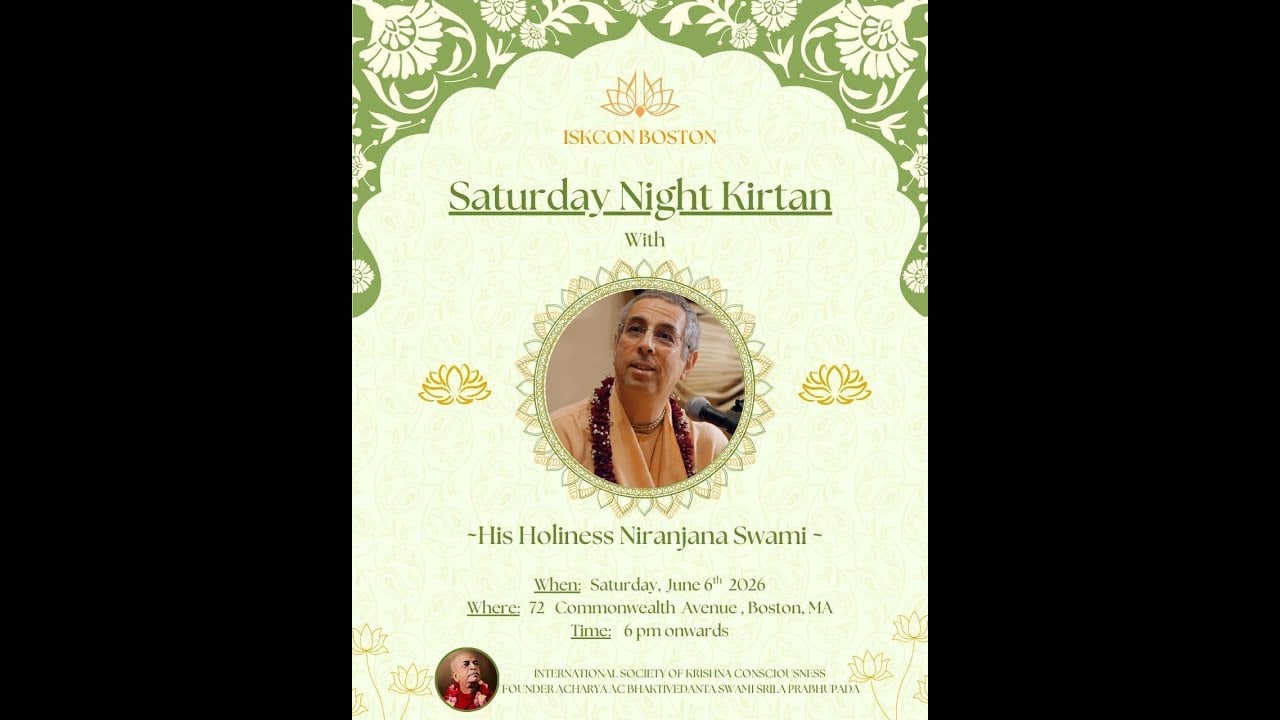
On 6 June 2026, ISKCON Boston hosted a kirtan led by HH Niranjan Swami Maharaj, offering an immersive experience in the Gaudiya Vaishnava tradition of congregational chanting. Framed within the Hare Krishna Movement’s living heritage, the gathering exemplified how devotional sound, community participation, and scriptural anchoring converge to create a deeply contemplative yet energetic practice of bhakti.
Kirtan in Gaudiya Vaishnavism functions as the primary form of sankirtana-yajna, a collective offering of sound where sacred names of Krishna are recited melodically and rhythmically. Scriptural foundations spanning the Bhagavad Gita and the Bhagavata Purana emphasize that devotion expressed through attentive hearing and chanting cultivates steady remembrance (smarana) and softens the heart, gradually orienting the practitioner toward divine service. The Boston assembly reflected this scriptural arc: sound became the medium, remembrance the method, and connection with Krishna the aim.
HH Niranjan Swami Maharaj is widely regarded in ISKCON for precise, steady, and heart-centered kirtan leadership that balances musicality with philosophical clarity. The approach consistently foregrounds attentive listening, devotional intention, and humilityqualities prized in the Guru-Shishya Traditionwhile welcoming participants of varied backgrounds to receive, respond, and harmonize.
Structurally, kirtan blends antiphonal (call-and-response) singing with cyclical rhythm (tala) and melodic frameworks (raga). Common rhythmic cycles include keharwa (8 beats), dadra (6 beats), and tintal (16 beats), while harmonium, mrdanga, and kartals supply tonal center, pulse, and high-frequency articulation. The leader establishes pitch, textual clarity, and tempo contours, while the assembly amplifies and stabilizes the devotional mood through collective repetition and responsive dynamics.
Lyrically, the core text is often the maha-mantraHare Krishna, Hare Krishna, Krishna Krishna, Hare Hare / Hare Rama, Hare Rama, Rama Rama, Hare Harewhich condenses Vaishnava theology into a direct sonic invocation. The mantra’s phonetic profile (open vowels, liquid consonants) and semantic density (names and forms of the Divine) support prolonged repetition without semantic fatigue, allowing participants to sustain focus and cultivate a devotional interiority.
From an acoustics and psychophysiology perspective, congregational singing supports rhythmic entrainment, breath synchronization, and prosocial bonding. Repetitive melodic phrases and predictable cadences can ease cognitive load, while group clapping and uniform tempo reinforce a shared somatic rhythm. Although not a medical prescription, studies on group singing more generally suggest improved mood regulation and social cohesion; within bhakti practice, these effects are directed toward remembrance of Krishna and interpersonal harmony.
Gaudiya aesthetics interpret these experiences through the lens of rasathe distilled emotion of devotionorganized in traditions that include shanta (reverence), dasya (service), sakhya (friendship), vatsalya (nurture), and madhura (sweet love). Kirtan functions as a sonic vessel through which these bhakti-rasas are tasted, beginning with steady hearing and maturing into spontaneous participation. This explains why gatherings frequently move from contemplative repetition to exuberant chorus without losing focus: the devotional mood intensifies even as musical energy rises.
Community dynamics observed in Boston align with long-standing ISKCON practices of inclusive participation: families chant together, newcomers learn by echoing the refrain, and children intuit rhythm through clapping and dance. This informal pedagogy honors the Guru-Shishya Tradition by emphasizing attentive hearing, accurate transmission of mantra, and lived example over mere instruction, ensuring continuity of practice without erecting barriers to entry.
The event also illustrates a broader dharmic consonance across traditions. Sikh kirtan in the Guru Granth Sahib-centered practice, Buddhist chant in communal recitation, and Jain stavan and sutra singing all affirm the unifying role of sacred sound. While the theologies and liturgies differ, the underlying principledevotional or contemplative sound as a path to ethical refinement, compassion, and inner steadinesssupports unity among Hinduism, Buddhism, Jainism, and Sikhism. This shared ethos fosters mutual respect and interfaith harmony without diluting distinctive paths.
ISKCON Boston’s geographic and cultural settingwithin a city renowned for scholarship and innovationhighlights another synergy: devotional culture flourishing alongside rigorous learning. The temple setting provides a living classroom for the Bhagavad Gita and Bhagavata Purana’s teachings on bhakti, transforming abstract principles into audible, embodied practice. For students, professionals, and families alike, kirtan becomes a way to integrate spiritual discipline with contemporary life.
The aesthetics of Indian music deepen accessibility. Simple melodic scaffolds drawn from familiar ragas and steady percussion help first-time participants quickly find their place in the texture of sound. As confidence builds, the responsive chorus expands, illustrating a key Gaudiya Vaishnava insight: devotion grows through association and shared practicehearing begets chanting, which begets remembering, which in turn nourishes serving and loving.
Digital recording and online availability extend the sankirtana beyond physical walls, enabling practice and reflection across time zones. While nothing replaces the tactile immediacy of voices and instruments in one room, recorded kirtans preserve cadence, lyrical clarity, and devotional mood, allowing seekers to revisit and internalize the experience at their own pace. In this way, media becomes a conduit for cultivating steady sadhana, not merely a record of an evening.
For those attending similar gatherings, simple guidelines optimize the experience: arrive with a calm, receptive mind; follow the lead voice closely; clap on the established beat to support ensemble coherence; and let the mind rest on the mantra’s meaning as much as its melody. The integration of posture, breath, and attentive listening anchors the mind, while the voice connects intention with actionan applied synthesis of Yoga, devotion, and mindfulness consistent with the wider currents of Indian spiritual thought.
In sum, the 6 June 2026 kirtan with HH Niranjan Swami Maharaj at ISKCON Boston demonstrated how Hare Krishna congregational chanting unites scriptural teaching, musical structure, communal participation, and ethical cultivation. Rooted in the lineages inspired by Srila Prabhupada and illuminated by the Bhagavad Gita and Bhagavata Purana, this practice offers a replicable, inclusive, and time-tested path to spiritual insight. By honoring sound as a shared sacred medium across dharmic traditions, such gatherings strengthen unity, deepen understanding, and offer a living example of harmony in diversity.
Inspired by this post on Dandavats.
