
-
Shattering the Illusion of Chains: Advaita Vedanta’s Guide to the Ever‑Free Self
Advaita Vedanta proposes a radical clarity: in ultimate truth there is neither bondage nor liberation; the Self (Atman) is ever-free, and only ignorance creates the sense of captivity. This article explains the logic of avidya and adhyasa, distinguishes empirical from absolute perspectives, and shows how moksha functions as recognition rather than attainment. Drawing on the…
-
Own Your Dharma with Clarity and Courage: A Dharmic Antidote to Social Comparison

This comprehensive essay examines a core Dharmic counseldo not get lost in others’ idealsand explains why it is vital in an age of social comparison. Drawing from the Bhagavad Gita, Upanishads, Yoga Sutra, Buddhist teachings, Jain Anekantavada, and Sikh principles, it presents a practical, ethical, and context-sensitive framework for staying aligned with one’s svadharma. Readers…
-
Beyond the Senses: Unveiling Brahman and the Limits of Perception in Hindu Thought

This article explores why, in Hindu philosophy, ultimate reality (Brahman) cannot be captured by the senses or by conceptual thought, and how Vedanta uses shabda-pramana and Upanishadic teaching to reveal the Self. It clarifies the roles of pratyaksha, anumana, and shabda in Indian epistemology, showing why the senses are necessary yet insufficient. It integrates Advaita…
-
Dharma in Action: 10 evidence-based daily practices for a transformative Hindu New Year

The Hindu New Yearmarked as Ugadi, Mesha Sankranti, Vishu, and Puthanduoffers a clear opportunity to align daily life with Dharma. This guide presents ten practical, evidence-informed resolutions grounded in yama and niyama and harmonized with Buddhist, Jain, and Sikh ethics. Each practice includes simple action cues for modern schedules, from mindful speech and ethical consumption…
-
Sri Aurobindo’s Inner Yajna: How Heart-Centered Worship Outshines Outer Rituals

Sri Aurobindo distinguishes outer ritual from inner yajna and shows why inner worship transforms consciousness more reliably than external observance. Drawing on Vedic philosophy, the Bhagavad Gita, and integral methods from Karma Yoga, Bhakti, Jnana, and Raja Yoga, the discussion explains how sacrifice progresses from the gross to the subtle, purifying manas, buddhi, and chitta.…
-
From ‘Why Me?’ to ‘What Now?’: Research-Backed Practice for Acceptance and Resilience

A small linguistic pivot from Why me? to What now? can transform adversity into a field of choice. This research-informed narrative examines a real case of Idiopathic Intracranial Hypertension, outlining how acceptance, present-moment awareness, and small, honest steps sustained healing and professional continuity. It clarifies the difference between acceptance and resignation, translating insights from resilience…
-
Challenging the Divine: How Sacred Confrontation in Hinduism Ignites Profound Enlightenment

Hindu scriptures and the wider dharmic traditions advance a bold claim: authentic enlightenment often arises through disciplined questioning and even confrontation with the divine. Far from promoting irreverence, this dialogical method integrates reason, devotion, and lived experience to clarify dharma and realize moksha. Case studies from the Upanishads, the Bhagavad Gita, and the Mahabharata show…
-
Unlocking Complete Knowledge: Krishna and the Five Realities in a Dharmic, Unified Perspective

This long-form reflection presents an academic, integrative reading of Krishna-centered wisdom in the Bhagavad Gita, showing how devotion and disciplined inquiry reinforce one another. It frames the Gita’s promiseyaj jñatvaas a call to meta-knowledge that orders facts, clarifies purpose, and unifies the sciences with spiritual realization. The five realitiesIshvara, Jiva, Prakriti, Kala, and Karmaare explained…
-
Wealth, Karma, and Krishna: Evidence‑Based Dharmic Guidance to Earn, Spend, and Give with Peace

This long-form analysis explains how money reflects inner consciousness and how Krishna’s sanction, karma, and purushartha interact to shape financial outcomes. It integrates Hindu philosophy with Buddhist Right Livelihood, Jain aparigraha, and Sikh principles of kirat karo, vand chhako, and seva to offer a unified ethic. Drawing on Srila Prabhupada’s reminders about destiny and greed,…
-
Power and Grace of ISKCON London’s Ladies Sankirtan: Book Distribution and Community Impact

ISKCON London’s ladies Sankirtan party demonstrates how devotional service, ethical outreach, and disciplined training can transform brief public encounters into enduring spiritual inquiry. Through consent-first dialogue, culturally sensitive communication, and the voluntary distribution of texts like the Bhagavad-gita, the teams nurture curiosity without coercion. Women-led leadership adds relational depth and approachability, improving the quality of…
-
Nish Shreyas in Hinduism: The Life-Changing Choice of Shreyas over Preyas toward Moksha

Nish Shreyas denotes the ultimate good in Hinduismthe enduring well-being that culminates in mokshaclarified through the Katha Upanishad’s contrast between preyas (the pleasant) and shreyas (the beneficial). This article explains how Vedanta, the Bhagavad Gita, and integrated yogic disciplines channel everyday decisions toward freedom rather than compulsion. It offers a clear decision framework and practical…
-
Kalatita Unveiled: A Rigorous Guide to the Timeless Self and Eternal Truth in Hinduism

This article presents a rigorous, accessible exploration of Kalatita’beyond time’in Hindu philosophy, anchored in the Upanishads, Bhagavad Gita, and Yoga Sutra. It clarifies how cyclical time (yuga, kalpa) coexists with the timeless ground of Brahman, using Advaita Vedanta, Sāṅkhya, and Bhakti perspectives. The discussion bridges theory and practice with concrete contemplations, showing how presence, fearlessness,…
-
Beyond Temples: Experiencing Vishnu’s All‑Pervading Presence in Nature, Mind, and Cosmos

This essay explores how Vaishnava scriptures and practice reveal Vishnu as all-pervading in elements, ecosystems, and consciousness, expanding devotion beyond temple walls. Drawing on the Upanishads, Bhagavad Gita, Pancharatra tradition, and living ritual, it outlines how daily actsdrinking water, mindful breath, lamp-lighting, and servicebecome universal worship. The discussion situates iconic and aniconic forms (including Śāligrāma)…
-
The Thirst That Remains: A Transformative Journey Across Hindu, Buddhist, Jain, and Sikh Wisdom

This long-form reflection reads the “thirst that remains” as a unifying metaphor across Hindu, Buddhist, Jain, and Sikh wisdom, showing how diverse practices meet a common aspiration for freedom and compassion. It maps core goalsmoksha, nirvana, kevala-jñāna, and muktiwhile explaining shared ethics like ahimsa, satya, dana/dasvandh, and aparigraha. It outlines practical contemplative methodsAṣṭāṅga Yoga, ānāpānasati…
-
Freedom from the Senses: A Dharmic Pathway to Moksha, Mastery, and Inner Sovereignty

This essay explores the Hindu philosophical insight that freedom from the slavery of the senses constitutes liberation and shows how it converges with parallel teachings in Buddhism, Jainism, and Sikhism. It clarifies how indriyas, raga-dvesha, and samskaras generate compulsion, and how masterynot repressionunlocks moksha. Drawing from the Bhagavad Gita, the Upanishads, and Yoga philosophy, it…
-
Hare Krishna in Ireland: Vedic Wisdom Transforming Lives and Nurturing Dharmic Unity

This academically grounded portrait of Hare Krishna practice in Ireland follows three devotees whose lives are reshaped by Vedic philosophy as taught in the Bhagavad-gita. It explains how Srila Prabhupada’s teachings address birth, old age, disease, and death in ways that are both doctrinally rigorous and practically actionable. The narrative shows how bhakti-yogajapa, kirtan, study,…
-
Dashavatara to Digital Screens: How Vishnu’s Avatars Shape Indian Politics and Pop Culture Today

Vishnu’s avatars are not relics of the past; they are an active ethical and cultural vocabulary shaping Indian politics, cinema, music, festivals, and civic life. Drawing on the Bhagavata Purana, Ramayana, and Mahabharata, this analysis shows how Rama and Krishna anchor debates on leadership, justice, and welfare without collapsing pluralism. It explains why Ayodhya’s contemporary…
-
Karma in Hinduism: A Definitive, Practical Guide to Action, Consequence, and Liberation

Karma in Hinduism is a precise ethical and philosophical system linking intention, action, and consequence within the larger pursuit of moksha. Drawing on the Bhagavad Gita, the Upanishads, and allied schools of Hindu philosophy, this long-form guide explains the threefold temporal modelsanchita, prarabdha, and agamialongside the Gita’s categories of karma, akarma, and vikarma. It clarifies…
-
Shattering the Illusion of Ego: How Pride Sabotages Liberation across Dharmic Traditions

Pridewhether named ahamkara, asmita, mana, or haumaiemerges as a shared obstacle to liberation across Hinduism, Buddhism, Jainism, and Sikhism. This essay synthesizes scriptural anchors from the Bhagavad Gita, Upanishads, and Yoga Sutra with parallel insights from Buddhist, Jain, and Sikh teachings to show how egoic inflation thrives on the illusion of separation. Readers will gain…
-
Craving the Crowd, Bearing Its Dust: Hindu-Dharmic Insights on Desire, Acceptance, Complaint
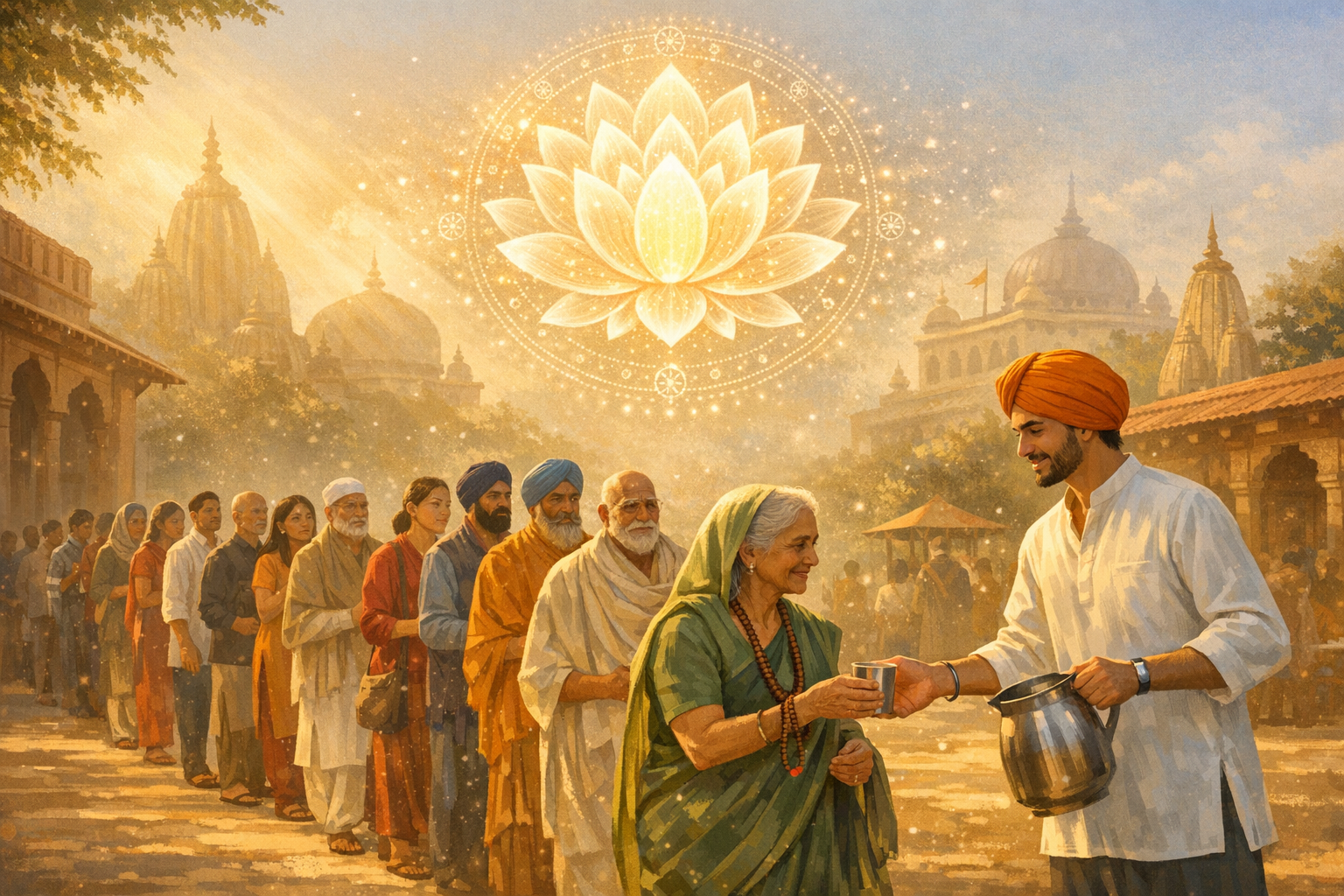
This reflection unpacks the proverb “If you want to be part of the crowd, do not complain about its dirt” through a dharmic, multi-tradition lens. It explains why the human need for belonging carries ethical trade-offs and how Hindu, Buddhist, Jain, and Sikh teachings transform complaint into constructive participation. Drawing on the Bhagavad Gita, Patanjali’s…