
-
Beyond Possessions: A Dharmic, Research-Backed Guide to Vairāgya and Inner Freedom

In an age of constant consumption and comparison, the dharmic disciplines of non-clinging provide a precise, research-aligned path to inner freedom. Drawing on Hindu philosophy’s vairāgya, the Bhagavad Gita’s karma-yoga, Patañjali’s abhyāsa and pratyāhāra, Jain Aparigraha, Buddhist mindfulness, and Sikh seva, this essay shows how engagement without entanglement enhances clarity, compassion, and performance. It explains…
-
Gupt Daan Explained: The Transformative Power of Anonymous Giving in Dharmic Traditions

Gupt Daanhidden giving without publicity or expectationstands at the intersection of dharma and dignity. Anchored in the Bhagavad Gita’s ideal of sattvika dāna and echoed in Buddhism’s dāna pāramitā, Jain aparigraha, and Sikh nishkam seva and dasvandh, it nurtures humility while delivering tangible social good. This comprehensive guide explains its scriptural basis, ethical psychology, and…
-
When Mistakes Happen: A Dharma-Guided, Science-Backed Playbook for Calm, Compassionate Resilience

Errors are inevitable, but responses can be principled, compassionate, and effective. This essay synthesizes dharmic wisdom from Hinduism, Buddhism, Jainism, and Sikhism with evidence-based tools from behavioural science and reliability engineering to offer a practical protocol for handling mistakes. Readers will learn a five-step responseregulate, acknowledge, repair, learn, and recommitthat protects relationships while improving systems.…
-
Unraveling Karma’s ‘Complicated Play’: Dharmic frameworks of action, causality, and grace

This long-form guide unpacks why “Gurudev says that it is a complicated play,” showing how Karma operates across intention, action, impressions, and outcomes. It compares Hindu, Buddhist, Jain, and Sikh frameworks, clarifying doership, responsibility, and grace without collapsing their differences. Readers gain a precise map of sañcita–prārabdha–kriyamāṇa, Buddhist intentionality (cetanā) and dependent origination, Jain karmic…
-
Breaking the Invisible Cage: Hindu Dharma on Renewal, Impermanence, and Dynamic Living

Modern routines can harden into an invisible cage, but Hindu Dharma treats life as ceaseless transformation rather than fixed habit. This essay explains why stagnation is a spiritual peril, using core ideas such as samskara, gunas (sattva–rajas–tamas), abhyasa–vairagya, and rita. It distinguishes lifeless routine from living rhythm, showing how nitya- and naimittika-karmas, pranayama, dhyana, and…
-
Arise and Awaken: Why Sense Control is the First Mastery on the Path to Liberation

A rigorous yet accessible exploration explains why control of the senses is the first indispensable skill for Self-Realization across Hinduism, Buddhism, Jainism, and Sikhism. Drawing on the Bhagavad Gita, Upanishadic insights, and Patanjali’s Yoga, it clarifies pratyahara as alignment rather than repression. Practical guidance shows how breath-led meditation, japa, and ethical living reduce impulsivity, stabilize…
-
Krishna’s Masterclass on Letting Go: Powerful Non‑Attachment Strategies for a Changing Life

Bhagavan Sri Krishna’s teaching on non-attachment offers a precise, actionable way to navigate change without clinging to the past. Grounded in the Bhagavad Gita and enriched by the Mahabharata and the Bhagavata Purana, it reframes excellence as duty fulfilled with freedom from possessiveness. The article clarifies anāsakti, vairāgya, aparigraha, tyāga, and sannyāsa, and shows how…
-
Taming Unreasonable Expectations: A Dharmic, Neuroscientific Guide to Peace and Performance

Unreasonable expectations are a predictable byproduct of miscalibrated predictions, ego-involvement, and ignored constraints; they drive anxiety, burnout, and disappointment. Grounded in dharmic wisdom and modern neuroscience, this article outlines how Hinduism, Buddhism, Jainism, and Sikhism converge on a practical antidote: calibrated aspiration. The Bhagavad Gita’s karma-yoga, Buddhist mindfulness of anicca and anatta, Jain anekāntavāda and…
-
Mastering the Modern Mind: Bhagavad-gita, Patanjali, and Dharmic Paths to Clarity

Delivered at Hsuan Chuang University (Hsinchu City, Taiwan) on 18 March 2026, this lecture by Dr. Kenneth Valpey (HH Krishna Kshetra Swami) offers a rigorous, practical roadmap for mastering the modern mind. It integrates the Bhagavad-gita, the Yoga Sutras of Patanjali, and allied dharmic traditions to explain manas, buddhi, citta, and the five koshas. Listeners…
-
Batu (Vatu) in the Padma Purana: The Transformative Power of Bhagavad GitaEven After Death

The Padma Purāṇa’s narrative of Batu (Vatu) presents a powerful meditation on the transformative potency of Bhagavad Gita recitation. Framed within the Gītā-māhātmya tradition, the story depicts devoted svādhyāya leading to liberation and radiating grace even beyond death. The article situates this account within Purāṇic theology, where sacred sound (śabda) and disciplined practice generate enduring…
-
Moksha Beyond the Gunas: A Definitive, Scholarly Guide to Liberation and Dharmic Unity

Moksha in Hindu philosophy is best understood as freedom from the three gunassattva, rajas, and tamasrather than the dominance of any one of them. This comprehensive guide explains how Sankhya, Vedanta, and Yoga converge on transcending material nature, while the Bhagavad Gita clarifies why even sattva can bind. It offers a clear synthesis of Jnana,…
-
Surrender Made Practical: Sharanagati, Inner Resilience, and Divine Help in Daily Life

Surrender (sharanagati) is presented here as a rigorous, actionable discipline within Sanatana Dharma, grounded in a widely cited Back to Godhead teaching attributed to Srila Prabhupada and centered on a simple, sincere prayer to Krsna. The article clarifies that surrender is not passivity but intelligent consent to higher wisdom, consistent with the Bhagavad Gita’s call…
-
Unmasking the Self: Dharmic Wisdom on Maya, Ahamkara, and Authentic Living Today

In a culture of performative identities, dharmic traditions provide a precise, compassionate roadmap for authentic living. Drawing on Hindu concepts such as māyā, avidyā, ahaṁkāra, and Pancha Kosha Viveka, alongside Buddhist analysis of the skandhas and anatta, Jain practices of samayika and pratikramana, and Sikh disciplines of nām simran, kīrtan, and sevā, the piece shows…
-
Bhagavad Gita’s Arjuna vs Yoga Vasishta’s Rama: Two Renunciations, One Dharma-Centered Path
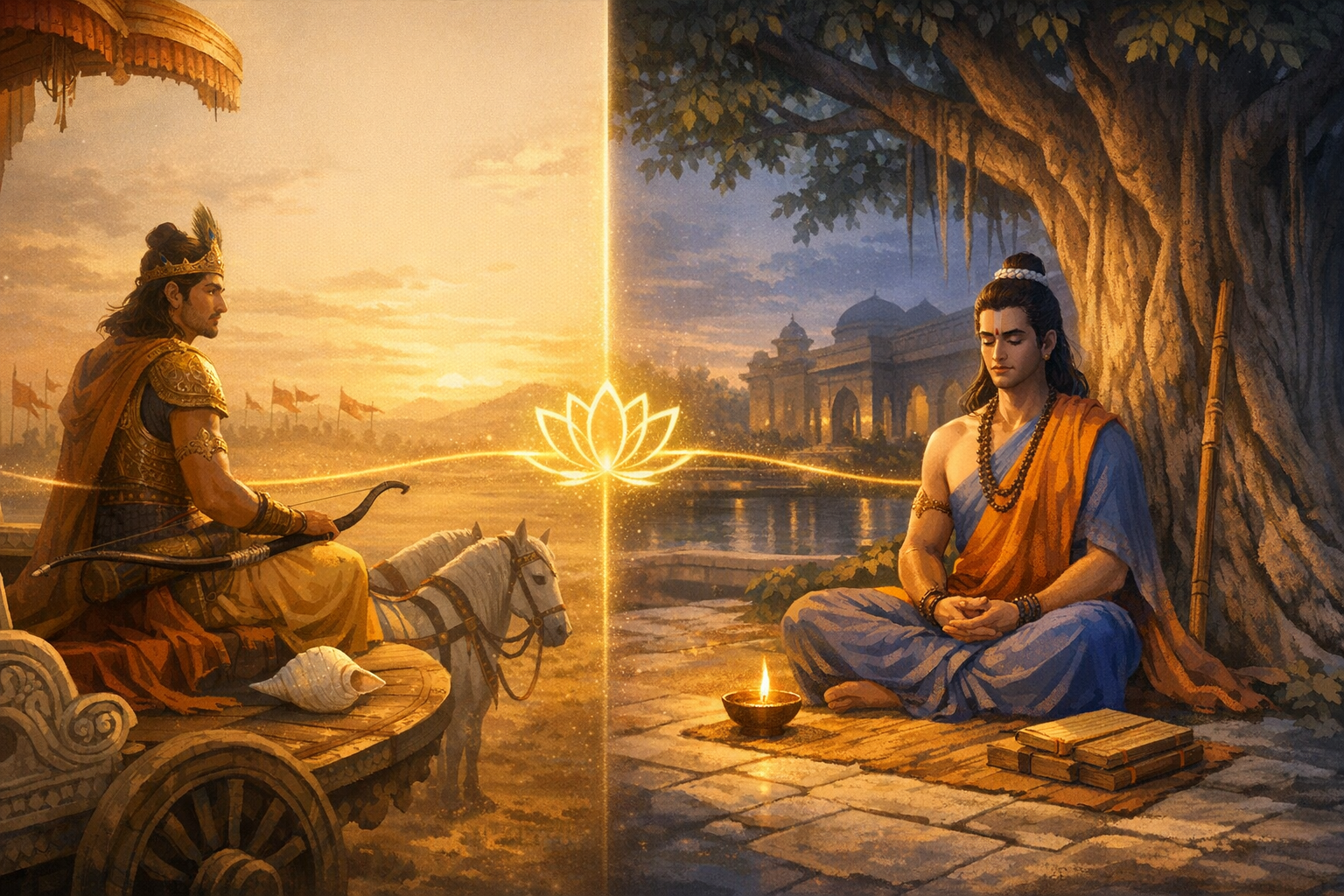
This long-form analysis contrasts Arjuna’s crisis in the Bhagavad Gita with Rama’s dispassion in the Yoga Vasishta to clarify why two similar withdrawals demand different remedies. It explains how moha (confusion) calls for karma-yogaduty purified by relinquishment of fruitswhile vairagya (dispassion) calls for vichara and jnana-yoga. Readers gain a practical diagnostic to discern whether they…
-
Definitive 9‑Lecture Journey into the Bhagavad Gita with Prof. Ithamar Theodor

This nine‑lecture series at Bhaktivedanta Research Center presents a rigorous, text‑based journey through the Bhagavad Gita with Prof. Ithamar Theodor, uniting academic clarity and contemplative depth. Participants gain historical context, philological literacy, and a comparative understanding of Advaita, Visistadvaita, and Dvaita interpretations. Core teachings on Dharma, Karma Yoga, Jnana Yoga, and Bhakti Yoga are examined…
-
Beyond 24×7 Devotion: A Dharmic Guide to Spiritualizing Every Daily Action

Many assume spirituality requires unbroken prayer or constant meditation. Dharmic traditions, led by the Hindu way of life, offer a more practical path: spiritualize each action through intention, ethics, and mindful presence. Grounded in the Bhagavad Gita’s teachings on Karma Yoga, īśvara-arpana-buddhi, and prasāda-buddhi, this approach consecrates work without withdrawing from responsibility. The Pañca-Mahā-Yajña translates…
-
From Ritual to Realization: Ending Barren Devotion with Dharmic Discipline and Insight

Modern worship often looks vibrant yet feels spiritually thin. This long-form, academic analysis explains why devotion turns barrentransactional aims, inattentive ritual, neglected ethics, and fragmented attentionand details what Hindu, Buddhist, Jain, and Sikh scriptures actually prescribe for transformation. It offers an integrated method grounded in yama–niyama or śīla, daily abhyasa of japa or dhyana, breath…
-
Loka Saṅgraha in the Bhagavad Gita: Powerful Ethics for Leadership, Duty, and Social Order

Loka saṅgrahawelfare and cohesion of the worldis the Bhagavad Gita’s public-spirited anchor for Karma Yoga and ethical leadership. Rooted in verses 3.20–3.26, it unites inner freedom with responsible action, guiding leaders to serve by example and to act without attachment. The concept emphasizes integration rather than control, advancing social harmony, trust, and the flourishing of…
-
From Restless Longing to Inner Guru: Bridging the Finite Self and the Infinite in Kali Yuga

This long-form exploration presents a clear, academic guide to bridging the finite self and Infinite Reality in Kali Yuga through the Inner Guru, or antaryāmin, while honoring unity among Hinduism, Buddhism, Jainism, and Sikhism. It integrates the Bhagavad Gita’s Karma, Bhakti, Jñāna, and Rāja Yoga with cross-traditional practices like ethical steadiness, meditation, mantra-japa, and seva.…
-
Yoga and Psychological Stress Relief: Evidence-Based Pathways to Calm, Clarity, and Resilience
HH Krishna Kshetra Swami’s address at China Medical University highlighted how the classical yoga tradition approaches stress through systematic preparation of the minduniting meditation, Pranayama, and ethics. This comprehensive analysis bridges those insights with contemporary psychophysiology, explaining how slow breathing boosts vagal tone, meditation reshapes attention and emotion, and ethical congruence reduces cognitive load. Practical…