
-
When Dharma Bows Before Battle: Yudhishthira’s Sacred Humility and the Ethics of Kurukshetra

Before the first arrow flies at Kurukshetra, the Mahabharata pauses for an indelible act of humility: Yudhishthira lays down his arms and seeks blessings from elders on both sides. This ethical rite aligns rajadharma and kshatra-dharma, signaling that even warfare must be governed by Dharma-Yuddha. The gesture affirms the guru–shishya tradition, anchors strength in reverence,…
-
Unquenchable Spiritual Thirst: A Dharmic Path of Bhakti, Japa, Seva, and Inner Realization

Spiritual thirst is a disciplined, one-pointed aspiration for ultimate truth, cultivated through listening, singing, remembrance, mantra-japa, and ethical living. Across Hinduism, Buddhism, Jainism, and Sikhism, it matures when aspiration is yoked to steady practice, community support, and responsible conduct. The Varkari tradition exemplifies how sustained kirtan, abhangas, and pilgrimage transform longing into culture. Vedānta names…
-
Who Is the Real Father? ISKCON and Gita on the Soul, Death, and the Supreme Source

This essay explores the Hare Krishna (ISKCON) understanding of who the “real father” is by distinguishing bodily from spiritual parenthood through the lens of the Bhagavad Gita. It explains why everyday bereavement language“he has gone”implicitly recognizes the self (ātmā) as distinct from the body. Drawing on key verses (Gita 14.4, 2.13, 2.20, 15.7), it shows…
-
Idle Mind Is the Devil’s Workshop: A Dharmic, Scientific Guide to Focus and Virtue

This article reframes the proverb ‘An idle mind is the devil’s workshop’ through a dharmic and scientific lens, unifying insights from Hinduism, Buddhism, Jainism, and Sikhism with contemporary psychology. It distinguishes restorative rest from unstructured idleness and shows how right effort, seva, and mindfulness reduce rumination and impulsivity. Readers gain a practical framework: align purpose…
-
Vikarna’s Tragic Fall at Kurukshetra: Bhima’s Uncommon Reverence and the Paradox of Dharma
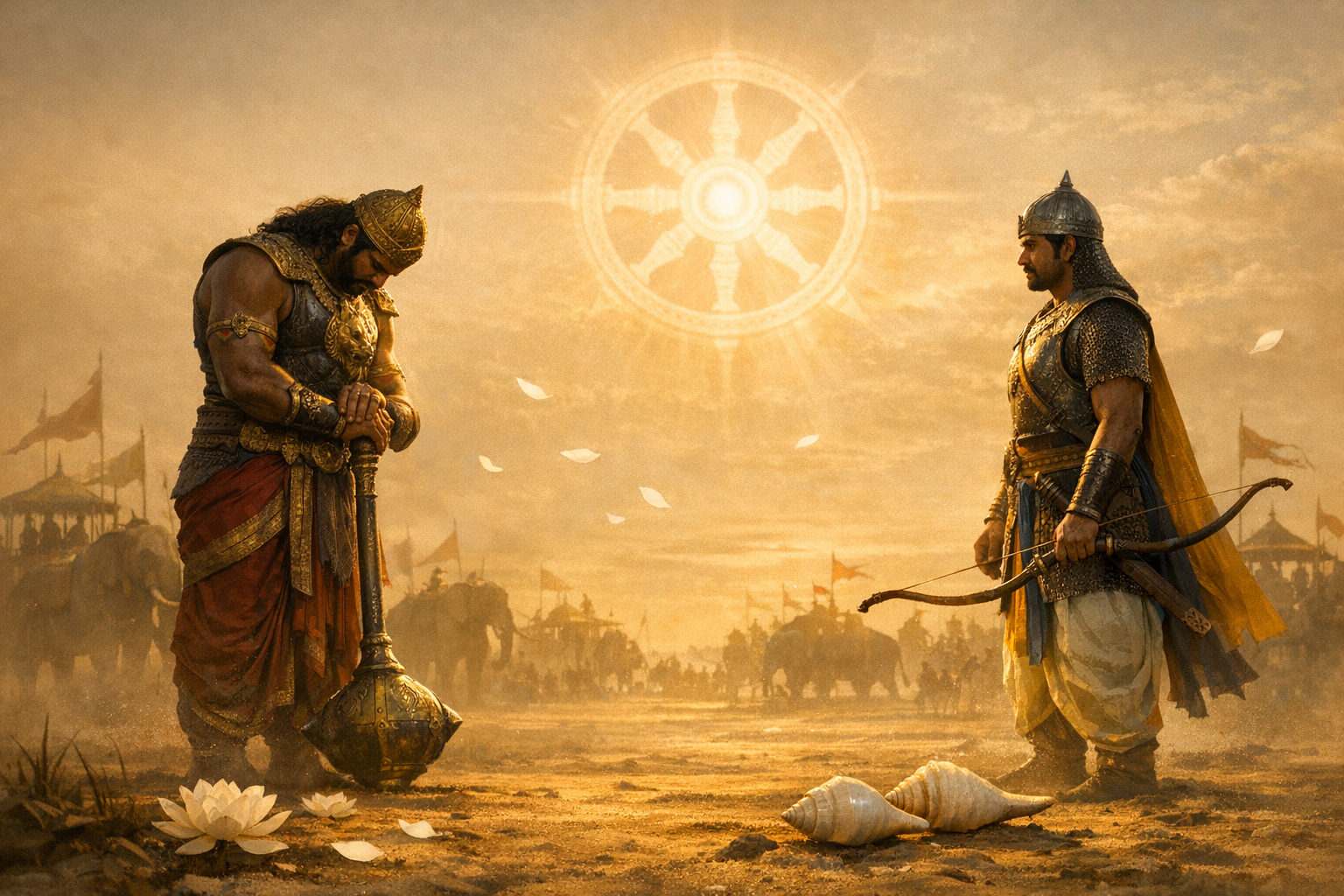
Vikarna’s death at Kurukshetra, and Bhima’s rare public respect for him, reveal the Mahabharata’s refusal to reduce war to simple binaries. The episode traces Vikarna’s lonely protest during Draupadi’s humiliation, his later loyalty under kṣātra-dharma, and Bhima’s empathetic yet resolute response in battle. Read through the lens of Dharma-Yuddha, it becomes a case study in…
-
Radically Honest with Krishna: Vraja Vihari Prabhu on Real Bhakti, Courage, and Healing

This reflection distills Vraja Vihari Prabhu’s central insight: spiritual life flourishes through a truthful relationship with Krishna rather than perfectionism. It explains why divine omniscience makes honesty safe, not risky, and anchors the point in Bhagavad Gita and Bhakti Tradition teachings. It outlines how candid disclosure during japa, kirtan, and evening reflection reduces inner resistance…
-
Beyond Labels: Hindu, Buddhist, Jain, and Sikh Wisdom to Reclaim Identity and Inner Freedom

Modern society rewards borrowed identities built on titles, metrics, and public narratives, yet Hindu wisdomand allied dharmic perspectivesoffers a precise path to inner freedom. Drawing on the Upanishads, Bhagavad Gita, Yoga Sutras, and the Pancha Kosha model, this essay distinguishes social roles from the enduring Self. It explains how avidya, maya, and the kleshas distort…
-
Ignorance Is Its Nemesis: A Definitive Advaita Vedanta Guide to Avidya, Jnana, and Moksha

This long-form, academically grounded exploration clarifies how Advaita Vedanta understands avidya (ignorance) as the root of bondage and jnana (knowledge) as its precise antidote. Drawing on the Upanishads and the Bhagavad Gita, it explains key conceptsadhyasa, maya, sadhana-chatushtaya, and sravana–manana–nididhyasanawhile detailing how knowledge functions as a pramana for Brahman. The discussion situates Advaita within a…
-
Timeless Grace Beyond Scholarship: Women’s Devotional Intelligence Unifying Dharmic Traditions
This essay reframes spiritual intelligence through a Dharmic lens, showing how sincerity of purposeexpressed through bhakti, seva, and ethical disciplineelicits transformative results more reliably than scholastic display alone. It grounds this claim in Indian epistemology (pramana), the Bhagavad Gita, and parallel concepts in Buddhism, Jainism, and Sikhism. Historical exemplarsfrom Gargi and Maitreyi to Andal, Mirabai,…
-
Bhima vs. the Elephant Legion: Epic Power, Strategy, and Dharma in the Kurukshetra War

This study examines Bhima’s encounters with the Kaurava elephant corps in the Mahabharata’s Kurukshetra War, integrating military history, scriptural exegesis, and symbolism. Readers gain a precise view of how a gaja-vyuha functioned, why elephants were both decisive and dangerous, and how Bhima’s gada-work exemplified targeted counters to heavy shock units. The ethically fraught Ashvatthama episode…
-
Srila Prabhupada’s Living Bhakti: How Simplicity, Purity, and Love Transform Lives

This in-depth analysis presents Srila Prabhupada as a True Guru whose simplicity, purity, and love operationalized the Bhakti Tradition in modern life. Grounded in Bhagavad Gita and Srimad-Bhagavatam, it explains guru-tattva, paramparā, and the practical mechanics of sadhana-bhakti. The piece highlights how pastoral warmth and ethical clarity work together to produce durable transformation. It examines…
-
Life After Death in Hinduism: A Clear, Compassionate Guide to Karma, Rebirth, and Moksha

Hindu philosophy portrays life after death as an ethically coherent, compassionate continuum shaped by karma, guided by dharma, and culminating in moksha. Core ideas from the Upanishads, the Bhagavad Gita, and Puranic literature explain how the atman journeys onward through subtle and causal bodies, modulated by sanchita, prarabdha, and agami karma. Temporary states such as…
-
Why Questioning Is Sacred in Hinduism: A Deep Dive into Dharmic Philosophy and Pluralism

This article examines why questioning is sacred in Hinduism and the wider dharmic traditions, showing how inquiry anchors both philosophy and spiritual practice. It explains how the Upanishads, the Bhagavad Gita, and the classical darshanas institutionalize rigorous debate, evidence, and contemplative verification. Readers learn practical tools from pramana theory to navigate misinformation, and from disciplines…
-
Unveiling the Soul’s Journey: Life After Death in HinduismKarma, Yama, Moksha

Hinduism presents life after death as a just, compassionate, and educative journey governed by karma and oriented toward moksha. Foundational textsthe Upanishads, Bhagavad Gita, and Puranasaffirm that the immortal ātman continues through realms (lokas) or returns via reincarnation according to ethical causality. Lord Yama Dharma embodies impartial moral order, while rites such as antyeṣṭi, śrāddha,…
-
Akshaya Tritiya Dāna: The Definitive Guide to Inexhaustible Blessings and Scriptural Merits

Akshaya Tritiya, the sarva-siddhi day of Vaishakh, is celebrated across Dharmic traditions as an auspicious time for dāna (charitable giving) that yields inexhaustible merit. This guide explains the day’s scriptural footing in the Puranas and Dharmaśāstra, unifies perspectives from Hinduism, Jainism, Buddhism, and Sikhism, and details practical, ethical ways to give. It highlights Jala Daanam…
-
Love Conquers All: Bhakti’s transforming power, Gita-guided compassion, Dharmic unity

This essay examines the proposition “Love conquers all” through the lens of bhakti, situating Virgil’s maxim alongside Bhagavad-gita teachings on equal vision and empathy. It clarifies how Sri Krishna and Srimati Radharani are interpreted in Gaudiya Vaishnava theology as complementary expressions of the Divinelove’s object and love’s essencewithout imposing exclusivist claims. It explains Puranic cosmology’s…
-
When Knowledge Feels Hollow: Hindu Philosophy on Reuniting Intellect and Spirit

Modern life often shapes keen intellects while leaving many with a quiet sense of hollowness. Hindu philosophy explains this as a split between buddhi (intellect) and adhyatma (spiritual orientation), and prescribes integration through the four YogasJnana, Bhakti, Karma, and Raja. Drawing on the Upanishads, the Bhagavad Gita, Patanjali’s Yoga, and the Pancha Kosha model, this…
-
From Stalemate to Synthesis: Laws of Bhakti as a Rigorous, Measurable Science of Consciousness
The long-standing impasse between science and religion dissolves when bhakti is reframed as a disciplined, measurable science of consciousness. This article articulates ten practice-based lawscovering intention, attention–affect coupling, rhythmic regularity, ethical congruence, community resonance, embodiment, narrative internalization, pluralism (Ishta), grace–readiness reciprocity, and self-correctionthat guide reliable spiritual growth. Each law invites operational definitions and supports testable…
-
Mapping Krishna’s Four Horizons: Jagannath, Dwarka, Nathdwara and Udupi as Guides in Kali Yuga

India’s sacred geography can be read as a spiritual compass: four living centers of Krishna-bhaktiPuri (Jagannath), Dwarka (Dwarkadhish), Nathdwara (Srinathji), and Udupi (Sri Krishna)situated at the subcontinent’s horizons. This article explains how each manifestation offers distinct guidance for Kali Yuga: communal kirtana and prasada at Puri, dharma-anchored leadership at Dwarka, seva and aesthetic devotion at…
-
Modern Education’s Illusion of Control: Dharmic Wisdom to Build Resilient, Purposeful Lives

Modern culture often trains people to believe life can be engineered into submission. Dharmic traditionsHinduism, Buddhism, Jainism, and Sikhismoffer a corrective: disciplined agency paired with principled surrender. The Bhagavad Gita’s focus on action without attachment, the Yoga Sutra’s blend of practice and non-attachment, Buddhism’s insight into impermanence, Jainism’s many-sidedness, and Sikhism’s hukam together form a…