

You may be facing two demands that seem to pull in opposite directions. Citizens want the state to stop favoring particular religions, while devotees want sacred names, institutions and practices protected from degrading commercial use. You do not have to choose between them.
The workable answer is a two-part rule: public benefits and burdens should be allocated without religious preference, while narrowly defined protections should apply equally to the sacred identities of every tradition. That distinction gives you a practical way to assess welfare schemes, liquor licensing, heritage grants, noise controls and similar disputes without treating secularism as hostility to Dharma.
Neutrality and sacred protection answer different questions
Religion-neutral policy asks how the state distributes money, permissions, restrictions and enforcement. Sacred-identity protection asks whether conduct in a regulated setting imposes a degrading or conflict-producing association on what a community reveres. Confusion begins when these are treated as the same question.
A stipend reserved for the functionaries of one religion raises a neutrality problem because religious identity determines access to public support. A means-tested pension open to every eligible low-income resident does not become religious merely because a purohit, granthi, bhikkhu, imam or priest receives it. The beneficiary qualifies as a citizen facing an economic need, not as a representative of a favored denomination.
Now reverse the direction of the policy. Preventing a liquor shop from using the name of a deity is not a payment to that deity’s devotees. It is a condition on a licensed vice-goods business. If the same condition protects the sacred figures, texts, pilgrimage places and institutions of every religion, the government is not selecting a favored theology. It is regulating public-facing commerce through a common standard.
This distinction matters for Dharmic communities. Hindu, Buddhist, Jain and Sikh traditions do not need to be made invisible in order for the state to remain neutral. They need equal citizenship, freedom of practice and a public order in which sacred identity is neither bought with selective patronage nor casually attached to intoxicants, gambling or adult entertainment.
Use a two-axis test before supporting any proposal
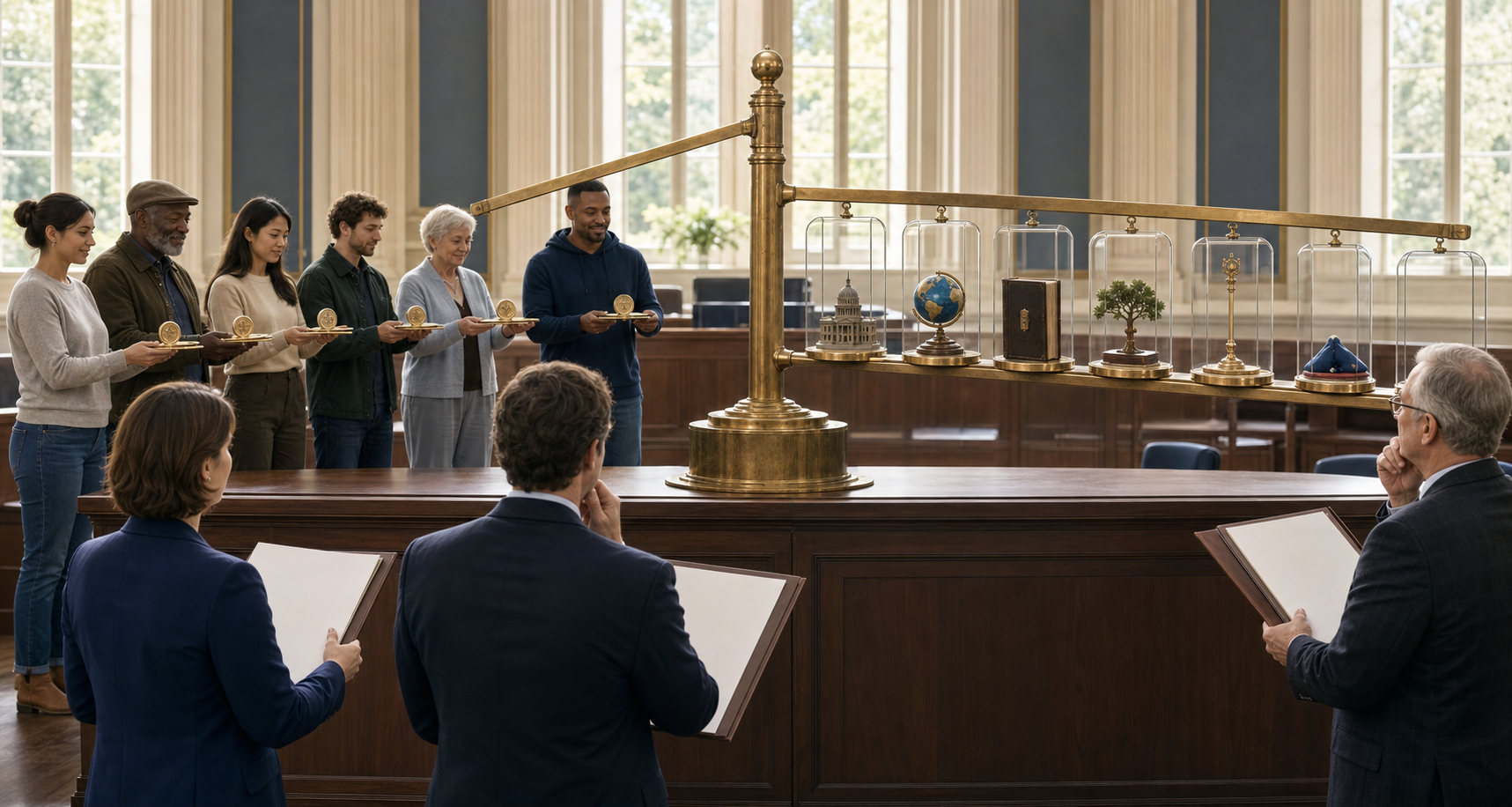
When a policy invokes religion, test it on two separate axes. The first examines favoritism. The second examines proportionality. A proposal should pass both.
- Purpose: Identify the secular public purpose in one sentence. Examples include relieving poverty, conserving heritage, controlling noise, preventing deceptive branding or reducing predictable conflict around licensed vice goods.
- Classification: Ask what actually determines eligibility or liability. Income, disability, age, conservation need, zoning and business type are neutral classifications. Membership in a selected denomination usually is not.
- Coverage: Check whether similarly situated religions, institutions, businesses and citizens are governed by the same rule. Equal wording is not enough if exceptions quietly restore preference.
- Narrowness: Regulate the setting that creates the problem. A concern about sacred names on liquor outlets does not justify controlling the names of bookshops, restaurants or ordinary family businesses.
- Evidence: Require an objective trigger such as a license category, decibel reading, conservation assessment or public-facing use of a protected signifier. A complaint may start a review, but it should not by itself prove a violation.
- Procedure: Give the affected person notice, reasons, time to respond and access to an appeal. Neutral ends do not excuse arbitrary administration.
- Outcome: Examine who receives the benefit, who carries the burden and who is actually inspected. A rule that is neutral on paper can become sectarian through selective enforcement.
India’s constitutional structure supports this separation of functions. Articles 14 and 15 anchor equality and non-discrimination; Articles 25 and 26 protect religious freedom within limits connected to public order, morality and health; and Article 27 places a specific constraint on taxation used for the promotion or maintenance of a particular religion. Secularism’s status as a basic constitutional feature, together with the distinction between protected religious affairs and regulable secular administration, makes neutral design more than a political preference.
Commercial restrictions require their own analysis. Article 19(1)(g) protects the freedom to conduct a trade or business, while Article 19(6) permits reasonable restrictions. Article 51A(e) asks citizens to promote harmony, and Article 51A(f) concerns the preservation of India’s composite cultural heritage. These provisions can support a carefully limited licensing condition, but they are not a blank cheque for officials to prohibit whatever someone finds offensive. Final rule text needs independent constitutional and administrative-law vetting; an overbroad definition can suppress legitimate expression, invite selective action and fail in court.
Draft sacred-name protections around conduct, not theology

The strongest sacred-identity rule does not ask the state to decide which faith is true. It identifies a regulated commercial context, defines protected signifiers and prohibits a limited type of public-facing use.
An illustrative core provision could say: a licensee in a listed vice-goods sector may not use a protected sacred signifier as the trade name, principal brand or prominent storefront identity of the licensed establishment. That sentence still requires definitions, exceptions and an appeal process, but it keeps the legal focus on the licensee’s conduct.
Start with the covered sectors. Alcohol retail and service are the clearest case. A government may consider tobacco sales, betting and gambling, and adult entertainment where those activities fall within its regulatory authority. Do not write an unrestricted ban across all commerce. The special justification comes from the combination of a sensitive association and a licensed vice-goods activity, not from a general power to police language.
Then define the protected class by category rather than by a Hindu-only list. It can include deities and other revered figures, canonical sacred texts, tirthas and pilgrimage places, distinctively religious institutions, and widely venerated saints or gurus. Hindu deities, the Vedas, the Guru Granth Sahib, the Tripitaka, the Agamas, mathas, viharas and gurdwaras illustrate the kinds of signifiers that may require consideration. The operative rule should also cover corresponding sacred identities in other traditions.
Neutrality does not require pretending that the original grievance was vague. If devotees object to Hindu deity names on liquor shops, the explanatory record should state that concern plainly. The remedy becomes neutral by protecting equivalent sacred interests consistently, not by erasing the Hindu experience that revealed the policy gap.
Several exclusions are essential. A common personal name should not be prohibited merely because a revered figure shares it. An official should have to find that a reasonable member of the public would understand the branding as a direct sacred reference in context. Incidental address information, a proprietor’s legal name and a geographic term with both civic and religious uses require case-specific safeguards. Without such exclusions, a rule meant to protect reverence can become an unpredictable naming bureaucracy.
Do not give any complainant an automatic veto. The licensing authority should record the wording, imagery, business category, local context and reason for its decision. Where meaning remains genuinely ambiguous, a small review panel can seek informed input from the relevant tradition while keeping the final decision with the public authority. This lets officials understand sacred vocabulary without delegating state power to a religious body.
Goa offers the clearest administrative path because excise licensing and municipal signage controls already provide points at which trade names and storefront presentation can be reviewed. A circular can clarify current practice, while a rule amendment can establish a more durable approval system. Pre-approval during application or renewal is less disruptive than waiting for a dispute after signs, menus and marketing materials have been purchased. A sector-specific, faith-neutral naming standard therefore protects both sacred identity and commercial predictability.
Apply the same principle differently to welfare, heritage and noise

One slogan cannot govern every religion-related policy. The principle stays constant, but the relevant classification changes with the state function. Use this comparison when reviewing a scheme or preparing a public representation.
| Policy instrument | Likely to satisfy neutrality when | Warning sign |
|---|---|---|
| Income support | Eligibility turns on income, age, disability or another general measure of vulnerability, and religious workers apply on the same terms as everyone else. | Public money is reserved for selected clergy because of their religious office. |
| Heritage grant | Published conservation, safety, educational or community-service criteria are open to temples, gurdwaras, viharas, derasars, waqf properties, churches and comparable institutions. | Officials choose denominations or institutions without scored criteria, reasons and audits. |
| Noise control | The same zone limits, equipment permissions, time rules and measurement procedures govern every place of worship. | Enforcement begins or ends with the identity of the worshippers rather than the measured conduct. |
| Sacred-name restriction | The rule covers listed vice-goods sectors, protects equivalent sacred signifiers across traditions and includes contextual exceptions and appeal. | The rule singles out one religion, reaches ordinary commerce or treats every shared personal name as exclusively sacred. |
For welfare reform, map the person to the universal scheme before ending a faith-specific payment. A low-income religious worker may depend on a modest honorarium even if the scheme’s classification is constitutionally doubtful. The responsible transition is not to deny the need; it is to move the person into an income-linked pension, health, disability, livelihood or informal-worker program for which similarly placed citizens can qualify. Publish the replacement criteria, application route, budget reallocation and effective date before the old scheme closes.
Heritage funding requires another distinction. Conserving an old temple structure, stabilizing a historic gurdwara or protecting manuscripts can serve cultural, architectural and public purposes without financing worship as such. The application should identify the asset, conservation need, permitted expenditure, public benefit and audit conditions. Score the project against those features. Do not score the truth, population or political usefulness of the associated religion.
Noise regulation is a particularly visible test of administrative integrity. The Noise Pollution (Regulation and Control) Rules, 2000, operating under the Environment (Protection) Act, 1986, use zone-based limits and a night period generally running from 10 p.m. to 6 a.m., subject to narrow notified exceptions. Permissions for loudspeakers, calibrated measurement, written reasons and a common complaint channel should apply to temples, mosques, gurdwaras, churches, viharas and other worship sites alike. The right question is what equipment was used, at what time, in which zone and at what measured level – not which community was praying.
Make enforcement corrective, transparent and appealable

A sound rule can still lose legitimacy at the enforcement desk. Build the procedure before announcing the prohibition.
- Pre-clear new names: Let an applicant submit the proposed trade name and sign design with the original license application or renewal. Return a written approval or a reasoned objection within a published time limit.
- Publish examples: A multilingual guide should show clearly prohibited cases, clearly permissible cases and ambiguous cases requiring contextual review. Examples guide decisions but should not replace the legal definition.
- Provide an informal checker: A helpline or online screening form can prevent small businesses from paying for non-compliant boards. Preliminary guidance should be marked as such until formal approval is issued.
- Give existing businesses a transition window: Require a name-change plan first, followed by replacement of primary signage and licensed branding within a stated period. Coordinate the trade-name, municipal and excise updates so the proprietor does not face conflicting records.
- Use graduated sanctions: Begin with an advisory notice, then a reasoned rectification order and a proportionate monetary penalty for deliberate non-compliance. Reserve suspension for persistent or serious refusal, not an arguable first mistake.
- Create a time-bound appeal: The reviewer should be institutionally separate from the initial decision and able to pause a disproportionate sanction while the appeal is heard.
- Audit patterns, not only cases: Publish anonymized totals showing approvals, objections, religious categories implicated, business sectors, reversals on appeal and inspection geography. A large imbalance is a prompt to investigate definitions, training or selective enforcement.
Training should use paired scenarios. If officials prohibit a Hindu sacred name but approve an equivalent use involving another tradition, they should have to identify a legally relevant difference. The same discipline applies in reverse. Equal treatment does not mean identical vocabulary; it means applying the same level of protection and the same decision rule to functionally comparable sacred identities.
Consultation is most useful before the language hardens. Include excise and municipal officials, constitutional lawyers, small-business representatives, and informed Hindu, Buddhist, Jain, Sikh and other religious participants. Ask them to test definitions against difficult examples, transition costs and likely routes of evasion. Consultation should improve the rule, not become a vote over which community deserves protection.
Review the policy after its first implementation cycle. Look for successful voluntary renaming, recurring ambiguous terms, complaint patterns, appeal reversals, business compliance costs and credible signs of selective action. Amend the guidance when the problem is interpretive. Amend the rule when the definition itself is defective.
Key takeaways
- Religion-neutral does not mean religion-blind. The state can withhold denominational preference while protecting equivalent sacred interests across traditions.
- Universal welfare should follow socio-economic need. A religious worker may qualify, but religious office should not be the privileged gateway to taxpayer-funded assistance.
- Sacred-name restrictions are most defensible when confined to licensed vice-goods sectors and written around public-facing commercial conduct.
- Protected categories need contextual exceptions for shared personal names, civic place names and other ambiguous uses.
- A complaint should trigger examination, not establish guilt. Written reasons, evidence and appeal are indispensable.
- Neutral wording is only the beginning. Inspection data, sanctions and appeal outcomes reveal whether neutrality survives implementation.
If you are evaluating a proposal now, ask its sponsor for four things before lending support: the neutral public purpose, the exact covered class, the exceptions and the appeal route. A policy that cannot answer those questions is not ready. One that can answer them may protect both constitutional equality and the living dignity of the sacred.
References
- Hindu Jagruti Samiti – Safeguarding the Sacred in Goa: A Strong Policy Case to Rename Deity-Named Liquor Shops
- Hindu Existence – West Bengal Ends Religion-Based Aid: Imam-Muezzin-Purohit Stipends Reviewed for Neutral Welfare