
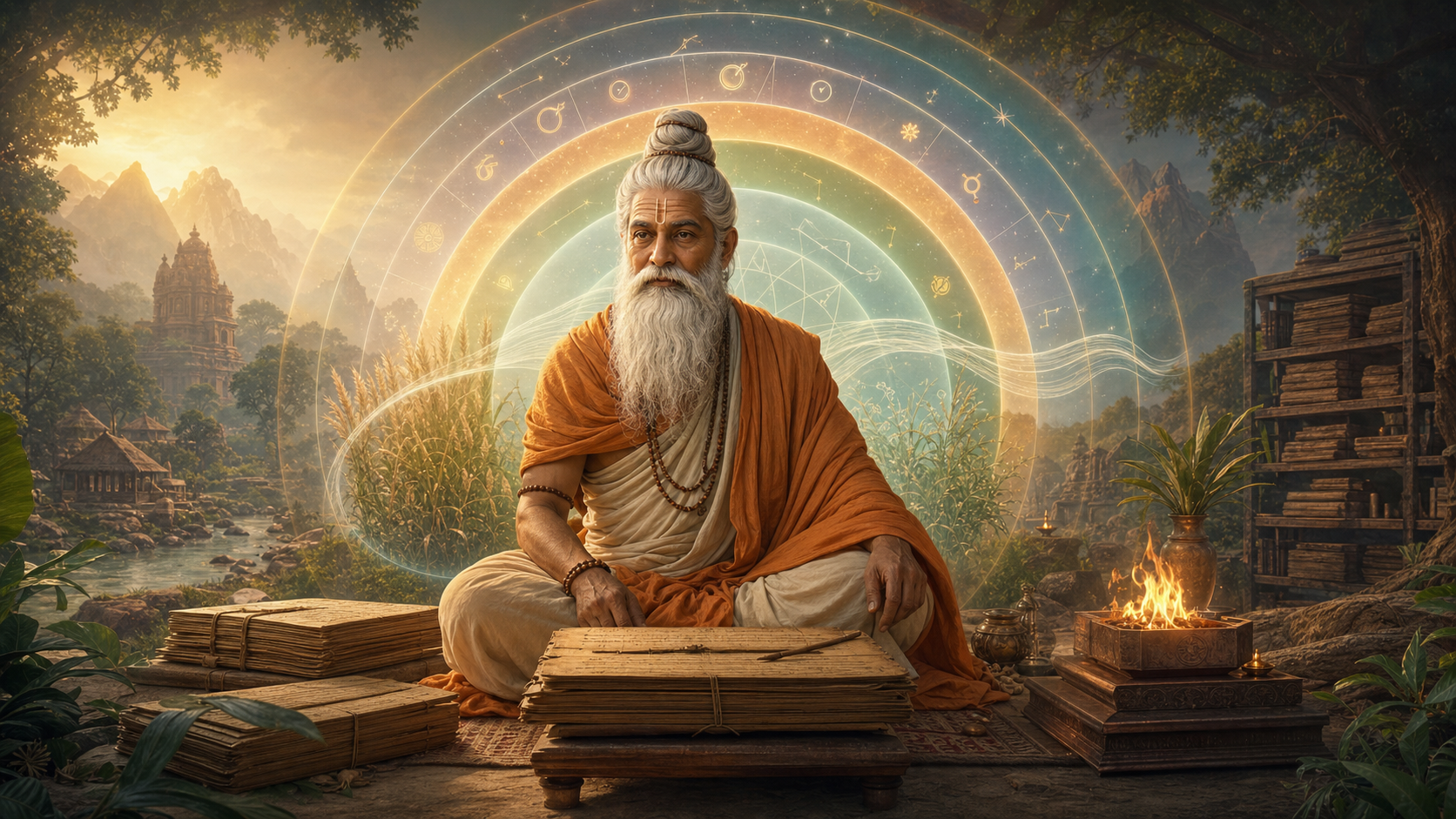
Bhrigu Maharshi occupies an unusually broad place in Hindu intellectual memory. He appears not merely as a revered sage but as a Prajapati associated with creation, an ancestral figure of the Bhargava lineage, a participant in epic and Puranic narratives, a teacher connected with dharma literature, and the traditional authority behind the Bhrigu Samhita. The resulting portrait cannot be reduced to a single biography. It is a layered sacred identity formed across Vedic hymns, the Upanishads, the Mahabharata, the Bhagavad Gita, the Puranas, legal literature, Jyotisha traditions and regional devotional memory.
Understanding Bhrigu Through Tradition and Textual History
Traditional accounts describe Maharishi Bhrigu as one of the mind-born sons of Lord Brahma and one of the Prajapatis entrusted with extending creation. Some devotional descriptions accordingly call him a foremost son of Brahma, endowed with exceptional spiritual knowledge and ascetic power. These affirmations express his theological status within sacred genealogy; they are not equivalent to a datable modern biography supported by inscriptions or contemporary historical records.
This distinction is important because names such as Bhrigu can designate more than one kind of identity in Sanskrit literature. “Bhrigu” may identify an individual rishi, an ancestral seer, or the collective Bhrigus whose descendants are called Bhargavas. A work attributed to Bhrigu may therefore preserve teachings associated with his lineage or authority even when its surviving manuscript form was compiled, copied or expanded by later scholars. Traditional attribution and modern historical authorship answer different questions and need not be treated as mutually hostile.
The popular claim that Bhrigu was born in the territory of present-day Uttar Pradesh belongs to regional tradition. Other accounts associate his austerities or ashram with places in Rajasthan, while local memory also connects him with a sacred site in the Kanchipuram region of Tamil Nadu. Such associations demonstrate the geographical reach of Bhrigu’s veneration. Present-day state boundaries, however, cannot be projected uncritically onto a sage situated in sacred time, and no single regional claim should be presented as an established historical birthplace.
The Vedic Horizon: Bhrigu, the Bhargavas and Sacred Fire
The earliest textual horizon is associated with the Bhrigus as an ancient priestly lineage closely connected with Agni. Rigvedic verses remember the Bhrigus as discoverers, kindlers or custodians of sacred fire. In this setting, fire is more than a physical element: Agni carries offerings, links human ritual with the divine order and illuminates the disciplined transformation at the heart of Vedic practice. An English translation preserved by the Indira Gandhi National Centre for the Arts includes a verse describing the Bhrigus as cherishing Agni like a precious treasure.
This connection helps explain why later literature associates the Bhargavas with ritual expertise, spiritual intensity and formidable tapas. Fire becomes an appropriate symbol for the lineage: it can nourish, clarify and consecrate, but it also demands restraint. Narratives about Bhrigu repeatedly place knowledge beside anger, authority beside humility, and spiritual power beside responsibility. The sage is therefore remembered not as a flat image of perfection but as a figure through whom the ethical use of power can be examined.
The adjective “Bhargava” means a descendant of Bhrigu or one belonging to the Bhrigu lineage. In epic and Puranic genealogies, this lineage eventually embraces celebrated figures such as Chyavana, Richika, Jamadagni and Parashurama, although the precise sequence varies among texts. The continuity of the name shows how Indian traditions often preserve intellectual and spiritual authority genealogically. A lineage carries ritual knowledge, memory, obligations and modes of interpretation across generations.
Was Bhrigu One of the Saptarishis?
Bhrigu is frequently described as one of the Saptarishis, the Seven Great Sages. This statement requires a textual qualification: Hindu cosmology preserves several Saptarishi lists, sometimes associated with different Manvantaras or literary traditions. Bhrigu belongs to prominent enumerations and to the broader circle of primordial sages, but he does not appear in every list. The variation reflects the plurality of Hindu scriptural traditions rather than a simple contradiction.
The title “Maharishi” likewise communicates spiritual rank rather than an administrative office. It recognizes a great seer whose insight, tapas and teaching are considered civilizationally significant. In Bhrigu’s case, the designation is reinforced by the remarkable range of texts in which his name or lineage appears.
Bhrigu Valli: A Technical Map of Spiritual Inquiry
One of the most philosophically important appearances of Bhrigu occurs in the third section of the Taittiriya Upanishad, traditionally called the Bhrigu Valli. Here Bhrigu is identified as Varuna’s son or descendant and approaches Varuna with a direct request for knowledge of Brahman. This relationship differs from the Puranic genealogy that calls him a son of Brahma. The texts preserve distinct theological and pedagogical settings, and an academic reading should allow each setting to speak in its own terms.
Varuna does not hand Bhrigu a finished definition to memorize. He directs attention toward that from which beings arise, by which they live and into which they finally enter. Bhrigu is instructed to seek through tapas. In this Upanishadic context, tapas is not adequately translated as physical hardship alone; it includes concentrated reflection, disciplined investigation and the sustained refinement of understanding.
Bhrigu’s realization unfolds through a sequence: anna, prana, manas, vijnana and ananda. He first recognizes food or material nourishment as Brahman because embodied beings arise from food, live through it and return to the material order. Yet this insight is not treated as the end. He returns to Varuna, undertakes further tapas and progressively recognizes life-energy, mind, discriminative knowledge and bliss as increasingly subtle dimensions of reality.
The progression is technically significant. Anna denotes the material and nutritional basis of embodied existence. Prana denotes the vital processes that animate the organism. Manas organizes perception, intention and thought. Vijnana signifies discerning or determinative knowledge rather than an accumulation of information. Ananda, the culminating realization, points toward the fullness of Brahman that cannot be reduced to bodily pleasure or a temporary emotional state.
This ascending inquiry corresponds closely to the Upanishadic analysis of the human being through increasingly subtle dimensions, often discussed in relation to the five koshas. The teaching does not despise the body in order to praise spirit. Food, breath, mind and intelligence are recognized as real and indispensable, but none is isolated as the whole truth. Bhrigu’s method moves through embodied experience toward its deepest ground.
The later portions of the Bhrigu Valli return forcefully to food, hospitality and interdependence. Food is not to be despised, resources are to be cultivated, and a person seeking shelter should not be casually rejected. Spiritual realization is therefore linked with ecological awareness, nourishment and social ethics. The seeker who discovers unity must also recognize material responsibility. The Sanskrit text of the complete section is available through the Government of India’s Vedic Heritage Portal.
For contemporary readers, the emotional force of this episode lies in Bhrigu’s willingness to return repeatedly to the same question. Each insight is meaningful, yet each is tested rather than protected by pride. The episode presents a disciplined learning process in which provisional understanding becomes the foundation for deeper inquiry. Intellectual humility, not instant certainty, marks the path toward wisdom.
Bhrigu in the Bhagavad Gita
Bhrigu’s eminence is affirmed in the Bhagavad Gita. In 10.25, within the enumeration of divine manifestations, Krishna declares that among the great sages he is Bhrigu. The verse places Bhrigu beside Om, japa and the Himalayas as an exemplary manifestation of excellence in a particular class. The verse and several classical translations can be consulted through IIT Kanpur’s Gita Supersite.
This reference does not provide a biography, but it confirms the sage’s established prestige within the epic’s theological imagination. Bhrigu represents concentrated spiritual distinction: the capacity of a rishi to see beneath appearance and transmit knowledge capable of reshaping human understanding.
Bhrigu in the Mahabharata and the Story of Puloma
The Adi Parva of the Mahabharata gives Bhrigu a major genealogical role. It names Puloma as his wife and Chyavana as their son. During Bhrigu’s absence, a rakshasa also named Puloma carries away the pregnant Puloma. The child emerges from the womb and, through his radiance, destroys the abductor. This extraordinary birth is used to explain the name Chyavana and establishes one of the epic’s most influential Bhargava lines. An early English translation of the episode is preserved in the Pauloma Parva.
The narrative then turns toward Agni. When Bhrigu learns that Agni disclosed Puloma’s identity to the rakshasa, he curses the fire deity in anger. Agni responds by explaining the obligation to bear truthful witness and the indispensable role of fire in sacrifice. The episode is not merely a supernatural adventure. It stages a conflict among truth, duty, injury and uncontrolled anger, demonstrating that even a powerful rishi’s judgment can be challenged within the moral universe of the epic.
The emotional complexity of the story deserves attention. Puloma’s vulnerability, Chyavana’s dramatic birth, Bhrigu’s protective anger and Agni’s defense all resist a simplistic division between flawless heroes and obvious villains. Sacred narrative becomes a forum for reasoning about responsibility under pressure. The episode also reinforces the ancient relationship between the Bhrigus and Agni, now expressed through conflict as well as ritual affinity.
Wives, Children and the Variability of Sacred Genealogies
Traditional summaries associate Bhrigu with Khyati, Puloma and Kavyamata. They also connect him with Dhata, Vidhata, Shukra, Chyavana and Bhargavi. These relationships should not be compressed into a single modern family register. Different Puranas and epic passages organize the genealogy for different narrative and theological purposes.
Khyati is commonly associated with Dhata and Vidhata, while Sri or Lakshmi is identified in certain Puranic genealogies as Bhrigu’s daughter and is consequently called Bhargavi. Puloma is securely connected with Chyavana in the Mahabharata. Other traditions connect Kavyamata with Shukra, also called Ushanas, the renowned preceptor associated with the asuras and with a major body of political, ethical and astrological lore.
The differences are not accidental noise to be erased. Genealogy in sacred literature can establish ritual affiliation, explain an epithet, connect a deity with a lineage or transmit a theological relationship. The historically responsible formulation is therefore that Bhrigu is associated with these spouses and descendants across several traditions, not that every text supplies the same domestic biography.
Bhrigu and the Manusmriti
Bhrigu also has a structural role in the Manusmriti. Its opening narrative presents sages approaching Manu for instruction about dharma. Manu then directs Bhrigu to expound the teaching, and at verse 1.60 Bhrigu asks the assembled sages to listen. The text thereafter proceeds largely as his recitation. The verse, Sanskrit transliteration and Medhatithi’s commentary can be examined in the Ganganath Jha translation.
It is therefore reasonable to say that Bhrigu contributes to the narrative transmission of the Manusmriti. It is less precise to state, without qualification, that a historically identifiable Bhrigu personally composed every verse in the surviving recension. The distinction between revealed authority, framed recitation, compilation and manuscript redaction is essential to the academic study of Sanskrit texts.
What Is the Bhrigu Samhita?
The Bhrigu Samhita is traditionally attributed to Maharishi Bhrigu and is celebrated as a foundational work of predictive Jyotisha. In popular accounts, it contains vast numbers of horoscopic configurations through which a practitioner can interpret an individual’s past, present tendencies and possible future. Some living traditions describe leaves or folios selected according to the seeker’s time of arrival, while others work from systematic combinations of ascendants, planets, houses and yogas.
The word samhita broadly means a collection or carefully joined compendium. Within Jyotisha, however, terminology can become more specialized. Classical astral knowledge is commonly discussed through siddhanta, dealing primarily with mathematical astronomy and calendrical computation; hora, dealing with horoscopy and natal interpretation; and samhita, dealing with collective phenomena such as omens, weather, political conditions and other terrestrial correlations. Material circulating as the Bhrigu Samhita is predominantly associated with horoscopic or phalita interpretation, even though its title uses the broader word samhita.
A technical horoscope in this tradition generally begins with the lagna, or ascendant, and maps the grahas across twelve rashis and twelve bhavas. Interpretation considers planetary dignity, rulership, conjunction, aspect, house placement, benefic and challenging combinations, and the activation of results through timing systems. Rahu and Ketu function as the lunar nodes rather than material planets. A yoga is a meaningful configuration whose interpretation depends on the complete chart; it should not be isolated mechanically from strength, context and timing.
Surviving manuscript descriptions offer valuable evidence about the text’s practical organization. A descriptive catalogue of Sanskrit manuscripts records Bhrigusamhita fragments framed as dialogues between Shukra and Bhrigu. It identifies sections concerning yogas, the effects of yogas, annual horoscopes and ascendant-specific analysis, including material organized under Mithuna and Karka. The catalogue also notes missing leaves, lacunae, modern Nagari scripts and nineteenth-century copies. These details can be reviewed in the Descriptive Catalogue of Sanskrit Manuscripts.
This manuscript evidence supports the existence of substantial astrological works transmitted under Bhrigu’s name. It does not establish that every modern collection called Bhrigu Samhita descends unchanged from one primordial manuscript. Copyists, teachers and regional lineages preserved different selections, sometimes in fragmentary condition. A nineteenth-century copy dates the surviving physical witness, not necessarily every teaching contained within it.
The distinction also explains why printed editions and consultation traditions can differ significantly. “The Bhrigu Samhita” may refer to a revered archetypal work, a particular manuscript family, a regional collection, a published redaction or a method of astrological judgment. Related systems such as Bhrigu Nandi Nadi should not automatically be treated as identical to every text bearing the Bhrigu Samhita title.
In What Sense Is Bhrigu Its Author?
Calling Bhrigu the author of the Bhrigu Samhita is accurate within traditional attribution. Academic precision adds that “authorship” in premodern Sanskrit culture may identify the originating sage, the authoritative speaker in a dialogue, the founder of a teaching lineage or the sacred namesake under whose authority a compendium developed. This differs from the modern expectation of a single person privately composing a fixed edition and publishing it at a documented date.
The most balanced conclusion is therefore twofold. Bhrigu remains the acknowledged rishi and traditional source of the Bhrigu Samhita, while the textual history of surviving Bhrigu astrological manuscripts is plural, layered and incompletely reconstructed. Respect for tradition is strengthened, rather than diminished, when manuscript evidence is described honestly.
Astrology, Interpretation and Responsible Claims
Jyotisha has long served religious, calendrical, cultural and interpretive functions in South Asia. Its vocabulary preserves sophisticated systems of classification and generations of computational practice. Predictive interpretations, however, belong to a traditional divinatory framework and should not be presented as experimentally guaranteed forecasts. No horoscope should replace qualified medical care, legal advice, financial analysis or personal responsibility.
A responsible engagement with the Bhrigu Samhita therefore combines cultural literacy with critical judgment. The text can be studied as Sanskrit intellectual heritage, a living spiritual tradition, a manuscript phenomenon and a history of human efforts to discern pattern in time. Such study avoids both uncritical sensationalism and dismissive caricature.
The Famous Test of Brahma, Shiva and Vishnu
One of Bhrigu’s best-known Puranic narratives concerns a gathering of sages seeking to evaluate the dispositions of Brahma, Shiva and Vishnu. In versions associated with the Bhagavata Purana and the Padma Purana, Bhrigu subjects each deity to a deliberate provocation. He withholds expected reverence from Brahma, speaks offensively to Shiva and finally strikes or kicks Vishnu on the chest.
Vishnu responds without retaliatory anger. He rises, receives the sage and expresses concern that Bhrigu’s foot may have been hurt by contact with his chest. The response overwhelms Bhrigu, who recognizes the depth of Vishnu’s composure and compassion. The Padma Purana version emphasizes Vishnu’s tranquillity, hospitality and patience, while a Vaishnava retelling connected with the Bhagavata tradition explains the provocations as mental, verbal and bodily offenses of increasing severity.
The moral center of the story is not Bhrigu’s freedom to insult others. It is the transformation produced by an unexpectedly gentle response. Vishnu’s humility interrupts the cycle of injury and reaction, allowing Bhrigu to recognize his own error. The source tradition consequently interprets the encounter as the removal of the sage’s pride through compassion rather than humiliation through force.
Some Vaishnava readings use the episode to affirm Vishnu’s supremacy, whereas Shaiva, Shakta, Smarta and other Hindu traditions articulate divine unity and hierarchy differently. An inclusive reading need not erase the Vaishnava theology of the passage, but it should not weaponize a sectarian narrative against other Dharmic paths. Brahma, Vishnu and Shiva remain deeply revered across interconnected traditions, and the enduring ethical lesson is that self-mastery is revealed most clearly under provocation.
Bhrigu’s Ashrams and the Sacred Geography of Memory
Regional traditions locate Bhrigu’s presence in several parts of India, including Uttar Pradesh, Rajasthan and the Kanchipuram area of Tamil Nadu. Such sites may preserve temples, ashram traditions, ritual observances or oral histories. Their plurality shows how sacred geography works: communities make a rishi’s memory locally accessible without necessarily claiming possession of his entire legacy.
Historical investigation should document the age of a shrine, its inscriptions, land records, local texts and ritual continuity separately from the timeless identity assigned to the sage. Devotional significance and archaeological dating are related but distinct categories of evidence. Both can be respected when neither is forced to impersonate the other.
A Unifying Dharmic Reading
Bhrigu’s legacy is specifically rooted in Hindu scriptures, yet several of its ethical themes can support respectful conversation among Hindu, Buddhist, Jain and Sikh traditions. These paths remain doctrinally distinct, but each contains disciplined approaches to knowledge, ethical conduct, the restraint of ego and compassionate responsibility. Unity does not require flattening their differences; it requires the willingness to encounter difference without hostility.
The Bhrigu Valli contributes a particularly valuable model. A teacher offers a method rather than demanding passive repetition, and a student deepens understanding through sustained inquiry. This combination of guidance, reflection and lived verification resonates across the wider Dharmic intellectual world. It allows conviction to coexist with humility.
The Puranic encounter with Vishnu contributes a complementary lesson. Spiritual greatness is tested not by titles, lineage or rhetorical victory but by conduct when dignity appears threatened. A calm response can reveal more power than retaliation. For readers navigating family disagreements, sectarian debate or public conflict, that insight remains immediately relatable.
Why Bhrigu Maharshi Still Matters
Bhrigu Maharshi endures because his identity joins several dimensions of Indian civilization. The Vedic Bhrigus preserve the mystery of sacred fire. The Upanishadic Bhrigu embodies disciplined inquiry into Brahman. The epic Bhrigu anchors a major lineage and participates in morally complex narratives. The legal tradition presents him as a transmitter of dharma, while Jyotisha remembers him as the authority behind the Bhrigu Samhita.
His legacy also cautions against intellectual shortcuts. Sacred genealogy cannot simply be converted into modern biography; regional memory cannot automatically become archaeological proof; and traditional attribution cannot always be reduced to modern individual authorship. Careful distinctions make the tradition more intelligible while preserving its spiritual depth.
Devotional remembrance continues through invocations such as “OM SREE BHRIGU MAHARISHIYE NAMAHA” and “OM NAMO NARAYANA”. Within a scholarly account, these formulas can be recognized as expressions of reverence rather than historical evidence. Within devotional practice, they concentrate attention on the sage and on the divine humility displayed in his encounter with Vishnu.
Bhrigu Maharshi is therefore best understood as a multidimensional rishi rather than merely the name attached to an astrological book. His most enduring contribution lies in a demanding vision of knowledge: inquiry must be sustained, power must be governed, inherited wisdom must be interpreted responsibly, and genuine realization must become visible in conduct.
Inspired by this post on Hindu Pad.
