
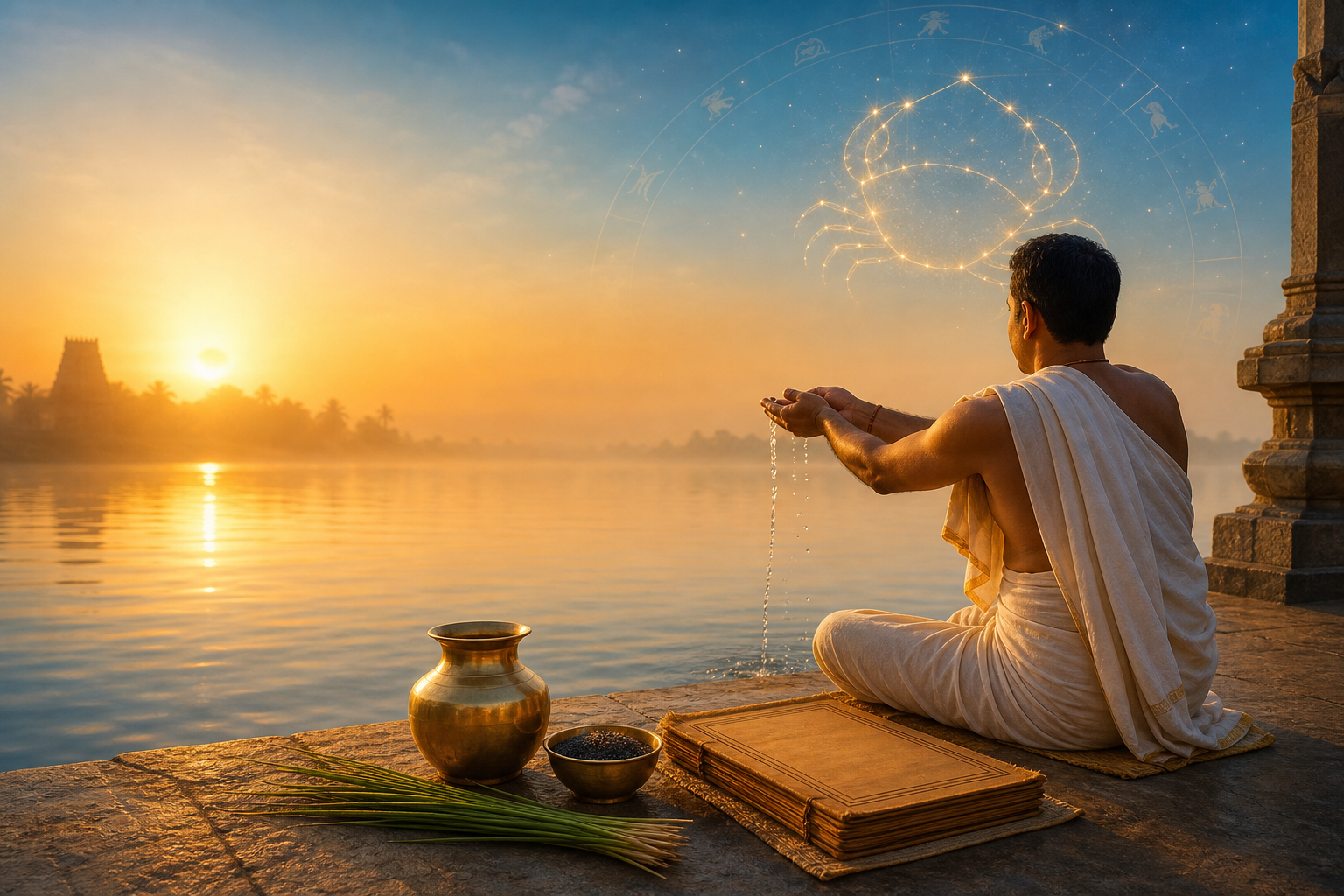
Dakshinayana Punyakalam in 2026
Dakshinayana Punyakalam associated with Karka Sankranti falls on Thursday, 16 July 2026, according to the South Indian panchanga framework followed by the source tradition. This observance marks the Sun’s transition into Karka Rashi and the ritual beginning of the six-month Dakshinayana period. For families who perform ancestral rites, the occasion provides a significant setting for tharpana, sankalpam, remembrance and the discharge of Pitru Rina through water and sesame offerings.
The 2026 calendar details belong to Parabhava Nama Samvatsaram. A dedicated [2026–27 tharpana compilation](https://brahminrituals.blogspot.com/2026/03/tharpana-sankalpams-for-year-2026-27.html) lists 16 July 2026 as Dakshinayana Punya kalam, while an independently calculated [2026 Karka Sankranti calendar](https://www.drikpanchang.com/sankranti/karka-sankranti-date-time.html?time-format=12hour&year=2026) confirms the civil date but demonstrates why the exact Sankranti moment and punya-kala interval must be calculated for the observer’s location.
Why June 21 and July 16 are both encountered
Discussions of Dakshinayana sometimes produce two dates. The June solstice, falling around 21 June in 2026, represents the astronomical turning point after which the Sun’s apparent northward movement reverses in the Northern Hemisphere. Some modern, regional or tropical-calendar explanations therefore associate Dakshinayana with the June solstice.
The traditional panchanga observance discussed here follows the nirayana or sidereal zodiac. Under that framework, Dakshinayana is ritually connected with Karka Sankranti, the Sun’s entry into sidereal Karka Rashi, around the middle of July. The two dates arise from different reference systems and should not be treated as evidence that either calendar is simply careless. For the tharpana sankalpam presented here, the applicable date is 16 July 2026 under the cited South Indian tradition.
This distinction is technically important. The solstice describes a seasonal astronomical event, whereas Karka Sankranti records a solar ingress within a sidereal calendrical system. Ritual calendars integrate astronomical calculation with inherited rules governing sunrise, tithi, nakshatra, Sankranti and punya kala. Consequently, a household should follow the panchanga and sampradaya consistently used for its rites instead of combining isolated elements from several systems.
What tharpana and sankalpam signify
Tharpana is a ritual offering of water, frequently accompanied by tila or sesame, made with the intention of honoring and satisfying the ancestral lineage. Its precise form, eligibility rules, sacred-thread position, direction, number of offerings and accompanying mantras vary among Vedic shakhas, sutras, regional customs and family traditions. A general online text can therefore explain the calendar formula, but it cannot replace lineage-specific instruction.
Sankalpam is the formal declaration of ritual intention. It situates an act within sacred time by naming the year, ayana, season, solar month, lunar fortnight, tithi, weekday and nakshatra before stating what is to be performed. The formula is not merely a date recitation. It connects personal religious action with a larger cosmological order and identifies the purpose for which the rite is undertaken.
For many households, this ordered declaration creates a powerful experience of continuity. A participant stands at a specific place and moment, yet remembers generations extending beyond individual memory. Water passes through the hands in a simple physical act, while names, gotras and inherited obligations place that act within a much longer family history.
Published 2026 calendar particulars
The cited 2026 source gives Parabhava Nama Samvatsaram, Uttarayana until 11.37 PM, Greeshma Ritu, Mithuna Masa, Sukla Paksha and Thursday, expressed as guru vasara. It gives Dvitiya until 8.54 AM and Tritiya afterward. It also gives Ashlesha Nakshatra until 7.53 PM.
These transitions matter because a sankalpam describes the calendrical state at the time of performance. If the rite is performed after a listed tithi or nakshatra has ended, the corresponding word may need to change. The supplied formula therefore must not be copied mechanically at every hour of the day. The applicable tithi, nakshatra and ayana should be confirmed for the actual ritual time.
The published note says that Ashlesha is followed by Pushya, but this is internally inconsistent with the standard nakshatra sequence. Pushya precedes Ashlesha, while Magha follows Ashlesha. This apparent editorial error is another reason to verify the day’s details with a reliable local panchanga or qualified family priest before recitation.
Dakshinayana Punyakalam tharpana sankalpam for 16 July 2026
The following transliterated wording preserves the form published for 2026:
Parabhava nama samvathsare, utharayane (up to 11.37 P M), Greeshma rithou, mithuna mase, Sukla pakshe, adhya dwitheyaam Punya Thidhou, guru vasara yukthayam, aslesha nakshatra yukthayam, Shubhayoga, ShubhaKarana evam guna viseshena, visishtayam asyam dwitheyaam punya thidhou,
……
Dakshinayana punya kale Kadaka ravi sankramana sradham, thilatharpana roopena adhya karishye
(Dwitheeya up to 8.54 Am , later Tritheeya; aslesha up to 7.53 pm later pushya nakshatra )
The ellipsis is not a decorative pause or a mantra to be pronounced as written. It represents material that may include lineage, gotra, ancestral intention or another sampradaya-specific declaration. That portion should be supplied only according to the procedure learned from the household’s acharya, priest or established ritual manual.
Tamil-script form preserved from the 2026 source
(துவிதியை காலை 8.54 வரை,பிறகு திரிதியை; ஆஸ்லேஷா மாலை 7.53 வரை)
பராபவ நாம சம்வஸ்த்ஸரே, உத்தராயணே (இரவு 11.37 வரை), க்ரீஷ்ம ருதௌ, மிதுன மாஸே, ஸுக்ல பக்ஷே, அத்ய த்வீதியாயாம் புண்யதிதௌ, குரு வாஸர யுக்தாயாம், ஆஸ்லேஷா நக்ஷத்ர யுக்தாயாம், சுபயோக சுபகரண ஏவங்குண விசேஷண, விசிஷ்டாயாம் அஸ்யாம் த்வீதியாயாம் புண்யதிதௌ, (ப்ராசீனாவீதி)
…………………………….
உபய வம்ச பித்ரூணாம்ச அக்ஷய த்ருப்தியர்த்தம்
தக்ஷிணாயன புண்யகாலே கடக ரவி ஸங்க்ரமண தர்ச ஸ்ரார்த்தம் திலதர்பண ரூபேண அத்ய கரிஷ்யே.
The Tamil script assists readers who learned the liturgical sounds through Tamil orthography. It does not remove the need for oral instruction, because vowel length, aspiration, consonant articulation and ritual pauses may not be fully conveyed by an informal transliteration. The household’s received pronunciation remains more authoritative than an isolated online spelling.
Meaning of the principal calendar terms
Parabhava nama samvathsare identifies the named year Parabhava within the traditional sixty-year samvatsara cycle. Naming the year prevents a previous year’s sankalpam from being reused without correction.
Utharayane identifies Uttarayana as the ayana prevailing before the cited ingress time. The source explicitly qualifies it with “up to 11.37 P M,” indicating that the ayana changes when the relevant solar transition occurs. A performance taking place after the transition may require Dakshinayane, subject to the governing panchanga and ritual rule.
Greeshma rithou places the observance in Greeshma Ritu, the summer season under the calendrical system used by the formula. Ritu is one of the temporal coordinates through which the sankalpam moves from the broader year toward the immediate day.
Mithuna mase identifies the prevailing solar month before the Sun’s entry into Karka. This wording can initially appear surprising in a rite associated with Karka Sankranti, but a sankalpam performed before the precise ingress naturally describes the solar month still in effect at that moment.
Sukla pakshe identifies the bright lunar fortnight, during which the illuminated portion of the Moon increases. Paksha is distinct from the solar month and must therefore be calculated through the lunar calendar.
Adhya dwitheyaam Punya Thidhou identifies Dvitiya as the tithi presented in the main formula. Because the same source states that Dvitiya ends at 8.54 AM and Tritiya follows, the wording requires confirmation if the sankalpam is made later in the morning.
Guru vasara yukthayam identifies Thursday. Guru vasara is the traditional weekday designation corresponding to the day governed by Guru or Brihaspati.
Aslesha nakshatra yukthayam states that Ashlesha Nakshatra is operative. Nakshatra changes do not occur at midnight by default, so the relevant lunar mansion must be checked for the precise time and location.
Shubhayoga, ShubhaKarana evam guna viseshena invokes the auspicious qualities of the operative yoga, karana and associated calendrical attributes. Yoga and karana are two of the five limbs traditionally considered within a panchanga, alongside vara, tithi and nakshatra.
Dakshinayana punya kale Kadaka ravi sankramana sradham states the ritual occasion and identifies the solar transition into Kadaka or Karka. The phrase connects the ancestral act with the punya kala of Dakshinayana and the Sankramana-related shraddha intention.
Thilatharpana roopena adhya karishye declares that the act will now be performed in the form of tila-tharpana. Tila denotes sesame, while tharpana refers to the offering made for ritual satisfaction and remembrance.
Why Uttarayana appears in a Dakshinayana observance
The presence of utharayane in the published formula is not necessarily a contradiction. A sankalpam records the calendrical condition at the time it is uttered. When the exact solar ingress occurs late at night, a tradition may prescribe an associated daytime observance under particular Sankranti rules even though Uttarayana remains technically operative during the ritual itself.
This also explains the appearance of Mithuna Masa in a Karka Sankranti formula. Immediately before the ingress, the Sun remains in Mithuna; immediately afterward, it is in Karka. The correct expression depends on when the sankalpam is made, not merely on the name printed at the top of the festival calendar.
No universal time should be inferred from the single figure of 11.37 PM. Solar-ingress moments are converted into local civil time, and published panchangas may also employ different computational parameters. The date can remain 16 July while the clock time, punya-kala interval and even the appropriate civil day for a ritual vary by location.
How location changes the observance
A person living in Chennai, Delhi, Toronto, London, Singapore or California cannot safely assume that an Indian clock time applies unchanged. Longitude, time zone and daylight-saving rules affect the displayed local time. Panchanga rules are also commonly organized around local sunrise rather than the midnight-to-midnight structure of the civil calendar.
An observer outside India should therefore use a location-aware panchanga configured for the actual city of performance. The selected panchanga should display the Sankranti moment, sunrise, tithi and nakshatra with the correct time zone. A household following a particular matha, Veda shakha or regional almanac should retain that authority consistently.
The local calculation should answer four questions before the formula is recited: when the Sankranti moment occurs, which punya-kala rule the tradition applies, which tithi prevails at the ritual time and which nakshatra prevails at that same time. These checks are more reliable than copying a mantra labeled only with a date.
Traditional preparation and ritual sequence
Procedures differ substantially, but a traditional observance commonly begins with personal cleanliness, an orderly ritual space and the gathering of prescribed materials. Water, tila, darbha and a suitable vessel are frequently associated with tharpana. Their exact use should follow the family’s inherited paddhati rather than a generalized checklist.
Preliminary acts may include achamana, pranayama, purification and the positioning of darbha. The sacred thread may be placed in a form prescribed for ancestral rites. Direction of facing, hand formation and the manner in which water is released can also differ according to the applicable sutra and sampradaya.
The sankalpam is then pronounced with the correct temporal details. The performer states the intention, supplies the required lineage-specific portion and proceeds to the tharpana mantras learned within the tradition. The number and order of offerings should not be reconstructed from fragments when an established family procedure is available.
The rite concludes according to the relevant paddhati, often with purification, prayer and respectful disposal or placement of the ritual water in an appropriate location. Environmental care remains compatible with ritual seriousness: clean natural materials may be used without introducing plastic, chemical colorants or other contaminants into soil or waterways.
Symbolism of water, sesame and darbha
Water is both physically sustaining and ritually expressive. In tharpana, its flowing quality makes it an especially fitting medium for continuity, transmission and offering. The act is materially modest, yet its meaning is expansive because it joins bodily action, spoken intention and ancestral memory.
Tila, commonly understood here as sesame, has a long ritual association with ancestral offerings and purification. Its use distinguishes tila-tharpana from a merely symbolic pouring of water. However, the amount, handling and accompanying formulas remain matters of received practice.
Darbha occupies an important place in many Vedic domestic rites. It may define ritual purity, mediate contact with vessels or water and mark the performer’s disciplined attention. These meanings should be understood within the living tradition rather than reduced to unsupported scientific claims.
Pitru Rina and the ethics of gratitude
Pitru Rina refers to the inherited obligation toward parents and ancestors. Human life is not viewed as an isolated achievement; it depends upon bodies, language, care, knowledge, livelihood and cultural memory transmitted through earlier generations. Ancestral ritual gives formal expression to that dependence.
This does not require an uncritical idealization of every family history. Families may carry grief, estrangement and unresolved memories alongside affection and gratitude. The discipline of remembrance can acknowledge the complexity of inheritance while directing attention toward continuity, responsibility and the welfare of future generations.
The quiet repetition of names and offerings often makes the rite emotionally immediate. Ancestors who may otherwise survive only in photographs or brief stories are given a deliberate place in the household’s sacred calendar. In this sense, tharpana serves as both ritual duty and an embodied practice of cultural memory.
Respect across Dharmic traditions
Dakshinayana tharpana is a specifically Hindu ritual and should not be presented as though Buddhist, Jain and Sikh communities necessarily follow the same mantras or procedures. Each Dharmic tradition possesses its own teachings, memorial customs and authorities. Accuracy requires recognition of those differences.
At the same time, gratitude toward teachers, parents, elders and earlier generations offers an ethical point of connection across Dharmic communities. Respectful comparison can strengthen unity without erasing doctrinal or ritual distinctiveness. Such an approach preserves both shared civilizational bonds and the integrity of each sampradaya.
Frequent errors to avoid
The first common error is reusing the previous year’s wording. Samvatsara, weekday, tithi, nakshatra, month and transition time can all change. For 2026, Parabhava replaces the preceding annual designation used in 2025 material.
The second error is treating 11.37 PM as a universal global time. It belongs to the calculation represented by the source and should not be transferred unchanged to another city. A location-aware panchanga is essential.
The third error is reciting Dvitiya after the source’s stated 8.54 AM transition without checking whether Tritiya has begun. The fourth is retaining Ashlesha after its end time without verifying the succeeding nakshatra. These are not stylistic details; they are the temporal coordinates of the sankalpam.
The fifth error is reading the ellipsis aloud or omitting a required lineage-specific passage without guidance. The sixth is treating a general sankalpam as the complete tharpana procedure. The declaration of intention and the subsequent offerings are related but distinct components.
The seventh error is assuming that every Hindu household follows identical eligibility and sacred-thread rules. Practices can differ among Apastamba, Bodhayana and other sutra traditions, as well as between Smarta, Sri Vaishnava, Madhva and additional sampradayas. Family instruction should take precedence over generalized internet directions.
Practical questions
What is the principal date? The cited South Indian panchanga tradition assigns Dakshinayana Punyakalam and Karka Sankranti to Thursday, 16 July 2026.
Why does another calendar mention June 21? That date refers to the June solstice or a tropical-seasonal interpretation. The July observance follows the sidereal Karka Sankranti framework used by the ritual source.
Can the displayed mantra be used anywhere in the world? Its structural vocabulary is useful, but its time-sensitive components cannot be applied globally without recalculation. The local Sankranti time, sunrise, tithi and nakshatra must be checked.
Is the formula a complete tharpana manual? No. It is a calendar-based sankalpam with an omitted personalized or lineage-specific section. The full rite requires the mantras and method prescribed by the performer’s tradition.
What if the household’s panchanga differs? A consistently followed family, matha or regional panchanga should normally govern the observance. Apparent conflicts should be referred to a qualified acharya or priest familiar with that calendar and sampradaya.
Final observance note
Dakshinayana Punyakalam on 16 July 2026 brings together solar transition, sacred time and ancestral responsibility. Its depth lies not in hurriedly reproducing a formula, but in reciting the correct sankalpam with attention to place, time, lineage and intention. When approached with careful panchanga verification and fidelity to sampradaya, tharpana becomes a disciplined expression of gratitude linking the living, the remembered and the generations still to come.
Inspired by this post on Hindu Pad.
