
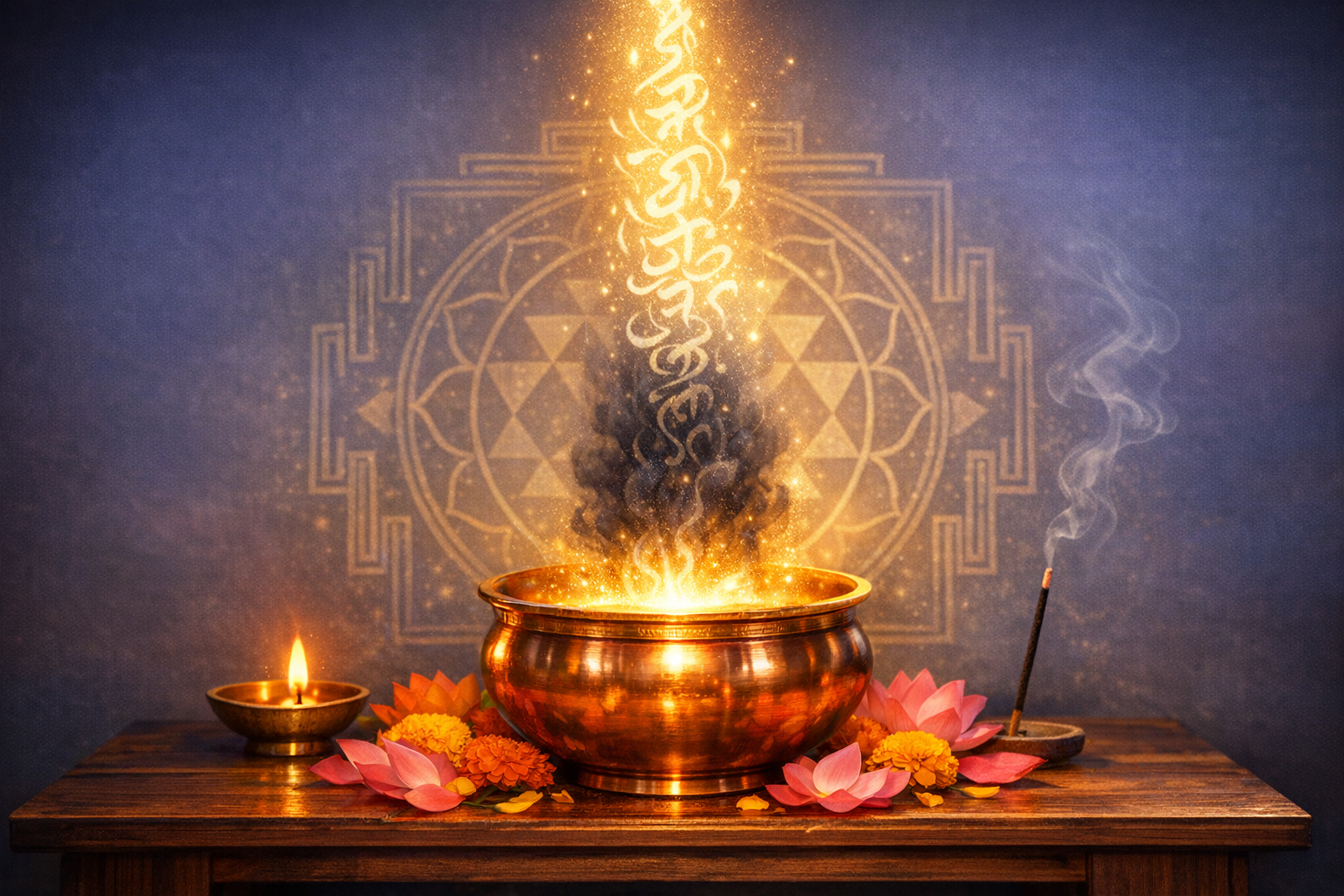
Patra Puja within Shakta Tantra is often mischaracterized as a mere offering of alcohol; in practice, it is a sophisticated rite of inner alchemy. The thematic arc From Tamas to Amrita: The Inner Alchemy of Patra Puja in Shakta Tantra captures the ritual’s intent: to transmute inertia and obscuration (tamas) into nectar-like clarity (amrita) through mantra, visualization, and disciplined contemplative absorption. Approached in its classical framework, the sacred vessel (patra) becomes a mobile temple of Devi, and its contents a mirror for consciousness. The following account presents a technical, historically grounded, and practice-informed explanation while affirming shared dharmic values that honor non-harm, inner purity, and unity across Hindu, Buddhist, Jain, and Sikh traditions.
Etymologically, patra denotes a vessel or receptacle and puja signifies reverential worship. In Shakta lineages, the patra is not an inert container but a sanctified body, a locus in which Shakti is invoked and realized. The rite engages the vessel, the liquid offering, mantra-sound, and the practitioner’s refined attention as a single, integrated technology of consciousness. When carried out in accordance with guru-parampara, Patra Puja unfolds as a precise psycho-ritual process rather than an indulgence.
Historically, Patra Puja sits within a broader Shakta and Kaula matrix that speaks of pañcamakārafive transgressive offeringswhose purpose is to transform habitual energies instead of repressing them. Classical sources and oral transmissions distinguish pathways: externalized practice (often linked to vamachara), right-hand ritual conservatism (dakshinachara), and the fully internalized contemplative approach (samaya). Diverse sampradayas therefore emphasize different degrees of symbolism and substitution, yet they converge on the same telos: the recognition of Shakti as the substratum of experience and the transmutation of tamas into amrita.
The patra itself may be fashioned from clay, copper, silver, or other ritually appropriate materials; in fierce Bhairava-oriented contexts, a kapāla (skull-cup) appears as a symbol of impermanence and ego-transcendence, while in more domestic settings a kalaśa stands for abundance and purity. Materials are not arbitrary: their thermal, tactile, and symbolic qualities shape the practitioner’s somatic and affective field during worship. The vessel is washed, perfumed, and marked as a yantra-like body receptive to prāṇa and mantra.
The rite begins with saṅkalpa (intention-setting), bhūta-śuddhi (elemental purification), and nyāsa (installing mantra on the hands and body), thereby aligning the practitioner’s inner landscape with the ritual cosmos. Breath is regulated, attention stabilized, and a protective mandala visualized. Through avahana, Shakti is invited to abide within the patra so that the vessel no longer holds a mundane substance but a sanctified medium of transmission.
Mantra-saṁskāra follows: seed syllables of the chosen deity (bīja-mantras) and the mūla-mantra are recited to refine the offering’s subtle signature. This sonic imprint is not metaphorical; in tantric hermeneutics, mantra is considered the vibratory architecture of form. The practitioner holds the vessel with steady mudrā, synchronizing breath, gaze, and sound so the offering’s “rasa” is re-coded from obscuring heaviness into illuminating nectar.
The liquid itself varies across lineages. While some traditions use consecrated madya, many employ substitutes such as panchamrita (a blend of milk, curd, ghee, honey, and sugar), herbal infusions, or sweet spiced panaka. The operative principle is not the pharmacology of the liquid but the consciousness attending it. Under mantra and bhāva, the substancewhatever its compositionis ritually recognized as amrita, the life-giving essence of Devi.
The sequence commonly includes gandha (fragrance), puṣpa (flower-offering), dhūpa (incense), dīpa (lamp), and naivedya (offering), culminating in ātma-samarpaṇaself-offeringwherein the practitioner yields contracted identity into the deity’s presence. Portions of the consecrated liquid may be shared as prasada in a spirit of gratitude, restraint, and clarity, never as license for excess.
From an inner-alchemical perspective, the rite stages a guṇa re-calibration. Tamas, when unexamined, congeals as lethargy, denial, and fear; ritually harnessed, it becomes steadiness and containment. Rajas, which otherwise disperses as restlessness, is refined into focused vigor. The emergent sattva clarifies perception, quiets reactivity, and reveals the awareness in which all states arise and subside. In this sense, Patra Puja performs a hermeneutics of energy, converting raw impulses into devotional intelligence.
Psychophysiologically, the process modulates breath, interoception, and autonomic tone. Nyāsa maps attention across the body, enhancing somatic coherence, while mantra trains rhythmic entrainment. Practitioners report that this coordination quiets the sympathetic overdrive of anxiety and opens the parasympathetic spaciousness associated with ease and clarity. Within the yogic anatomy, this is often described as facilitating the ascent of Kundalini through the sushumna nadi, with shifts felt at muladhara, svadhishthana (swadishtana), manipura, anahata, and beyond.
Ritual complexity is always bounded by ethical clarity. Classical instructions presuppose yama and niyama, ahimsa, and satya. Many sampradayas prohibit intoxicants categorically and use non-alcoholic substitutes; others permit strictly measured sacramental use under guru guidance. In all cases, the criterion is whether the rite stabilizes clarity and compassion. Any practice that degrades attention or harms beings is outside the dharmic intent and must be abandoned.
Comparative dharmic perspectives illuminate the shared essence. In Vajrayana Buddhism, the gaṇacakra feast similarly consecrates a vessel and offering, transmuting aversion and fixation into wisdom; yet ethical guardrails and meditative absorption remain paramount. Jain traditions emphasize radical ahiṃsā and abstinence, directing all energies toward inner purificationa stance that underscores tantra’s own aim of non-harm and self-mastery. Sikh teachings reject intoxicants while celebrating Naam as Amrit, the nectar of remembrance; the symbol of amrita as inner luminosity resonates across all these streams. Read together, Patra Puja affirms a plural yet harmonious dharmic vision: different methods, common awakening.
Common misunderstandings arise when the rite is severed from its vows, symbolism, and contemplative container. Colonial-era caricatures and sensationalist portrayals often mistook disciplined transmutation for license. A close reading of Shakta and allied sources, supported by living traditions, shows the opposite: Patra Puja is a measured, vow-bound practice dedicated to integration, gratitude, and lucid compassion.
Shakta metaphysics frames the offering as an engagement with rasathe sap or essence of life. Devi is the substratum of experience; when the vessel is worshiped, one honors the all-pervading presence that expresses as body, breath, and world. The rite’s aesthetic texturesfragrance, flame, sweetness, coolnessbecome pedagogies of nonduality, guiding attention from gross sensations to subtle awareness without rejecting embodiment.
For practitioners and communities seeking alignment with health and social responsibility, substitutions are integral. Herbal nectars, panchamrita, or fresh juices can embody the amrita principle without introducing intoxicants, and they reflect local ecology and seasonality. What matters is mantra-saṁskāra, bhāva, and ethical claritynot the chemistry of any single ingredient.
In many households, Patra Puja interfaces with daily worship of the kalaśa, where water is energized through mantra and later shared as tīrtha. This domestic expression makes the alchemy accessible: the vessel is kept clean, mantras are recited with steadiness, and the water is imbibed with reverence. In doing so, families enact the same principle of transmutation, offering tamasic fatigue and worry into the fire of remembrance and receiving back calm, sattvic clarity.
Accounts from practitioners describe an arc of experience: initial restlessness gives way to embodied stillness; breath becomes subtle; attention brightens; gratitude arises spontaneously. Elders recount that when the vessel is regarded as Devi’s very body, even simple water tastes “sweet” with presence. Such reports, while personal, cohere with tantric phenomenology: when attention is purified, perception of the ordinary becomes sacramental.
Seen through the lens of Panca Kosha Viveka, Patra Puja educates across sheaths of embodiment. On the annamaya-kosha (physical) level, it cultivates cleanliness and steadiness; at the pranamaya-kosha (vital) level, it refines breath and flow; in manomaya and vijnanamaya (mental and intuitive) sheaths, it trains sustained attention and insight; and in anandamaya (bliss), it reveals the unconditioned sweetness symbolized by amrita. The vessel becomes a curriculum for the whole person.
Socially, the rite encourages humility, reciprocity, and care. Because the patra stands for shared essence, communal distribution as prasada reminds participants that transformation is not a private hoard but a collective blessing. This communitarian ethos resonates with the dharmic commitment to sarvabhuta-hitawelfare of all beingsand nurtures harmony among diverse practitioners and neighboring traditions.
In sum, Patra Puja is a practice of sacred vessel and sacred view, uniting external rite and internal realization. It does not glorify intoxication; it sanctifies attention. By re-patterning tamas and refining rajas into sattvic clarity, it reveals the amrita that devotional lineages, yogic disciplines, and contemplative communities across Hinduism, Buddhism, Jainism, and Sikhism all celebrate in their own ways. Understood thus, Patra Puja stands as a luminous example of Shakta Tantra’s capacity to turn everyday embodiment into a path of wisdom and compassionate action.
Inspired by this post on Hindu Blog.
