
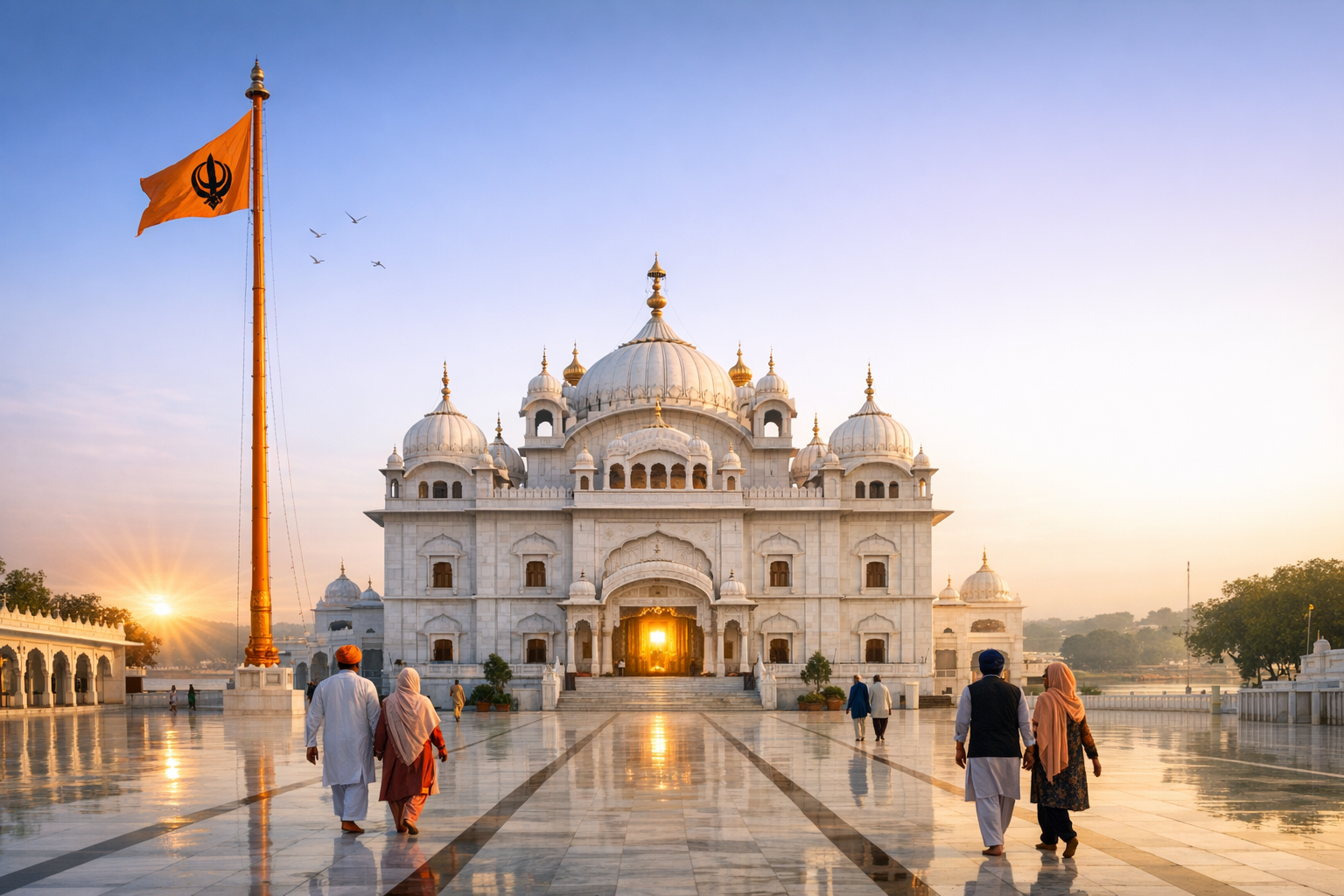
Takht Sri Hazur Sahib (Sachkhand Sri Hazur Abchalnagar Sahib) in Nanded, Maharashtra, stands as one of the five Takhts of Sikhism and is revered as the final abode of Guru Gobind Singh Ji. Situated on the banks of the Godavari River, this sacred seat anchors Sikh pilgrimage and memory, uniting spiritual devotion with institutional authority. As a destination entwined with the closing chapter of the Tenth Guru’s earthly life, it remains central to Sikh history, the evolution of Khalsa identity, and the continuity of the Guru Granth Sahib’s eternal Guruship.
The term “Sachkhand” evokes the Sikh spiritual cosmology’s realm of ultimate truth, while “Abchalnagar” (“steadfast city”) reflects the community’s enduring allegiance to divine principles. Together, these names encapsulate both metaphysical aspiration and historical rootedness, underscoring why the site is held with singular reverence among Sikhs worldwide.
Historically, it is widely held that Guru Gobind Singh Ji arrived in the Deccan during the early 18th century, eventually residing at Nanded in 1708. At this juncture, important developments unfolded that would shape the trajectory of the Panth. The Guru’s well-attested encounter with Madho Das Bairagi, who embraced the Khalsa path as Banda Singh Bahadur, symbolizes the transmission of spiritual authority and disciplined sovereignty (Kshatra grounded in Dharma) that would soon alter North Indian politics and Sikh self-governance.
Tradition records that an assassination attempt wounded the Guru at Nanded; though the assailants were overcome, the injury later proved fatal. Before merging with the Eternal in 1708, Guru Gobind Singh Ji affirmed the Guru Granth Sahib as the eternal, living Guru of the Sikhsestablishing the scriptural and spiritual authority that governs Sikh life to this day. This decisive bequeathal of Guruship is inseparable from Hazur Sahib’s identity and the maryada (discipline) followed here.
The shrine’s subsequent evolution reveals layered patronage and meticulous care. While the original memorialization traces to the early 18th century, significant architectural patronage is associated with nineteenth-century Sikh leadership, often linked in traditional accounts to Maharaja Ranjit Singh’s era. The result is a monumental complex whose material form complements its historical gravitas, binding memory, sovereignty, and devotion.
Architecturally, the Takht complex exemplifies a synthesis of North Indian and Deccan idioms: white-marble facing, domed profiles, and a sanctum that enshrines the Takhtthe seat upon which the Guru Granth Sahib is ceremonially enthroned. Within the orbit of the complex lies Angitha Sahib, associated with the place of the Guru’s cremation, reinforcing the site’s intimate connection to the Tenth Guru’s last days. The soaring Nishan Sahib (saffron flag) and the rhythmic cadence of daily maryada visually and sonically define the sacred precinct.
A distinct feature at Hazur Sahib is the preservation and veneration of shastar (arms) and relics associated with Guru Gobind Singh Ji and the Khalsa tradition. Weapon veneration (shastar-seva) is integral to understanding the Khalsa’s disciplined ideal of saint-soldierhoodwhere spiritual realization and ethical defense of justice are harmonized. The curated display of relics provides a tangible link to the Guru’s lived presence and pedagogical ethos.
The daily maryada centers on the Prakash (ceremonial opening) and Sukhasan (ceremonial repose) of the Guru Granth Sahib, accompanied by Nitnem, kirtan in established raag traditions, and the Hukamnama (divine order) that guides congregational reflection. In line with historical practice at this Takht, the Dasam Granth holds a respected liturgical place, and recitations from it are part of the living tradition at Hazur Sahib. This continuity signals both fidelity to inherited practice and the site’s role in conserving early Khalsa-era modes of devotion and discipline.
Festivals and commemorationsespecially those associated with Guru Gobind Singh Ji, such as his Parkash Purab and the tercentenary “Gur-ta-Gaddi” observancesanimate the gurdwara with processions (Nagar Kirtan), martial displays (gatka), and Amrit Sanchar ceremonies. These events reaffirm the Khalsa’s founding principles at Anandpur Sahib and their living transmission in Nanded, making Hazur Sahib both a guardian of memory and a workshop of virtues.
Contextualized among the five seats of Sikh temporal-spiritual authorityAkal Takht (Amritsar), Takht Sri Keshgarh Sahib (Anandpur Sahib), Takht Sri Patna Sahib (Patna), Takht Sri Damdama Sahib (Talwandi Sabo), and Takht Sri Hazur Sahib (Nanded)the Nanded Takht is uniquely bound to the Guru’s last testament and the doctrine of the Guru Granth Sahib’s eternal Guruship. This confers upon Hazur Sahib a distinctive authority in matters of maryada and memory, complementing the roles played by the other Takhts in adjudication, teaching, and Panthic cohesion.
Institutionally, the Takht’s administration is overseen under statutory frameworks developed after Independence, with the Nanded Sikh Gurdwara Sachkhand Board widely recognized for stewarding the shrine and associated gurdwaras. Conservation of manuscripts, shastar, and architectural integrity has increasingly drawn on heritage-management methods, while digital dissemination of kirtan and Hukamnama connects the global sangat to the daily rhythm of Hazur Sahib.
For pilgrims, Nanded is accessible by rail and air; the Shri Guru Gobind Singh Ji Airport links the city to major hubs, and the Nanded (NED) railway junction sits on important routes through Maharashtra and Telangana. Mornings begin before dawn with Prakash, while evenings conclude with Sukhasan; modest, clean attire and covered heads align with gurdwara etiquette. The langar operates as a practical school of seva, where all sit together regardless of originan embodied expression of equality that has defined Sikh institutions for centuries.
The broader cultural landscape of Nanded is shaped by the Godavarioften called the Dakshin Gangawhose sacred profile in the Deccan has nurtured layers of civilizational exchange. Within this milieu, Hazur Sahib has long interacted with Marathi-speaking communities and neighboring sacred sites, reflecting the shared civilizational grammar of the Indian subcontinent in which dharma, karuna (compassion), and satya (truth) form a common ethical core across traditions.
In that spirit, the Takht’s ethos resonates with values cherished across the dharmic familyHinduism, Buddhism, Jainism, and Sikhismwhere devotion, discipline, service, and non-aggression cohere as social virtues. While each tradition retains its distinctive doctrines and practices, their convergence on ethical living and universal dignity offers a constructive basis for unity in diversity. Hazur Sahib’s langar, seva, and collective remembrance model this inclusive vision in daily practice.
From a historical-research perspective, Hazur Sahib invites multidisciplinary inquiry: textual traditions (such as Sri Gur Sobha and early Sikh chronicles), material culture (arms, manuscripts, and architectural fabric), and lived religiosity (kirtan, maryada, and festival cycles). Careful triangulation of sources is prudent for dating specific episodes and understanding the evolving functions of the Takht, yet the core significance of Nanded as the Guru’s final earthly station and the cradle of the Guru Granth Sahib’s eternal Guruship remains constant in Sikh memory and practice.
Ultimately, Takht Sri Hazur Sahib endures as a living heart of the Khalsa: a place where remembrance crystallizes into responsibility, and where sovereignty is tempered by service. To encounter Hazur Sahib is to meet Sikh history in situwhere scripture is enthroned, relics teach what words alone cannot, and the Panth’s disciplined freedom continues to find fresh expression along the banks of the Godavari.
Inspired by this post on SikhNet – News.
