
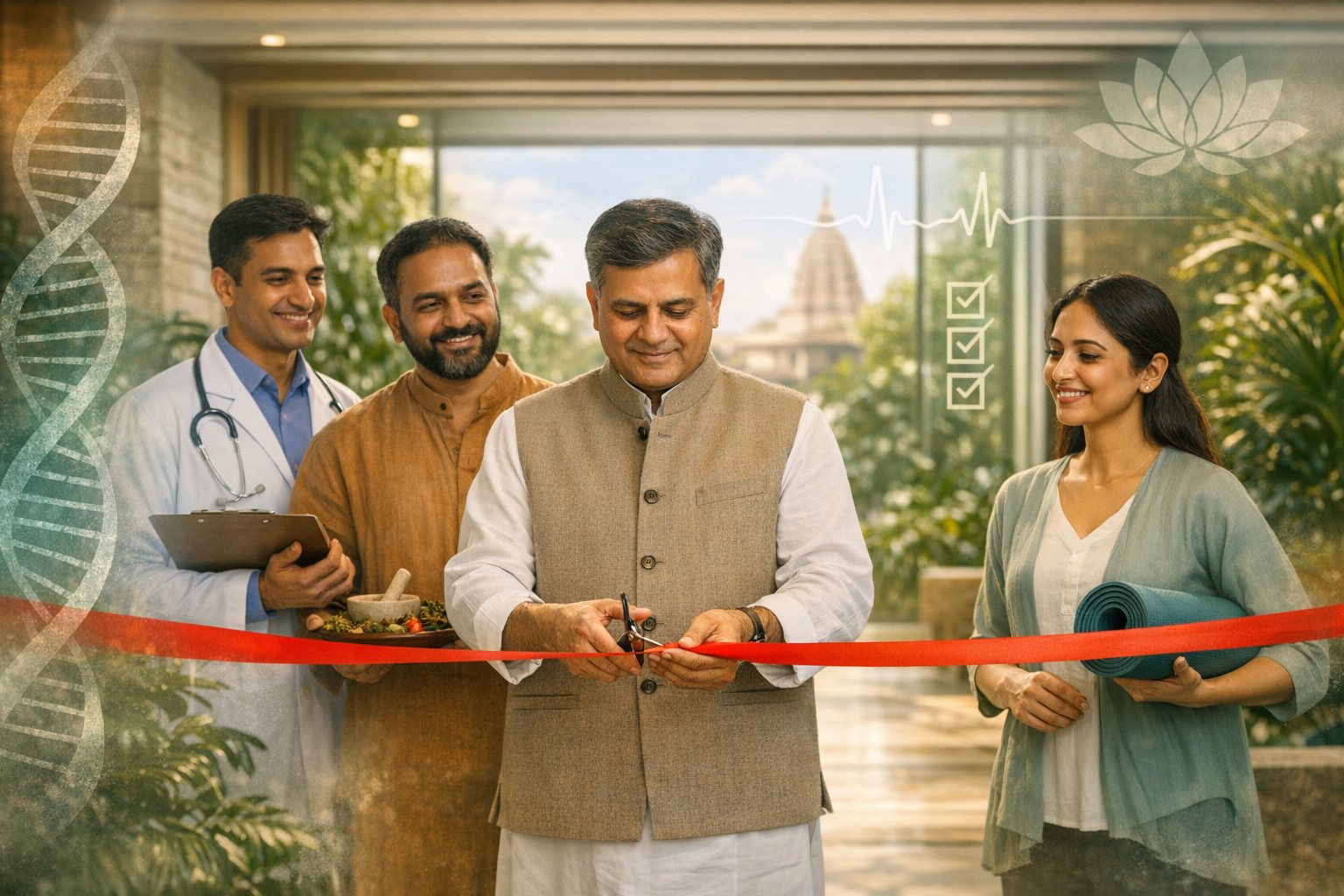
On 30 May 2026, the Governor of Maharashtra inaugurated the ISKCON Kharghar Holistic Cancer Healing Retreat, an initiative of the ISKCON Navi Mumbai Bhaktivedanta Ayurvedic Healing & Research Centre. Positioned as a unique, evidence-based, and internationally aligned integrative oncology program, the retreat is designed to support individuals throughout the cancer journeyfrom active treatment to survivorshipwithout replacing standard-of-care therapies such as surgery, chemotherapy, radiation, immunotherapy, or targeted agents.
The retreat explicitly frames its services as complementary and integrative, aligning with international oncology guideline principles for supportive care and symptom management. It emphasizes structured, multidisciplinary pathways that incorporate Ayurveda, yoga therapy, mind–body interventions, nutrition, psycho-oncology, rehabilitation, and spiritual care, with safety and evidence standards guiding every protocol. The program seeks to improve quality of life, mitigate treatment side effects, and strengthen resilience in a manner congruent with contemporary oncology practice.
Integrative oncology has matured into a recognized discipline globally, with guidance from major oncology bodies emphasizing person-centered supportive care that addresses pain, fatigue, anxiety, sleep disturbance, distress, and functional decline. Within this paradigm, the retreat situates its approach as complementary to conventional oncology, focusing on realistic, measurable outcomes that matter to patients and clinicians alike. This positioning ensures that innovation is balanced by responsibility, transparency, and continuous evaluation.
Program design reflects a continuum-of-care model. Prospective participants undergo a multidisciplinary intake that screens for clinical status, current oncologic regimens, contraindications, and psychosocial needs. Care plans are then tailored to the phase of treatmentprehabilitation before surgery or systemic therapy, peri-treatment symptom management, and survivorship programs that address fatigue, neuropathy, cognitive changes, mood, sleep, nutrition, physical conditioning, and return-to-work goals. Clear referral pathways to oncology teams are maintained to protect treatment fidelity and timelines.
Ayurveda is integrated as supportive care with an emphasis on safety and standardization. Formulations are selected with attention to herb–drug interaction risks, manufacturing quality, and dose transparency, and are withheld when contraindicated. Panchakarma and other intensive detoxification procedures are applied, if at all, only with oncologic precautions and timing considerations to avoid interference with systemic therapies or wound healing. The overarching principle is judicious application of traditional knowledge within a modern pharmacovigilance framework.
Yoga therapy and breath-based mind–body practices are deployed to address anxiety, fatigue, deconditioning, sleep disruption, and pain. Individualized protocolsspanning asana modifications, pranayama, relaxation, and guided imageryare calibrated to a patient’s performance status and treatment stage. The approach is consistent with current integrative oncology guidance that supports selected mind–body interventions for symptom relief and psychosocial well-being, while avoiding overreach into curative claims.
Nutrition counseling focuses on maintaining adequate energy intake during treatment, mitigating gastrointestinal side effects, supporting weight and muscle preservation, and addressing taste changes or mucositis. Plans emphasize food safety for immunocompromised states, hydration, and culturally appropriate meal design. Where relevant, evidence-informed micronutrient strategies are considered cautiously, with oncologist coordination to prevent interactions with active therapies.
Psycho-oncology and spiritual care are integral. Distress screening triggers stepped-care responses ranging from counseling and caregiver support to group sessions that cultivate meaning, gratitude, acceptance, and coping skills. Spiritual support is offered in a dharmic, plural, and inclusive manner, honoring the diverse pathways of Hinduism, Buddhism, Jainism, and Sikhism, and welcoming people of all faiths. This unity-oriented ethos underscores compassion (karuṇā), non-harm (ahiṁsā), mindful awareness, and seva as shared values across dharmic traditions.
Rehabilitation services address deconditioning, balance, lymphedema risk and management, neuropathy, and functional goals. Evidence-based exercise prescriptions are individualized to treatment phase and comorbidities, integrating physiotherapy, gentle strength training, and range-of-motion work. The intent is to restore autonomy, reduce fall risk, and enhance endurance safely over time.
Palliative and supportive care principles are embedded across the program. Pain management coordination, symptom control, communication support, and end-of-life planningwhere appropriateare conducted in alignment with patient preferences and oncologic recommendations. Family engagement and caregiver well-being are recognized as determinants of patient outcomes and are therefore actively supported.
To generate clinical evidence, the retreat is collaborating on a planned randomized clinical trial with Tata Memorial Hospital. The study is expected to examine patient-reported outcomes, functional measures, symptom burden, treatment adherence, and safety signals, with longer-term follow-up for clinically meaningful endpoints where feasible. Ethical governance, data integrity, and independent safety oversight are described as core commitments, aligning with Good Clinical Practice standards.
Operational quality is supported by multidisciplinary case conferences, explicit inclusion and exclusion criteria, and standard operating procedures for each modality. Documentation includes informed consent, shared decision-making notes, and careful recording of adverse events and concomitant therapies. A structured pharmacovigilance process monitors potential herb–drug interactions, while electronic health records facilitate continuity with primary oncology teams and enable research-grade data capture.
Equity and access are addressed through educational materials in multiple Indian languages, caregiver training, and telehealth follow-up for those traveling from outside Navi Mumbai. Group education on fatigue management, sleep hygiene, safe activity progression, and mindfulness extends benefits beyond individual sessions and helps create supportive communities of practice among participants and families.
Initial impressions from attendees at the inauguration emphasized the value of a calm, structured environment where clinical rigor coexists with compassionate care. Clinicians noted the importance of clear role delineationoncologists lead disease-modifying therapy while integrative teams deliver supportive interventions within defined boundaries. Caregivers reported feeling more confident about nutrition, activity pacing, and stress management strategies that complement ongoing medical treatment.
From a systems perspective, the retreat advances India’s leadership in integrative oncology by coupling traditional knowledge with modern research methodologies. If successfully validated, the model could inform protocols for symptom control, survivorship, and rehabilitation in resource-diverse settings, offering replicable blueprints for hospitals and community centers. It also positions Navi Mumbai and Kharghar as hubs for high-quality, patient-centered, complementary cancer care.
The program’s dharmic orientation emphasizes unity across Hindu, Buddhist, Jain, and Sikh traditionseach affirming compassion, service, restraint from harm, and the cultivation of inner equanimity. Within this shared value framework, yoga, meditation, mindful living, ethical nutrition, and service to others are presented as universally accessible tools that respect individual belief systems while strengthening collective well-being.
The inauguration therefore marks a careful but significant step forward: an evidence-aspiring, guideline-aligned, and ethically grounded retreat that complements standard oncology. The coming years will determine the depth of clinical impact through transparent research outputs. In the interim, the initiative models how integrative care can be both spiritually sensitive and scientifically accountableserving patients, caregivers, and clinicians in Maharashtra and beyond.
Inspired by this post on Dandavats.
