
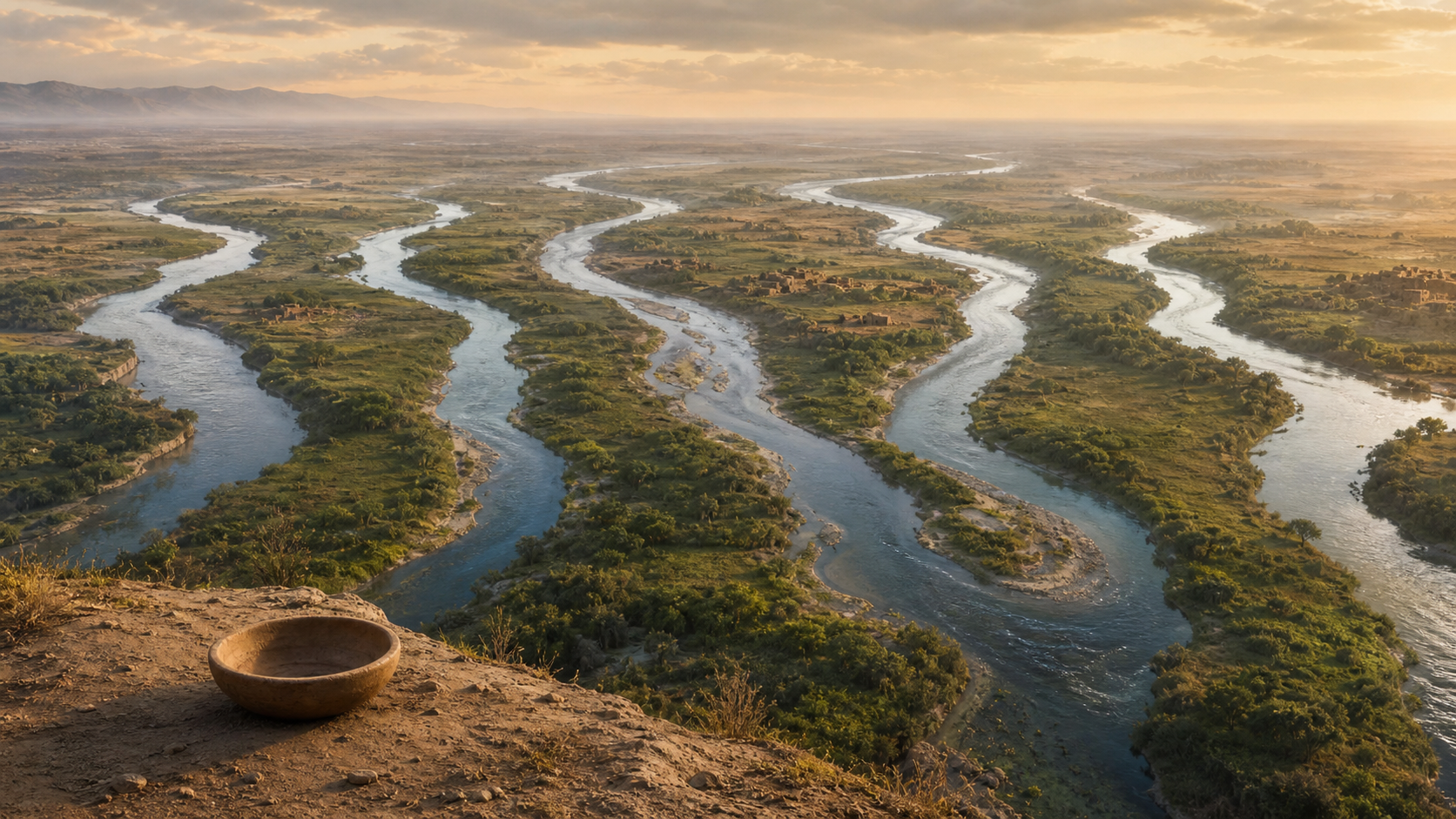
Panchanada appears in Hindu tradition as an ancient river-land whose identity joins geography, sacred memory, and civilizational history. According to Hindu Blog, its name means five rivers, and the region is also described as Madradesha or Aratta in ancient texts.
The available source is only a brief fragment, so a careful reading must distinguish its limited claims from broader interpretation. Even so, it offers a useful starting point for understanding how a landscape can become part of a culture’s spiritual vocabulary.
A name that carries geography and memory
Panchanada is a geographic name with an immediate natural meaning: a land defined by five rivers. Hindu Blog places it within fertile plains watered by the Sindhu, or Indus. The supplied extract does not identify all five rivers, establish precise boundaries, or name the ancient passages on which its description depends. Those details should therefore not be inferred.
The alternative names Madradesha and Aratta nevertheless show how one region may be remembered through more than one textual or cultural frame. They should not automatically be treated as perfectly interchangeable map labels. Ancient regional names can carry associations that vary with the narrative, community, or period in which they appear.
Why the river setting matters
Rivers generally shape settlement, cultivation, movement, and collective memory. In Dharmic thought, the natural world can also carry moral and sacred meaning. Water is not merely a resource in this view; it can remind communities that life depends upon relationships among land, living beings, and human responsibility.
This helps explain why Panchanada can be approached as more than a physical region. Its river-centered identity represents a form of sacred geography in which terrain and tradition reinforce one another. The landscape becomes a bearer of inherited meaning without ceasing to be a real environment that sustains life.
Key takeaways
- Panchanada literally refers to a land of five rivers.
- Hindu Blog associates the region with the fertile plains watered by the Sindhu.
- The source reports Madradesha and Aratta as other names found in ancient texts.
- The fragment supports a cultural and spiritual reading, but not a precise historical reconstruction.
A shared Dharmic lens without erasing differences
The source specifically presents Panchanada within Hindu traditions. It does not establish that Hindu, Buddhist, Jain, and Sikh sources describe the region identically. A responsible Dharmic interpretation should preserve that distinction rather than manufacture a single account.
There is still a meaningful common thread. Hindu reverence for sacred geography, Buddhist attention to interdependence, Jain concern for non-harm, and Sikh emphasis on service all encourage an ethical relationship with the world people inhabit. These traditions retain their own teachings and histories, yet each can contribute to a civilizational ethic of gratitude, restraint, and care for life-sustaining landscapes.
Keeping interpretation proportionate to the evidence
Panchanada should not be made to carry claims that the supplied material cannot support. The excerpt provides a name, two reported alternatives, an association with the Sindhu, and a statement of Hindu religious and historical significance. It does not supply dates, quotations from scripture, archaeological findings, or a detailed political geography.
Future study can strengthen this picture by comparing complete textual passages and historical evidence. Until then, Panchanada is best understood as a powerful but carefully bounded example of how the Dharmic imagination remembers land, water, and civilization together.
Inspired by this post on Hindu Blog.
