
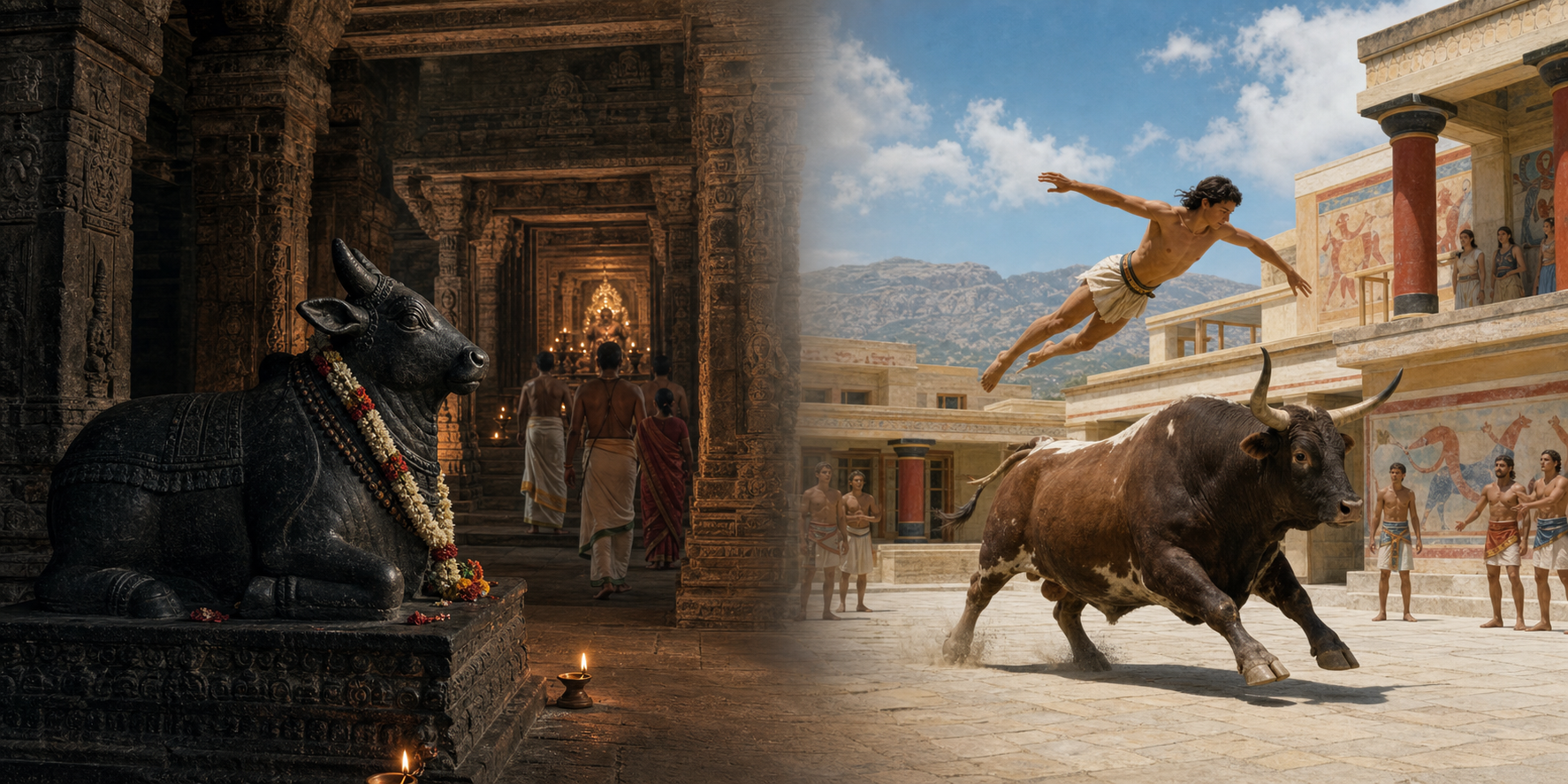
If you have stood behind Nandi in a Shiva temple and later seen the bull-leaping images of Knossos, the question comes naturally: are these remnants of one ancient bull tradition? The resemblance is real, and the Bronze Age chronologies partly overlap. Neither fact, however, proves that Hindu and Minoan worshippers understood the bull in the same way or inherited the symbol from each other.
You can make a more meaningful comparison by asking four concrete questions: What did the bull do in the ritual? Where was it placed? How did people approach it? What kind of evidence supports the interpretation? Those questions reveal two distinct sacred grammars—one centred on disciplined attention before Shiva, the other on formidable animal power expressed through performance, architecture and offering.
One sacred animal does not mean one ancient religion
A bull can communicate strength, fertility, wealth, protection or sovereignty without carrying all those meanings at once. Its physical power and economic importance made it available to many societies as a religious symbol. Similar imagery may therefore arise independently, even when two cultures existed during overlapping centuries.
Three kinds of claim must be separated. A visual resemblance means that two cultures represented bulls. A functional analogy means that bulls occupied comparable roles, such as guarding sacred space or expressing generative force. A historical relationship is a much larger claim: it requires evidence of contact, transmission and transformation, not merely two images placed side by side.
The chronology permits comparison but does not settle ancestry. Indus seals bearing prominent cattle belong roughly to 2600–1900 BCE. The principal Minoan evidence belongs roughly to 2000–1450 BCE, followed by Mycenaean phases. Vedic compositions are generally placed across approximately 1500–500 BCE, while the familiar Shaiva identity of Nandi becomes clear in later Puranic, Agamic, sculptural and temple traditions. These are overlapping and successive layers, not interchangeable snapshots of a single cult.
Key takeaways
- Nandi is most securely interpreted within the developed Shaiva setting: he is Shiva’s vehicle, guardian, attendant and exemplary devotee.
- The humped bulls on Indus seals are important evidence of bovine prominence, but calling every one of them Nandi goes beyond what the imagery can establish.
- Minoan bull imagery belongs to a ritual world of court spectacle, consecrated space, libation and, in some contexts, sacrifice and communal feasting.
- The strongest comparison concerns contrasting ritual functions—contemplative alignment in the Shiva temple and dangerous, coordinated movement in the Minoan court.
- A shared symbol can support comparison without proving migration, borrowing or a common theology.
The Hindu evidence must be read in three distinct layers
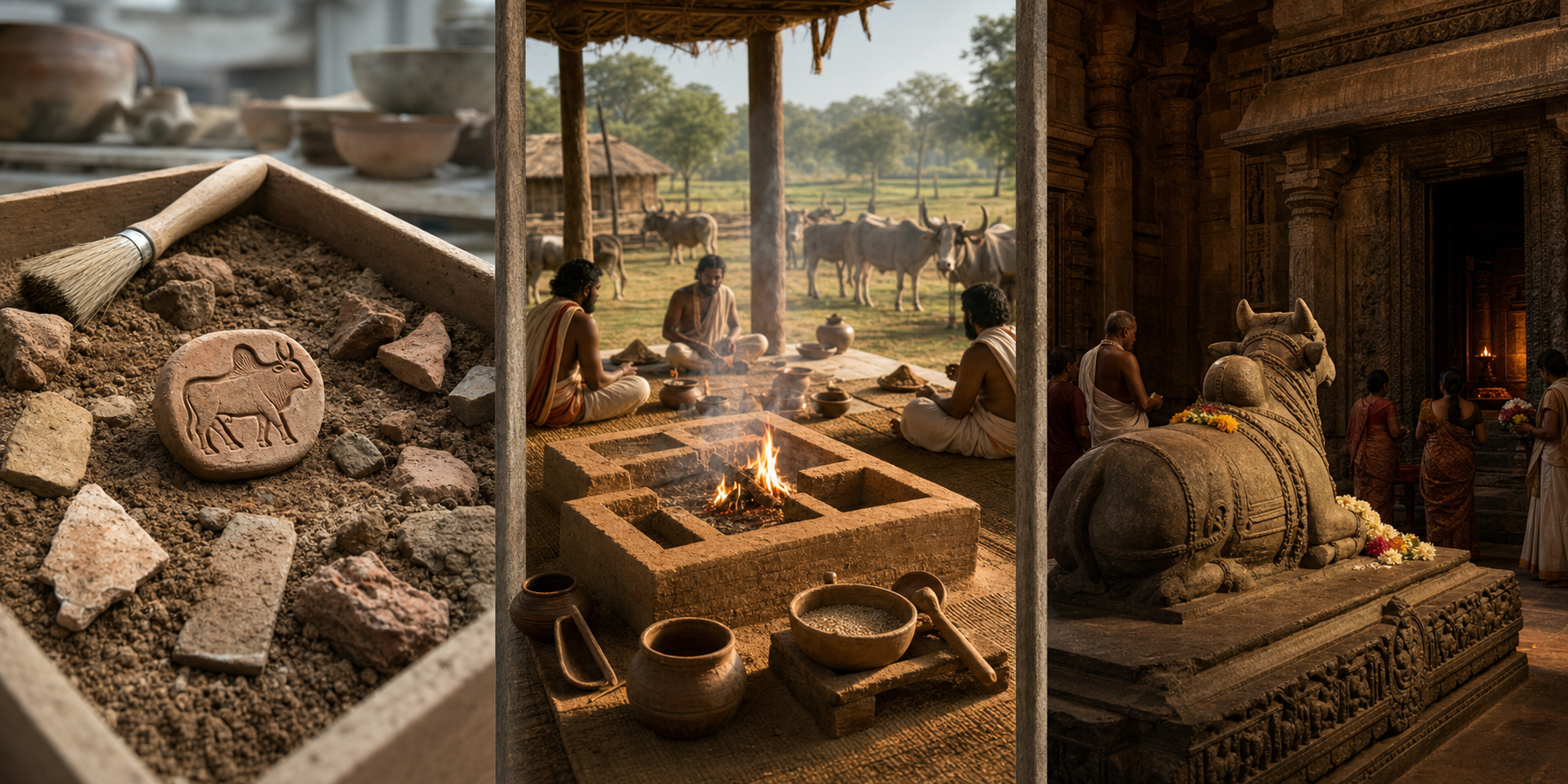
The Hindu side is sometimes compressed into a single line running from an Indus seal directly to the Nandi outside a modern Shiva temple. That shortcut hides the most interesting development. Bovine symbolism changes as it moves through different media, languages and ritual institutions. Keeping the layers separate makes the eventual Shaiva form more intelligible, not less significant.
Indus bulls show prominence, not a complete Shaiva identity
The humped zebu appears repeatedly on seals from Harappa and Mohenjo-daro, often in a commanding profile beside still-undeciphered signs. Cattle plainly mattered to the economy, and their formal presentation also supports some degree of sacral or symbolic valuation. The erect stance and carefully emphasized body can convey potency, territorial presence and protection.
What the seals do not provide is Nandi’s name, a narrated relationship with Shiva, or the axial temple arrangement familiar from later Shaivism. Even the so-called Pashupati seal cannot simply close that gap. The responsible conclusion is precise: Indus civilization offers an early South Asian setting in which cattle possessed exceptional material and symbolic importance, but the identification of its bulls with the later Nandi is not established merely by resemblance.
When you encounter an Indus bull in a museum or online, write down two statements separately. First record what you can see: species, posture, accompanying signs and archaeological context. Then record the proposed religious interpretation. That small discipline prevents a plausible hypothesis from quietly turning into a proven label.
Vedic language turns bovine power into a cosmic metaphor
In Vedic usage, vrishabha, or bull, functions as an epithet for deities including Indra and Agni. It conveys force, virility and generative capacity. Cattle wealth carries great value, while bovine language can participate in the larger imagination of fecundity and rita, the natural and moral order that sustains the cosmos.
This stage matters because it supplies a theological vocabulary for interpreting bovine strength. Raw force need not remain raw. It can serve life, order and divine activity. Yet an epithet applied to a Vedic deity is still not identical to the later sculpted bull facing a Shiva linga. Continuity of symbolic vocabulary should not be confused with sameness of ritual form.
Nandi makes strength answerable to dharma
Within mature Shaiva traditions, Nandi is not merely an impressive animal associated with a powerful god. He is Shiva’s vahana, the sentinel of the sanctum, a leader among Shiva’s ganas and a model of unwavering devotion. As Nandikeshvara, he can also embody dharma itself. Strength has been given direction: it becomes loyalty, restraint, service and watchfulness.
The temple plan teaches this interpretation without requiring a lecture. Nandi normally rests on the central axis facing the linga in the garbhagriha. The devotee approaches Shiva along the same sightline. In many places, worshippers whisper a prayer or intention into Nandi’s ear before turning their attention to the sanctum. The bull mediates approach not by obstructing vision but by modelling how to look—steadily, patiently and without distraction.
That is what you should notice on your next temple visit. Stand far enough behind Nandi to see the alignment among entrance, bull and linga. Observe how the open or public portion of the temple narrows toward the dark inner chamber. The posture of the recumbent bull is part of this movement from outward activity to inward concentration. His apparent stillness is an active spiritual discipline.
Processions and festival vehicles add a mobile dimension. On rishabha vahana occasions, including observances connected with Mahashivaratri in many regions, the bull carries sacred presence outward into the community. South Indian temple traditions from the Pallava and Chola periods onward also give the Nandi pavilion major architectural weight. The monumental Nandi at Brihadeeshwara Temple in Thanjavur shows how sculpture, procession and sacred sightline can converge in one coherent space.
The wider Dharmic family also warns against assigning one fixed meaning to every bull. The bull is the lanchhana, or identifying emblem, of the first Jain Tirthankara, Rishabhanatha or Adinatha, where it supports associations with endurance, restraint and ethical leadership. The Mauryan Rampurva bull capital places bovine dignity within an idiom of royal dharma and protective sovereignty. Sikh thought does not establish an animal cult, but its vision of creation supports care and seva toward living beings. Even among related Dharmic traditions, the symbol remains meaningful precisely because its function is not mechanically identical.
Minoan Crete presents the bull through movement and risk
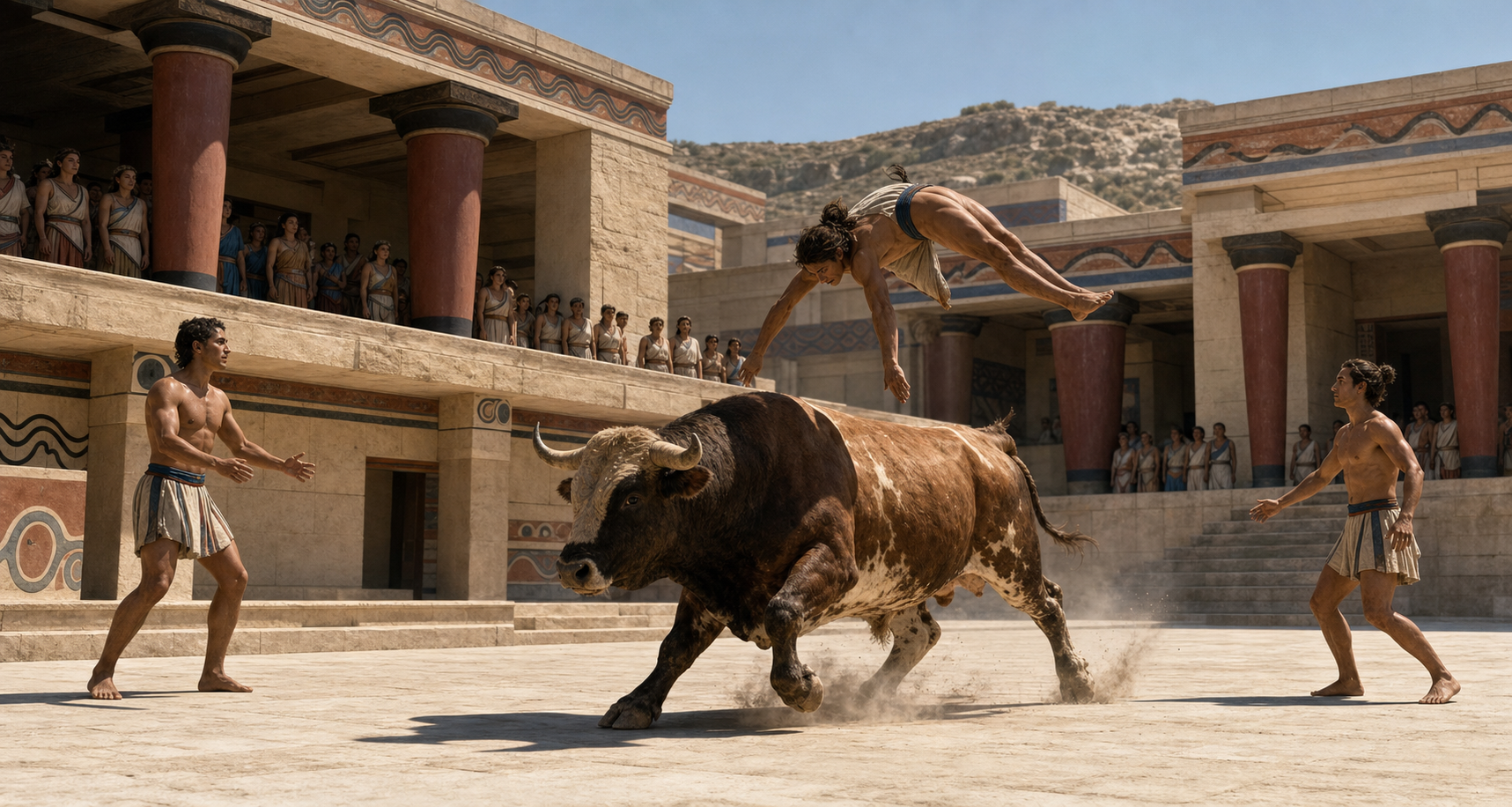
The Minoan bull belongs to a different ceremonial environment. Palatial centres such as Knossos, Phaistos and Zakros brought courts, processional routes and viewing areas into an integrated public setting. Instead of a recumbent guardian directing attention into a sanctum, Minoan imagery often places the living bull at the centre of dangerous, coordinated action.
Bull-leaping depicts a negotiated encounter with power
The Taureador fresco from Knossos presents acrobatic figures engaging a charging bull, while seals and small plaques repeat related motifs. The figures grasp, vault or move around the animal with an elegance that does not erase the danger. Minoan imagery includes figures conventionally identified as both male and female participants, suggesting that the represented performance carried a socially integrative dimension.
The precise religious meaning remains disputed. Bull-leaping has been interpreted as a rite of passage, a propitiatory spectacle or a performance preceding sacrifice. No single explanation should be presented as settled. The safest conclusion is also the most useful: the repeated motif made mastery of fear, bodily balance and communal witnessing central to the image of the bull encounter.
A fresco proves that an action was important enough to represent; it does not by itself tell you how frequently the action occurred, who was eligible to participate or whether every depiction records a literal event. When examining bull-leaping art, separate the depicted sequence from the reconstructed ceremony. The first is visible. The second depends on interpretation.
Horns, vessels and animal remains answer different questions
Stylized forms known as horns of consecration appeared on rooftops, parapets and sacred locations. Their placement appears to have marked or protected consecrated space, extending the bull’s presence beyond the animal body. Here the horns operate architecturally: they tell the participant that a location has entered a ceremonial order.
The double axe, or labrys, also occurs in Minoan religious settings and may have participated in sacrificial or ceremonial activity. Its exact relationship to the bull varies by context and should not be reduced to a universal equation. Seeing horns and a double axe near each other is evidence of association in that setting, not a complete key to Minoan theology.
Bull-shaped rhyta add the action of pouring. These vessels probably served libations, converting the animal form into a conduit for an offering and linking liquid, renewal and ceremonial circulation. Faunal assemblages from some ritual settings indicate animal sacrifice and communal feasting, although the scale and importance of bull sacrifice differ across sites and periods. A vessel, a fresco and animal bones should therefore not be made to say the same thing: one helps reconstruct offering, another visual performance, and the third the treatment of actual animals.
Later Greek stories about the Minotaur and the Athenian youths preserve a powerful bull-centred memory, but they come from a later mythic world. They cannot be projected backward as a literal script for Minoan ritual. Conversely, Linear B tablets from Knossos belong to Mycenaean administration in the Late Bronze Age. Their cattle allocations to sanctuaries and palatial stores demonstrate a continuing ritual economy, but they should not automatically be treated as direct explanations of earlier Minoan images.
If you are viewing Minoan material, begin with the medium. Ask whether you are looking at a fresco, seal, architectural feature, pouring vessel, administrative tablet or faunal deposit. Each object can support a different kind of conclusion. Many extravagant theories begin by ignoring that distinction.
Stillness and spectacle reveal two sacred grammars
The most illuminating comparison is not bull against bull in isolation. It is the complete relationship among animal, human body, sacred space and ritual action. That comparison reveals both genuine affinities and decisive differences.
| Question | Shaiva tradition | Minoan Crete | What you can reasonably conclude |
|---|---|---|---|
| What is the bull’s central role? | Nandi serves as Shiva’s vehicle, guardian, attendant and ideal devotee. | The bull appears as a focus of spectacle, danger, offering and consecrated power. | Both are sacred, but sacredness does not give them the same theological identity. |
| Where does the encounter occur? | On the axial approach to the Shiva sanctum, with Nandi facing the linga. | In palatial courts, processional settings, marked architecture and ritual objects. | Spatial placement explains meaning better than the isolated animal image. |
| What does the human participant do? | The devotee follows Nandi’s gaze, prays and turns inward toward Shiva. | The represented acrobat confronts, grips or vaults over the moving animal before witnesses. | One pattern disciplines attention; the other dramatizes coordination under risk. |
| What quality of power is emphasized? | Composed strength made obedient to devotion and dharma. | Dynamic force encountered through skill, danger and ceremonial control. | The traditions transform bovine potency in different directions. |
| What is known about animal sacrifice? | Some Vedic settings included animal sacrifice; later Hindu worship strongly developed puja, vows, symbolic offerings and an emphasis on ahimsa. | Faunal remains support sacrifice and feasting in some contexts, with substantial variation by place and period. | Neither civilization should be described with a single timeless practice. |
| What remains uncertain? | The exact relationship between Indus cattle imagery and later Shaiva Nandi traditions. | The precise purpose, frequency and social organization of bull-leaping and the full meaning of related symbols. | Uncertainty belongs in the conclusion, not in a footnote added after a sweeping claim. |
Nandi turns bovine power into disciplined service. The Minoan bull presents power as something a community approaches through danger, grace and public coordination. One sacred setting gathers the mind into a straight line toward the divine centre; the other expands ceremonial energy into a court of participants and witnesses. This contrast is more revealing than a catalogue of similar horns and muscular bodies.
The ethical histories also require care. Vedic religion cannot be collapsed into every later Hindu practice, and Minoan Crete cannot be reconstructed as one unchanging bull-sacrifice system. The later Hindu prominence of puja, vrata, symbolic offering and ahimsa gives Nandi a setting in which the sacred bull is predominantly honoured, ornamented and contemplated. Minoan remains include evidence of sacrifice and consumption alongside images of athletic encounter and vessels for offering. This is a difference in the surviving ritual trajectories, not permission to caricature either civilization.
Use five tests before accepting a civilizational claim
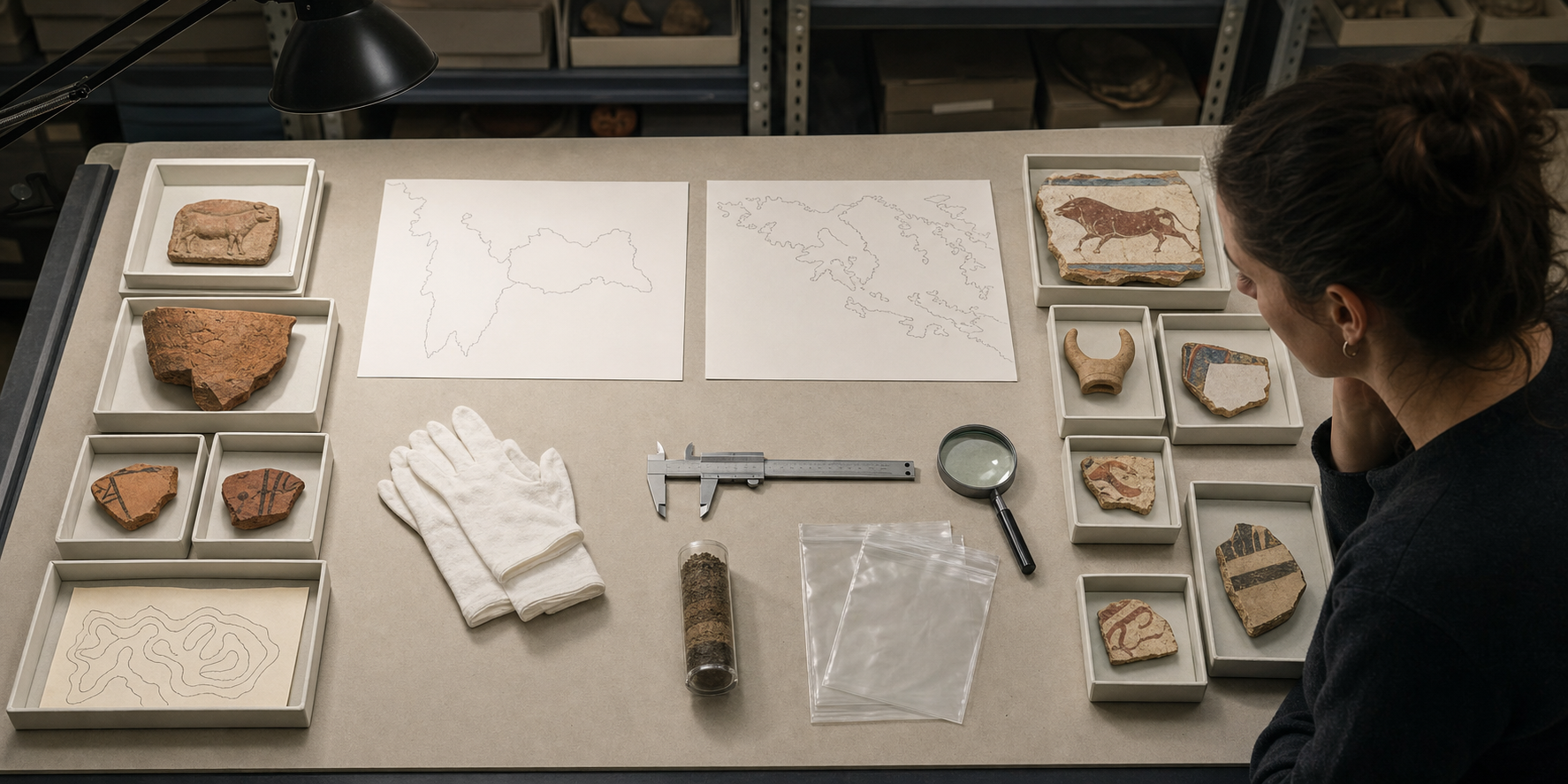
Comparisons involving ancient Bharat often attract two equally weak reactions. One dismisses every resemblance as meaningless coincidence. The other treats resemblance as proof that Sanatana Dharma directly generated every sacred bull tradition. You do not have to choose between those extremes. A disciplined Dharmic reading can value deep South Asian continuity while refusing claims that the available evidence cannot carry.
- Name the exact object and period. An Indus seal, a Vedic epithet, a Chola-era Nandi, a Minoan fresco and a Mycenaean tablet do not belong to one undifferentiated ancient moment.
- Separate what is visible from what is inferred. A recumbent bull facing a linga establishes an intentional sightline. A painted acrobat over a bull establishes a represented encounter. Claims about doctrine, initiation or ancestry require additional reasoning.
- Ask what would demonstrate transmission. A persuasive historical connection needs more than chronological overlap. Look for a plausible contact route, intermediate forms, distinctive shared features and evidence that the symbol changed as it moved.
- Compare ritual function before appearance. Two bull figures may look similar while doing entirely different religious work. Ask whether the animal guards, carries, receives offerings, marks territory, enters sacrifice or becomes the focus of performance.
- Preserve the uncertainty in your final sentence. If an identification is debated, say that it is debated. If evidence establishes importance but not meaning, stop at importance. Precision makes a civilizational case stronger because it shows which claims can withstand scrutiny.
Several popular shortcuts fail these tests. An Indus bull is not automatically Nandi. The Minotaur is not a verbatim account of Minoan ceremony. Every horned form is not evidence of one migrating priesthood. Nor can all bull symbolism be reduced to fertility: guardianship, royal power, ritual economy, danger, devotion and dharma are independently visible possibilities.
On your next temple visit, pause behind Nandi and follow his gaze before you move toward the sanctum. On your next encounter with Minoan art, identify the object’s medium, location and likely ritual use before attaching a myth to it. Hold two notes in your mind—what the evidence shows and what an interpretation proposes. That habit allows you to honour the depth of the Hindu tradition, appreciate another ancient civilization on its own terms and recognize a meaningful resemblance without turning it into an unsupported genealogy.