
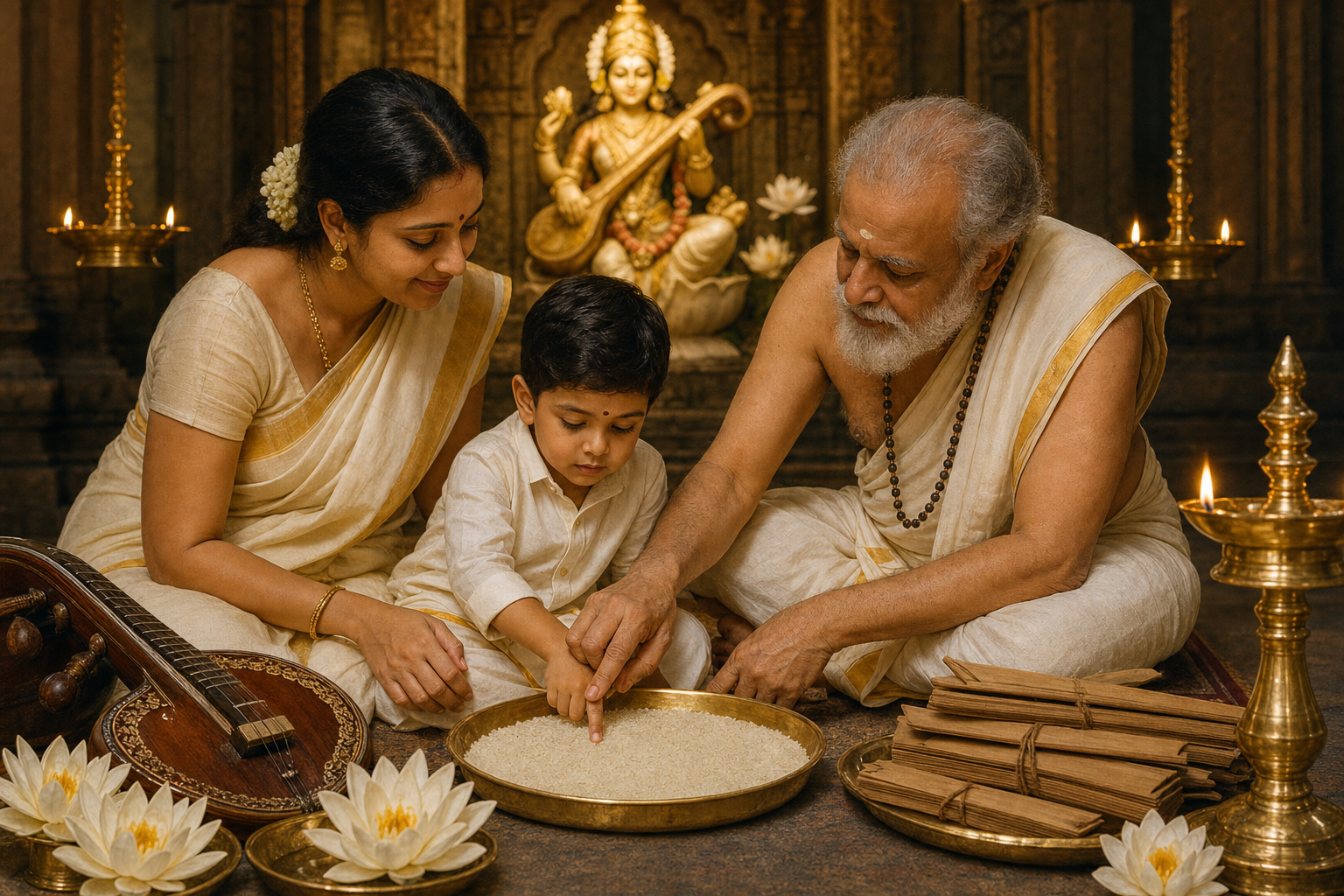
A child’s first written character can be treated as a small academic exercise or as the beginning of a lifelong responsibility. Aksharabhyasam, also known as Vidyarambham, chooses the latter view: entry into literacy is placed under the blessing of Saraswathi and within a relationship among child, family, teacher, language, and sacred tradition.
The account of the ceremony at Koothanur Maha Saraswathi Temple brings these dimensions together. Read closely, the rite is not simply about making an auspicious start at school. It presents learning as guided practice, joins intellectual growth to ethical formation, and gives families a vocabulary for hope without separating grace from sustained effort.
More than a milestone on the way to school
The terms used for the ceremony disclose its larger purpose. The source explains Vidyarambham through vidya, knowledge, and arambham, beginning. It describes Aksharabhyasam as initiation into the disciplined practice of akshara, the letter or syllable. Both names direct attention to a beginning, but neither reduces that beginning to school enrollment or the mechanical recognition of an alphabet.
In the educational vision presented by the source, letters participate in a wider world of sound, speech, script, memory, recitation, grammar, and meaning. The first written mark therefore opens several paths at once. It introduces the child to literacy, but it also suggests that speech should be refined, memory cultivated, and knowledge received with humility.
This helps explain why Saraswathi is central to the rite. The supplied account associates the goddess not only with school learning but also with eloquence, music, poetry, grammar, reasoning, creativity, and clarity in higher inquiry. Her presence broadens the family’s aspiration: the child is not merely expected to collect information, but to develop the capacities needed to understand, express, create, and act responsibly.
Seen in this light, Aksharabhyasam belongs to the logic of a samskara, a rite marking a meaningful transition. The source interprets it as passage from early childhood toward disciplined learning. Its lasting relevance lies in the question it places before education: what kind of person should knowledge help to form?
The guided hand expresses a philosophy of education
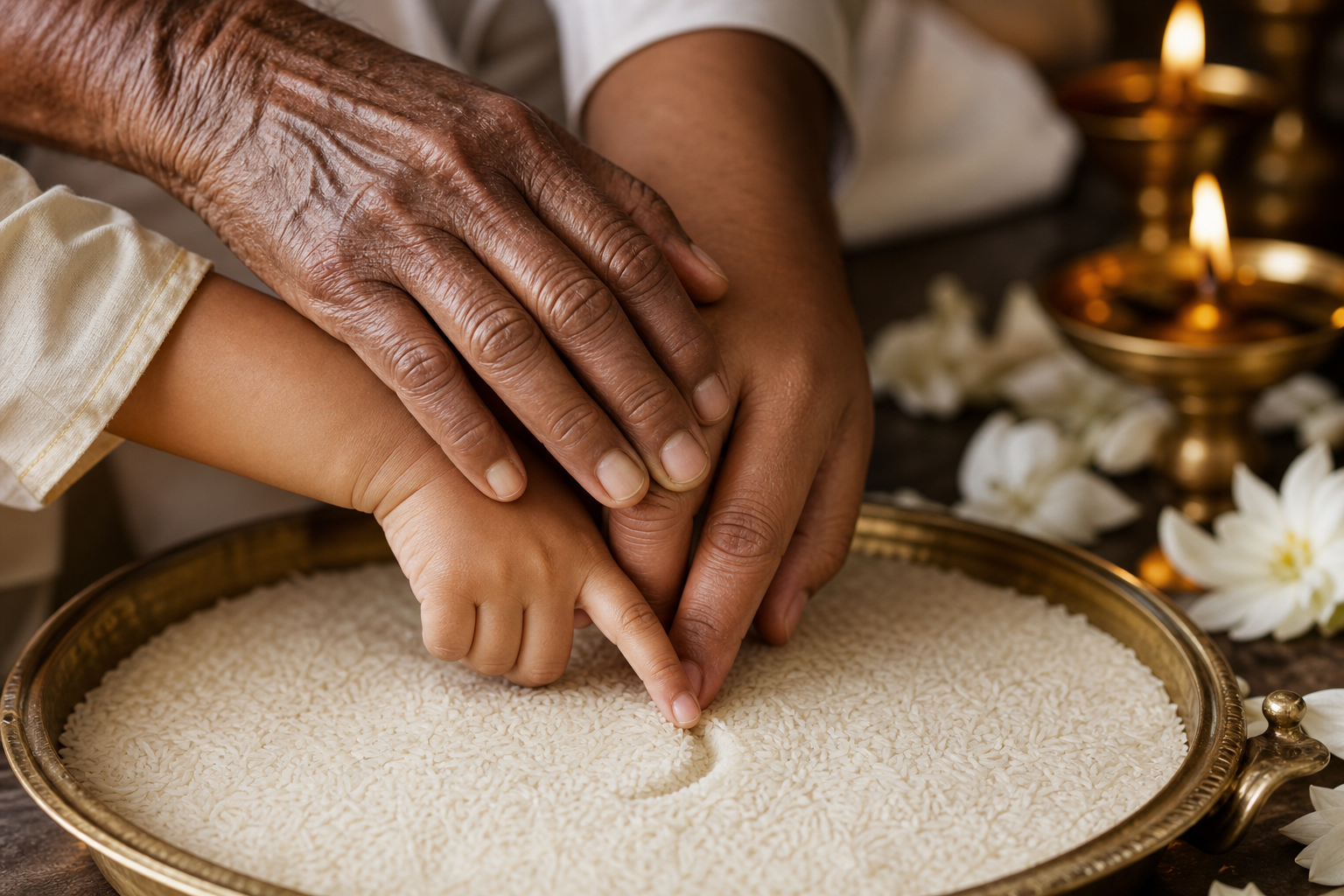
The ceremony’s most memorable action is also its most instructive. According to the Koothanur account, rice or wheat may be spread on a plate or banana leaf, and a parent, teacher, priest, or respected elder gently guides the child’s finger through sacred syllables, a mantra, or the first letters of the mother tongue. In some South Indian practices described by the source, the Panchaksharam or Ashtaksharam may come before the alphabet.
Every element changes the meaning of the act. The child does not write alone, so learning begins as a relationship rather than an isolated performance. The guiding hand acknowledges dependence without denying the child’s agency: assistance enables the first mark, while later mastery will require repeated effort. The spoken sound, traced form, and attentive movement also join hearing, memory, language, and action in one experience.
The grain beneath the finger carries another layer of meaning. The source connects it with nourishment, fertility, continuity, abundance, agriculture, and family prosperity. Writing on grain therefore places intellectual development within the conditions that sustain life. Knowledge is not imagined as detached from household, food, work, or community; it is one form of cultivation among others.
The ritual setting also turns an educational threshold into a shared memory. The source notes that families may remember the child’s hesitation, the chanting, the sensation of rice, and the seriousness of the occasion. Such details matter because affection and reverence can give learning an emotional foundation before a child can explain its philosophy. Books, letters, and teachers enter memory as worthy of care.
This does not mean that the ceremony substitutes for instruction. Its own structure points in the opposite direction. A teacher or elder demonstrates; the child attends and imitates; practice follows initiation. Blessing establishes an orientation toward learning, while education still unfolds through patience, repetition, correction, and disciplined use of what is learned.
Koothanur joins temple, language, and literary memory

Place gives the Koothanur ceremony a distinctive resonance. The source locates Koothanur Maha Saraswathi Temple in Tamil Nadu’s Tiruvarur district and describes temples with Saraswathi as principal deity as comparatively rare. It further reports that Koothanur is widely regarded as Tamil Nadu’s only individual temple in which Saraswathi is the main deity. That reported status helps explain its importance to families, students, teachers, artists, and other seekers of learning.
The temple is presented as a living educational shrine rather than merely a monument to the past. The source says that families bring children for Aksharabhyasam, while students seek blessings around examinations, admissions, and major academic transitions. Devotees pray for concentration, memory, confidence, clarity, and relief from confusion. In this context, the temple gives public and devotional form to concerns that often remain private within a household.
The regional character of the practice is equally significant. The account notes that prayers at the temple are commonly rendered in Tamil and that children often trace letters from their native language. Sanskritic names, mantras, and sacred concepts consequently coexist with Tamil speech and script. The ceremony does not require devotion to become linguistically uniform; it makes the language closest to the child part of the sacred beginning.
Koothanur’s literary associations deepen that connection. The source links the place with the Tamil poet Ottakoothar and reports a local explanation that joins Koothan, the poet’s name, with oor, village. It also records a tradition involving King Rajaraja Chola II and the honoring of the poet. These are presented as strands of local tradition rather than independently established conclusions, but they show how the community remembers the site through poetry, patronage, language, and devotion.
That memory expands the meaning of initiation. The alphabet is the child’s starting point, not the boundary of learning. The same sacred regard can extend from a first letter to a poem, from elementary recitation to musical discipline, and from basic literacy to sustained inquiry. Koothanur thus represents a continuum between learning to make a mark and learning to use language with precision and beauty.
Vijayadashami turns beginning into renewal

Aksharabhyasam is often associated with Vijayadashami, the concluding day of Navaratri. The source situates the rite within South Indian observances that include Saraswathi Puja and Ayudha Puja. Books, musical instruments, tools, and implements are placed for worship and then taken up again on Vijayadashami with renewed commitment.
This sequence offers an important counterpoint to the language of initiation. Vijayadashami is not meaningful only for a child encountering letters for the first time. It also invites students, musicians, craftspeople, and other practitioners to pause, acknowledge the means of their work, and resume it attentively. Beginning and renewal become complementary: one establishes a path, while the other restores purpose along it.
The treatment of books and tools also prevents an artificial division between intellectual and practical competence. The source’s description places written study, artistic practice, and skilled work within the same atmosphere of gratitude. Saraswathi’s domain can therefore be understood broadly, encompassing clarity of thought and expression while remaining connected to the disciplines through which knowledge becomes effective.
For families facing the anxieties of admission, examinations, or a new educational stage, the ritual can provide an ordered response. The supplied account characterizes temple visits not simply as superstition but as expressions of gratitude and aspiration. Without making claims about academic outcomes, it is reasonable to see how a shared ceremony can give emotional structure to uncertainty: concern is expressed, elders offer support, effort is reaffirmed, and the learner is reminded that the journey is not solitary.
Key takeaways
- Initiation establishes an ethic: Aksharabhyasam frames literacy as the beginning of disciplined, responsible learning rather than a one-time auspicious act.
- Guidance is part of the symbolism: The elder guiding the child’s hand shows that knowledge is transmitted through relationship, demonstration, and trust.
- The materials connect mind and life: Letters traced in grain link intellectual cultivation with nourishment, household continuity, and abundance.
- Mother tongue and sacred tradition can coexist: The use of Tamil or another native alphabet allows the child’s immediate linguistic world to participate in the rite.
- Vijayadashami speaks to lifelong learners: Taking up books, instruments, and tools again turns the festival into an occasion for recommitment as well as first beginnings.
The enduring promise of Saraswathi initiation lies beyond the first character traced. Its future is carried in every occasion when a learner meets knowledge with attention, a teacher guides without possessing, and a family treats education as both opportunity and obligation. Preserved in that spirit, the ceremony can remain meaningful through every new alphabet, medium, and field of study.