
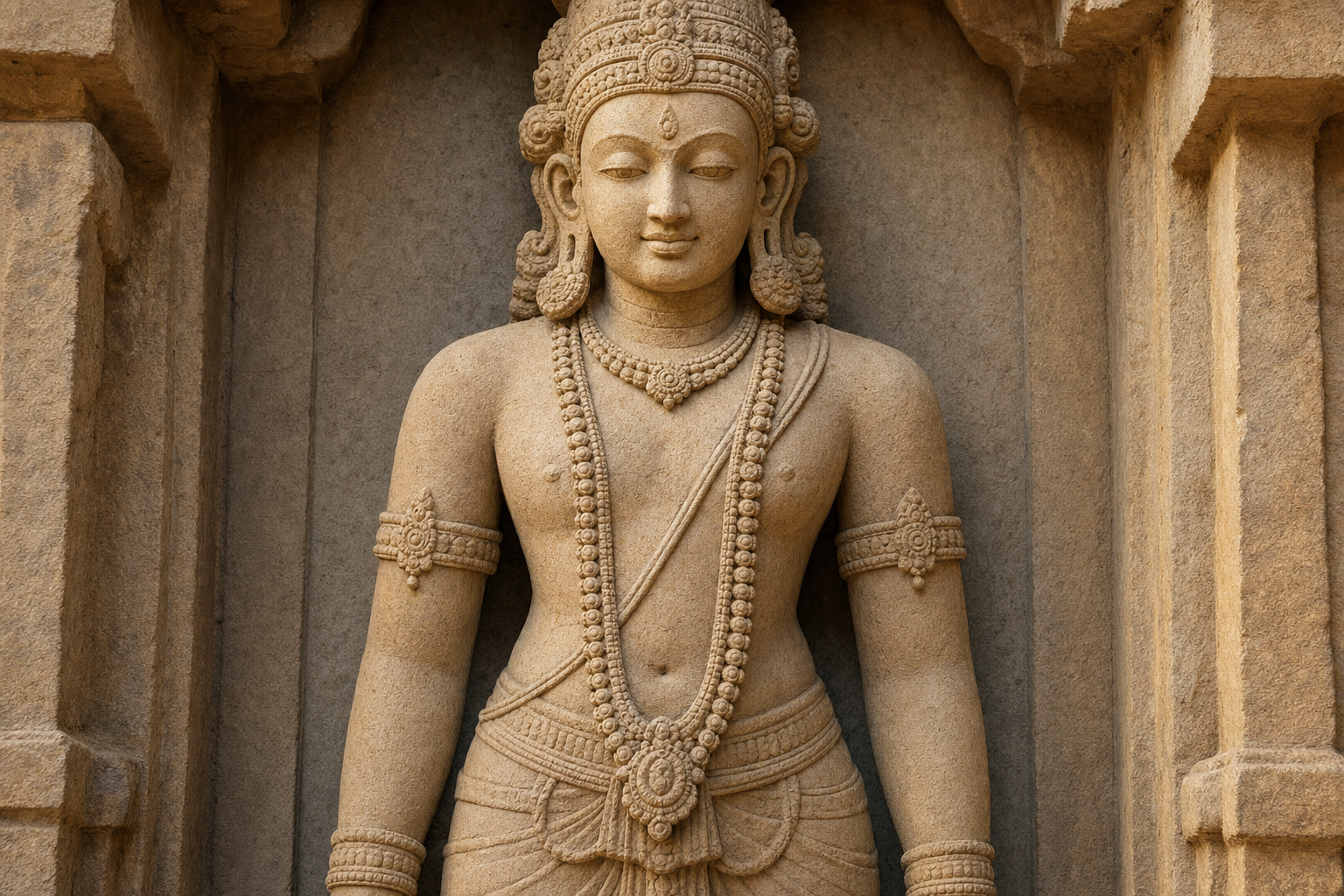
On a sculpted Hindu figure, a necklace can organize the entire torso. The hāra draws attention from the face toward the chest, establishes rhythm among other ornaments, and helps communicate the figure’s ceremonial or divine presence.
Reading it well requires more than noticing jewellery. Form, length, placement, neighboring ornaments, and the identity of the figure must be considered together. This approach also guards against assigning a technical name or spiritual meaning on the basis of one visual feature alone.
What the term hāra identifies
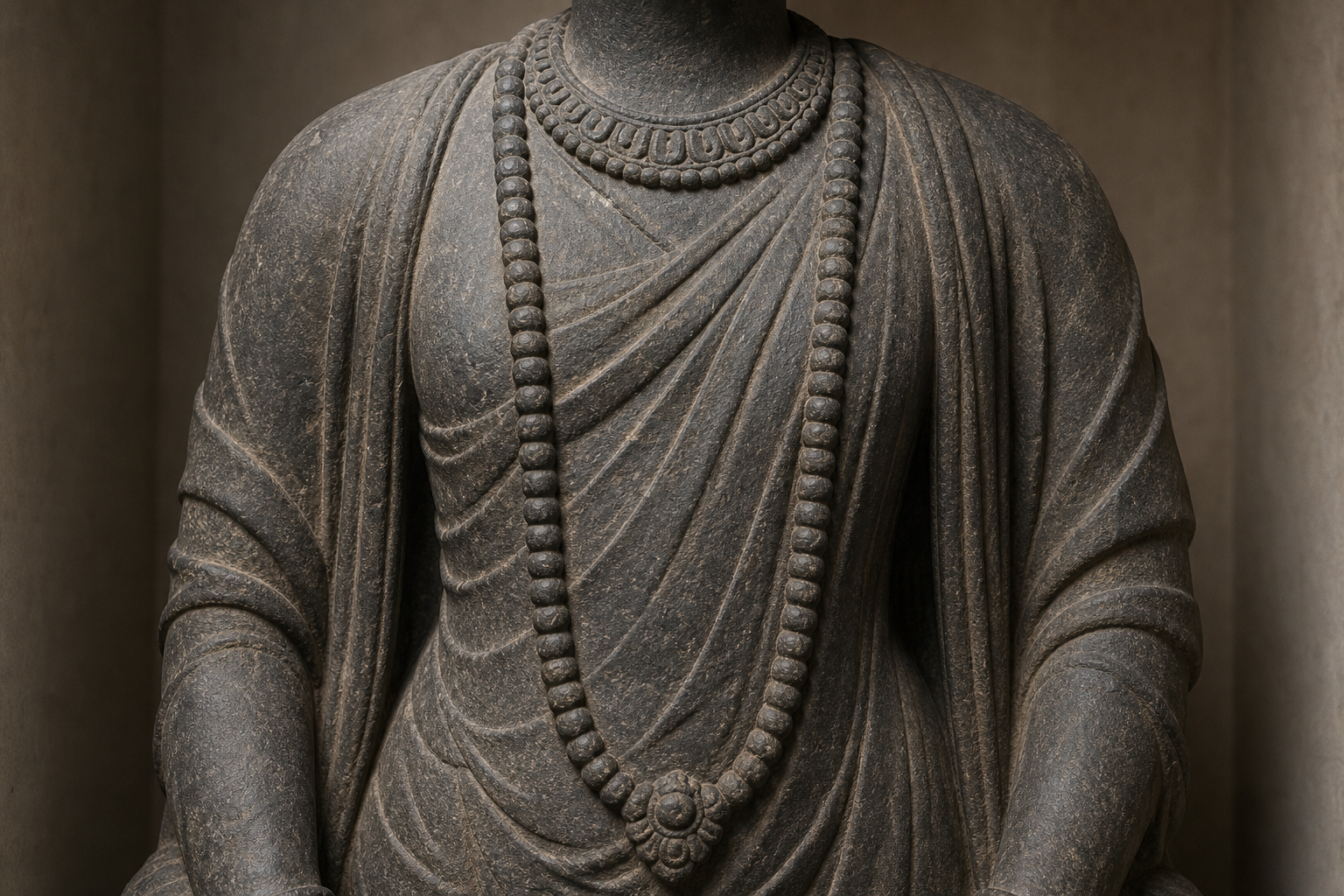
In its broad Sanskrit usage, hāra can mean a necklace or garland. As a practical category in Hindu iconography, it commonly describes an ornament that leaves the immediate neck area and descends across the chest. It may end high on the sternum or continue farther down the torso. Its construction can include a substantial single strand, several graduated strings, linked plaques, beads, gems, or a central pendant.
The DharmaRenaissance account emphasizes that hāra is a family of forms rather than one fixed design. A sculptor might render it as a shallow arc, a deep U-shaped loop, a pendant-bearing chain, a tiered arrangement, or a broad field of ornamental units. Length matters, but it cannot identify the ornament by itself.
Terminology should remain flexible because texts, regional traditions, historical workshops, museum catalogues, and modern scholarship do not always classify jewellery in the same way. A careful description such as “three-strand necklace descending to the middle chest” can therefore be more reliable than an uncertain technical label.
Transliteration also prevents a basic ambiguity. Hāra, with a long first vowel, denotes the necklace or garland under discussion. Hara is a name of Shiva. The phrase “Shiva’s hāra” consequently refers to a necklace worn by Shiva, not to an ornament whose name derives from Hara.
The necklace as an organizing line
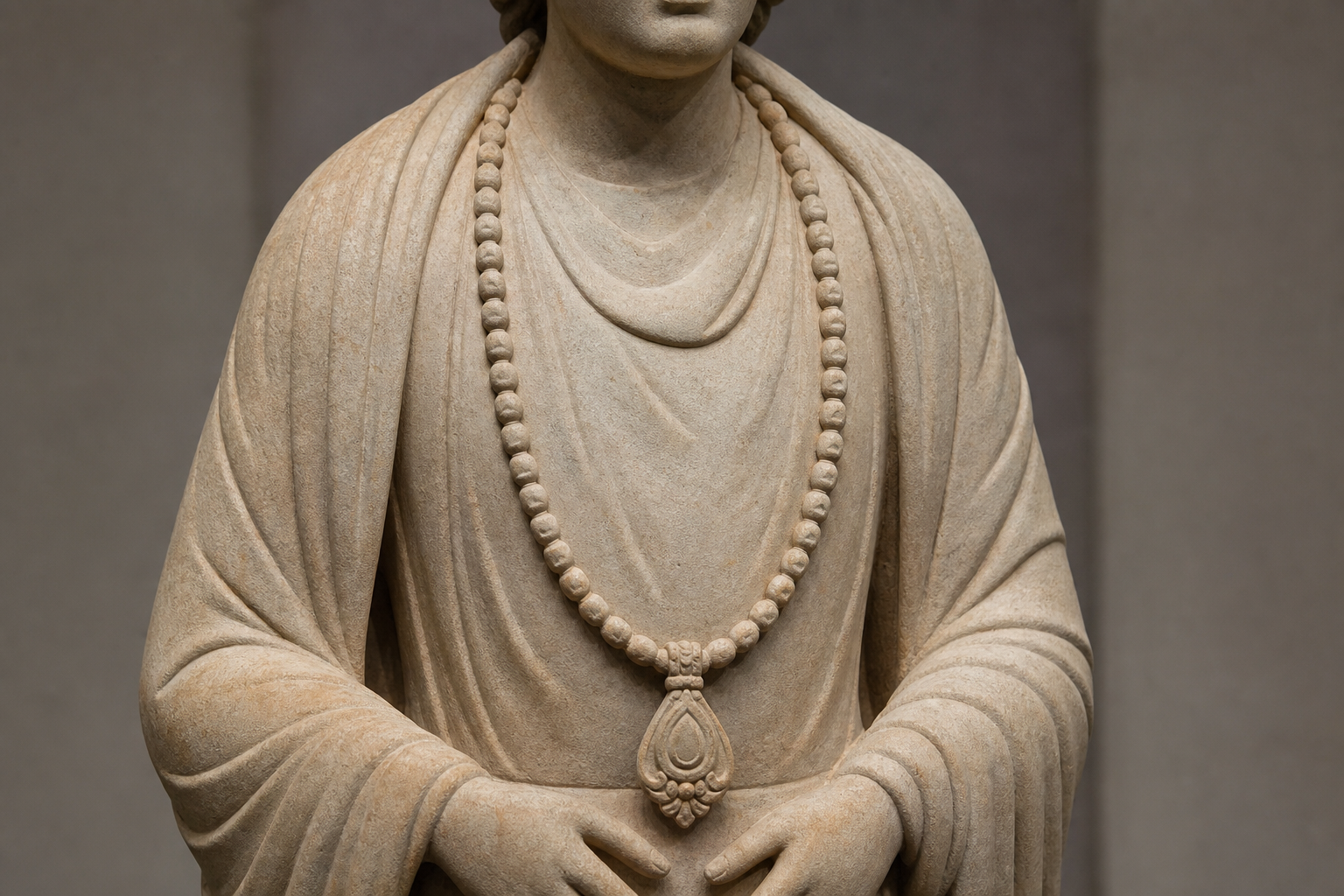
Hindu sculpture coordinates ornaments, clothing, bodily posture, gestures, and attributes as parts of one composition. The hāra connects the neck to the torso and often establishes a central downward axis. Its curve can repeat the sweep of the shoulders, frame the chest, counterbalance raised arms, or lend stability to an animated pose. Even a delicately carved strand may therefore have a large compositional effect.
The chest is rarely an isolated field. A hāra may appear with a short necklace, sacred thread, cross-belt, garland, divine jewel, chest mark, or additional strings of beads. These layers create depth and hierarchy: a close ornament anchors the throat, while a longer one opens the visual field below it. Apparent ornamental abundance can thus be structurally deliberate rather than repetitive.
Placement near the chest may invite devotional reflection on inwardness, protection, generosity, or the spiritual heart. It does not, however, establish a universal association with the anāhata chakra. Such an interpretation requires support from the particular devotional, textual, or yogic context; location alone is insufficient evidence.
Distinguishing related ornaments
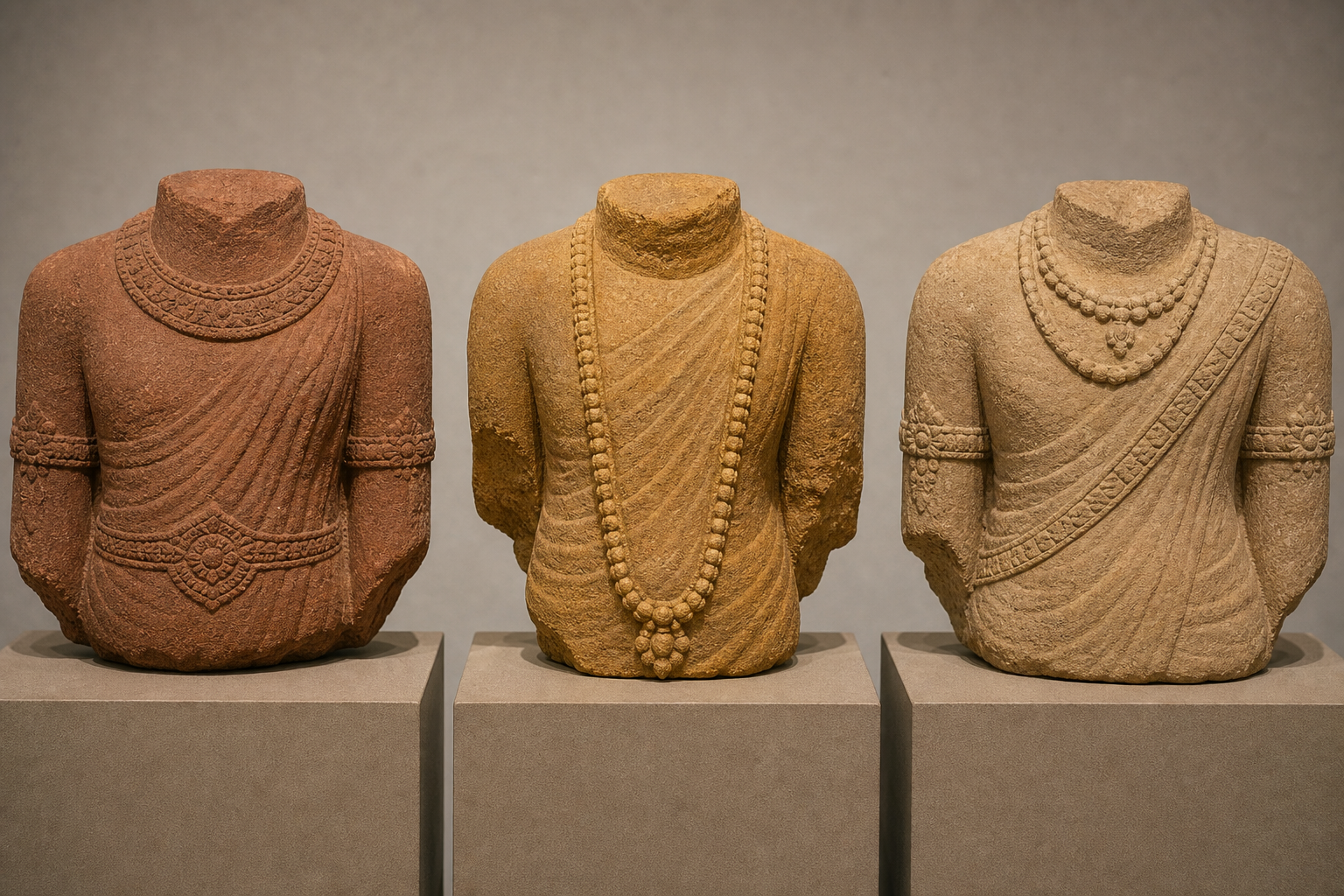
The most useful distinctions combine geometry with construction. Strand count, direction across the torso, ornamental vocabulary, and relationship to other features are generally more informative than overall length alone.
| Ornament or feature | Primary visual clue | Important caution |
|---|---|---|
| Hāra | Falls from the neck across the chest; may have one or several strands, plaques, beads, or a pendant | No single depth, silhouette, or construction defines every example |
| Kaṇṭhī | Sits comparatively close to the throat or collar line | It can coexist with a longer hāra, so the two layers should not be treated as duplicates |
| Ekāvalī | Defined principally by its single-strand construction | A single strand need not always be short; construction and length should be recorded separately |
| Vanamālā | Usually suggests flowers, leaves, or other vegetal units and may descend well below the chest | Weathering or stylization can make floral forms resemble jewellery beads |
| Kaustubha and Śrīvatsa | Kaustubha is a particular jewel associated with Vishnu; Śrīvatsa is a chest mark | A hāra may frame either feature, but a central pendant alone does not prove that it is Kaustubha |
| Yajñopavīta and channavīra | Travel diagonally across the torso rather than hanging as a symmetrical neck loop | They may intersect a hāra, making direction and points of overlap diagnostically useful |
Graiveyaka is especially resistant to a rigid visual definition. The source notes that some classifications use the term for a broad upper-chest necklace, while others apply it to an ornament close to the neck. When the evidence does not settle the terminology, describing the visible form preserves more information than forcing a disputed label.
Key takeaways for reading a sculpture
- Begin with geometry: determine whether the ornament encircles the throat, hangs symmetrically over the chest, or crosses the torso diagonally.
- Record length and construction independently; a single strand is not necessarily short, and a long necklace is not necessarily multistranded.
- Examine the units closely: beads, plaques, gems, flowers, and leaves can indicate different ornamental categories.
- Use intersections with sacred threads, cross-belts, garlands, and shorter necklaces to reconstruct the layering.
- Consider the complete iconographic setting before identifying a pendant as a particular divine jewel.
- Preserve uncertainty when weathering, regional vocabulary, or inconsistent cataloguing prevents a secure name.
Toward more precise interpretation
A sound interpretation moves from observation to classification and only then to meaning. The first question is what the stone actually shows; the second is which ornamental category best explains it; the third is what that ornament contributes within the figure’s larger visual and sacred program. Reversing that sequence can turn a suggestive association into an unsupported identification.
This method makes the hāra valuable beyond the study of jewellery. It becomes evidence for how sculptors structured the body, separated ornamental layers, directed attention, and made sacred identity visible. Future cataloguing can strengthen such study by recording observable traits alongside technical names, allowing interpretations to be revised without losing the underlying visual evidence.