
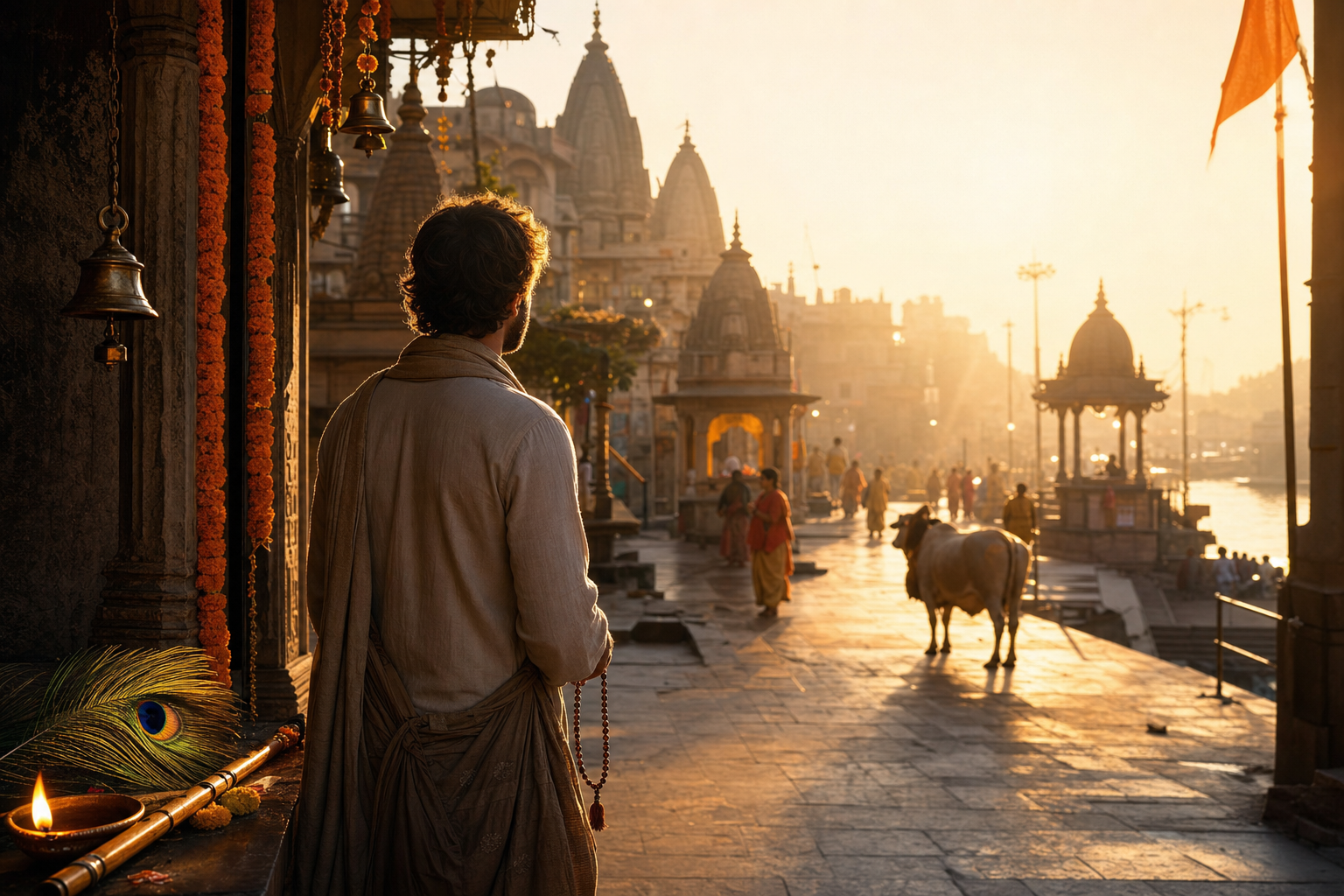
Reconnection – A change of heart story set in Vrindavan presents itself as more than a devotional film title. Even from the limited source material available, its central promise is clear: a human being enters the sacred atmosphere of Vrindavan and undergoes an inward shift. The phrase “change of heart” is important because it does not suggest mere travel, ritual performance, or external religiosity. It points toward transformation at the level of perception, emotion, memory, and moral orientation.
Vrindavan is not a neutral backdrop for such a story. In the Hindu spiritual imagination, Vrindavan is inseparable from Sri Krishna, bhakti, sacred geography, temple culture, kirtan, seva, and the living memory of divine play. A narrative set there naturally carries the weight of Hindu spirituality and Sanatana Dharma, but it can also speak to the broader dharmic idea that inner renewal is possible when the restless mind is brought into contact with truth, humility, compassion, and disciplined self-reflection.
The title “Reconnection” suggests that the protagonist is not discovering something entirely foreign. Rather, the story appears to concern a return: to faith, to conscience, to family, to community, to the sacred, or to a forgotten dimension of the self. In dharmic traditions, this distinction matters. Spiritual life is often described not as the importation of belief from outside, but as the removal of distance from what is already deepest within human life. The human being reconnects because the connection was obscured, not because it never existed.
An academic reading of such a film begins with its setting. Vrindavan functions as a sacred field where the outer world and inner world are made to confront each other. Its lanes, temples, ghats, devotional music, cows, pilgrims, sadhus, and everyday acts of worship form a social and symbolic environment. For a character carrying doubt, grief, alienation, ambition, pride, or emotional fatigue, this environment can become a mirror. It does not merely decorate the story; it structures the character’s transformation.
The emotional force of a change-of-heart narrative lies in its realism. People rarely transform because of a single argument. More often, they change through repeated encounters: a moment of kindness, an unexpected silence, a remembered teaching, a song heard at the right time, a glimpse of suffering, or the dignity of someone living simply and sincerely. A film set in Vrindavan has a natural vocabulary for these experiences because bhakti is not only philosophical; it is embodied through sound, food, service, pilgrimage, darshan, and shared devotional memory.
In this sense, the story belongs to a long Indian tradition in which place becomes pedagogy. Sacred places do not teach through lectures alone. They teach through rhythm. The day begins with bells, lamps, chanting, and movement. The individual is drawn out of private isolation into a shared order of meaning. Vrindavan, especially in Krishna bhakti, emphasizes love, surrender, humility, and the sweetness of divine relationship. These themes are especially suited to a film about emotional and spiritual reconnection.
The phrase “change of heart” also deserves careful attention. In many modern stories, transformation is treated as psychological self-improvement. In a dharmic frame, however, transformation is wider. It includes the refinement of intention, the softening of ego, the recognition of dharma, and the restoration of right relationship with others. A change of heart is not sentimental weakness. It is a reordering of the inner life so that action becomes less governed by self-centered desire and more guided by clarity, compassion, and responsibility.
Vrindavan’s connection with Lord Krishna makes this especially meaningful. Krishna’s presence in Hindu philosophy and devotional culture is not limited to one mood or one doctrine. He is the divine child, the friend, the beloved, the teacher of the Bhagavad Gita, the protector, the strategist, and the source of spiritual delight. A story set in Vrindavan can therefore hold tenderness and seriousness together. It can show devotion as joy while also treating spiritual awakening as a demanding ethical process.
The likely strength of a film such as Reconnection lies in its ability to make bhakti intelligible through lived experience. Devotion can be misunderstood when reduced to outward signs alone. A tilak, a mala, a temple visit, or a chant becomes meaningful only when connected to inner transformation. The best devotional storytelling does not merely show religious symbols; it reveals how those symbols reshape the human heart when approached with sincerity.
This is also where the film’s relevance extends beyond one individual plot. Many people in contemporary life experience disconnection: from family, from tradition, from community, from the natural world, from moral confidence, and from spiritual practice. Such disconnection may not always appear dramatic. It can look like numbness, cynicism, impatience, loneliness, or the inability to receive love. A Vrindavan-based story can make these wounds visible without turning them into abstract theory.
From the standpoint of cultural heritage, the film’s setting carries documentary value as well. Vrindavan is a living center of Hindu tradition, not a museum of the past. Its devotional culture continues through temple rituals, festivals, food offerings, pilgrimage circuits, music, storytelling, Sanskritic memory, Braj culture, and the daily participation of residents and visitors. A cinematic narrative placed there inevitably becomes part of a larger conversation about preserving sacred spaces while allowing them to speak to modern emotional realities.
At the same time, a responsible reading must avoid treating Vrindavan as a magical shortcut. The sacred does not cancel human agency. Dharmic traditions repeatedly emphasize effort, discipline, humility, and self-examination. The mind must be trained. Habits must be confronted. Relationships must be repaired through action, not merely through feeling. If the film succeeds, its change-of-heart arc would show that grace and effort are not enemies. Grace opens the door, but the individual must still walk through it.
This distinction is important for modern viewers. Spiritual cinema can become shallow if it suggests that a pilgrimage automatically solves every problem. A more mature approach shows pilgrimage as a beginning. The atmosphere of Vrindavan may awaken the protagonist, but the real measure of reconnection is what follows: whether speech becomes gentler, whether duties are accepted, whether relationships are healed, whether pride is reduced, and whether devotion becomes a steady way of life.
The theme also resonates across dharmic traditions. Hinduism, Buddhism, Jainism, and Sikhism differ in theology, practice, and philosophical vocabulary, yet they share a serious concern with inner discipline, ethical conduct, compassion, self-mastery, and liberation from ignorance or ego-driven suffering. A film about reconnection can therefore be read in a unifying dharmic spirit. Its Hindu setting remains specific and honored, while its moral insight remains accessible to a wider spiritual audience.
In Hindu terms, reconnection may be understood through bhakti and dharma. In Buddhist terms, it may recall mindfulness, compassion, and awakening from delusion. In Jain thought, it may suggest restraint, non-violence, and purification of intention. In Sikh tradition, it may evoke remembrance of the Divine, humility, seva, and truthful living. These parallels do not erase differences; they show that the dharmic traditions can be appreciated together as civilizational resources for ethical and spiritual renewal.
The emotional appeal of the story likely comes from its recognition that human beings do not always lose faith through hostility. Sometimes they drift away because of pain, neglect, confusion, social pressure, or disappointment. Reconnection, then, is not a triumphalist return but a tender recovery. It asks whether a person can become receptive again after becoming hardened. It asks whether sacred memory can survive beneath layers of modern distraction.
That question is especially relevant for younger generations negotiating identity in a fast-moving world. Indian cultural traditions are often inherited through family rituals, festivals, stories, temple visits, food practices, and language. Yet inheritance alone does not guarantee understanding. A film like Reconnection can help bridge that gap if it presents tradition not as a burden, but as a living source of meaning that can speak to loneliness, moral confusion, and the search for belonging.
The technical challenge for such a film is balance. If it becomes too didactic, the characters may feel secondary to the message. If it becomes too vague, the sacred setting may lose its depth. The strongest devotional narratives allow spiritual meaning to emerge through character, conflict, atmosphere, and consequence. Viewers should be able to feel why Vrindavan matters before they are told why it matters.
Sound is often central in a Vrindavan story. Kirtan, temple bells, street sounds, and devotional singing can carry narrative meaning without heavy exposition. In bhakti culture, sound is not merely aesthetic. Nama-sankirtana and sacred music are themselves practices of remembrance. When used thoughtfully, the soundtrack can mark the protagonist’s gradual movement from noise to listening, from restlessness to attention, and from isolation to participation.
Visual language is equally important. Vrindavan’s sacred geography offers powerful imagery: temple lamps, narrow lanes, dust, flowers, Yamuna-associated devotion, Govardhan memory, and the faces of pilgrims. Yet these images must be handled with respect. Their function should not be tourist spectacle alone. In a serious spiritual film, visual beauty becomes meaningful when it reflects the inner movement of the story.
The film’s title also implies restoration of relationship. Reconnection may refer to the Divine, but it may also refer to parents, children, friends, teachers, spouses, or community. Dharmic life rarely treats spirituality as purely private. The quality of one’s inner life is tested in conduct toward others. Forgiveness, gratitude, humility, and responsibility are not decorative virtues. They are the practical signs that a change of heart has become real.
For this reason, the narrative can be read as a study in moral repair. Modern life often encourages people to define freedom as detachment from obligation. Dharmic traditions offer a more nuanced view. Freedom is not irresponsibility. True freedom arises when attachment, ego, fear, and resentment no longer control action. A person who reconnects with dharma may become more capable of love precisely because the self is no longer the only center of concern.
There is also a social dimension. Vrindavan is sustained by communities of worship, service, teaching, pilgrimage, and everyday labor. Any story set there implicitly depends on these communities. The film can therefore remind viewers that spiritual heritage survives through collective care. Temples, traditions, scriptures, songs, and festivals continue because generations preserve them through practice. Reconnection is not only individual; it is civilizational.
This civilizational aspect is especially important in discussions of Hindu culture and Indian heritage. Sacred places such as Vrindavan are not only religious centers. They are repositories of language, music, architecture, cuisine, ecology, memory, and social practice. When cinema treats such spaces with seriousness, it contributes to cultural preservation by helping viewers see familiar traditions with renewed attention.
The story’s possible appeal also lies in its refusal to separate emotion from philosophy. Bhakti is often described through love, longing, surrender, and devotion, but these emotions are not anti-intellectual. They rest upon a sophisticated understanding of human limitation and divine relationship. The heart changes because it begins to know differently. It sees the self, others, and the sacred with a clarity that was previously blocked.
In that sense, Reconnection can be understood as a spiritual journey rather than merely a religious film. A religious film may display rituals. A spiritual journey shows why rituals matter, how they shape attention, and what happens when a person becomes inwardly available to meaning. The difference is crucial. Viewers are moved not by symbols alone, but by the human transformation those symbols help make possible.
The most persuasive change-of-heart stories avoid simplistic villains. Often the central conflict is not between good people and bad people, but between forgetfulness and remembrance, arrogance and humility, distraction and presence. This is consistent with many dharmic teachings, where the deepest struggle occurs within the mind. A person may appear successful outwardly while remaining inwardly estranged from peace.
Vrindavan’s devotional culture addresses this estrangement through relationship. The devotee does not approach the Divine as an abstraction alone. Krishna is remembered through stories, names, forms, relationships, songs, festivals, and loving service. This relational theology allows cinema to communicate spiritual ideas in concrete ways. The viewer does not need a philosophical lecture to understand the loneliness of separation or the relief of returning.
The film’s title therefore carries a quiet promise: that the heart can still turn. This promise is neither naive nor merely emotional. In dharmic thought, transformation is possible because human beings are not fixed in their present state. Through satsang, self-reflection, discipline, devotion, compassion, and grace, the direction of life can change. That idea remains powerful because it preserves hope without denying responsibility.
For readers and viewers interested in Hindu spirituality, the film is valuable as an invitation to think about what reconnection means in practical terms. It may mean returning to daily prayer. It may mean listening to elders with more patience. It may mean learning the stories behind festivals. It may mean serving without seeking recognition. It may mean recognizing that sacred geography is not distant from ordinary ethics.
For those interested in Indian cinema, the film points to the continuing importance of regional, devotional, and culturally rooted storytelling. Not every meaningful film depends on spectacle or commercial scale. Some stories matter because they take a familiar human crisis and place it within a civilizational frame. A personal wound becomes legible through dharma. A private transformation becomes connected to a living tradition.
Ultimately, Reconnection – A change of heart story set in Vrindavan should be approached as a meditation on return. Its significance lies in the way it brings together place, memory, devotion, and ethical renewal. Vrindavan is not simply where the story happens; it is the spiritual grammar through which the story can be understood. The change of heart is meaningful because it suggests that even in an age of distraction, the path back to humility, love, and dharma remains open.
The enduring lesson is simple but demanding: reconnection is not nostalgia. It is not merely remembering a sacred place or admiring devotional culture from a distance. It is the difficult, graceful work of allowing sacred memory to reshape conduct. When that happens, Vrindavan becomes more than a location on a map. It becomes a reminder that the heart, however far it has wandered, can still find its way back.
Inspired by this post on Dandavats.
