
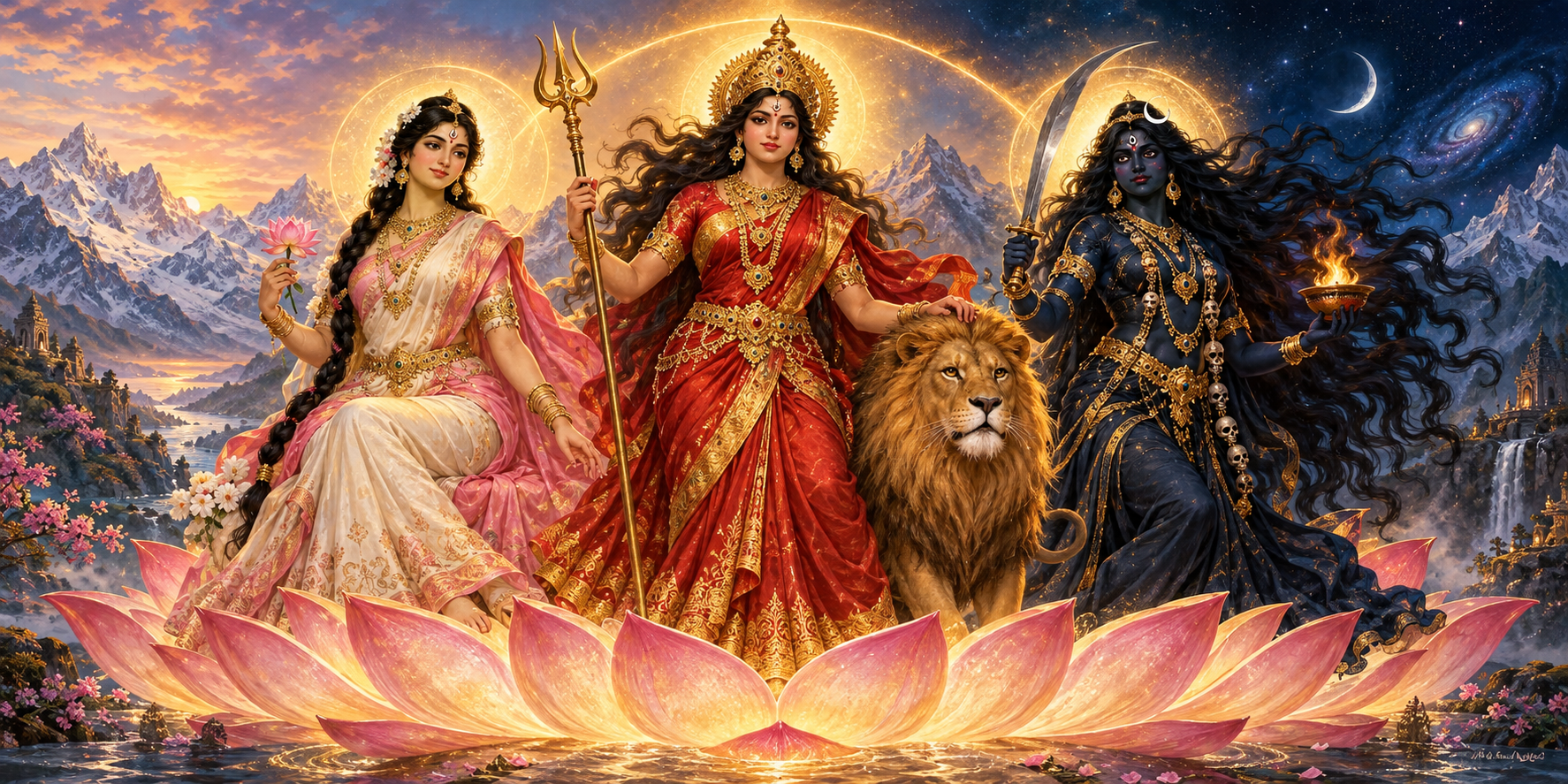
You are looking at an image of Devi. The weapons and ornaments are easy to notice, but her hair may tell you how the whole image is meant to be approached: as power gathered into form, power moving against disorder, or power released beyond ordinary boundaries.
Hair is not a name tag, and one feature should never decide an identification by itself. Yet if you read it together with the face, posture, crown, hands, setting, and direction of movement, it becomes one of the clearest clues in the visual language of Shakti.
Begin with three questions, not three labels
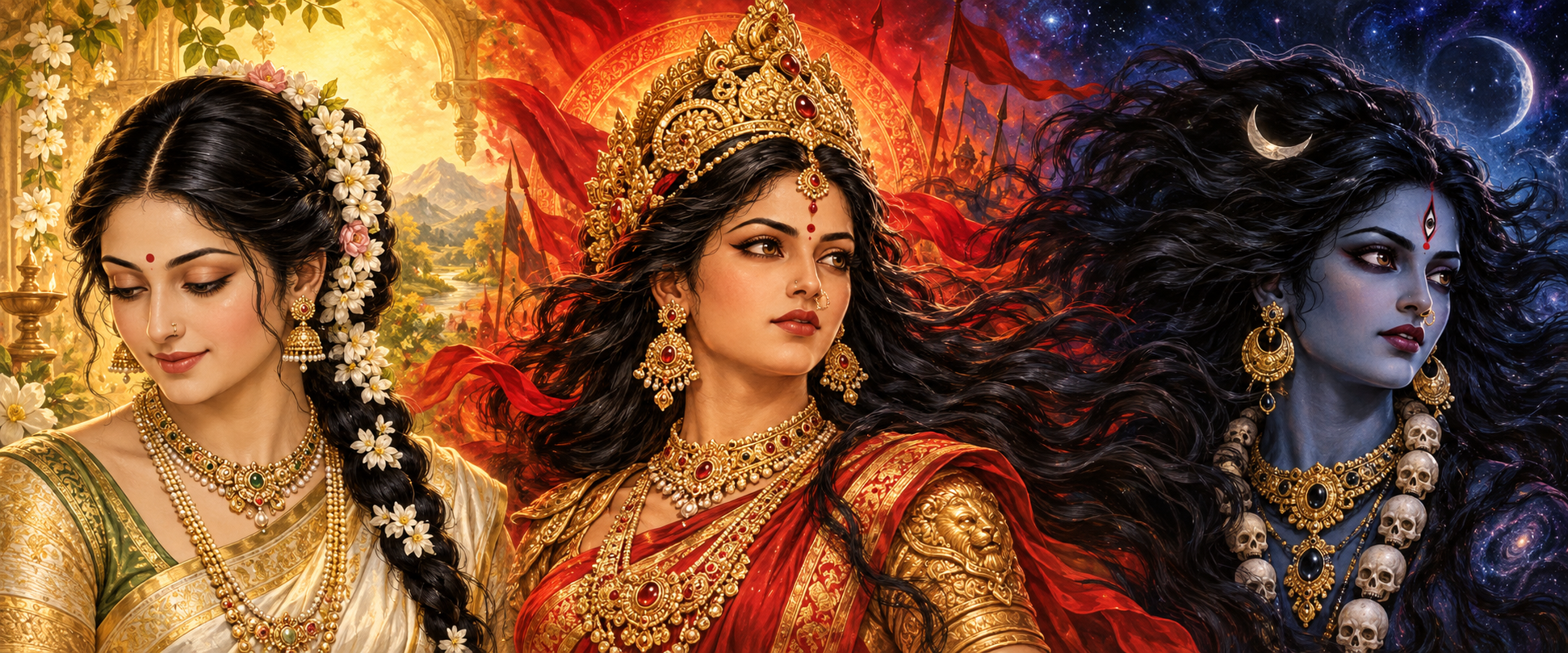
First ask whether the hair is gathered, streaming, or radically unbound. These are visual conditions, not merely hairstyles. Gathered hair concentrates many strands into an ordered form. Streaming hair preserves direction while making movement visible. Unbound hair spreads beyond the outline that would ordinarily contain it.
Next ask what the rest of the body is doing. Is the face serene while the hair remains carefully arranged? Do the garments, weapons, mount, and locks all move in one direction? Does the hair seem to overflow the composition itself? The same loose lock can signify purposeful momentum in one image and the transcendence of restraint in another.
Finally, ask what kind of world surrounds Devi. A familial, royal, martial, ascetic, or liminal setting changes the force of the cue. Hindu iconography treats hair as meaningful alongside ornaments, weapons, and posture, but meaning arises through their relationship. No isolated detail functions like a dictionary entry.
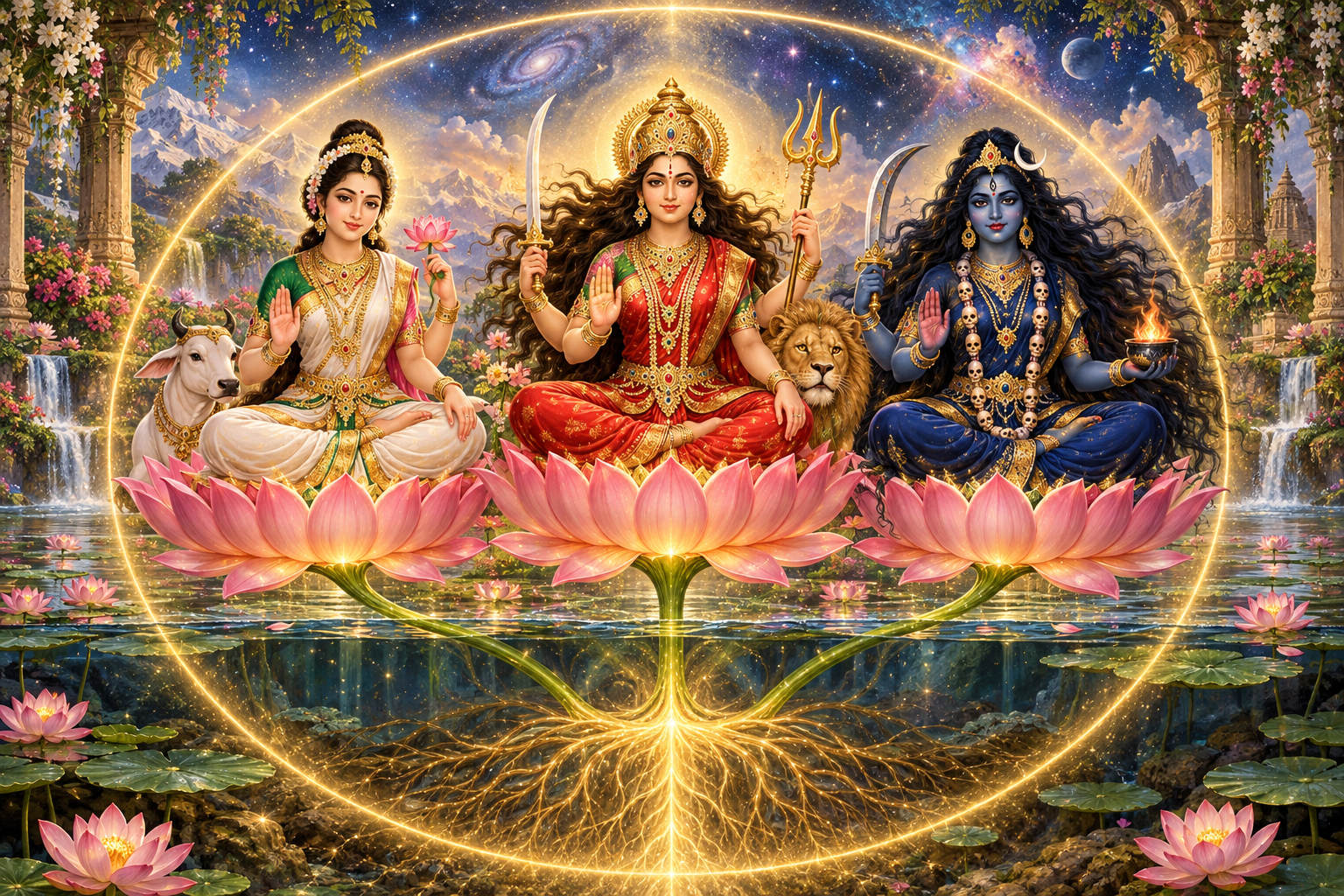
This method also prevents a common error: arranging Parvati, Durga, and Kali on a ladder from respectable to disorderly. They are not three grades of womanhood or three stages in a loss of composure. They present distinct operations of Shakti. The question is not which form is more controlled, civilized, or divine. It is what the one divine power is doing in each form.
Parvati: gathered hair, gathered presence
When Parvati’s hair is dressed, bound, braided, or arranged beneath ornament, the visual emphasis falls on integration. Separate strands have been brought into deliberate relation without losing their vitality. Her power is present, but it does not need to burst through the form that carries it.
This is why composed hair can work so naturally with Parvati’s auspicious, relational presence. She may appear beside Shiva or within a familial setting, but it would be a mistake to translate the arrangement as submission. Bound hair does not mean bound Shakti. It can signify power capable of inhabiting relationship, discipline, beauty, and social form without being diminished by them.
Look for reinforcement in the rest of the image. A balanced silhouette, composed expression, ordered ornaments, and stable posture strengthen this reading. If the hair is elaborate, notice whether its complexity has been resolved into symmetry. The important cue is not simplicity. It is collectedness.
If you are trying to identify an unfamiliar figure, treat gathered hair as supporting evidence rather than proof. Ask whether the surrounding image also presents Shakti as settled, relational, or contemplative. When those features agree, a Parvati-oriented reading becomes stronger. When they do not, keep looking: many divine and royal figures wear carefully arranged hair.
The spiritual insight is equally practical. Parvati’s arrangement challenges the assumption that freedom must always look like refusal. There is a form of freedom that gathers itself, accepts a chosen discipline, and remains fully powerful within commitment. The icon asks you to distinguish self-possession from suppression.
Durga: movement held inside sovereign control
Durga introduces motion. Her hair may be arranged beneath a crown, partly loosened, or shown streaming with the energy of the encounter. Iconographic traditions and individual compositions vary, so the crucial feature is not whether every lock is technically tied. It is whether movement remains directed.
Trace the lines through the image. Hair, garments, weapons, limbs, and mount may all contribute to a shared momentum. Even when the composition is crowded, Durga’s force is coordinated. Her many instruments do not scatter her intention; they express its reach. Flowing hair therefore need not mean that control has been lost. It can make controlled force visible.
The crown is especially useful when reading this balance. It can hold the upper silhouette in sovereign order while locks or strands carry movement outward. The resulting image contains two truths at once: Durga is fully engaged in conflict, and she remains the ruler of her own energy.
Compare this with Parvati without turning the comparison into opposition. Parvati’s arranged hair often keeps power visibly gathered. Durga’s moving hair lets that power travel through action. The Shakti has not changed into a less disciplined force; its work has changed. It now meets disorder directly.
When distinguishing Durga from a more radically fierce form, inspect the whole composition for command. Do the weapons act as a coordinated array? Does the face retain focus? Does the motion have a target? If the answer is yes, streaming hair is best read as purposeful momentum. The image shows power entering danger without surrendering its centre.
Kali: unbound hair beyond social containment
With Kali, looseness becomes more radical. Her hair can fall freely, spread across the field, or resist the neat outline expected of an ornamented body. What Durga directs through a sovereign composition, Kali may reveal as a force that no conventional frame can finally contain.
This should not be reduced to rage, neglect, or madness. Those readings import everyday judgements about women’s appearance into an image designed to unsettle such judgements. Kali’s unbound hair does not announce a personal failure to remain respectable. It helps place her beyond the social terms by which respectability is granted or withheld.
Read the cue with Kali’s fierce or liminal setting, bodily stance, expression, and other signs of dissolution. Her hair extends the theological claim made by the whole form: reality includes powers that exceed domestic order, political order, and even the observer’s desire for reassuring boundaries. Kali does not become less divine as the familiar frame falls away. The falling away is part of what her divinity reveals.
Unbound hair can therefore signify freedom from containment, but even that phrase needs care. Kali is not simply a modern emblem of doing whatever one wants. Her freedom is more demanding. It confronts attachment to the identities, appearances, and structures we treat as permanent. The icon turns the viewer’s discomfort into a question: what are you trying to keep neatly enclosed because you fear what its dissolution would disclose?
When you encounter a fierce Devi image, do not identify Kali from loose hair alone. Determine whether the entire visual world has crossed from directed struggle into radical liminality. Durga confronts a threat while retaining the grammar of sovereign action. Kali presses beyond that grammar, toward the point where ordinary distinctions can no longer secure the viewer.
Key takeaways for your next darshan
- Classify the hair before naming the figure: gathered, directionally streaming, or radically unbound.
- Read Parvati’s composed hair as gathered and integrated power, not as evidence of weakness or confinement.
- Read Durga’s moving hair with her crown, weapons, posture, and mount. Coordinated movement indicates force under sovereign direction.
- Read Kali’s unbound hair as part of an image that exceeds conventional containment, not as a stereotype of an irrational or disordered woman.
- Confirm every reading through the face, body, ornaments, setting, and overall movement. Hair supports an identification; it does not establish one alone.
- Never turn the three forms into a moral ranking. Bound, streaming, and unbound hair disclose different modes of Shakti rather than higher and lower kinds of femininity.
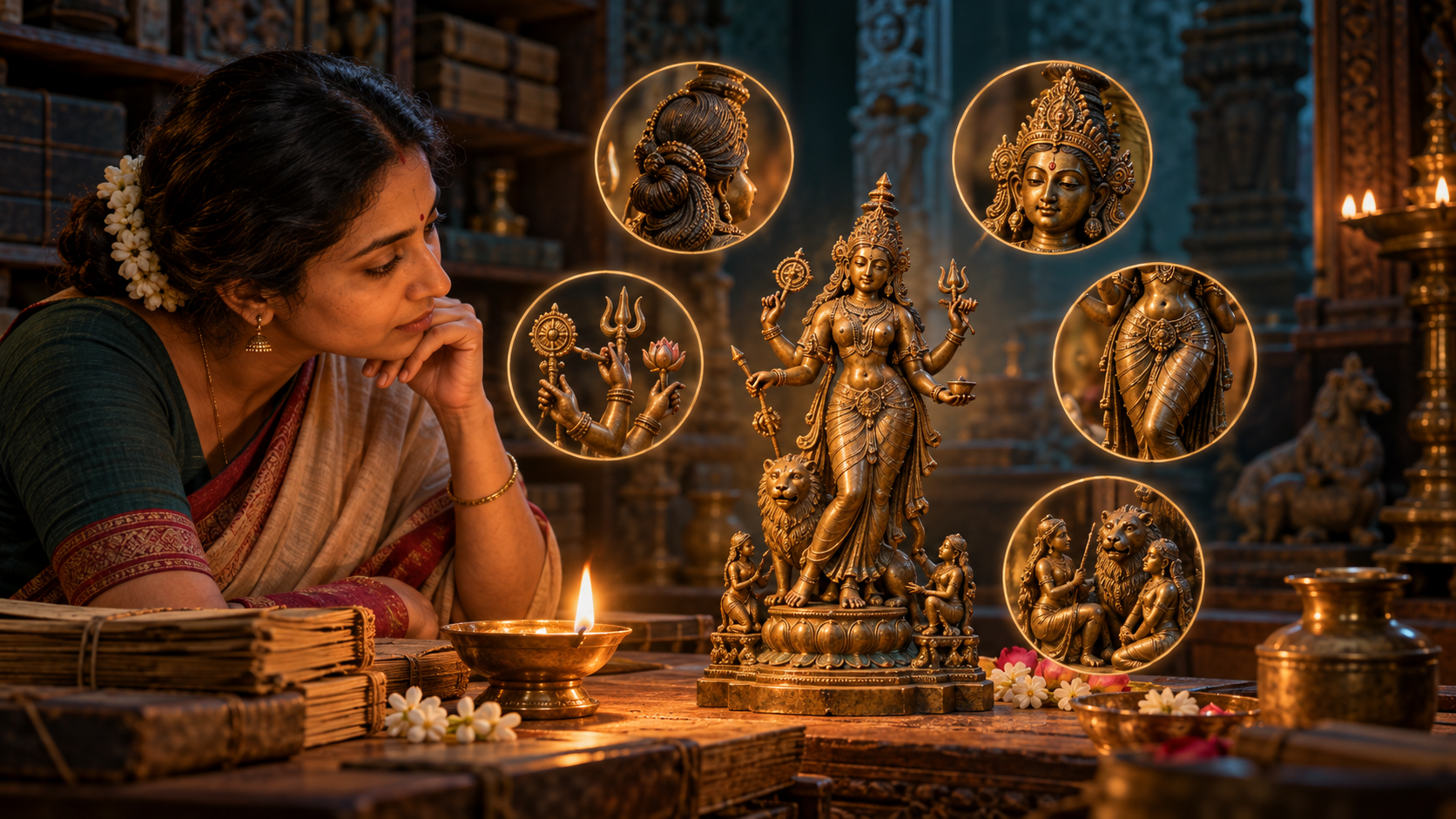
At your next temple, shrine, or museum visit, pause before reading the label. Follow the hair from crown to ends and choose the verb that best describes it: gathers, advances, or overflows. Then test that verb against the rest of the image. You will not have reduced darshan to a code; you will have learned to look long enough for the form of Devi to disclose its own coherence.
References

Leave a Reply
You must be logged in to post a comment.