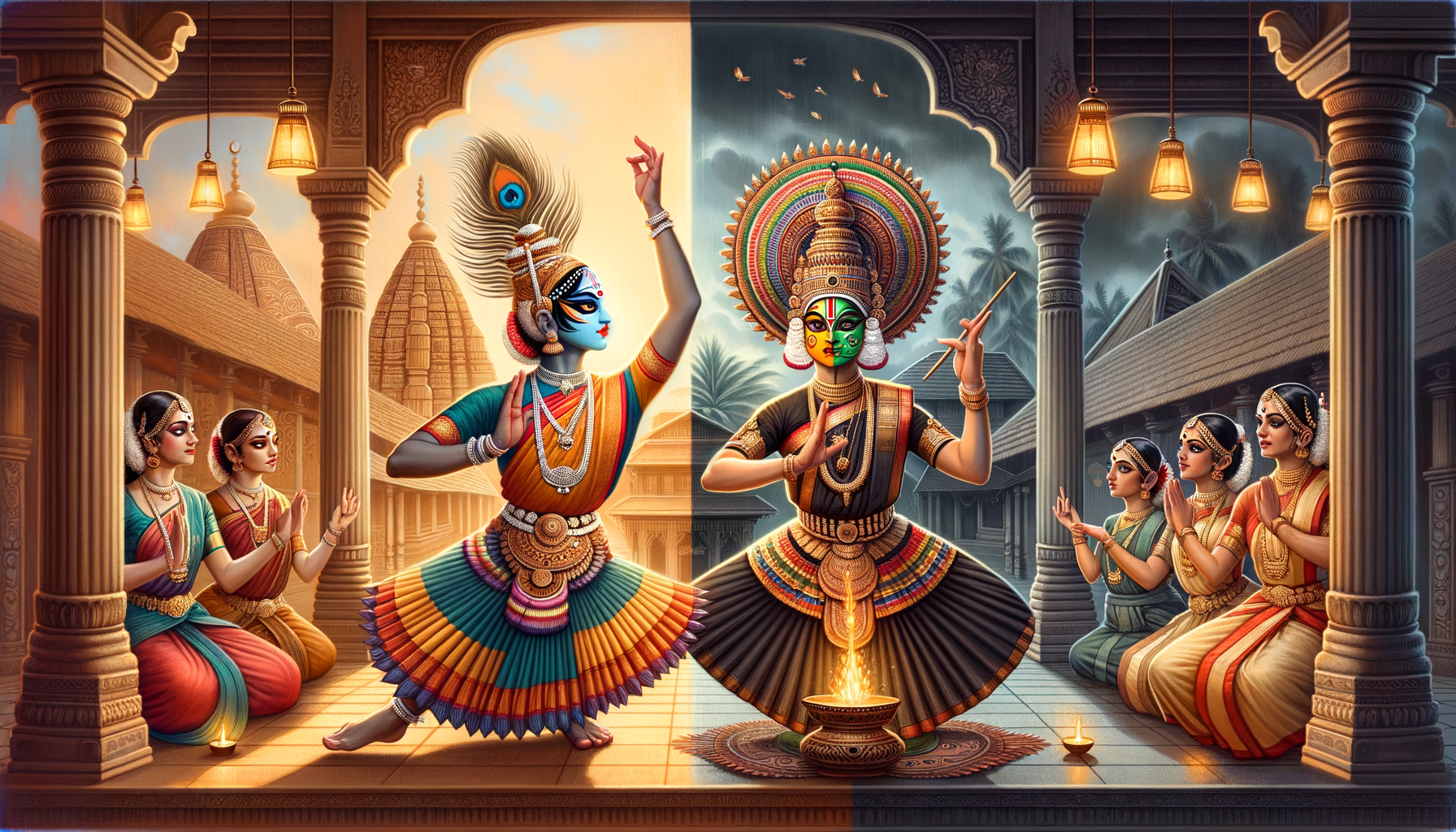
Bhagavata Mela of Tamil Nadu and Krishnattam of Kerala stand as luminous examples of India’s classical dance-drama heritage, each narrating episodes inspired by the Bhagavata Purana and the life of Lord Krishna. While both traditions share a devotional core rooted in the Bhakti Tradition, they evolved within distinct regional ecologiesTamil Nadu’s Thanjavur region and Kerala’s temple culturegiving rise to contrasting aesthetics, musical idioms, performance contexts, and audience experiences.
Historically, Bhagavata Mela consolidated in the Thanjavur district, particularly around Melattur, where scholar-performers (bhagavatars) nurtured a ritual theatre closely aligned with temple festivals. Krishnattam, by contrast, crystallized at the Guruvayur Temple in Kerala in the 17th century, traditionally attributed to Manaveda (the Zamorin of Calicut), who composed the Krishnagiti cycle as a temple offering. These foundations anchor both forms within a sacred continuum of ritual, literature, and music that centers on Lord Krishna’s leelas.
Performance ecology reveals meaningful contrasts. Bhagavata Mela is community-facing and integrally tied to village temple festivities, often presented during annual celebrations and known for sustaining collective memory through shared participation. Krishnattam is structured as a temple art and votive offering at Guruvayur, typically presented in a multi-night sequence that guides audiences through Krishna’s life from birth to transcendence. In both, theatre functions as worship, turning performance into an act of devotion rather than entertainment alone.
Aesthetically, Bhagavata Mela leans toward the expressive precision of Bharatanatyam-inspired abhinaya alongside codified nritta passages, with costumes and gestures emphasizing clarity of narrative and bhava. Krishnattam, allied in outlook to Kerala’s ritual theatre idioms, employs elaborate aharya (costume and make-up), ornate headgear, and color-coded facial patterns that heighten character types and moral cues. These visual grammars allow audiences to intuitively read heroism, devotion, or antagonism at a glance.
Music and language further differentiate the forms. Bhagavata Mela is grounded in Carnatic music, employing familiar ragas and lyrical compositions in Sanskrit and Telugu, which support nuanced abhinaya and lyrical storytelling. Krishnattam draws on Kerala’s sopana-style musical traditions and Sanskrit slokas integral to temple liturgy, often complemented by regionally intelligible explanations. The result is two sonic worlds that converge in their devotional intent while retaining distinct regional signatures.
The repertoires illuminate shared devotional aims via different dramaturgical routes. Bhagavata Mela frequently stages episodes from the Bhagavata Purana, including Krishna-centric narratives and other Vaishnava themes that underscore dharma, surrender, and grace. Krishnattam typically follows an extended cycle covering Krishna’s birth, childhood exploits, the defeat of Kamsa, and culminating spiritual ascentoffering an immersive, night-by-night progression through a sacred biography.
For many viewers, the first encounter with either tradition is transformative. Audiences often report a sense of timelessness as music, gesture, and sacred poetry synchronize into a single devotional current. Community members in Tamil Nadu find continuity and belonging through Bhagavata Mela’s village-centered celebrations, while devotees in Kerala describe Krishnattam’s temple ambience as deeply meditative. In both spaces, shared silence, collective anticipation, and the climactic revelation of divine episodes create an emotional bond that transcends region and language.
Despite stylistic differences, both traditions articulate a unifying dharmic ethosdevotion to the Divine, compassion, and moral claritythat resonates across Hinduism and finds appreciation among Buddhists, Jains, and Sikhs as well. This inclusive spirit reflects India’s broader cultural unity in diversity, where multiple paths in spiritual and artistic practice are celebrated rather than homogenized. The two art forms thus serve as bridges, strengthening respect and dialogue among dharmic traditions.
Contemporary practice emphasizes preservation and pedagogy. Bhagavata Mela sustains its lineage through temple-linked communities and training rooted in classical technique and textual fidelity. Krishnattam maintains a rigorous repertoire and training system at Guruvayur, ensuring continuity of costume craft, musical discipline, and ritual protocols. Cultural institutions, temple trusts, and community initiatives across India continue to support documentation, transmission, and outreach, reinforcing these forms as living heritage rather than museum artifacts.
Viewed together, Bhagavata Mela and Krishnattam offer a complete portrait of India’s ritual theatre, showing how region shapes style without diluting spiritual intent. Their differences in movement vocabulary, music, language, costume, and staging enrich rather than divide, revealing a shared devotion to Lord Krishna and a common commitment to ethical and aesthetic excellence. Understanding both traditions deepens appreciation for India’s cultural heritage and affirms the unified spirit that animates its diverse dharmic arts.
Inspired by this post on Hindu Blog.