
Vishu is widely revered in Kerala as the Astronomical New Year, observed when the Sun enters sidereal Aries (Mesha), a moment known in Jyotisha as Mesha Sankramana. Falling every year around 14–15 April on the Gregorian calendar, this Sankranti aligns the festival with the first day of Medam in the traditional Malayalam reckoning. The term Vishu is often associated with vishuvam (equinox), reflecting the festival’s deep astronomical sensibility even as Indian calendars adopt the sidereal zodiac. Regardless of the civil-calendar shift that begins the Malayalam Kollavarsham in Chingam, Vishu endures as the auspicious threshold of the solar year in Kerala’s living tradition.
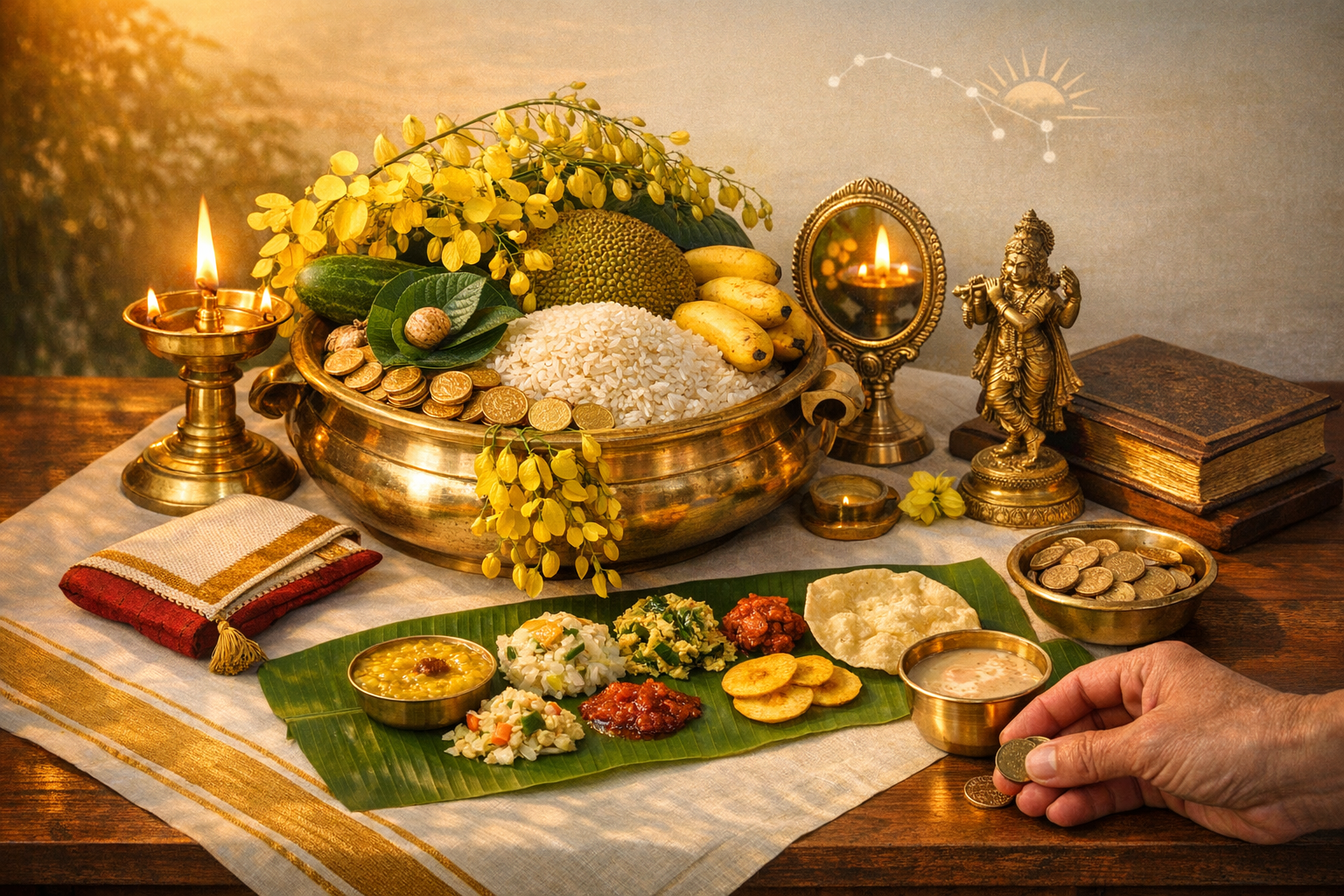
In cultural practice, Vishu sets a rhythm of renewal that begins before dawn with Vishukkani Darshan, the first sight of carefully curated symbols of abundance and clarity. Households prepare the kani the previous night, typically in a polished bell-metal uruli filled with freshly harvested rice, seasonal vegetables such as cucumber, tender jackfruit, betel leaves and arecanut, ripe kadali bananas, and gleaming coins. Adorned with the golden konna blossoms (Cassia fistula), lit by a nilavilakku (traditional lamp), and composed with an image of Vishnu or Krishna alongside a sacred text such as the Bhagavad Gita or Ramayana, the kani is a tableau of prosperity, knowledge, and light.
At daybreak, family members are led with eyes gently closed to behold the Vishukkani. The mirror (valkannadi), often placed within the arrangement, signals self-reflection: the first gaze of the year falls upon both sacred abundance and one’s own face, inviting an alignment of inner intention with outer action. The nilavilakku’s flame embodies the dispelling of tamas, the coins symbolize artha rightly pursued, the foodgrains and fruits indicate nourishment and agricultural fertility, and the scripture foregrounds dharma-guided knowledge. In this single glance, Vishu integrates the ethical, spiritual, and material dimensions of life that Hindu festivals so carefully braid together.
Vishu Kaineettamthe gifting of money from elders to the youngfollows the darshan. Historically linked to the circulation of auspicious wealth (kasu) within the family, Kaineettam reinforces an ethic of dana and intergenerational responsibility. Children experience it as affirmation and joy, while adults regard it as a vow to steward prosperity with compassion in the year ahead. Many extend Kaineettam beyond the home to neighbors, workers, and community members, reflecting Kerala’s inclusive social ethos and the shared festival spirit that bridges households and faith communities alike.
Foodways at Vishu culminate in a festive vegetarian meal known as the Vishu Sadya, distinct to each family yet resonant with Kerala’s seasonal produce. The meal commonly includes parippu curry finished with ghee, avial, kalan, olan, kootu curry, thoran, pachadi, puli inji, mango-based preparations that celebrate the new harvest, pappadam, upperi (banana chips), sharkara varatti, pickles, and a payasam such as palada or paal payasam. Ayurveda’s sensibility of shad rasa (the six tastes) informs the Sadya’s balance, supporting digestion, mood, and seasonal adaptation as the monsoon-bearing months approach. In this way, culinary tradition becomes seasonal science, where taste, nutrition, and ritual converge.
Across Kerala, Vishu also carries the sensory delight of Vishu Paddakam (firecrackers) and Vishukodi (new garments). Fireworks mark joy and festive soundscapes, particularly in Malabar, while new attire expresses personal renewal and community dignity. Increasingly, families adopt safer, eco-conscious practicesquiet fireworks, ear protection for children, and biodegradable decorationspreserving the festival’s exuberance while honoring environmental stewardship.
Temple observances amplify the day’s sanctity. Major kshetras such as Sabarimala (Ayyappa), Guruvayur (Sri Krishna), and Padmanabhaswamy Temple in Thiruvananthapuram welcome streams of devotees for Vishukkani Darshan and early morning archana. Many temples display elaborate kani arrangements, allowing the community to receive a collective first sight. These gatherings make visible the social harmony integral to Kerala’s ritual life, where darshan is both personal orientation and shared blessing.
Astrologically, Vishu coincides with the publication and popular reading of Vishu Phalam, the solar-year outlook by Rashi. While panchang-based forecasts offer guidance on trends and propensities, traditional counsel emphasizes purusharthahuman effort shaped by dharmaas the decisive complement to graha influences. In this perspective, Vishu Phalam invites contemplation rather than fatalism, encouraging households to plan with prudence, cultivate inner steadiness, and invest in education, health, and service.
Ritual elements vary by region and family lineage. Some households emphasize agricultural symbolssprouted grains, seed packets, and farm toolsechoing Kerala’s paddy heritage. Others include vessels of water to signify purity and life, or specific Vishnu iconography to reflect Vaishnava devotion. What remains universal is the kani’s role as a curated moral-aesthetic universe: a reminder that beauty (alankara), knowledge (jnana), and prosperity (sampat) must be harmonized by light (jyoti) and self-awareness (atma-darshana) at the year’s first glance.
Although Vishu is uniquely Malayali, it stands within a larger subcontinental arc of mid-April New Year observances across dharmic cultures. On the same solar threshold, Tamil communities mark Puthandu (Varusha Pirappu), Sikh communities celebrate Vaisakhi, Odias observe Mahavishuba Sankranti, Bengalis welcome Pohela Boishakh, Assamese usher in Rongali Bihu, and Tulu speakers celebrate Bisu Parba. In Sri Lanka, Sinhalese and Tamil New Year is observed; in many Buddhist-majority regions of Southeast Asia, cognate New Year festivals flourish. This shared calendar moment expresses a civilizational unity of renewal, generosity, and ethical resolvevalues cherished across Hindu, Buddhist, Jain, and Sikh traditions.
From an astronomical perspective, Vishu’s timing reflects India’s sidereal framework, which anchors zodiacal calculation to fixed stars and compensates for the precession of the equinoxes. Mesha Sankramana occurs when the Sun reaches 0° of sidereal Aries (near Ashvini), explaining Vishu’s stable mid-April placement. In contrast, the tropical zodiac fixes Aries to the vernal equinox, which now occurs in late March. This distinction clarifies why the “Astronomical New Year” in Kerala, aligned with the sidereal Sun, does not coincide with the equinox, even as the festival’s name preserves that older resonance.
Vishu’s material culture is itself a heritage archive. The uruli exemplifies Kerala’s bell-metal craftsmanship; the valkannadi evokes classical aesthetics; the nilavilakku’s steady flame stands at the center of temple and household worship; and the konna’s golden shower marks peak flowering in April, tying seasonal ecology to ritual symbolism. Through these objects, Vishu transmits skills, stories, and sensory memory across generations, safeguarding continuity while embracing measured change.
A concise home practice captures the day’s essence. The night before: clean the puja area, assemble the uruli with rice, fruits, vegetables, coins, and place the deity image, scripture, mirror, lamp, and konna flowers. At dawn: light the nilavilakku, chant simple prayers or verses (for instance from the Bhagavad Gita), and lead family members to the Vishukkani with eyes closed for the first sight. After darshan: offer Vishu Kaineettam, share prasada (bananas or sweets), visit a nearby temple if possible, and sit together for the Vishu Sadya. Conclude by extending goodwillphone calls to relatives, kindness to neighbors, and, where feasible, acts of service that strengthen community bonds.
Kerala’s diaspora adapts Vishu with creativity and fidelity. Where konna is unavailable, marigolds or seasonal local blooms echo the intended symbolism; where bell-metal vessels are rare, any clean, beautiful bowl serves; where community temples are distant, small home altars become focal. The festival’s grammar remains intact because its core is intention: to begin the year with clarity, gratitude, and collective goodwill.
Beyond custom, Vishu articulates a philosophy: life proceeds well when seen whole at the startself and society, means and ends, effort and grace. By binding astronomy to agriculture, ritual to ethics, and family to community, the festival offers an integrative template for the year ahead. In this light, Vishu is not only Kerala’s Astronomical New Year but also a yearly seminar in harmonious living, renewing a civilizational commitment to dharma that resonates across the broader dharmic world.
Inspired by this post on Hindu Pad.
