
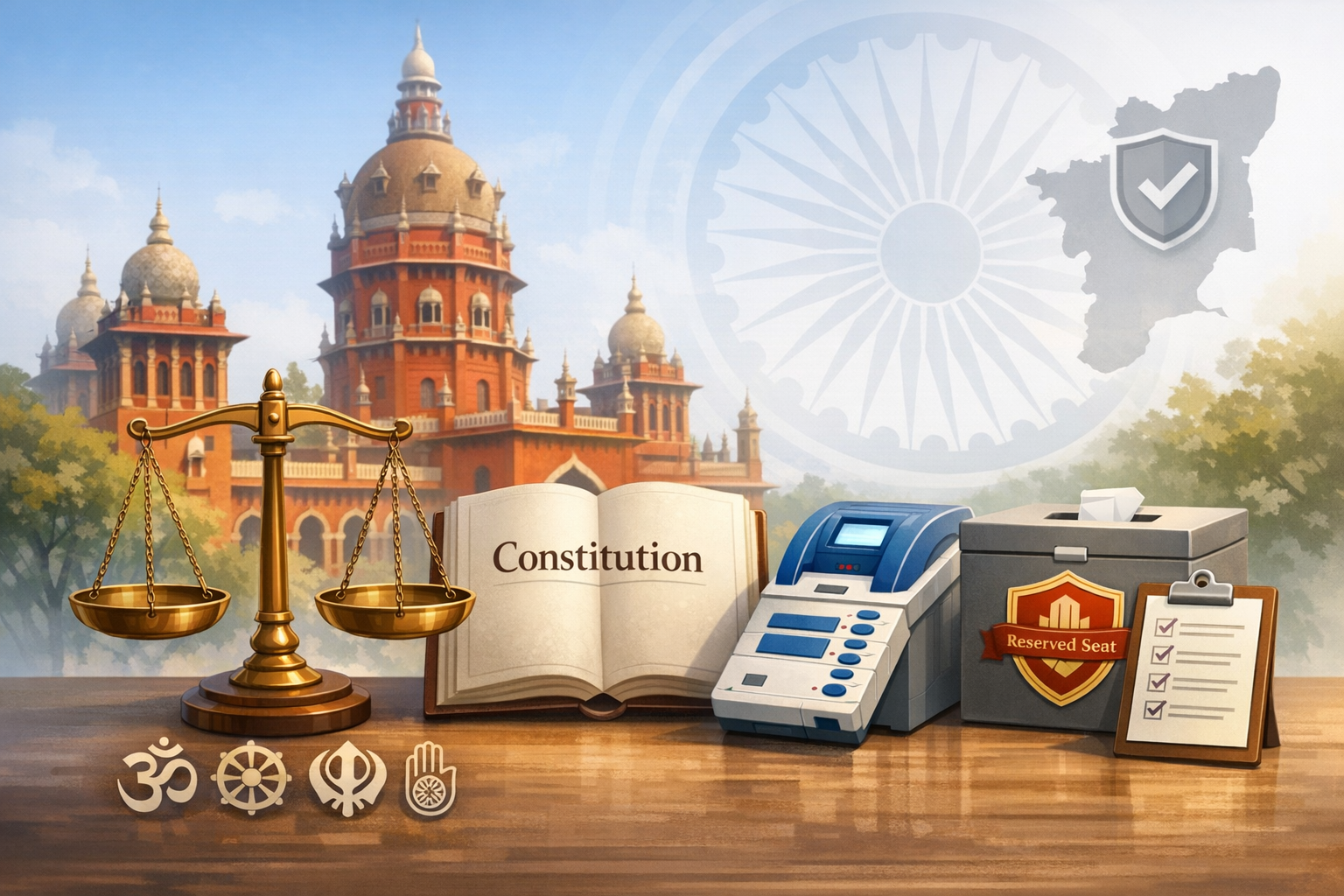
A Public Interest Litigation has been moved before the Madras High Court by Hindu Makkal Katchi (HMK) leader Arjun Sampath seeking directions to ensure that only those who constitutionally qualify for Scheduled Caste (SC) statusnamely Hindus, Sikhs, and Buddhistsare permitted to contest seats reserved for SCs in Tamil Nadu elections. The petition places electoral integrity and legal clarity at the center of the debate, asking election authorities to align candidacy rules with the Constitution (Scheduled Castes) Order, 1950, as amended.
The core contention is straightforward yet consequential: when the Constitution and the central list of Scheduled Castes tie SC status to specific religious communities, candidates who do not fall within those communities at the time of nomination should not be allowed to seek election from SC-reserved constituencies. The plea draws attention to recurring allegations about “Crypto-Christians” in Indiaindividuals who may have undergone religious conversion yet continue to claim SC-linked electoral and welfare benefitsarguing that such practices, if left unaddressed, risk distorting the purpose of reservations and eroding voter trust.
The legal framework is well defined. Article 341 empowers the President, in consultation with Governors, to issue and amend the list of Scheduled Castes. The Constitution (Scheduled Castes) Order, 1950 initially applied to Hindus; it was extended to Sikhs in 1956 and to Buddhists in 1990. As of now, converts to Christianity or Islam are not included in the SC list at the central level. This statutory position underpins SC reservation in education, employment, and political representation, including eligibility to contest SC-reserved seats under the Representation of the People Act, 1951 and the Conduct of Election Rules, 1961.
Supreme Court jurisprudence has consistently referenced this framework. In Soosai v. Union of India (1985), the Court declined to extend SC status to Dalit Christians under existing law, noting that any change would require legislative action. In K.P. Manu v. Scrutiny Committee (2015), the Court held that a person reconverting to Hinduism could reclaim SC status if the original SC community accepted the person back, underscoring the importance of community acceptance and documentary proof. Together, these decisions affirm that religion can be determinative for SC recognition in law, while also providing a due-process pathway for reconversion cases.
Administratively, the Election Commission of India (ECI) and Returning Officers scrutinize nomination papers, which include affidavits and community certificates for reserved seats. The petition seeks a clearer, state-wide protocol in Tamil Nadu to verify a candidate’s current religion alongside the SC certificate, reducing ambiguity at the scrutiny stage. While existing processes allow objections and hearing, the plea argues that a uniform checklist for documentary verification would strengthen consistency across districts and minimize last-minute litigation.
The broader national conversation is also relevant. In 2022, the Union government appointed a commission headed by former Chief Justice of India K. G. Balakrishnan to examine the question of SC status for historically disadvantaged groups that convert to Christianity or Islam, reflecting the evolving policy discourse. Until such time as Parliament amends the law or the commission’s recommendations are acted upon, the current constitutional position remains that SC status is confined to Hindus, Sikhs, and Buddhists, with carefully circumscribed exceptions for reconversion grounded in community acceptance.
In Tamil Nadu’s competitive political landscape, reserved constituencies carry high stakes for both representation and coalition arithmetic. Voters in several SC-reserved seats have voiced concerns over fairness when allegations of covert conversions surface during campaigns. Families who trace generational access to education and employment through reservation policies often express that a single reserved seat can tangibly alter opportunities for entire communities. These experiences give the present plea its emotional resonance, even as the issues demand a measured, evidence-based response.
The petition intersects with a larger societal aspiration: unity among dharmic traditions. While the statutory framework recognizes Hindus, Sikhs, and Buddhists for SC status, Jain communitiesequally part of the dharmic familyare not included in the SC list under current law. Any policy dialogue or administrative reform in this domain benefits from an ethos that affirms shared dharmic heritage and mutual respect, even as it adheres to constitutional boundaries and judicial precedents. This balance helps prevent polarization and sustains social cohesion.
Effective implementation requires procedural clarity without sacrificing civil liberties. Disclosure of current religion in affidavits, accompanied by explicit timelines for any conversion or reconversion and consistent with privacy norms, can be paired with time-bound hearings and reasoned orders by Returning Officers. False declarations, if proven under due process, would attract existing penal and electoral consequences, aligning with the integrity standards already embedded in the Representation of the People Act.
A practical roadmap emerges from the case law and administrative practice: pre-nomination advisories that summarize eligibility for SC-reserved seats; standardized documentary checklists for religion-linked SC status; community acceptance documentation in reconversion cases consistent with K.P. Manu; and a transparent, auditable trail of decisions by Returning Officers. Such measures reduce ambiguity for candidates, parties, and voters alike.
Safeguards against misuse should also avoid overreach. Verification mechanisms must be neutral, non-stigmatizing, and focused on documentary evidence rather than intrusive inquiries into personal belief. Targeted audits based on specific, recorded objections can prevent fishing expeditions. A grievance redress window before finalization of nominations, with reasoned, appealable orders, can further fortify procedural fairness.
The potential outcomes of the PIL carry distinct implications. If the Madras High Court directs the ECI and state authorities to implement tighter verification protocols before the Tamil Nadu poll cycle, candidates will receive clearer guidance and communities may gain confidence that reservations are insulated from manipulation. Alternatively, the Court may seek status reports, consult existing ECI circulars, or defer to the Union commission’s ongoing examination, thereby favoring incremental administrative steps over immediate, sweeping directives.
For political parties, the message is already salient: institute internal compliance checks for nominees in SC-reserved constituencies, ensure that community certificates and religion disclosures are consistent and current, and anticipate scrutiny. This internal discipline reduces reputational and legal risk, while signaling respect for both the letter and spirit of the law.
For civil society and faith-based organizations across the dharmic spectrumHindu, Buddhist, Jain, and Sikhthere is an opportunity to model constructive engagement: educate prospective candidates on eligibility norms; support lawful documentation; and discourage incendiary rhetoric. Unity in this space does not require uniformity of views; it requires a shared commitment to fairness, non-violence, and the constitutional process.
Ultimately, the petition underscores a principle that resonates beyond Tamil Nadu: reservation is a trust. Honoring that trust means aligning electoral practice with constitutional text, Supreme Court guidance, and transparent administration. When these elements move in concert, reserved representation does what it was designed to doamplify the voice of historically oppressed communitieswhile preserving the integrity of the democratic process.
Clarity, compassion, and constitutionalism can coexist. By grounding verification in law and due process, by recognizing the lived stakes for SC families, and by affirming unity among dharmic traditions, Tamil Nadu’s elections can advance both representation and social harmony. The Madras High Court PIL invites precisely this synthesis: protect dharmic rights within the current legal framework, strengthen election integrity, and keep open the space for informed, inclusive policy evolution.
Inspired by this post on Struggle for Hindu Existence.
