-
Transforming Shame into Pride: Guru Ravidas and a Unified Dharmic Identity in America
This academic reflection traces a Hindu American’s journey from cultural hesitation to confidence through the teachings of Guru Ravidas Ji. It highlights how inclusive Sanatana Dharma and the Bhakti Tradition foster inquiry over rote ritual, anchoring devotion in understanding. By emphasizing Oneness and dignity beyond social labels, the narrative affirms Religious Pluralism and unity across…
-
Karya Karana Bhava: Unveiling Causality’s Power Across Dharmic Wisdom Traditions

Karya Karana Bhava—the principle of cause and effect—offers a clear lens for understanding reality, ethics, and spiritual growth in Hinduism. Grounded in the Vedas and Upanishads and refined by Samkhya, Nyaya, and Vedanta, it clarifies how choices shape outcomes through karma and disciplined practice. Everyday examples show how patience, consistency, and seva produce meaningful effects,…
-
Satya in Yoga: How Truthfulness Unifies Inner and Outer Self for Lasting Inner Peace

Satya, the practice of truthfulness in Patanjali’s Yoga Sutras, unifies inner self and outer self by aligning thought, speech, and action. This ethical discipline reduces inner conflict, strengthens integrity, and supports mental clarity. Practiced with Ahimsa, truthfulness improves communication, trust, and community cohesion. The principle resonates across dharmic traditions—Jainism, Buddhism, Sikhism, and Hinduism—affirming unity in…
-
Durga’s Bow and Arrow: Unveiling the Power of Universal Will and Spiritual Discipline

Goddess Durga’s bow and arrow symbolize the union of universal will and disciplined focus. The bow represents restrained power aligned to dharma, while the arrow embodies one-pointed concentration and purposeful action. Read through yoga, they mirror pratyāhāra, dhāraṇā, and dhyāna culminating in right action. During Navaratri and Durga Puja, this iconography becomes a practical guide…
-
Darbha (Kusha) and Durva Grass: Sacred Ritual Uses, Purifying Power, and Eco-Wisdom
Darbha (Kusha) and Durva occupy a revered place in Vedic and Hindu ritual life, where they symbolize purity, steadiness, and auspiciousness. Clarifying their botanical identity—Darbha/Kusha as Desmostachya bipinnata and Durva as Cynodon dactylon—helps practitioners apply them accurately in puja, meditation, and ancestral rites. Traditional use highlights their purifying role and eco-friendly character, aligning sacred practice…
-
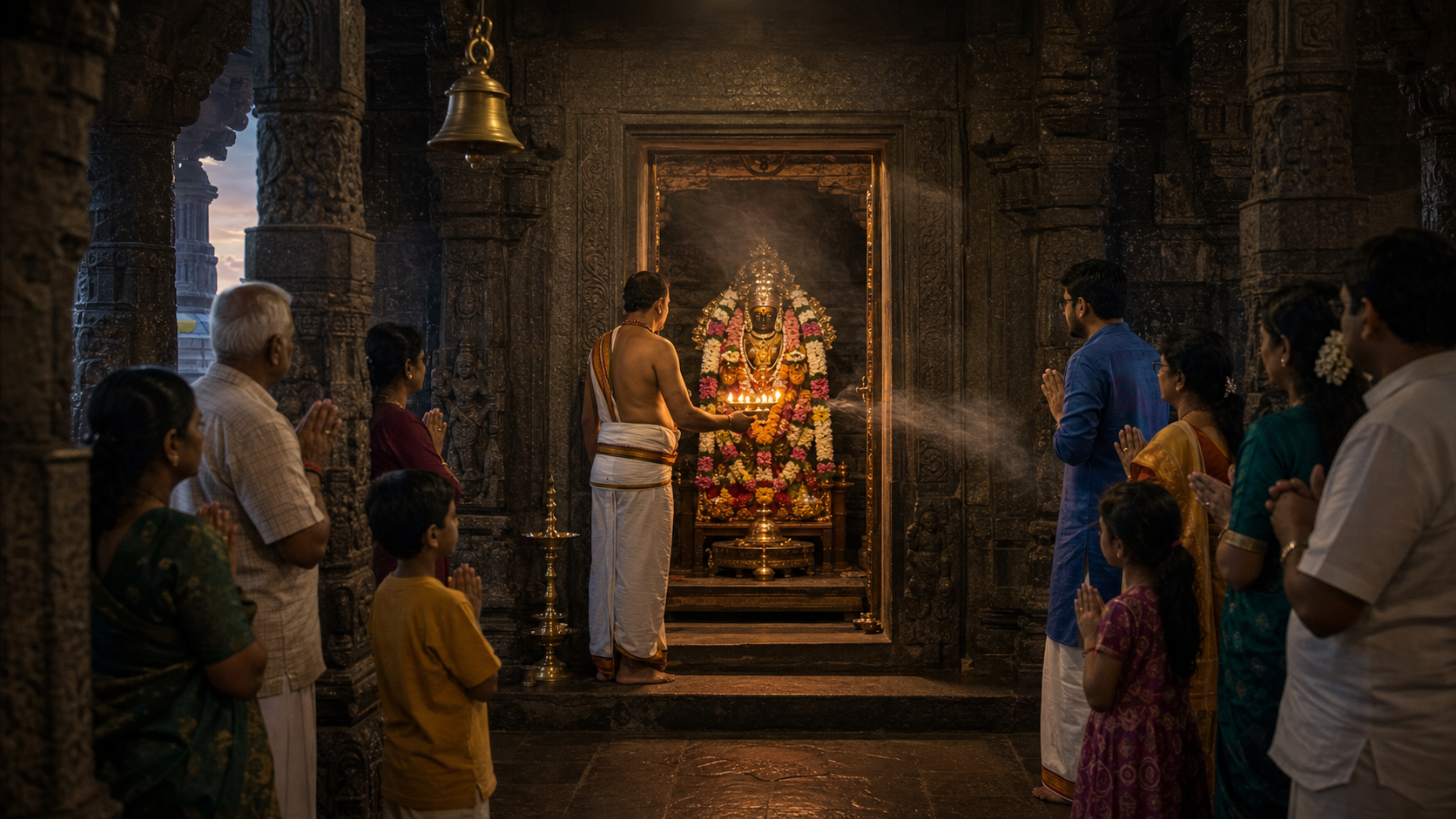
Prana Prathistha Unveiled: Sacred Energy, Living Idols, and Dharmic Unity in Temples
Prana Prathistha is the consecration rite through which prana (vital energy) is ritually invited into a murti, transforming an image into a living focus of worship. The aagama literature and Vedic procedures detail purification, mantra nyasa, homa, and kumbhabhisheka, explaining why the sanctum’s deity becomes the heart of temple worship. Many visitors describe a distinct…
-
Amavasya on 17 Feb 2026: Sacred No‑Moon Night, Significance and Ritual Guide

Amavasya in February 2026 occurs on Tuesday, 17 February—Phalgun Amavasya in North Indian Hindi calendars and Magha Amavasya in Marathi, Gujarati, Telugu, and Kannada traditions. The no‑moon night invites fasting, meditation, sesame‑lamp offerings, and pitṛ tarpaṇa where customary. Pilgrims observe punya snāna at Prayagraj’s Triveni Sangam, Haridwar, and the ghats of Varanasi, often combining sacred…
-
Moon in the 1st House (Lagna): Transform Identity, Amplify Intuition, Balance Emotions

Moon in the 1st House (Lagna) heightens sensitivity, intuition, and public presence, shaping how identity and emotions meet the world. Traditional Vedic astrology notes both strengths—empathy, adaptability, and social connection—and challenges such as mood fluctuations or over-responsiveness. Results depend on sign, Nakshatra, lunar phase, and aspects, with benefic influences stabilizing emotional expression. Some classical remarks…
-
Sun in the 1st House (Lagna): Leadership, Public Service, and Prosperity

Sun in the 1st house (Lagna) in Vedic astrology often indicates leadership, visibility, and principled action. Individuals commonly feel drawn to public welfare—building sacred spaces and life-sustaining infrastructure that serve diverse dharmic communities. Careers may align with government or civic institutions, where honest earnings and transparent conduct foster long-term prosperity. A fact-first mindset favors direct…
-
Breaking Cycles of Unworthiness: How Conscious Parenting Heals Intergenerational Wounds

A child’s quiet confession—“There’s something wrong with me”—reveals a repeating pattern of intergenerational trauma centered on conditional approval and self-worth. This reflection traces how elusive validation in childhood can shape adult relationships, despite meaningful therapy and self-awareness, and explains why knowing isn’t healing without somatic integration and nervous system regulation. It shows how conscious parenting,…
-
Shakti-Putra Shivaji: Strategic Genius, Dharmic Virtue, and a Timeless Blueprint for Just Power

Chhatrapati Shivaji’s legacy emerges as a rare fusion of strategic brilliance and dharmic virtue. Positioned alongside Chandragupta Maurya and Skandagupta, he exemplifies the Shakti-putra ideal—uniting shakti (force) and yukti (strategy) to redirect history. His conduct in victory—protecting civilians, honoring women, and respecting places of worship—shows a plural, ethical framework consonant with Sanatana Dharma and shared…
-
Panchmukhi Vishwakarma: Awe-Inspiring Five-Faced Icon of Craft, Cosmos, and Dharma

Panchmukhi (five-faced) Vishwakarma, preserved in parts of Bengal and South India, presents a compelling symbol of complete, ethical craftsmanship within Hindu iconography. The five faces evoke integrated creativity across elements, directions, and disciplines, aligning skill with dharma. This tradition affirms the dignity of labor, guiding artisans, engineers, and students to treat tools as instruments of…
-
When Ravana Became Rama: A Brief Awakening to Dharma and the Transformative Power of Virtue

This exploration of a lesser-known Ramayana motif—Ravana assuming Rama’s form—examines how virtue resists imitation and demands inner transformation. By situating the episode in the ethical drama of Sita’s steadfastness in the Ashoka grove, it shows how adharma collapses under the weight of authentic dharma. The analysis highlights literary, psychological, and philosophical dimensions, clarifying the difference…
-
Nadi Samudra Nyaya: A Powerful River–Ocean Metaphor of Jiva, Brahman, and Liberation

Nadi Samudra Nyaya, the “Maxim of the River and the Ocean,” clarifies how Advaita Vedanta explains the relation between the individual self (jiva) and the ultimate reality (Brahman). The metaphor shows how apparent separateness dissolves at the point of realization, aligning with Upanishadic insights such as “Tat Tvam Asi.” Readers gain a clear, experience-near understanding…
-
Srila Prabhupada-lilamrita with HG Kusha Mataji: A Powerful Portrait of Compassion and Dharma

Srila Prabhupada-lilamrita offers a scholarly yet accessible portrait of His Divine Grace A. C. Bhaktivedanta Swami Prabhupada, illuminating how devotion and disciplined leadership reshaped global spiritual discourse. The narrative emphasizes universal compassion and unity in spiritual diversity, aligning with the shared ethical core of Hinduism, Buddhism, Jainism, and Sikhism. Readers gain clear insights into ISKCON’s…
-
Agni Within: Unlocking SB 3.26.40 on Fire, Digestion, Ayurveda, and Spiritual Vitality

Srimad-Bhagavatam 3.26.40 portrays fire as a transformative force that illuminates, warms, cooks, and digests, while awakening hunger and thirst as drivers of growth. Drawing on insights shared by HG Narayani Dasi, the reflection links Agni with Ayurveda’s Jatharagni and Yoga’s Tapas and Prana to show how balanced digestive fire sustains vitality and clarity. The analysis…
-
Sri Ramakrishna’s Tarpana Dilemma: Symbolism, Grief, and Spiritual Evolution

Sri Ramakrishna Paramahamsa’s inability to perform tarpana for his mother is a symbolic, compassionate teaching on the unity of ritual and realization. It reframes ancestor rites (tarpana, Shraddha, Amavasya) as living expressions of gratitude grounded in intention. The episode models how devotion, grief, and non-dual awareness can converge without dismissing Hindu rituals. It offers practical…
-
Lotus of Wisdom in Durga’s Hand: Padma, Shakti, and the Defeat of Mahishasura

Goddess Durga’s Padma (lotus) in the Devi Mahatmya is more than ornament—it is a compass of consciousness guiding Shakti’s righteous action against Mahishasura. The lotus’s rise from mud to light illustrates clarity amidst chaos and courage tempered by wisdom. Across Hinduism, Buddhism, Jainism, and Sikhism, the shared lotus motif promotes unity, detachment, and compassionate awareness.…
-
Sphatik Mala Benefits Unveiled: Authentic Quartz Guide for Calm, Clarity, and Who Should Wear It

Sphatik Mala, crafted from natural clear quartz, is valued across Hinduism, Buddhism, Jainism, and Sikhism for its clarity, calm, and support in japa and meditation. Genuine quartz is typically colorless or milky-white with subtle inclusions and a naturally cool touch. Practitioners often report improved focus, emotional balance, and a quieter mind when using Sphatik for…
-
Shiva Tattva Explained: Profound Meaning and Practical Paths to Dissolve into Oneness
Shiva Tattva points to the universal principle of pure, all-pervading consciousness—beyond form and sect—where experience arises and subsides. Drawing on Advaita, yoga, and related dharmic insights, this overview clarifies what Shiva Tattva means and why all are already immersed in it. It outlines practical methods—self-inquiry, meditation, prāṇāyāma, mantra-japa, devotion, and selfless service—grounded in ethical disciplines.…