
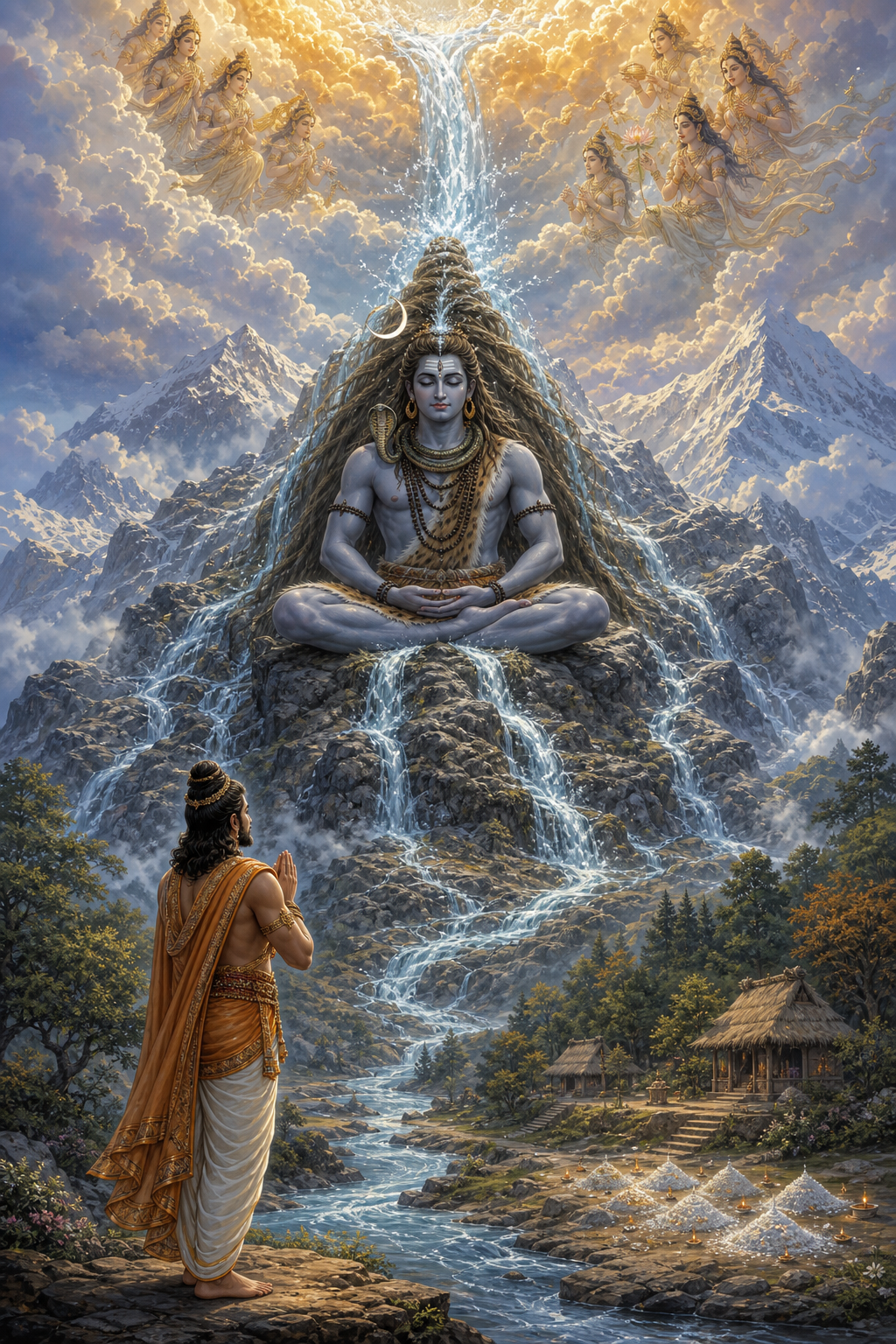
Perhaps you remember only the spectacular parts: a stolen horse, sixty thousand princes reduced to ashes, and Ganga falling from heaven. That shorthand makes the account sound like a chain of unrelated miracles. Its real coherence appears when you follow one question: what happens when power acts before discernment, and who accepts responsibility afterward?
If you are trying to understand why Ganga is associated with ancestral liberation, or to explain this sacred account without flattening it into a children’s fable, pay attention to the succession of duties. Sagara begins the crisis, his sons deepen it, Amsuman identifies the remedy, Dilipa continues the effort, Bhagiratha completes it, and Shiva makes its power bearable. The sequence is the teaching.
The story in its essential order
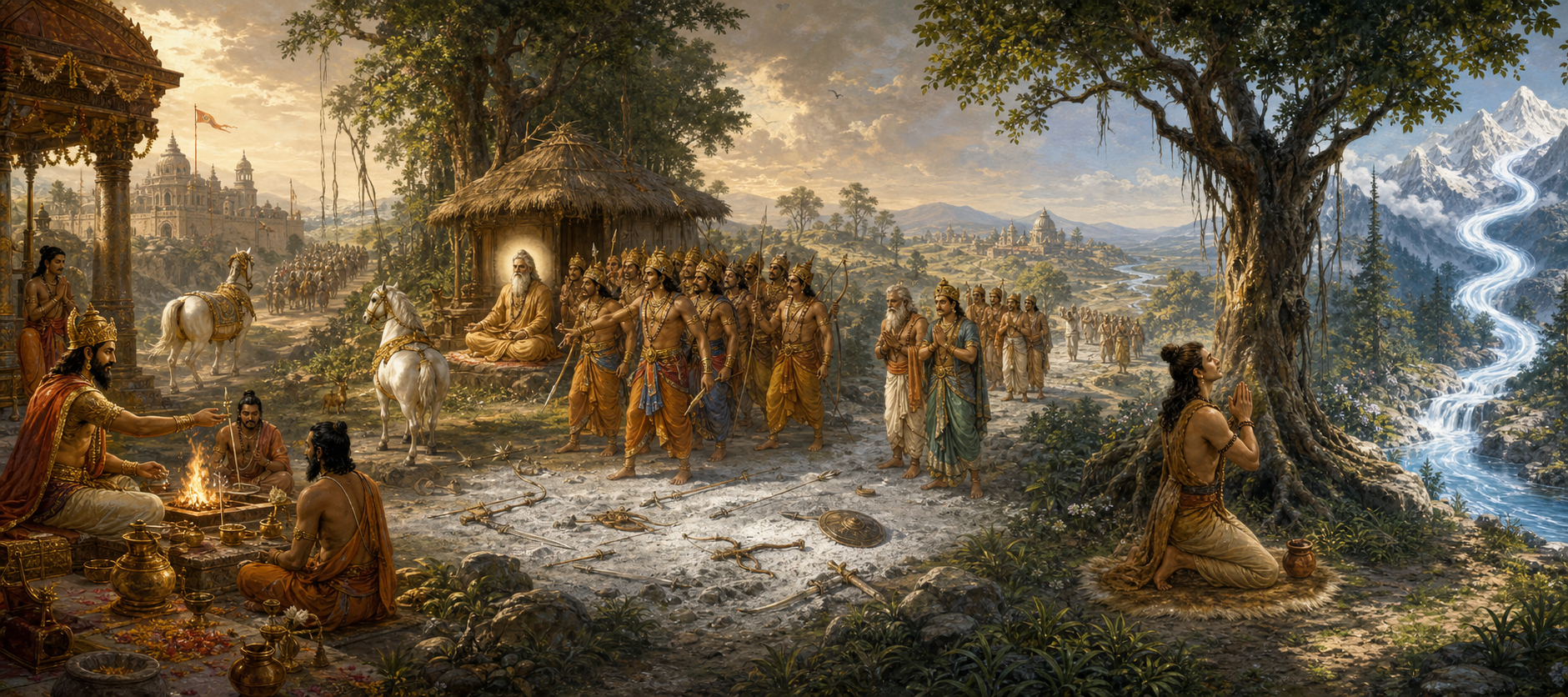
King Sagara belongs to the Ikshvaku dynasty of the Suryavamsa, the solar lineage in which Rama would later appear. The Ramayana, the Bhagavata Purana, and allied Puranic traditions preserve variations in names and details, but the central movement remains stable: a royal succession problem becomes a lesson in restraint, inherited responsibility, tapas, and grace.
- Sagara faces a succession crisis. Although powerful and prosperous, he has no heir. He undertakes severe tapas under the guidance of rishis because the continuity of the royal house is not merely a private wish. For a king, it concerns the stability of the realm and the performance of raja-dharma.
- His queens receive an unequal but complementary boon. One will bear a single heir who can continue the throne; the other will produce sixty thousand sons. In several tellings, the multitude first appears as one mass of embryonic life that is divided and nurtured in kumbhas, sacred vessels, or gourds. The imagery presents enormous potential requiring cultivation, formation, and discipline.
- Birth does not guarantee character. The single-heir line proceeds through Asamanja, whose disturbing conduct brings royal censure. His son Amsuman restores moral direction to the family. The contrast is deliberate: noble ancestry can confer responsibility, but it cannot manufacture virtue.
- Sagara begins an ashvamedha yajna. The rite affirms legitimate sovereignty. When the sacrificial horse disappears, many tellings attribute the removal to Indra’s rivalry. Sagara’s sixty thousand sons set out to recover it, digging through the earth with immense collective force.
- The princes mistake proximity for guilt. They find the horse near the meditating sage Kapila and assume that he stole it. Instead of investigating or approaching with humility, they accuse him. Their aggression meets the tapas-tejas of the rishi, and they are reduced to ashes.
- Amsuman discovers that force cannot finish the task. He finds the horse and learns that only the descent of the celestial Ganga can purify the ashes and liberate the princes. Recovering the horse resolves the interrupted yajna, but it does not resolve the deeper debt created by the princes’ conduct.
- The duty outlives its first bearer. Amsuman cannot bring Ganga to earth. Dilipa strives but also falls short. The failure of one generation does not cancel the obligation; it passes through the lineage until someone can fulfill it.
- Bhagiratha’s tapas opens the way. After sustained austerity, he secures Ganga’s descent. Her unrestrained force cannot simply strike the earth, however, so Shiva receives the torrent in his matted locks and releases it as a life-giving flow. Ganga reaches the ashes, and Sagara’s sons are finally liberated.
This order matters. The account does not move directly from wrongdoing to forgiveness. It moves from wrongdoing to recognition, from recognition to inherited duty, from duty to repeated effort, and from effort to grace that must still be properly channeled.
Do not let differences among names distract you from that structure. The two queens may be identified as Vaidarbhi or Sumati and Shaibya or Keshini, with some recensions varying the pairings. Vaidarbhi means a princess associated with Vidarbha, while Shaibya indicates affiliation with the Sibi lineage; such lineage names can function alongside personal names. You can acknowledge the variation without pretending that every recension uses one fixed genealogy.
The number sixty thousand also belongs to epic scale. Within the sacred narrative it expresses the vastness and collective weight of the princes’ action. Treating it only as a modern demographic claim misses what epic enumeration is doing; dismissing it as meaningless exaggeration misses the moral magnitude it conveys.
Three common readings that obscure the point
Kapila is not simply an irritable sage punishing strangers
Calling the event “Kapila’s curse” is familiar shorthand, but it can shift all moral attention onto the sage. The decisive failure occurs earlier. The princes see the missing horse beside a silent ascetic and turn an association into an accusation. Stillness looks like weakness to men already carried forward by group confidence and martial urgency.
Kapila’s tapas-tejas represents concentrated spiritual power, not ordinary temper. Aggression without viveka encounters a force it neither recognizes nor understands. The result dramatizes moral recoil: undisciplined power is destroyed by the reality it presumptuously attacks.
You can apply this distinction whenever a group is preparing to condemn someone. Separate three propositions before acting: something is missing; a person is nearby; that person is responsible. The first two do not prove the third. The princes collapse the gap between suspicion and knowledge, and no amount of collective certainty protects them from the consequence.
Sagara does not personally bring Ganga to earth
Sagara’s name belongs to the whole cycle, but Bhagiratha accomplishes the descent. That distinction is not trivia. It reveals a Dharmic understanding of responsibility that can extend beyond one lifetime and one generation. Sagara’s household creates the unresolved condition. Amsuman learns what must be done. Dilipa preserves the effort. Bhagiratha supplies the tapas that finally makes liberation possible.
This gives you a practical way to think about inherited damage. You may receive a duty whose cause preceded you and whose completion will not benefit you alone. Dharma does not require you to pretend that you personally caused every inherited wrong. It asks you not to abandon a remedy merely because the problem began before your arrival.
Ganga is not a shortcut around effort
The river’s purifying power can be misunderstood as an automatic eraser of consequences. The narrative itself resists that reading. Ganga comes only after the princes’ destruction, Amsuman’s discovery, Dilipa’s unsuccessful striving, Bhagiratha’s tapas, and Shiva’s intervention. Grace consummates disciplined effort; it does not make responsibility unnecessary.
When you invoke purification in your own spiritual life, ask what preparation accompanies it. Is there recognition of the error? Has conduct changed? Is sustained effort present? Is the force of change being directed toward service rather than display? Without those elements, the language of purification becomes an excuse. With them, it can name a real transformation.
Why Shiva must receive the river first
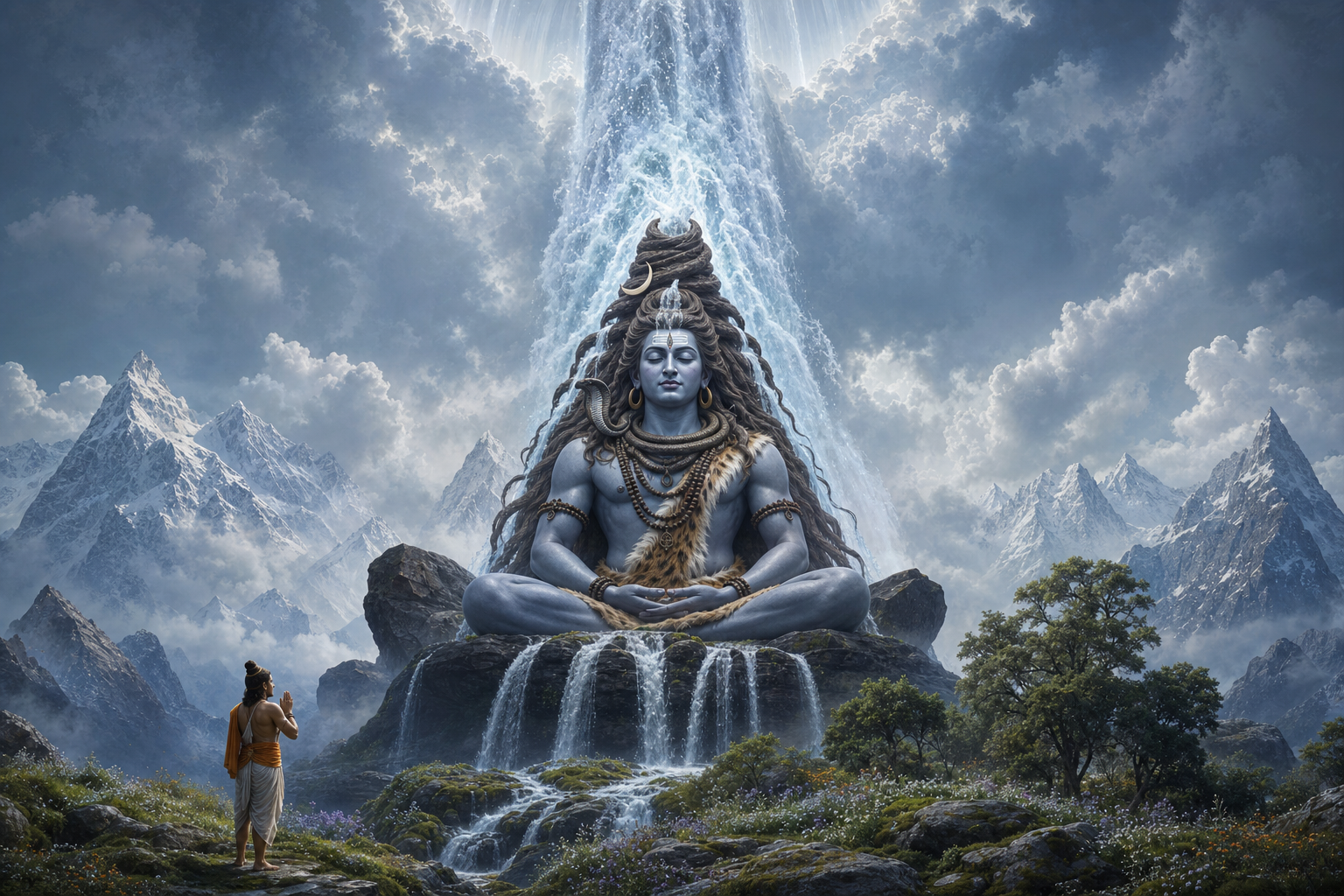
Shiva’s role is not a decorative appearance inserted between Bhagiratha’s tapas and Ganga’s arrival. It solves a precise problem: the power capable of liberating Sagara’s sons is also too great to descend without mediation. The compassionate force must be grounded, contained, and released in a form the world can receive.
This gives the cycle a complete spiritual grammar. The princes embody energy multiplied without self-command. Kapila embodies the sovereignty of concentrated stillness. Ganga embodies liberating knowledge and compassionate grace. Shiva embodies yogic integration, the capacity to receive tremendous force without being overwhelmed by it or allowing it to become destructive.
The same pattern can guide any intense undertaking. Before releasing energy into the world, identify its channel:
- Name the force. Is it anger, ambition, grief, devotion, public enthusiasm, or institutional power?
- Test the capacity of its container. A worthy aim can still cause damage when the person, practice, or institution carrying it lacks discipline.
- Control the release. More intensity is not always more effective. Shiva does not reject Ganga; he makes her descent beneficial.
- Keep the end in view. The purpose is liberation and restoration, not the spectacle of power.
This pairing of interior discipline with ethical action also helps you recognize a family resemblance across Dharmic traditions without claiming that they are interchangeable. Buddhist right view and mindfulness restrain blind zeal; Jain tapas and ahimsa discipline intention and conduct; Sikh simran and seva join remembrance to service. The vocabulary and theology differ, but each refuses to treat uncontrolled action as spiritual strength.
How lineage becomes sacred geography

The descent of Ganga does more than settle a royal family’s ancestral debt. It inscribes memory onto the land. Gangotri, Haridwar, Prayagraj, Varanasi, and Ganga-Sagara belong to a sacred geographical imagination in which a river can be physical water, a route of pilgrimage, a bearer of civilizational memory, and an ethical teacher at once. In many retellings, even the ocean bears the name Sagara in connection with the king’s quest.
This is why the path from Ganga’s Himalayan source to the sea can be read as a moral landscape. The river joins royal duty, the peril of collective arrogance, the tapas of a descendant, Shiva’s restraint, and the liberation of ancestors. Geography becomes a curriculum because each place recalls part of the relationship between human action and sacred order.
If you visit Ganga, you can use the Sagara cycle as a four-part contemplation. This is not a prescribed ritual, but a simple way to prevent pilgrimage from becoming sightseeing:
- Remember Sagara. Name one responsibility you cannot ignore merely because it is difficult or larger than your private interests.
- Remember the princes. Identify one assumption that could turn urgency into unjust accusation.
- Remember Bhagiratha. Choose one patient action that serves people beyond your immediate benefit.
- Remember Shiva and Ganga. Decide how that action will be contained, guided, and directed toward restoration.
The same contemplation carries an ecological implication. A river revered as a bearer of purification cannot be treated as spiritually significant only during worship and ethically irrelevant afterward. Care for the water and its banks belongs to the same discipline as reverence. Sacred geography is not merely land from which you receive merit; it is land toward which you owe conduct.
Key takeaways for reading and retelling the account
- Keep the generations distinct. Sagara initiates the royal cycle, but Bhagiratha brings Ganga down after Amsuman and Dilipa carry the unresolved duty.
- Place the moral failure before the miraculous destruction. The princes accuse Kapila without discernment. Their ashes are the consequence of power acting upon an untested assumption.
- Do not reduce tapas to wish-fulfillment. Sagara’s austerity serves dynastic duty, Kapila’s tapas produces spiritual radiance, and Bhagiratha’s tapas serves ancestral liberation.
- Explain Shiva’s mediation. Transformative power needs a capable channel. Ganga’s force becomes life-giving because Shiva receives and regulates it.
- Treat sixty thousand as epic magnitude. The number communicates the scale, simultaneity, and moral weight of collective action; it should not be made to carry a modern statistical argument.
- Connect ritual purity to ethical change. Ganga’s arrival follows recognition, perseverance, and disciplined mediation. Purification is the culmination of responsibility, not permission to evade it.
The next time you hear this account, resist shortening it to a sage’s anger or a river’s miracle. Follow each decision and each transfer of duty. Then choose one unfinished responsibility within your own reach, test your assumptions before acting, and give your effort a disciplined channel. That is how the memory of Sagara and Bhagiratha remains a living instruction rather than a distant wonder.